Buyer Fit Snapshot
| Best fit | Custom Retail Packaging for Logistics projects where brand print, material claims, artwork control, MOQ, and repeat-order consistency need to be specified before quoting. |
|---|---|
| Quote inputs | Share finished size, material target, print colors, finish, packing count, annual reorder estimate, ship-to region, and any compliance wording. |
| Proofing check | Approve dieline scale, logo placement, barcode or warning zones, color tolerance, closure strength, and carton packing before bulk production. |
| Main risk | Vague material claims, crowded artwork, missing packing details, or unclear freight terms can make a low unit price expensive after revisions. |
Fast answer: Custom Retail Packaging for Logistics: Material, Print, Proofing, and Reorder Risk should be specified like a repeatable production item. The safest quote records material, print method, finish, artwork proof, packing count, and reorder notes in one written spec.
Production checks before approval
Compare the actual filled-product size with the drawing, then confirm tolerance on folds, seals, hang holes, label areas, and retail display edges. Reserve space for logos, QR codes, warning copy, and material claims before decorative graphics fill the panel.
Quote comparison points
Review material grade, print process, finish, sampling route, tooling charges, carton quantity, and freight assumptions side by side. A quote is only useful when the supplier can repeat the same color, closure quality, and packing count on the next order.
Two products can leave the same warehouse in boxes that look almost identical and still rack up very different freight bills. With Custom Retail Packaging for logistics, the gap usually starts with a few extra millimeters of empty space. That tiny bit of slack can trigger dimensional weight, let the product rattle around, and slow the pack line before the carton even gets near a customer or store.
Packaging stops being a pretty wrapper at that point. Custom Retail Packaging for logistics sits between product protection, warehouse flow, store presentation, and shipping cost. If a box is too large, too fragile, or annoying to handle, the bill shows up somewhere else: more dunnage, more labor, more damage claims, more returns. The best packaging teams think like operators first and designers second. That gives you product packaging that earns its keep by doing several jobs at once.
Retailers feel that quickly. A clean box is not enough. The carton has to stack well, move fast through fulfillment, survive carrier abuse, and still make the brand look deliberate. That is the real promise of custom retail packaging for logistics: not decoration, but control. Better fit. Better flow. Better cost discipline. Better branded packaging where it actually matters.
What Custom Retail Packaging for Logistics Really Changes
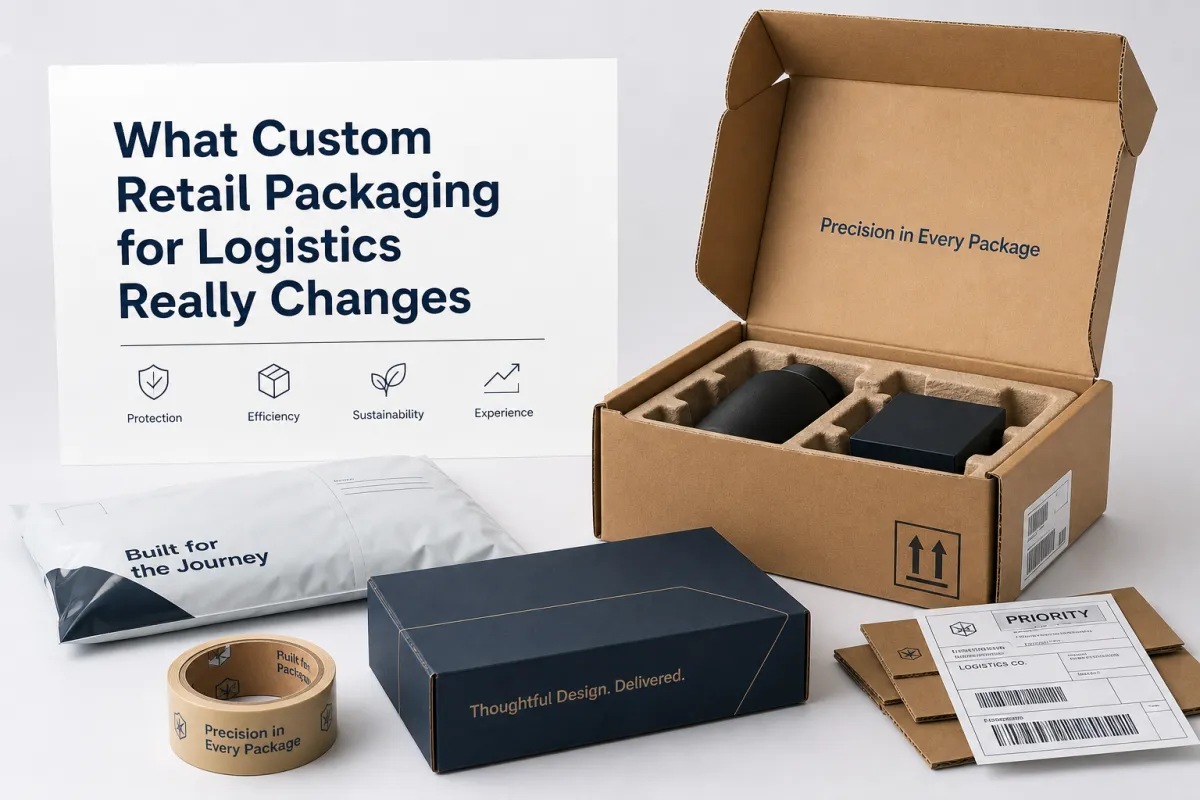
Take the simplest case. Two identical items ship for different amounts if one sits in an oversized carton with air pillows and the other is nested in a right-sized structure. Parcel carriers bill on weight and volume, so the bigger box can cost more even when the product weighs the same. That is the first place custom retail packaging for logistics changes the math. It pulls the carton size toward the product instead of stuffing the product into a generic shell.
Damage changes too. Loose movement is the enemy. A carton that lets the product shift half an inch on each side can turn a minor drop into a cracked corner, a scuffed finish, or a broken insert. A better structure cuts that motion with shaped inserts, partitions, or stronger board construction. That is why custom retail packaging for logistics often lowers breakage before anyone touches the graphics or outer label. The structure does the heavy lifting.
Warehouse gains are just as practical. A well-designed pack is easier to identify, easier to scan, and easier to stack on a pallet or conveyor. When carton footprints stay consistent, fulfillment teams waste less time hunting for filler or wrestling with weird closures. I have seen operations save real minutes per hundred units by standardizing a structure that closes cleanly and stores flat. Those minutes are not trivial. At scale, they turn into labor dollars.
Retailers also need one pack to pull double duty. A carton may need to look polished on a shelf, arrive intact through parcel networks, and still stay efficient inside a distribution center. custom retail packaging for logistics is what makes that possible. It lets branded packaging support the sale instead of fighting the shipment. Small difference. Big cost if you ignore it.
A carton that saves six cents at purchase can cost forty cents in freight, labor, and damage. Packaging decisions need a landed-cost lens, not a unit-price reflex.
There is a branding side here too, and people miss it all the time. A box that opens cleanly and lands square says something about the retailer before the customer even reads the insert card. The same package can reduce transit risk and reinforce the brand story. That is the sweet spot for custom retail packaging for logistics: less wasted material, fewer surprises, more consistency between what the warehouse sends and what the shopper receives.
How Custom Retail Packaging for Logistics Works in Practice
Good packaging starts with data, not artwork. The first pass should capture actual product dimensions, weights, weak points, and the shipping lanes involved. A display item headed to a regional store needs a different structure than the same product going through parcel delivery to consumers. custom retail packaging for logistics works best when teams map the product's worst travel path first, then build the pack around that reality. That includes warehouse handling, carrier sorting, pallet compression, and shelf presentation.
The design process usually moves through a few clear steps. First comes the dimensional audit. Then the team drafts a dieline and picks a substrate, insert style, and closure method. After that comes the prototype, which should be tested against actual pack-out conditions, not just admired on a desk. With custom retail packaging for logistics, the prototype is not a vanity sample. It is a working tool. If it takes too long to assemble, too much tape to close, or too many hands to load the product, the design still needs work.
- Measure the product, including handles, corners, coatings, and any protrusions that create fit risk.
- Identify the shipping environment: parcel, LTL, palletized retail, or mixed-channel fulfillment.
- Build the first dieline around stackability, closure, and insert placement.
- Run a sample through warehouse reality: pack line, scan, seal, label, and load.
- Revise before tooling, because fixing a bad fit after production starts is expensive.
Testing should not be theater. Serious programs usually use drop testing, vibration exposure, and compression checks that line up with ISTA methods. The International Safe Transit Association publishes helpful guidance at ista.org, and that standard matters because carrier handling is rarely gentle or predictable. A package that survives a clean tabletop demo may still fail under repeat compression or random vibration. custom retail packaging for logistics only earns the name when the structure survives that kind of abuse.
Warehouse operations shape the final answer too. An elegant box that requires four assembly steps can bottleneck the line. A simpler design that locks together in one motion may beat a fancier pack that looks better in a mockup. Brands love to pretend labor is free until it starts eating into shipping cutoffs. Funny how that works. custom retail packaging for logistics should reduce friction for the people building the order, not add it.
For omni-channel brands, the challenge gets sharper because the same SKU may move through stores, direct-to-consumer fulfillment, and wholesale replenishment. That is why custom retail packaging for logistics becomes a systems question. It is not just one carton. It is a family of packs with shared logic, less changeover, and enough flexibility to support retail and transit goals without turning the back room into a mess.
Key Factors That Shape Performance, Cost, and Speed
Material choice sits near the top. Corrugated board is the workhorse for most shipping programs because it balances strength, printability, and cost. Folding carton board works better when shelf presentation matters and the pack does not need heavy crush resistance. Molded pulp and paper inserts secure fragile items with less loose filler. In each case, custom retail packaging for logistics should match the material to the shipping risk, not to habit. A mailer that handles a light accessory will not protect a glass item with hard edges. That would be wishful thinking, and wishful thinking is expensive.
Structure matters just as much as material. Wall style, flute type, insert geometry, closure method, and interior clearance all affect performance. A difference of even 1/8 inch can change how a product settles inside the carton. That does not sound dramatic until you see the movement and freight math it creates. In parcel networks, it can mean the difference between a compact shipment and a chargeable oversize carton. custom retail packaging for logistics performs best when fit is treated as cost control, not just a protection feature.
Print and finishing choices are another balancing act. High-coverage graphics, soft-touch coatings, foil, and specialty varnishes can lift brand perception, but they also add setup complexity and unit cost. A retailer selling premium cosmetics may want a polished unboxing moment, while a warehouse club SKU may need a cleaner, tougher print approach. Either way, custom retail packaging for logistics should not pretend decoration is free. It is a spend item, and the return should show up in sales, repeat orders, or fewer damages.
Sustainability gets talked about like a slogan. The useful version is simpler: reduce void space, use recyclable materials where feasible, and cut unnecessary filler. Those steps often reduce environmental impact and shipping expense at the same time. For fiber sourcing, FSC certification is worth checking at fsc.org, and EPA recycling guidance helps teams choose materials that fit local recovery systems at epa.gov. custom retail packaging for logistics gets stronger when it improves the package and the footprint together.
Fulfillment constraints can settle the argument before design does. Automated packing lines need predictable dimensions and machine-friendly folds. Manual pack stations need easy assembly and low error rates. Inventory teams need storage space for bulk packaging, which means oversized custom structures can backfire if they eat pallet positions. That is why custom retail packaging for logistics should be evaluated across the whole operation, from receiving to replenishment. A better carton is not better if it clogs the back room.
- Corrugated board for stackability, shipment strength, and broad carrier compatibility.
- Paperboard for shelf-facing packs and lower-weight retail presentation.
- Molded pulp for restraint and cushioning with less loose fill.
- Custom inserts for fragile, irregular, or high-value items.
- Right-sized closures for faster pack-out and cleaner sealing.
Custom Retail Packaging for Logistics Costs: What You Actually Pay For
The biggest mistake buyers make is comparing box prices in isolation. That number is only one slice of the bill. custom retail packaging for logistics may cost more per unit than a stock carton, but the actual economics depend on the whole chain: materials, print coverage, tooling, labor, freight, and damage exposure. If a carton saves two cents at purchase but adds forty cents in freight waste or return handling, it is not cheaper. It is just cheaper on paper.
Think about it in two buckets: front-end costs and hidden costs. Front-end costs include board grade, insert count, die-cut tooling, print plates, and finish selection. Hidden costs show up later as extra pack time, wasted void fill, pallet inefficiency, or claims. With custom retail packaging for logistics, the right comparison is landed cost per shipped unit, not box cost per thousand. That changes decisions fast.
| Packaging Option | Typical Unit Cost | Best Use | Trade-Off |
|---|---|---|---|
| Stock mailer with loose fill | $0.18-$0.32 | Light, low-fragility items | Higher void space and more motion inside the carton |
| Custom corrugated carton with simple insert | $0.32-$0.68 | Most retail and e-commerce shipments | Tooling and sample approval add lead time |
| Premium printed folding carton with insert | $0.55-$1.20 | Shelf-ready, brand-forward product packaging | Better presentation, but less crush resistance than corrugated |
| High-coverage custom printed boxes with specialty finish | $0.85-$1.80 | Premium branded packaging and gift-ready formats | Higher setup cost and more complex production planning |
Those numbers are directional, not universal. Volume changes everything. A run of 5,000 units spreads tooling and setup across enough pieces to make a custom design reasonable, while a 1,000-unit trial can make even a modest structure look expensive. custom retail packaging for logistics often looks pricey in small runs because the fixed costs have not been diluted yet. At larger quantities, the picture changes quickly. That is why experienced buyers ask for price breaks at 2,500, 5,000, and 10,000 pieces instead of signing the first quote that lands in their inbox.
Print complexity matters too. One-color flexographic print on corrugated is a different cost profile than four-color process plus coating. Add foil or embossing and the line item climbs again. Higher print cost is not automatically wrong. If the packaging sits on a retail shelf, the design may drive conversion. In that case, custom retail packaging for logistics has to justify both transport efficiency and shelf performance. The package needs to travel well and sell well.
For teams checking return on investment, a better formula includes four variables: freight savings, damage reduction, labor minutes saved, and storage footprint. That is where the payoff tends to show up. A carton that trims packing time by 12 seconds per unit can save hundreds of labor hours across a busy season. A design that lowers damages by just a few percentage points can cut replacement stock and service calls. In that sense, custom retail packaging for logistics often pays back more than it first appears.
Step-by-Step Timeline for Launching a Better Pack
Most projects begin with an audit. That means reviewing product dimensions, current carton sizes, damage data, shipping lanes, and pack-out time. A good audit should also look at returns and customer-service notes. If support tickets mention crushed corners, scratched surfaces, or loose contents, that is signal, not noise. custom retail packaging for logistics works best when the baseline is honest and specific. Guessing only creates false confidence.
Then comes concept development. The packaging team, supplier, or designer turns the data into a few structural options. One may prioritize minimum freight volume, another faster assembly, and another shelf appeal. At this stage, the design needs to earn its place with numbers, not vibes. custom retail packaging for logistics stops being abstract once you can hold the samples, measure them, and compare them against the same ship conditions. A design that looks good in a presentation but fails in a pack station should be cut early.
Prototype timing varies, but many simple projects move from brief to sample in about 5-10 business days once dimensions and artwork are locked. More complex packs, especially those with molded inserts or multi-panel structures, take longer. Testing adds another layer. I would rather see one careful revision cycle than rush a pack into production and spend three months dealing with preventable breakage. custom retail packaging for logistics rewards patience at the sample stage.
After samples are approved, procurement has to line up tooling, print setup, and raw material availability. Lead times often land in the 12-20 business day range after proof approval, though rush jobs can move faster if the structure is straightforward and materials are in stock. The supply chain piece matters here. If you need FSC-certified board or a specific flute profile, plan for it. custom retail packaging for logistics is easier to launch when purchasing, operations, and the supplier share the same schedule.
The launch itself should be watched closely. Track breakage, freight cost, and pack speed for the first few shipments, then compare those figures with the baseline. Small changes can hide big problems. A carton that saves a cent per unit but slows the line by two seconds can quietly erase the savings. That is why custom retail packaging for logistics should be treated as a live process, not a one-and-done project.
- Week 1: gather data and define the packaging problem.
- Week 2: review structural concepts and select a direction.
- Weeks 3-4: test samples, revise fit, and confirm assembly steps.
- Weeks 4-6: finalize proofing, tooling, and production schedule.
- Launch: monitor damage, labor, and freight for early shipments.
Common Mistakes That Undermine Custom Retail Packaging for Logistics
The first mistake is designing for shelf appeal before transit reality. Beautiful graphics cannot save a carton that collapses under stack pressure or leaves too much room for the product to move. custom retail packaging for logistics has to be strong enough for the route it travels, not just attractive in a mockup. If the box fails on the conveyor or under a pallet load, the brand promise never gets a chance to matter.
The second mistake is ignoring warehouse behavior. A pack that takes three extra motions to assemble can slow down an entire line. That sounds small until it repeats hundreds or thousands of times. A cleaner closure, fewer parts, and more intuitive insert placement can make a big difference. In a lot of cases, custom retail packaging for logistics is less about engineering perfection and more about removing friction for the people doing the work.
Under-testing is another expensive habit. Some teams approve packaging after a single sample survives a gentle hand carry. That is not testing. Real shipping exposes cartons to drops, vibration, compression, stacking, and temperature variation. ISTA and ASTM methods exist for a reason. If a package has not been run through some combination of those stressors, it is being trusted on hope. custom retail packaging for logistics should be validated before scale-up, not after complaints show up.
Cost tunnel vision is common too. Procurement may compare unit price and choose the lowest quote, only to discover that the cheapest carton generates the most damage claims. That trade-off is backwards. The cheapest package is the one that keeps the product intact, uses labor efficiently, and ships in the smallest reasonable footprint. custom retail packaging for logistics only looks expensive when the analysis stops too early.
Too many brands also assume one format can handle every SKU, every channel, and every season. Product mix changes. Order volume changes. Carrier behavior changes. A structure that works for a dense kit may fail for a fragile accessory. A pack that performs well in wholesale may be clumsy in direct-to-consumer fulfillment. That is why custom retail packaging for logistics should be sized to the business, not the other way around.
- Do not approve a design without checking stack strength and closure integrity.
- Do not ignore how many seconds assembly adds to each pick-and-pack cycle.
- Do not assume a low-cost carton will stay low-cost after freight and damage are counted.
- Do not skip lane-specific testing if the product ships through multiple carriers or regions.
Expert Tips and Next Steps for Better Results
Start small. If a brand has ten SKUs, it usually makes more sense to begin with the one that ships the most units or generates the most damage claims. That gives you a clear baseline and a measurable win. custom retail packaging for logistics is easier to justify when the first pilot focuses on a SKU with real volume. The lesson from one high-visibility product usually carries into the rest of the line.
Create a scorecard that includes landed cost, packing time, damage rate, and customer presentation. A scorecard keeps the discussion honest. It stops the team from overvaluing appearance or undercounting labor. If the package looks great but slows fulfillment by 15%, that should show up on the page. If a sturdier board grade adds three cents but cuts breakage, that should show up too. custom retail packaging for logistics improves when the numbers sit in one place instead of scattered across four departments.
Ask for samples that reflect real operating conditions. That means the actual product, the actual filler, the actual closure method, and the actual label placement. Too many sample reviews happen on a clean table in a quiet room. A warehouse is louder, faster, and less forgiving. Good custom retail packaging for logistics gets tested with that reality in mind. It should be easy to assemble with gloves, clear to scan, and stable enough to move through normal handling without drama.
Cross-functional review is another practical habit. Operations sees pack speed. Procurement sees pricing and MOQ pressure. Marketing sees visual consistency. Customer service sees what happens when the experience breaks down. Bring those views together before approving the final structure. That is how custom retail packaging for logistics becomes a business decision instead of a siloed packaging choice. If you need a starting point for materials and structure options, the range of Custom Packaging Products can help narrow the search quickly.
One more thing: document the current state before changing anything. Photograph the existing pack, record the average carton size, list the return reasons, and note the shipping method. Without that baseline, improvement is hard to prove. With it, the value of custom retail packaging for logistics shows up in freight bills, damage reports, and assembly metrics. That is the kind of evidence decision-makers trust.
Honestly, the best programs are not the fanciest ones. They are the ones that take fit, labor, and transit seriously enough to measure them. If the product is fragile, the route is rough, or the brand wants a cleaner shelf presence, custom retail packaging for logistics can pull all of those priorities into one structure. And if a retailer is ready to pilot the idea, the next move is simple: document the pain point, test one SKU, compare landed cost, and expand only after the numbers prove it works. That is the whole play. Spend where it matters, trim where it does not, and let the box do the boring work so the product and the brand can do the rest.
FAQ
How does custom retail packaging for logistics reduce shipping damage?
It cuts movement by fitting the product more tightly, adding the right inserts or board strength, and limiting void space. custom retail packaging for logistics is also tested for drops, vibration, and compression before full rollout, so weak points get exposed before carrier handling does the job for you.
What materials work best for custom retail packaging for logistics?
Corrugated board works well for most shipping and stacking needs. Folding carton board is useful when shelf presentation matters and the pack must stay light. Molded pulp and custom inserts help with fragile items. The best material for custom retail packaging for logistics depends on fragility, channel, and the finish the brand wants.
How much does custom retail packaging for logistics cost?
Cost depends on board grade, print complexity, tooling, insert count, and order volume. A simple custom structure may cost only a little more than stock packaging, while premium printed boxes with specialty finishes cost more. The real comparison for custom retail packaging for logistics should include freight savings, labor time, and damage reduction, not unit price alone.
How long does it take to launch custom retail packaging for logistics?
Simple projects can move from audit to prototype to production in a short timeline, often within a few weeks once approvals stay on track. Complex structures, inserts, or premium print finishes take longer. Testing and revision are usually the biggest variable in custom retail packaging for logistics, especially for fragile or high-volume SKUs.
When should a retailer redesign packaging for logistics?
Redesign becomes urgent when damage rates rise, freight costs climb because cartons are too large, or fulfillment methods change and the old pack no longer fits. If the product mix shifts, shipping lanes change, or customer complaints point to crushed or loose items, custom retail packaging for logistics is worth revisiting.

