Buyer Fit Snapshot
| Best fit | Custom Retail Packaging with Embossing projects where brand print, material claims, artwork control, MOQ, and repeat-order consistency need to be specified before quoting. |
|---|---|
| Quote inputs | Share finished size, material target, print colors, finish, packing count, annual reorder estimate, ship-to region, and any compliance wording. |
| Proofing check | Approve dieline scale, logo placement, barcode or warning zones, color tolerance, closure strength, and carton packing before bulk production. |
| Main risk | Vague material claims, crowded artwork, missing packing details, or unclear freight terms can make a low unit price expensive after revisions. |
Fast answer: Custom Retail Packaging with Embossing: Design It Right should be specified like a repeatable production item. The safest quote records material, print method, finish, artwork proof, packing count, and reorder notes in one written spec.
Production checks before approval
Compare the actual filled-product size with the drawing, then confirm tolerance on folds, seals, hang holes, label areas, and retail display edges. Reserve space for logos, QR codes, warning copy, and material claims before decorative graphics fill the panel.
Quote comparison points
Review material grade, print process, finish, sampling route, tooling charges, carton quantity, and freight assumptions side by side. A quote is only useful when the supplier can repeat the same color, closure quality, and packing count on the next order.
Custom Retail Packaging with Embossing: Design It Right
Custom Retail Packaging with embossing can turn a plain box into something people actually want to touch. A shopper may skip the copy, ignore the subhead, and still run a thumb over the raised logo in half a second. That tiny physical pause does a lot of selling before the carton is even opened. That is the real value of custom retail Packaging with Embossing: it gives the brand a tactile cue, not just another graphic layer.
Used well, custom retail packaging with embossing adds depth, hierarchy, and a premium signal without yelling about it. Used badly, it becomes a pricey way to make a weak layout look slightly less weak. The finish usually is not the problem. The structure, the stock, the artwork, and the discipline around restraint are the parts that decide whether the box feels refined or awkward.
If you are building branded packaging for retail shelves, gift sets, cosmetics, apparel, or subscription products, embossing deserves serious attention. Not because it is trendy. Because it works in the hand. And packaging lives or dies in the hand, not in the render file.
What Custom Retail Packaging with Embossing Actually Does
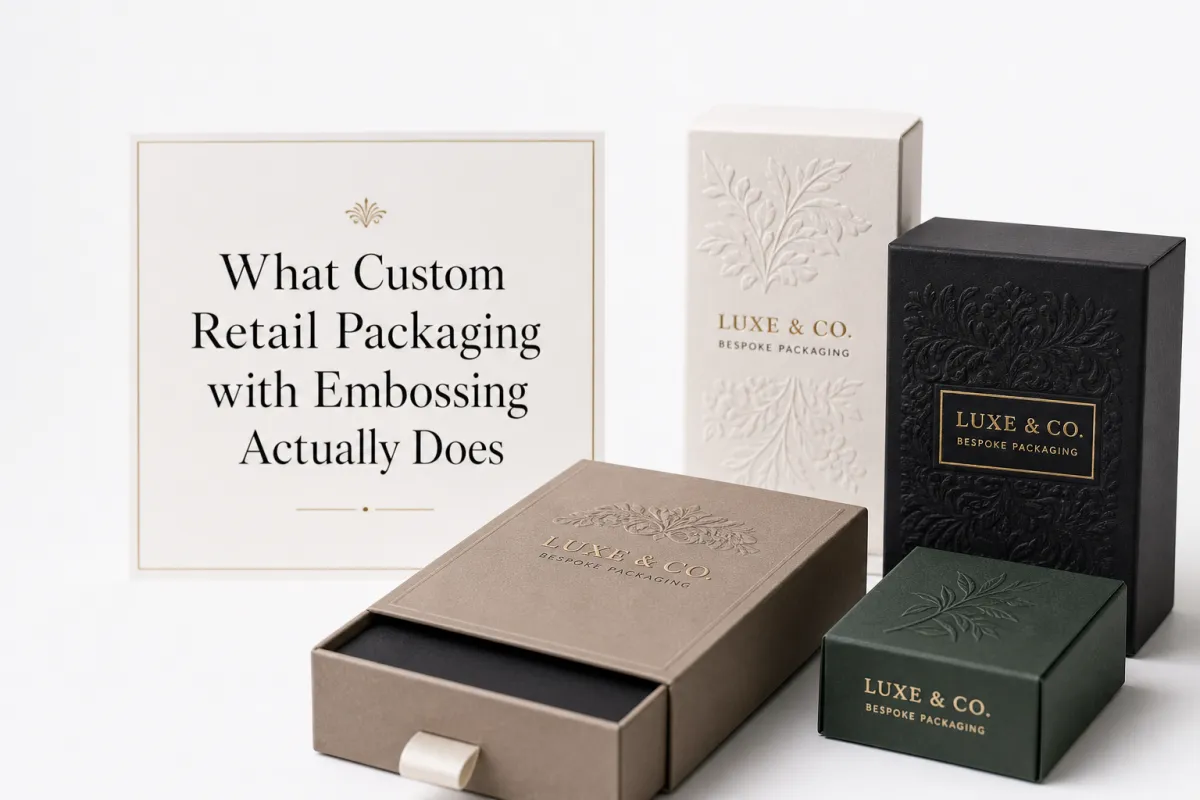
Custom retail packaging with embossing raises selected artwork above the surface of the board or paper so the design gets physical relief. That raised area can be a logo, a monogram, a border, a symbol, or a repeating pattern. The effect is immediate: light catches the edges, the surface feels dimensional, and the package gives off a more deliberate, finished impression.
Most shoppers do not think, “Excellent relief structure.” They just feel that the box is better made. That is the point. Custom retail packaging with embossing creates tactile memory, and tactile memory sticks harder than a few extra lines of print. If your packaging needs to communicate quality fast, embossing does real work without cluttering the layout.
It fits especially well on luxury goods, cosmetics, fragrance, apparel, seasonal gift sets, premium food items, and Product Packaging That needs shelf presence. If the box will sit behind glass, live in a boutique, or be passed around at checkout, custom retail packaging with embossing can separate “product” from “brand.” That sounds dramatic, but the shelf is not gentle. A box gets maybe two seconds to earn a second look, and sometimes less than that.
There is a catch. Embossing is not a rescue plan for weak branding. It supports strong typography, a clear logo system, and a decent paperboard. If the design is crowded or the stock is flimsy, custom retail packaging with embossing will not fix it. It will just make the flaws feel more expensive. I have watched a beautiful concept go sideways because someone insisted on embossing a detailed logo on low-grade board. It looked fine on screen. In hand, it looked kinda tired.
A good embossed box does not beg for attention. It earns it with touch, restraint, and a logo that still reads after the press hits it.
For brands comparing finishes, it helps to think in layers. Print handles color and messaging. Structure handles protection. Custom retail packaging with embossing handles perception. That is why it shows up so often in retail packaging and package branding. One finish can carry more emotional weight than a stack of small decorative tricks.
And yes, if you want to compare package formats while planning the finish, start with Custom Packaging Products. It is easier to choose an emboss-ready structure first than to force embossing onto a carton that was never built for it.
How Custom Retail Packaging with Embossing Is Made
Custom retail packaging with embossing starts with a die set. One metal die pushes into the board while a counter-die supports the other side. Under pressure, the chosen artwork rises into a controlled relief. The machinery matters, but the board matters just as much. The wrong stock will crush, flatten, or blur the shape. The right stock gives you a crisp profile with enough edge definition to look intentional.
There are three common versions. Blind embossing raises the shape without ink or foil inside the recessed area. Registered embossing lines up the raised area with printed artwork so the logo or pattern has both color and depth. Then there is combination work, where embossing pairs with foil stamping or spot UV for a higher-contrast finish. That last option can look excellent, but it can also tip into visual noise if every effect is trying to win.
In custom retail packaging with embossing, stock choice changes everything. Thicker paperboard, especially a well-made folding carton board in the 300gsm to 400gsm range, usually holds detail better than thin or overly slick stock. A softer fiber structure often gives a cleaner rise. Heavy coatings, very glossy laminations, or weak recycled boards can reduce the impact. Not always, but often enough that sampling beats guessing.
Artwork also needs to be simplified for the press. Tiny text, hairline strokes, dense icon clusters, and tightly spaced serif type may not survive the emboss the way they look on screen. If the design relies on a 3-point line to carry brand identity, custom retail packaging with embossing will expose that weakness quickly. Physical depth is not a Photoshop effect. It needs room to breathe.
That is why sampling matters. A logo can feel crisp on matte C1S artboard and mushy on a smoother coated sheet. The same custom retail packaging with embossing spec can produce different results based on fiber direction, caliper, and press depth. A press proof or sample is worth the wait because it tells you what the final box will actually feel like, not what the mockup claims.
If you are building a retail line that has to survive shipping as well as display, ask for transit testing that matches the carton use case. The International Safe Transit Association publishes test methods that many packaging teams use to evaluate distribution risk, while ASTM D4169 is a common reference for performance testing. Those standards do not make a box prettier, but they do keep a nice finish from arriving in pieces.
Key Factors That Affect the Look and Feel
Custom retail packaging with embossing depends on a few variables: paper thickness, fiber structure, coating, logo size, and emboss depth. That is the unglamorous truth. The finish looks magical when those pieces line up and oddly cheap when they do not.
Scale comes first. Larger, simpler shapes almost always emboss better than dense graphics. A bold seal, a monogram, or a short wordmark gives the die more room to rise cleanly. Thin strokes can work, but they need careful spacing and a stock that can hold the edge. If your logo looks great at 600 pixels wide and falls apart at actual size, custom retail packaging with embossing will not forgive that mistake.
Depth matters too. Too shallow and the effect disappears under retail lighting. Too deep and the paperboard starts to distort or crack, especially near folds. There is a middle ground, and a good packaging supplier should tell you where it is for the chosen board. In practice, subtle embossing often beats aggressive depth because it stays elegant across more viewing angles.
Finish coordination matters as well. Custom retail packaging with embossing usually looks strongest on matte surfaces, soft-touch lamination, uncoated stocks, or restrained print layouts. Busy artwork, loud gradients, and high-gloss coatings can fight the tactile effect. That does not mean you cannot combine them, but each added element needs a reason. Otherwise the package reads as expensive in the wrong way: confused.
Brand managers often think more finishes equals more premium. Usually it means more cost. A single strong tactile cue is often enough. One embossed logo on a clean box can outperform foil, spot UV, textured varnish, and metallic ink all stacked together. For custom retail packaging with embossing, restraint is not a downgrade. It is usually the thing that makes the package feel expensive.
Packaging that will be handled often also needs practical durability. Fold lines, edge rub, and cartoning pressure can soften the raised area over time. That is especially true in apparel shipping, gift packaging, and subscription retail where boxes may be touched repeatedly before opening. A design that survives a shelf, a warehouse, and a customer’s kitchen table is better than one that only looks good in a render. I say that from experience, not theory.
For paper sourcing, ask for FSC-certified materials if sustainability claims matter to the brand story. Buyers increasingly notice that detail, and it fits naturally with premium custom retail packaging with embossing when the rest of the spec is honest. If the board is responsible, the finish is cleaner, and the brand story makes sense, the box carries more weight.
A practical rule: if the emboss is the hero, let it be the hero. Keep the rest of the package quiet. That is one reason custom retail packaging with embossing works so well in product packaging. It gives you one strong sensory point instead of five half-strength ones.
Custom Retail Packaging with Embossing: Cost and Pricing
Custom retail packaging with embossing is not expensive in one universal way. It is expensive in layers. The die has a cost. Setup has a cost. The stock has a cost. Sampling has a cost. If the artwork is complicated, the quote climbs. If the run is short, the per-unit cost climbs faster. That is how packaging math behaves, and it does not care about your launch calendar.
For a clean, single-logo emboss on a moderate run, you might see tooling in the range of $120 to $350 and an added production cost of roughly $0.04 to $0.12 per unit at higher quantities, depending on board and coverage. For smaller runs, that per-unit figure can jump to $0.20 to $0.60 or more because the setup gets spread across fewer boxes. Registered embossing costs more than blind embossing because alignment adds time and inspection. Foil plus embossing costs more again because you are stacking finishing steps.
The cleanest way to think about custom retail packaging with embossing is this: simpler designs are cheaper, faster, and easier to approve. A single mark on one panel is usually the best value. Multiple embossed zones, deeply raised textures, or combination finishes can look beautiful, but they also increase make-ready time, rejection risk, and the chance that the paperboard behaves badly under pressure.
There are also hidden costs people forget to ask about. Revisions to the die artwork can add time and fees. Special board grades can require a minimum order. Foil pairing can demand tighter alignment tolerance. More inspection standards can slow the line. None of this is mysterious. It is just the part of custom retail packaging with embossing that marketing decks often leave out because nobody wants to discuss press setup in a meeting.
Here is the useful habit: ask for tiered quotes. One version should be the cleanest viable version. Another should be the premium version. If you are not comparing at least two specs, you are probably only comparing your imagination against a price number. That is not a smart buying process.
For buyers who want a faster path to a decision, use this simple comparison.
| Option | Typical Use | Tooling Cost | Added Unit Cost | Notes |
|---|---|---|---|---|
| Blind emboss | Logo, seal, subtle texture | $120-$250 | $0.04-$0.12 | Best for clean, minimal custom retail packaging with embossing |
| Registered emboss | Printed logo aligned to relief | $180-$350 | $0.06-$0.16 | More setup and tighter tolerance |
| Foil plus emboss | Premium gift or luxury cartons | $220-$450 | $0.10-$0.24 | Strong shelf impact, higher risk of overdesign |
| Deep texture emboss | Hero packaging, limited editions | $200-$500 | $0.08-$0.20 | Needs stronger board and more careful proofing |
If you are specing custom retail packaging with embossing for a small batch, be realistic about the economics. Small orders are fine, but they often cost more per unit because setup is fixed. That is not a vendor trick. It is how tooling works. If the order is small, keep the design tight and avoid paying for decorative extras you do not need. You can always move up later.
And if you want a broader view of options before you quote, check Custom Packaging Products and compare structures first. A better carton choice can reduce finishing costs before you even touch the embossing spec.
Process and Timeline for Custom Retail Packaging with Embossing
Custom retail packaging with embossing follows a pretty predictable path, which is good news because packaging chaos is already available everywhere else. The flow usually starts with a brief, then a dieline, then artwork prep, then tool creation, then a sample or proof, then production, finishing, and shipment. Miss one approval point and the schedule starts to wobble.
The first bottleneck is usually dieline confirmation. If the carton structure is not settled, the emboss position can end up too close to folds, glue flaps, or cuts. That creates distortion and waste. The second bottleneck is artwork prep. Embossing needs vector art with clean outlines and sensible spacing. The third bottleneck is proof approval, because nobody wants to press 10,000 cartons and then discover the logo is too high on the front panel by 4 millimeters.
For a straightforward project, custom retail packaging with embossing often needs an extra 5 to 10 business days for tooling and sample work before production even starts. After approval, a clean run might take 12 to 18 business days depending on quantity, finishing load, and factory capacity. Larger runs or projects with foil, coating, or multiple carton sizes need more breathing room. If the launch date is fixed, build buffer time into the plan instead of pretending everything will magically line up.
That timing is why custom retail packaging with embossing is usually a poor fit for last-minute launches. Can it be done quickly? Sometimes. Should you bank on that? No. The more complex the finish, the more likely it is that a proof will come back with a tiny problem that matters a lot. One bad proof can cost more than a week of planning, which is why disciplined teams approve physical samples before the production run.
Good production teams also check the packaging against the shipping plan. If the cartons are stacked, palletized, or sent through third-party fulfillment, the emboss should not sit in a place where abrasion will flatten it. Retail packaging is not only about the shelf. It is also about the trip to the shelf.
- Lock the carton structure before you decorate it.
- Keep the embossed area away from folds and glue zones.
- Request a physical sample, not only a digital mockup.
- Test the carton under shipping conditions if the route is rough.
- Approve the final spec only after touching the proof.
If you need a benchmark for handling and transit risk, use industry references like ISTA for test methods and general background on distribution testing. For anything that will be shipped through a distribution chain, pairing custom retail packaging with embossing with sensible performance testing is better than crossing your fingers and calling it a strategy.
Common Mistakes Brands Make With Embossed Packaging
Custom retail packaging with embossing exposes bad design choices faster than almost any other finish. That is why the mistakes are so visible. Tiny type turns muddy. Overcrowded logos lose shape. Thin paperboard buckles. High-gloss stock flattens the effect. The finish is not the problem. The spec is.
The most common mistake is over-detailing. People want to emboss a logo, a pattern, a tagline, a border, and maybe a decorative flourish because the blank space “feels empty.” That emptiness is often what makes the package feel premium. Custom retail packaging with embossing needs room to breathe. A crowded front panel makes the tactile cue less noticeable, not more.
The second mistake is choosing embossing for everything. Not every panel deserves a raised treatment. In fact, most do not. Use it where the eye should land first, then let the rest of the layout support that decision. The best custom retail packaging with embossing usually has one clear focus point. Anything more and the package starts competing with itself.
Stock mismatch is another expensive error. Weak board, low-caliper paper, or a very slick coating can flatten the emboss and make the finish look like a mistake from across the room. The package might still function, but it will not feel premium. Buyers can sense that difference even if they do not know the technical reason.
Layout placement matters too. Embossing too close to edges, cuts, score lines, or glue zones can create distortion and waste. It can also make carton assembly harder. People often forget that custom retail packaging with embossing has to survive the machine, not just the mockup. Packaging is a physical object first and a brand statement second.
The last mistake is approving art only on-screen. A flat render can hide a lot of trouble. A logo that looks perfect in a presentation can be too detailed for a die, too high for the panel, or too deep for the board. Physical proofing is boring, yes. It also saves money. Funny how that works.
If a box only works in a mockup, it does not really work.
That is why good custom retail packaging with embossing projects usually start with simple expectations. Not simple in quality. Simple in structure. A single strong mark, a sensible board, and a finish that suits the product category. That approach makes the package easier to print, easier to assemble, and easier to remember.
If your current box spec is doing too much, strip it back. Strong packaging design usually improves when one element gets to lead instead of four elements fighting for the spotlight. That is true for custom printed boxes across the board, and especially true once embossing enters the picture.
Expert Tips and Next Steps for Better Results
Custom retail packaging with embossing works best when the design starts with one focal point. A logo. A seal. A monogram. A short phrase. Pick one. That one raised area can carry far more brand value than a crowded front panel trying to prove it has taste. Usually, the simplest option is the one that survives real production cleanly.
I would also keep the palette restrained. Matte white, natural kraft, soft black, deep navy, muted green, or warm neutral stocks tend to make custom retail packaging with embossing feel more deliberate. Loud colors are not banned, but they need discipline. A strong tactile finish plus a loud print scheme can become noise very quickly. The package should feel composed, not like it fought a paint store and won.
Ask for two sample directions before you commit. One should be the cost-efficient version. The other should be the premium version. Compare them in hand, under normal lighting, at arm’s length and close up. Look at visibility, touch, and edge definition. That side-by-side test is often more useful than any slide deck because custom retail packaging with embossing is a physical decision.
Also check the final artwork at actual size on the dieline. Not in a mockup. Not in a presentation frame. On the actual panel dimensions. A logo that seems balanced on a screen can end up too small for the press or too close to a fold. A good supplier should help you catch that early, but the brand still needs to see it before production.
For brands building long-term retail packaging systems, embossing also helps with consistency. A tactile logo can become part of the package branding across multiple SKUs, seasonal runs, and product tiers. Used carefully, custom retail packaging with embossing gives the line a shared visual language without forcing every carton to look identical. That is useful if you carry several price points.
Here is the short version of what I would do next:
- Audit the current carton spec and remove any finish that is not earning its keep.
- Request a quote for one simple and one premium version of custom retail packaging with embossing.
- Confirm the emboss size against the final dieline, not a loose concept sketch.
- Ask for a physical proof before full production.
- Keep the rest of the design quiet so the emboss can do its job.
If the package needs support on the structure side as well, revisit Custom Packaging Products and choose the carton format before locking in the finish. Better structure choices reduce stress on the press and improve the final result.
My blunt take: custom retail packaging with embossing is worth the spend when the brand has enough discipline to let one tactile cue carry the premium feel. If the design is messy, the emboss will not save it. If the design is clean, custom retail packaging with embossing can make the whole package feel more expensive, more thoughtful, and more retail-ready without turning the box into a circus.
FAQ
How much does custom retail packaging with embossing usually cost?
Cost depends on tooling, stock choice, run size, and whether the emboss is blind or paired with print or foil. Short runs cost more per box because setup and die creation are spread across fewer units. A simple single-logo custom retail packaging with embossing spec is usually the most budget-friendly version.
Is embossing better than debossing for custom retail packaging?
Embossing is better when you want the brand mark to feel raised and more noticeable in hand. Debossing works well when you want a quieter, recessed look with a softer visual profile. The right choice depends on the brand mood, stock thickness, and how much tactile contrast you want.
What materials work best for custom retail packaging with embossing?
Thicker paperboard and sturdy folding cartons usually hold cleaner detail than thin or flimsy stock. Slightly softer fibers often emboss better than heavily coated or overly slick surfaces. Always test the final material before committing to full production.
How long does custom retail packaging with embossing take to produce?
Timeline depends on dieline approval, die making, sampling, and production capacity. Simple jobs move faster, while projects with multiple finishes need more lead time. Plan extra buffer for proof revisions so the launch does not get squeezed.
Can custom retail packaging with embossing work for small orders?
Yes, but small runs usually have a higher unit cost because setup and tooling are spread over fewer boxes. Keep the design simple to avoid overpaying for complexity you do not need. Ask for sample-based pricing so you can judge whether the tactile upgrade is worth it.
Custom retail packaging with embossing is one of those finishes that looks easy from the outside and gets fussy fast once you start specing it properly. That is normal. If you Choose the Right stock, keep the artwork clean, and approve a physical proof, the finish can do exactly what it should: make the box feel worth picking up. And in retail, that first touch matters more than most brands want to admit.
My practical takeaway is simple: start with a clean carton, keep the embossed area small enough to stay crisp, and make the proof test the decision point. If the sample feels good in the hand and reads clearly under light, you are on the right track. If it only looks good on a screen, keep digging.

