Buyer Fit Snapshot
| Best fit | Custom Ribbon for Branded Boxes projects where brand print, material claims, artwork control, MOQ, and repeat-order consistency need to be specified before quoting. |
|---|---|
| Quote inputs | Share finished size, material target, print colors, finish, packing count, annual reorder estimate, ship-to region, and any compliance wording. |
| Proofing check | Approve dieline scale, logo placement, barcode or warning zones, color tolerance, closure strength, and carton packing before bulk production. |
| Main risk | Vague material claims, crowded artwork, missing packing details, or unclear freight terms can make a low unit price expensive after revisions. |
Fast answer: Custom Ribbon for Branded Boxes: Design, Cost & Process should be specified like a repeatable production item. The safest quote records material, print method, finish, artwork proof, packing count, and reorder notes in one written spec.
Production checks before approval
Compare the actual filled-product size with the drawing, then confirm tolerance on folds, seals, hang holes, label areas, and retail display edges. Reserve space for logos, QR codes, warning copy, and material claims before decorative graphics fill the panel.
Quote comparison points
Review material grade, print process, finish, sampling route, tooling charges, carton quantity, and freight assumptions side by side. A quote is only useful when the supplier can repeat the same color, closure quality, and packing count on the next order.
Custom Ribbon for Branded Boxes: Design, Cost & Process
Learn how a custom ribbon for branded boxes is designed, priced, and produced, plus the specs, timelines, and mistakes that shape a polished package for gifting and retail presentation.
Custom ribbon for branded boxes can change a package faster than almost any other finishing detail. A rigid carton, by itself, can look competent and forgettable. Add ribbon and the same box gains movement, texture, and a clear sense of intention before the lid is even lifted. In premium gifting, seasonal launches, and retail presentation, that first touch shapes perception more than most teams expect.
From a packaging buyer's perspective, custom ribbon for branded boxes is not decoration bolted on at the end. It sits inside the brand system, affects the unboxing sequence, and sometimes serves a structural job as well. I have seen projects where the ribbon did more to elevate the package than a costly box upgrade would have done, simply because it was chosen with more care. That is why the strongest programs treat ribbon as part of the packaging architecture, not an accessory.
If you are building the full presentation at the same time, ribbon should be considered alongside the box, insert, and label, not after them. Our Custom Packaging Products page shows how ribbon, inserts, labels, and custom printed boxes can work together. Our Case Studies show how coordinated packaging choices can tighten the brand story instead of scattering it.
Custom Ribbon for Branded Boxes: The First Detail Customers Touch
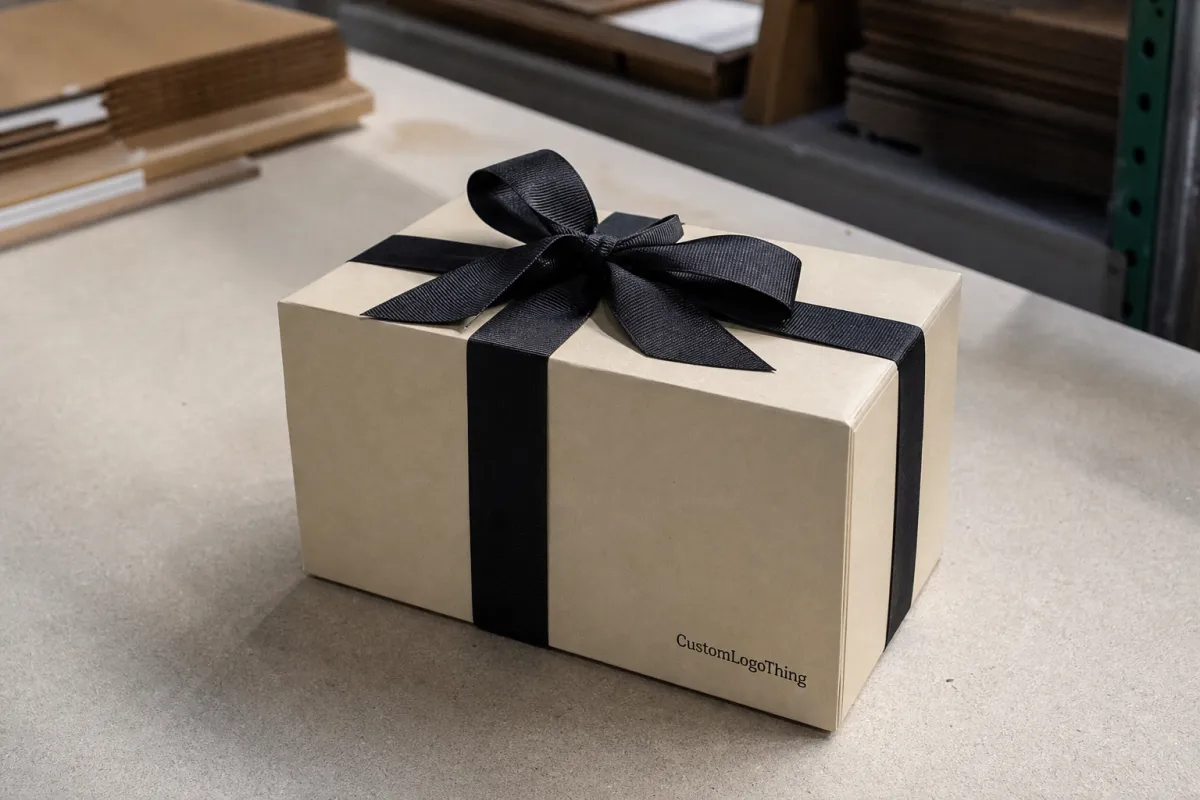
Custom ribbon for branded boxes often does its job before the customer consciously registers it. A satin bow across a rigid carton suggests celebration. A narrow grosgrain tie feels firmer, cleaner, and more disciplined. Sheer ribbon softens the whole presentation and makes the package feel lighter. Those are small shifts on paper, but in retail packaging and direct-to-consumer gifting, small shifts are usually the ones people remember.
The reason is straightforward: board gives structure, but ribbon gives motion. When someone touches custom ribbon for branded boxes, they feel the weave, the edge finish, and the resistance of the knot or bow. That tactile moment changes perceived value, especially when the carton itself is a simple construction. A well-chosen ribbon can make a modest box feel deliberate without redesigning the entire packaging system.
Different finishes carry different signals. Glossy satin usually reads as polished and luxury-leaning. Matte grosgrain feels tailored, steady, and less theatrical. Organza or sheer ribbon works well for softer gifting, event giveaways, and lighter product packaging because it does not dominate the box visually. Custom ribbon for branded boxes should match the emotional job of the package, not only the palette on a brand board.
There is a strategic side too. Seasonal collections, gift sets, and tiered launches all benefit from custom ribbon for branded boxes because the box can stay stable while the ribbon changes for holiday, limited release, or VIP editions. That matters for brands managing multiple SKUs at once. A ribbon update is a smaller move than a full carton redesign, but the customer still notices the shift immediately.
Many teams underestimate ribbon because it feels secondary to the box. The market does not. In influencer kits, premium retail displays, and gifting programs, custom ribbon for branded boxes can be the detail that tells a customer the package was built with care. I have watched a plain white rigid box move from standard to premium simply because the ribbon had the right weight and finish.
- Satin gives the brightest sheen and photographs well.
- Grosgrain adds texture and holds knots better.
- Organza creates a lighter, softer presentation.
- Velvet feels rich but adds cost and bulk.
Those four options are not the whole market, but they cover most buying decisions. In practice, the right choice often comes down to how the ribbon behaves under actual handling, not how it looks isolated on a swatch card.
How Custom Ribbon for Branded Boxes Is Made and Applied
Custom ribbon for branded boxes can be produced in several ways, and the method changes clarity, hand feel, lead time, and cost. Printed ribbon, woven logo ribbon, dyed stock ribbon, and specialty finishes such as metallic edges are the most common routes. Simple artwork usually favors printed ribbon because setup is lighter. If the brand mark needs a textile-like presence with more built-in texture, woven ribbon usually gives a richer result.
Printed ribbon is often the most direct route for custom ribbon for branded boxes because the design is applied onto a finished base. That makes color testing easier and artwork placement more predictable. Woven ribbon builds the logo into the ribbon structure itself, so the image feels integrated, but the weave limits fine detail. Tiny lettering, thin rules, and narrow taglines can disappear once the ribbon folds around a box edge or knot. Bold artwork survives better than delicate artwork.
Artwork setup for custom ribbon for branded boxes needs different thinking than box artwork. A box wrap gives broad panels. Ribbon gives a narrow surface that repeats across a long span. That means repeat length, logo spacing, left-right balance, and knot behavior all matter. A ribbon design can look clean in a flat proof and still fail on a tied box if the logo lands too close to a fold or the spacing feels cramped around the bow.
Application method matters just as much as production method. Custom ribbon for branded boxes can be used as a belly band, tied into a bow, wrapped around a rigid lid, threaded through a sleeve, or built into a tie-through closure. A folding carton may only support a decorative band. A rigid set box can handle a more dramatic wrap or closure treatment. If the ribbon helps hold the box shut, it becomes a functional element, not just decoration, and it should be planned that way from the start.
That functional split matters. A ribbon that decorates the package and a ribbon that supports structure are not the same problem. If custom ribbon for branded boxes is expected to restrain a multi-piece set, it should be tested for slip, stretch, abrasion, and knot stability. If the package needs parcel shipment, the ribbon should not be the only thing preventing the box from opening in transit. For shipping validation, standards and test methods from organizations like ISTA are worth reviewing because the package has to survive more than a showroom moment.
A ribbon that looks beautiful on a mockup but curls, slips, or scuffs in packing is not a good packaging decision. It has to look right and behave right on the line.
Samples matter more than many teams expect. Custom ribbon for branded boxes can look slightly different under office lights, daylight, and camera flash, especially if it has sheen, foil, or a tight weave. A digital proof confirms layout. A physical sample tells you how the ribbon drapes, how the edges finish, and whether the color feels too bright or too flat against the actual box stock. That sample step saves a lot of second-guessing later.
There is one more detail that is easy to miss: how the ribbon is handled before it reaches the pack line. If rolls are stored in heat, crushed in transit, or cut too early, the finish can shift. I have seen a ribbon arrive with a perfect spec sheet and still cause trouble because the edges were slightly marked from poor storage. Small material issues become large presentation issues once the box is in a customer’s hands.
Cost and Pricing: What Drives the Quote for Custom Ribbon
Custom ribbon for branded boxes is priced from a handful of practical variables: width, material, print method, color count, edge finishing, and order quantity. A 3/8-inch ribbon with one-color printing is a different job from a 1.5-inch woven logo ribbon with custom-dyed stock and a specialty edge. The more complex the structure, the more setup, inspection, and waste control the quote has to absorb.
Setup cost is a major part of custom ribbon for branded boxes, especially for woven programs or highly customized dye lots. If the ribbon needs new looms, color matching, or a dedicated print run, the first order carries more fixed cost than the reorders. Unit price usually improves as volume rises. A small pilot run can make sense for a launch test, but a recurring packaging program generally rewards higher quantity planning.
For budgeting, many buyers prefer ranges over exact cents. As a rough planning tool, printed stock ribbon for custom ribbon for branded boxes might land around $0.18-$0.45 per finished box at 5,000 units, depending on width and coverage. Woven logo ribbon may sit closer to $0.35-$0.75 per box, while specialty materials, custom dye, or heavier finishing can push a program above $1.00 per box before assembly labor. Those numbers are not universal, but they are concrete enough to compare options early and avoid fantasy budgeting.
The cheapest-looking ribbon is not always the cheapest program. If a low-cost material frays, twists, or prints poorly, the packing team spends time fixing it and yield drops. Landed cost should include assembly labor, proofing, shipping, storage, and waste allowance. In branded packaging, a ribbon that saves a few cents but creates line stoppages usually costs more in the end.
There are smart ways to keep the quote in check without flattening the design. One brand color instead of a four-color artwork can reduce print complexity. A standard width, such as 5/8 inch or 7/8 inch, often sits in a more efficient production lane than a custom odd width. If custom ribbon for branded boxes is only needed for launch kits or seasonal gifts, reserve fully custom woven work for hero products and use simpler ribbon on supporting SKUs.
The table below gives a practical comparison of common ribbon approaches for custom ribbon for branded boxes. The figures are directional, not absolute, but they help teams talk about packaging choices in a grounded way.
| Ribbon Type | Typical Look | Best For | Relative Cost | Notes |
|---|---|---|---|---|
| Printed satin | Glossy, clean logo transfer | Gift sets, launch boxes, retail packaging | Low to medium | Good balance of detail and price |
| Grosgrain with print | Textured, structured surface | Modern branded packaging, rigid cartons | Medium | Stronger knot hold, slightly less shine |
| Woven logo ribbon | Built-in textile logo feel | Premium presentations, repeat programs | Medium to high | Great durability, weaker for tiny text |
| Custom dyed specialty ribbon | Exact brand color, controlled appearance | Brand-led launches, strict color matching | High | Setup and lead time can be heavier |
| Organza or sheer ribbon | Light, airy finish | Event kits, soft gifting, seasonal promotions | Low to medium | Less formal, lower structural grip |
For sustainability-led programs, a packaging buyer should ask what the ribbon is made from and whether recycled or lower-impact options exist. If paper-based parts are part of the system, FSC guidance can help frame sourcing decisions. You can review FSC resources at FSC if chain-of-custody or certified paper components are part of your packaging design requirements.
One more practical point: custom ribbon for branded boxes should always be priced with assembly in mind. A ribbon that is easy to cut and tie can be far cheaper operationally than one that looks slightly nicer but slows the packing line. Experienced packaging teams make that tradeoff constantly because the line, not the mood board, decides what survives at scale.
There is also a quiet cost in inconsistency. If a vendor cannot reproduce the same shade or the same edge finish reliably, the apparent savings can disappear in rework, rejects, and customer complaints. Price matters, but repeatability matters more once the program reaches real volume.
Process and Timeline: From Proof to Production
The normal path for custom ribbon for branded boxes starts with a clear brief. Gather box dimensions, closure style, artwork files, target quantity, and any brand standards for color or finish. If the ribbon needs to coordinate with Custom Printed Boxes, labels, or inserts, share those materials at the same time so the supplier can judge the whole presentation, not only the ribbon by itself.
After the brief comes proofing. A digital proof shows repeat length, logo position, and general proportion, but it does not capture how a glossy surface catches light or how a woven edge feels in the hand. That is why a sample approval step is so useful for custom ribbon for branded boxes. It lets the team check whether the ribbon photographs well, ties cleanly, and stays readable after folding or knotting.
Timeline depends heavily on the production method. Printed ribbon can move faster because the base material is ready and the artwork application is direct. Woven ribbon or custom-dyed ribbon often needs more setup, color verification, and inspection, so lead time stretches. For many orders, a realistic production window is often about 12-15 business days after proof approval for simpler work, and longer if the order includes special finishing, complex color matching, or higher quantities. If the ribbon is part of a larger branded packaging launch, that extra time should be built into the schedule early.
Delay points are usually predictable. Incomplete artwork files slow proofing. Unclear color references create back-and-forth. Late sample approvals compress production and shipping time. Seasonal demand can push lead times out too, especially if the ribbon needs to line up with holiday, gifting, or retail packaging calendars. A good plan for custom ribbon for branded boxes assumes there will be at least one revision and leaves room for physical sample review.
Production planning should also line up with box assembly. Ribbon is not useful if it arrives too early and fills storage space, or too late and holds up packing. For custom ribbon for branded boxes, the box run, ribbon delivery, and line schedule need to be synchronized so the team can assemble and ship without costly stops. If the ribbon is being introduced into a new packaging design, a small pilot run is worth the time because it exposes friction before the full order lands.
Experienced buyers usually care about one detail more than the rest: if the ribbon choice needs a special fold, tie, or wrap path, document it clearly the first time. A simple assembly sheet with photo references, box dimensions, cut length, and knot style can save repeat confusion. That documentation becomes even more valuable if custom ribbon for branded boxes is ordered again later for a seasonal refresh or replenishment run.
Key Factors to Choose the Right Custom Ribbon for Branded Boxes
Box construction is the first filter. Rigid boxes, folding cartons, sleeves, and mailers all handle custom ribbon for branded boxes differently because the ribbon has to work with the package geometry. A rigid lift-off lid can support a formal wrap or bow. A folding carton may need a simple band. A mailer often uses ribbon only as a decorative secondary feature, since the structure is doing the real shipping work.
Width and proportion come next. A 1.5-inch ribbon can look elegant on a large gift box, yet it can crowd a compact carton and make the package feel heavy. A 3/8-inch ribbon may be neat and refined, but it can disappear on a large-format box. The right size for custom ribbon for branded boxes is the size that sits in balance with the box face, lid depth, and overall packaging style.
Material and finish should align with the brand personality and the product inside. A cosmetics or fragrance presentation may favor a polished satin surface. A wellness or craft product may feel better with a textured grosgrain. A luxury gift set may justify velvet or a heavier woven finish if the tactile impression matters enough. The blunt question I ask in sample reviews is simple: does this ribbon feel like part of the same product system, or does it feel pasted on?
Legibility matters more than many teams expect. If custom ribbon for branded boxes includes a logo, tagline, or web address, the artwork needs to survive folds, curves, and knot bulk. Tiny text is a common mistake because it looks fine on a screen and fails once the ribbon is tied. In most cases, a strong logo mark or short brand line is safer than trying to place too much information on a narrow surface.
Storage and handling are part of the decision too. Ribbon can crease, fray, or pick up dust if it is packed loosely, stored in humid conditions, or handled with too much friction during assembly. If the program runs through multiple shifts, ask how the ribbon will be staged at the line. Custom ribbon for branded boxes should arrive ready for efficient handling, not as a material that demands special care at every turn.
For teams balancing sustainability, there is a practical middle ground. A ribbon can be visually strong without being material-heavy, and it can support the broader branded packaging story if the rest of the system uses recyclable board, water-based inks, or responsibly sourced paper elements. Consistency matters. The ribbon, carton, and insert should all feel like they belong in the same packaging family.
From a product packaging standpoint, the best choices are usually the ones that survive real use, not just the ones that look best in a presentation deck. That is why custom ribbon for branded boxes should be judged on how it behaves when tied, stacked, shipped, and unpacked by someone who has never seen the prototype before.
Common Mistakes When Ordering Custom Ribbon for Branded Boxes
The first mistake is choosing the wrong width for the box size. Custom ribbon for branded boxes can look awkward if it is too narrow for a large lid or too wide for a small carton. The result is usually one of two things: the ribbon gets lost visually, or it starts to overpower the package and make the design feel dense. Neither outcome helps package branding.
Another common problem is overloading the ribbon with detail. Fine lines, small text, and crowded logos tend to disappear once the ribbon bends or knotting begins. If you are designing custom ribbon for branded boxes, keep the artwork bold enough to read from a normal viewing distance and from an angle. A cleaner design usually performs better than a clever one.
Teams also forget to test ribbon against the actual box finish. A matte carton can soften the same color, while a gloss-coated lid can intensify contrast and make the ribbon seem brighter than expected. Custom ribbon for branded boxes should always be viewed against the real box stock, not only against a screen rendering. Office light is not retail light, and neither is the same as home lighting after the box is opened.
There are hidden production losses too. Knot bulk uses more length than expected. Ribbon stretch can change the cut length. Assembly waste adds up during setup. If the team does not plan for those realities, the order arrives short even though the estimate looked fine on paper. For that reason, I usually advise a buffer above the clean visual calculation when planning custom ribbon for branded boxes.
Reorder inconsistency is another trap. A first run may look perfect, but if the second run uses a different lot, a different print setting, or a slightly altered finish, the brand sees variation right away. That matters especially for premium programs where color consistency signals control. Save the approved sample, record the ribbon width, note the finish, and keep the exact material description with the reorder file. That way custom ribbon for branded boxes stays repeatable instead of turning into guesswork.
If the ribbon program cannot be repeated with the same look and handling, it is not really a packaging system yet; it is only a one-time decoration.
One more issue shows up often: teams approve the ribbon in isolation and then discover it does not work with the insert, the lid magnet, or the shipping sleeve. That is why custom ribbon for branded boxes should be approved as part of the full package, not as a loose component. The ribbon has to coexist with the rest of the box structure, the packing sequence, and the shipping method.
It also helps to watch for over-correction. Some teams respond to one bad sample by making the ribbon wider, brighter, and more elaborate than the box really needs. The better fix is usually more restrained: tighten the artwork, improve the finish, or adjust the placement so the ribbon supports the box instead of competing with it.
Expert Tips and Next Steps for Custom Ribbon for Branded Boxes
The smartest starting point is usually a sample kit or physical swatch set. Hold the ribbon against the actual carton, inspect it under real light, and tie it the way it will be used in production. That tells you more than a digital mockup ever can. For custom ribbon for branded boxes, a physical review is often the difference between a package that looks good in theory and one that looks right in hand.
Match the ribbon finish to the box wrap or label stock if you want the result to feel polished. A soft-touch carton pairs nicely with a matte or lightly textured ribbon. A high-gloss printed carton may look more balanced with a satin or woven ribbon that has enough contrast to stand beside it. Good packaging design rarely comes from matching everything exactly; it comes from choosing surfaces that complement each other without fighting for attention.
Order a little more than the planned quantity. A buffer of 3% to 7% is often enough to cover setup loss, packing waste, damaged pieces, and future replenishment needs. That buffer is especially sensible if custom ribbon for branded boxes is being tied by hand, because hand assembly naturally creates more variation than machine-guided work. The extra material can also protect you if the next reorder date lands in a busy season.
Document the final decision set clearly. Keep the box dimensions, logo files, finish notes, width, repeat length, color references, sample photos, and target quantity in one place. If the ribbon is part of a larger branded packaging system, note the associated carton stock and print method too. That makes it much easier to recreate the setup later without losing the original look. For custom ribbon for branded boxes, good documentation is one of the cheapest quality-control tools you can have.
If you are building a launch or refresh, the practical path is straightforward: gather specs, request proofs, review samples on actual boxes, confirm the production schedule, and then move into repeatable ordering. That process keeps custom ribbon for branded boxes from becoming an isolated purchase and turns it into a controlled part of your product packaging program. It also makes it easier to coordinate with custom printed boxes, inserts, and the wider retail packaging plan.
Custom ribbon for branded boxes works best when it is treated as both a design decision and an operations decision. The brands that get the cleanest result are the ones that check the ribbon width, the material feel, the artwork clarity, the box structure, and the packing flow before they place the order. Lock those five pieces in before production begins, and the ribbon stops being a decorative afterthought. It becomes a repeatable part of the package.
How much custom ribbon for branded boxes do I need per box?
Measure the exact wrap path or bow style first, because a simple belly band uses far less ribbon than a full wrap with a large bow. Add a waste allowance for tying, cutting, and setup, since real production usually needs more length than the visual mockup suggests. For box programs with multiple sizes, build separate estimates for each format instead of using one average number for everything.
What ribbon material works best for premium branded boxes?
Satin is a strong choice when you want shine and a smooth, gift-ready look that photographs well. Grosgrain is a good option when you want more grip, more texture, and a slightly less formal feel. Woven or specialty finishes work well when durability and a more crafted appearance matter as much as visual impact.
Can custom ribbon for branded boxes show my logo clearly?
Yes, but clarity depends on ribbon width, print method, and how much detail is in the artwork. Simple logos, bold shapes, and short brand lines usually reproduce more cleanly than tiny text or thin line art. Ask for a proof at actual size so you can see how the logo reads once the ribbon is folded or tied.
What is the usual MOQ for custom ribbon orders?
MOQ varies by material and production method, with stock-based printed ribbon usually allowing lower entry quantities than fully woven or custom-dyed ribbon. Higher quantities generally lower unit cost, so it helps to plan for a repeatable program instead of only a one-time event run. If you are unsure, ask for quote options at two or three quantity tiers so you can compare cost efficiency.
How do I keep ribbon color consistent across reorders?
Save the approved sample, color reference, finish notes, and production details so the next run can match the first one as closely as possible. Use Pantone or other fixed color references when possible, and note whether the ribbon has a glossy, matte, or woven surface. Review a pre-production proof or sample before every major reorder if color consistency is critical to the brand.

