Buyer Fit Snapshot
| Best fit | Custom Rigid Boxes MOQ for Sustainable Packaging Orders projects where brand print, material claims, artwork control, MOQ, and repeat-order consistency need to be specified before quoting. |
|---|---|
| Quote inputs | Share finished size, material target, print colors, finish, packing count, annual reorder estimate, ship-to region, and any compliance wording. |
| Proofing check | Approve dieline scale, logo placement, barcode or warning zones, color tolerance, closure strength, and carton packing before bulk production. |
| Main risk | Vague material claims, crowded artwork, missing packing details, or unclear freight terms can make a low unit price expensive after revisions. |
Fast answer: Custom Rigid Boxes MOQ for Sustainable Packaging Orders should be specified like a repeatable production item. The safest quote records material, print method, finish, artwork proof, packing count, and reorder notes in one written spec.
Production checks before approval
Compare the actual filled-product size with the drawing, then confirm tolerance on folds, seals, hang holes, label areas, and retail display edges. Reserve space for logos, QR codes, warning copy, and material claims before decorative graphics fill the panel.
Quote comparison points
Review material grade, print process, finish, sampling route, tooling charges, carton quantity, and freight assumptions side by side. A quote is only useful when the supplier can repeat the same color, closure quality, and packing count on the next order.
A rigid box quote looks straightforward until the number lands and the Custom Rigid Boxes moq tells you the real story. The board usually is not the problem. Wrapping, hand assembly, inserts, and inspection do most of the damage. Folding carton buyers learn that the hard way, usually after the first quote makes them stare at the screen for a second too long.
Why custom rigid boxes moq matters more than the sticker price
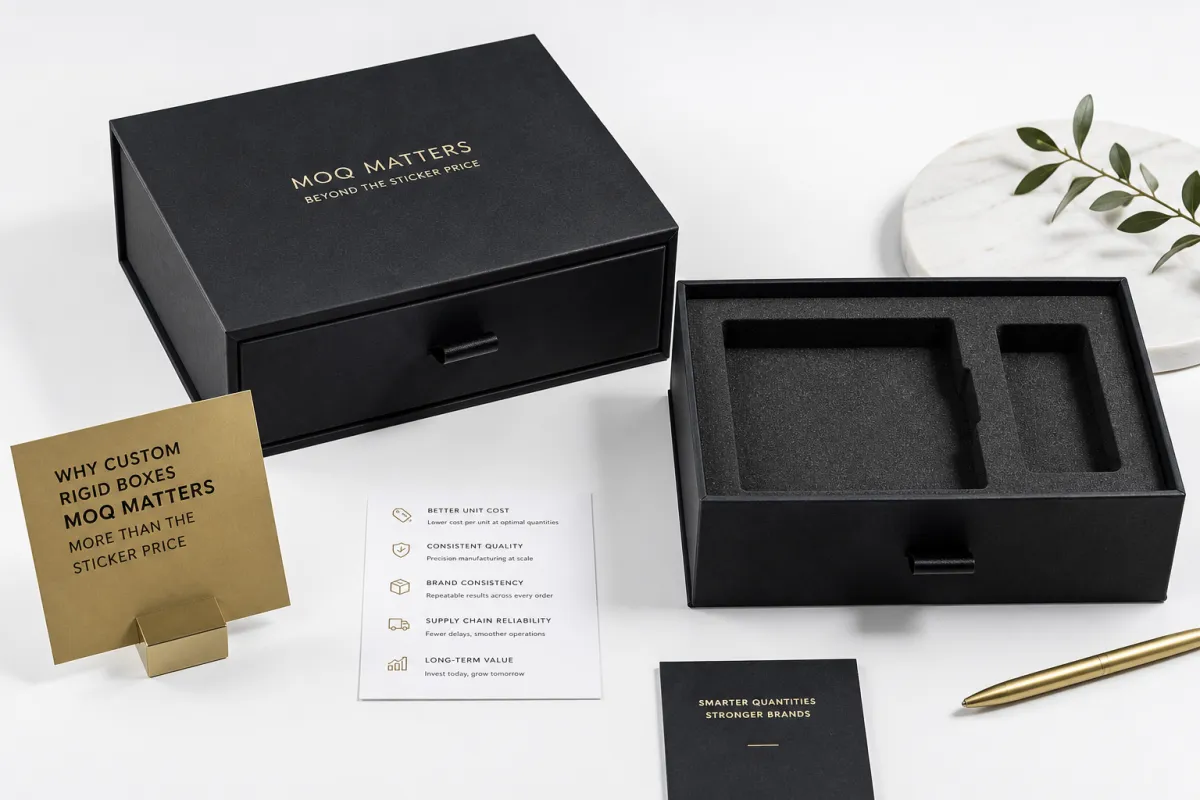
Buyers comparing Custom Rigid Boxes moq quotes usually lock onto unit price first. Fair instinct. Wrong target if the run is too small to absorb the real setup work. A rigid box is not a folding carton with a fancy attitude. It is a built structure that needs board cutting, paper wrapping, corner folding, insert assembly, and final inspection. Somebody has to pay for that labor, and somebody is gonna notice if the quote tries to hide it.
The other trap is a cheap-looking number with a long list of asterisks. Tiny quantities, magnetic closures, foil stamping, embossing, debossing, edge painting, and specialty inserts all add handling time. That time has a bill attached to it. The board is rarely the villain. Labor, waste, and quality control usually shape the custom rigid boxes moq more than anyone wants to admit in the first sales call.
Sustainable packaging buyers should think beyond the invoice. A well-built rigid box protects the product in storage and transit, supports a better unboxing moment, and cuts down on replacements when things go sideways. When the structure is planned properly, recyclable board, FSC-certified paper, and responsibly sourced wrap stock are all on the table without turning the job into a circus. That is why custom rigid boxes moq belongs in the planning stage, not the panic stage.
The better question is not, “What is the smallest number you can sell me?” It is, “What quantity makes this packaging work without wasting money?” That is where custom rigid boxes moq actually helps. It shows how the factory is balancing labor, waste, and assembly efficiency. Once you see that, you can make smarter choices on structure, finish, and timing instead of forcing a quote to obey a number that has nothing to do with the build.
The rest comes down to specifics: materials, structure, print coverage, insert design, and timeline. Each one changes custom rigid boxes moq in a predictable way, and each one is something a buyer can control before production starts.
What makes a rigid box a rigid box
A rigid box starts with a dense chipboard or paperboard shell, then gets wrapped with printed paper, specialty stock, or textured paper to create a clean presentation package. A folding carton bends. A rigid box keeps its shape. That stiffness is the point. It gives branded packaging a premium feel, protects the product, and supports sharper visual alignment for retail packaging and gift-ready product packaging.
The box styles buyers ask for most are easy to recognize once you have seen enough packaging drawings. Two-piece lift-off lid boxes are the workhorse. Magnetic closure boxes show up a lot in presentation sets and influencer kits. Drawer-style rigid boxes add a little theater to the opening. Shoulder-and-neck constructions create a neat reveal line and a tighter fit. All of them can support custom printed boxes, but each one changes the assembly steps behind custom rigid boxes moq.
Sustainability choices matter here too. Recycled board and FSC-certified board are common in rigid structures, and they pair well with paper wraps that keep plastic content down. Water-based coatings can replace more questionable surface treatments in many jobs, while soy or low-VOC inks support cleaner print specifications. If the goal is sustainable packaging without turning the box into a compromise, paper-forward builds usually make the most sense. Decorative extras that do not help the product should stay out of the way.
One detail gets ignored more than it should: sustainability and finish choices do not always pull in the same direction. Soft-touch lamination feels great, but it can complicate recyclability depending on the structure and the local recovery stream. Metallic foils make strong package branding, but they add setup and inspection work. Heavy inserts protect delicate items, then add material use and make disassembly messier. That is why custom rigid boxes moq should be discussed alongside structure and end-of-life goals, not after everyone has already fallen in love with the mockup.
I have seen projects go off the rails because someone treated the box like a mood board instead of a production item. Pretty matters. So does the fact that a box has to be built, packed, shipped, and sometimes recycled by a human being who did not sign up for extra friction.
If you are comparing suppliers, ask how they build the shell, what wrap stock they recommend, and whether their material sourcing can support FSC or recycled content targets. A supplier that can explain those choices clearly is usually easier to work with across the rest of the project too.
Specifications that change the MOQ conversation
Experienced packaging buyers learn the same lesson fast: the spec sheet drives the quote. If the dimensions are vague, the insert style is not defined, or the finish list keeps changing, the custom rigid boxes moq conversation will wobble every time somebody opens a spreadsheet. A rigid box quote depends on real production choices, not broad ideas. Exact size, board thickness, wrap coverage, artwork count, and product weight need to be nailed down early.
Dimensions matter more than many teams expect. A small cosmetic box and a large apparel box do not use the same amount of board, wrap, adhesive, or labor. Board thickness changes feel and strength. A 2 mm shell behaves differently from a 2.5 mm or 3 mm shell, especially after the wrap goes on and the corners get folded. Those changes affect appearance, yes, but they also influence die-cut waste and assembly time, which shape custom rigid boxes moq.
Insert style is another lever. Molded Pulp Inserts support a more sustainability-focused build, but they need proper fit and may require different sourcing windows. Paperboard dividers are usually easier to scale and easier to recycle. EVA foam gives strong protection for delicate items, though it changes the material profile and may miss the sustainability target. Die-cut paper inserts can land in the middle for lighter products. Each option changes tooling, labor, and production rhythm, so each one changes custom rigid boxes moq in its own way.
Decoration matters just as much. Foil stamping, embossing, debossing, spot UV, matte lamination, soft-touch coating, and edge painting all need extra setup or extra inspection. That does not mean they are off limits. It means they need a reason. A small foil logo may add real value to package branding. Full-panel special effects can push unit cost higher than the product deserves. Good packaging design does not decorate every surface just because it can.
To get a quote right the first time, I recommend sending a specification packet with these details:
- Final dimensions, including internal fit if the box carries an insert.
- Product weight and whether the box is for shelf display, transit, or gifting.
- Board thickness target and whether recycled or FSC-certified board is required.
- Wrap material preference, print coverage, and finish choices.
- Insert style, number of cavities, and whether the insert must be removable.
- Quantity target, plus any alternate quantity tiers for comparison.
That level of detail makes custom rigid boxes moq easier to answer because the factory can see the real build, not a rough idea. It also helps buyers compare custom printed boxes against other product packaging formats without guessing at hidden costs.
It also cuts down on the back-and-forth that eats a week for no good reason. Clear inputs save everyone from producing three rounds of quotes that all get revised because the insert depth changed by 2 mm. Tiny detail, big headache.
Custom rigid boxes moq, pricing, and quantity planning
The relationship between custom rigid boxes moq and price is simple once you think like a production planner. A rigid box run starts with fixed costs: tooling, setup, proofing, cutting, wrap preparation, and assembly planning. Order more boxes and those fixed costs get spread across a larger batch, so the unit cost drops. That is why 1,000 pieces can look far more expensive per unit than 3,000 or 5,000.
The trick is not to chase the lowest number blindly. Compare total landed cost, storage impact, and the risk of overbuying. If the project is tied to a launch, seasonal release, or test market, a slightly higher unit cost may be fine if it keeps inventory risk under control. If the box will support a long retail program, a higher initial order often makes better financial sense because it lowers the long-run custom rigid boxes moq pressure and improves unit economics.
A few cost drivers matter more than the rest:
- Board grade: recycled chipboard, virgin board, and specialty thicknesses do not price the same.
- Wrap stock: printed paper, textured paper, and specialty finishes each affect cost and appearance.
- Insert complexity: molded pulp, foam, and multi-part paperboard inserts all change labor.
- Decoration: foil, embossing, spot UV, and edge painting add setup and inspection work.
- Closure style: magnetic, drawer, and shoulder-style structures require different assembly effort.
For planning, here is a simple comparison that shows how structure tends to affect custom rigid boxes moq and unit cost. These are typical planning ranges, not promises. Print coverage, material availability, and insert design can shift the final quote.
| Rigid box style | Typical MOQ planning range | Typical unit cost trend at mid-volume | Setup intensity | Sustainability fit |
|---|---|---|---|---|
| Two-piece lift-off lid | 500-1,500 pieces | Lowest of the group for simple builds | Moderate | Strong with paper wrap and recycled board |
| Magnetic closure box | 800-2,000 pieces | Moderate to higher because of assembly time | Higher | Good if finishes stay paper-based |
| Drawer-style rigid box | 1,000-2,500 pieces | Moderate, depending on insert and pull tab | Higher | Good with paperboard inserts and limited lamination |
| Shoulder-and-neck box | 1,500-3,000 pieces | Higher because of tighter tolerances | High | Solid, but not ideal if the design is overfinished |
A lower MOQ is only a bargain if the structure, wrap, and insert can be built without piling on manual labor that keeps the unit cost high anyway.
That is why a tiered quote helps. Ask for pricing at several levels, like 1,000, 3,000, and 5,000 pieces. A small jump in quantity can reduce unit cost enough to justify the extra inventory. Not always, though. For some custom rigid boxes moq programs, the curve flattens after a certain point because material use and production capacity become the limit. In those cases, more volume does not buy much more savings.
For sustainable packaging teams, the cleanest rule is simple: if the box supports a launch with shaky demand, ask for a pilot run or a staged production plan. If demand is stable and the forecast is solid, compare a larger order against warehouse space, cash flow, and expected reorders. That keeps the custom rigid boxes moq decision tied to business reality instead of a neat number on a spreadsheet.
And yes, sometimes the cheapest quote is just the one that leaves out something important. A missed insert cost or a finish assumption can blow up the budget later. Cheap on paper is not the same thing as cheap in production.
From proof to delivery: process and timeline
A clean custom rigid boxes moq project usually follows the same path. Discovery and specification review come first, then quote confirmation, artwork preparation, structural proofing, material sampling, and production approval. After that comes conversion, wrapping, assembly, packing, and shipment. The steps are standard. The details inside those steps are where schedules start getting rude.
Delays tend to show up in the same spots. Artwork that is not print-ready can stall proofing. A vague insert dimension can force another sample round. A late shift from a lift-off lid to a magnetic closure can reset several production decisions at once. Even a small board-thickness change may alter the die line, which is why the custom rigid boxes moq should not be locked before the structure is settled.
Sustainable jobs can take a little longer when specialty paper, recycled content board, or custom inserts need sourcing. That does not make them difficult. It just means the calendar needs more honesty. If the project needs a paper wrap with a specific texture, or FSC-certified board from a preferred mill, the sourcing window should open early. The same goes for shipping tests aligned with ISTA test procedures. A presentation box can look beautiful in the office and still fall apart in transit. Shipping simulation is where weak corners, loose inserts, and bad glue lines usually show up.
Here is the checklist I recommend before releasing any rigid box order:
- Lock the final dimensions and product weight.
- Choose the box style before requesting final pricing.
- Confirm board grade, wrap stock, and any FSC requirement.
- Approve the insert design and test the product fit.
- Review artwork for bleeds, placement, and finish zones.
- Reserve time for sample review before production release.
That checklist sounds basic, but it prevents a lot of avoidable friction. The fastest custom rigid boxes moq jobs are the ones where the buyer already knows what the box must do and what it does not need to do. If the order is for retail packaging, shipping-protective product packaging, or premium gifting, say that plainly. The factory can judge how much structure and finish the box truly needs.
For teams comparing supply options across product packaging formats, our Custom Packaging Products page is a useful starting point for broader material and style discussions. And if you want a quick answer to common ordering questions before you request pricing, our FAQ covers the basics that usually affect approval timelines.
Why choose us for custom rigid boxes
What buyers usually want from a supplier is not a dramatic pitch. They want clear answers, predictable sampling, and honest guidance on where the money is going. That is the kind of approach that works best for custom rigid boxes moq. A supplier should explain why a structure needs a certain minimum, where the material trade-offs sit, and which finish choices are helping the product versus just adding cost.
Technical reliability matters more than decoration. A good rigid box partner should keep board sourcing consistent, control wrap registration, and maintain corner quality from sample to production. That kind of control keeps package branding sharp across the full run. It also protects the buyer from paying for extras that do not improve the final experience. Not every product needs soft-touch lamination. Not every box needs a heavy multi-step insert. A disciplined quote respects both the product and the budget, which is exactly where custom rigid boxes moq planning should land.
Sustainability should be practical, not fuzzy. Recyclable board structures, paper-based wraps, reduced-plastic designs, and responsible coating choices all have a place, but they need to match the product’s real protection needs. A cosmetics kit, a small electronics set, and a premium apparel item do not need the same packaging design. Honest guidance keeps you from overbuilding the box just to make it feel expensive. If the structure can carry the same visual weight with less material, that is the better move.
Factory experience matters too. When someone understands how wraps behave on corners, how glue lines affect the finish, and how inserts shift during assembly, the quote becomes more useful. It becomes a working plan, not just a number. That kind of guidance helps buyers balance branded packaging goals against procurement targets. If you are trying to keep the custom rigid boxes moq manageable while staying true to the product, you want a supplier who can speak plainly about those trade-offs.
For more on the materials and formats we handle, the Custom Packaging Products page gives a broader view of the structures and custom printed boxes we can support. And for material responsibility standards, FSC remains a useful benchmark for sourcing and chain-of-custody conversations; see FSC for background on certification and responsible forest management.
Next steps for custom rigid boxes MOQ requests
The fastest way to get a useful quote is to send complete information the first time. For custom rigid boxes moq requests, that means box dimensions, product weight, artwork files, preferred material, target finish, and expected order volume. If you can share whether the box is for retail packaging, a launch kit, or long-term shelf use, the recommendation gets sharper because the supplier can judge how much structure and protection the job actually needs.
If demand is still in flux, ask for two or three quantity tiers instead of a single number. That makes the custom rigid boxes moq comparison much easier to read. A good quote should show what changes at each tier, whether the unit cost improves enough to matter, and whether a pilot run would be smarter than locking into a larger batch. In a lot of programs, a short proof run gives the buyer more confidence than a guess ever could.
Use this simple path if you want to avoid surprises:
- Share the final size and product fit requirements.
- Tell the supplier which materials matter most to you.
- State any sustainability target up front, including FSC or recycled board preferences.
- Ask what decoration choices increase custom rigid boxes moq the most.
- Request pricing at multiple quantity levels.
- Confirm sample timing before you approve production.
That approach keeps the conversation centered on the real build. It also helps the factory protect your schedule, because there is less room for backtracking after the proof stage. In packaging, late changes get expensive fast, especially on rigid formats where assembly tolerances matter. Clear information on the front end is still the best way to keep custom rigid boxes moq under control.
If you are comparing options now, gather the spec sheet, narrow the finish list, and decide whether you need simple presentation boxes or a more elaborate structure. The closer the request is to the final build, the more accurate the quote will be, and the easier it will be to judge whether the box fits your product, your timeline, and your budget.
The takeaway is simple: pick the structure first, then choose the finish and quantity that match the product. Do that, and custom rigid boxes moq stops being a surprise and starts being a planning tool.
What is the usual custom rigid boxes MOQ for a new project?
It depends on size, structure, and finish complexity, but rigid boxes usually start at a higher minimum than folding cartons because the build is more labor intensive. Simple two-piece boxes with standard wrap materials can often be produced at lower quantities than magnetic or drawer-style designs with custom inserts. The most reliable way to confirm custom rigid boxes moq is to share dimensions, insert needs, and artwork details so the quote reflects the actual build, not a generic estimate.
Can I get sustainable custom rigid boxes with a smaller MOQ?
Yes, but the box style and material choices matter. Recyclable board and paper wraps are often easier to support at lower quantities than highly specialized finishes. Keeping the structure simple usually helps more than changing one material detail, especially when you want a lower custom rigid boxes moq. Ask for sustainable alternatives early so the supplier can recommend options that balance recyclability, appearance, and production efficiency.
What affects the price most when custom rigid boxes MOQ changes?
Setup labor, insert complexity, decoration methods, and material waste usually have the biggest impact on unit cost. A larger quantity spreads those fixed costs across more boxes, which is why the price often drops as MOQ increases. The most reliable comparison is a tiered quote that shows pricing at several quantities, not just one number.
How long do samples and production usually take?
Sampling often takes longer when the structure is new, the artwork needs revisions, or the insert requires custom cutting. Production timing depends on material availability, finishing steps, and assembly complexity, so simple boxes move faster than highly decorated ones. Build in approval time for proofs and samples before production begins, because late changes are one of the most common causes of delay in custom rigid boxes moq projects.
Can I mix sizes or artwork to meet the MOQ?
Sometimes, but only if the factory can share a common structure, board size, or print setup across the versions. Mixing too many variables usually raises cost and complicates scheduling, so it is better to group versions strategically when possible. Ask whether the project can be built as a family of boxes with shared components; that approach can make custom rigid boxes moq easier to meet.
Is a lower MOQ always the better choice?
No. A lower MOQ can be useful for launches, seasonal runs, and uncertain demand, but it is not automatically the smartest buy. If the quantity is too small to spread setup cost, the unit price may stay high and the packaging can end up more expensive than the product deserves. I’d rather see a realistic order size than a tiny run that looks tidy on paper and wastes budget in the real world.
If you are comparing custom rigid boxes moq for a sustainable launch or a steady retail line, start with the structure, then choose the material, finish, and quantity that fit the real job rather than the fanciest version on the table. That is the clean way to keep the box beautiful, the schedule intact, and the budget from drifting off into nowhere.

