Buyer Fit Snapshot
| Best fit | custom rigid boxes with foil stamping for packaging buyers comparing material specs, print proof, MOQ, unit cost, freight, and repeat-order risk where brand print, material, artwork control, and repeat-order consistency matter. |
|---|---|
| Quote inputs | Share finished size, material target, print colors, finish, packing count, annual reorder estimate, and delivery region. |
| Proofing check | Approve dieline scale, logo placement, barcode or warning zones, color tolerance, and any recyclable or compostable wording before bulk production. |
| Main risk | Vague material claims, crowded artwork, or missing packing details can create delays even when the unit price looks attractive. |
Fast answer: Custom Rigid Boxes with Foil Stamping: Design & Cost should be specified like a repeatable production item. The safest quote includes material, print method, finish, artwork proof, carton packing, and reorder notes in one written spec.
What to confirm before approving the packaging proof
Check the product dimensions against the actual filled item, not only the sales mockup. Ask for tolerance on folds, seals, hang holes, label areas, and retail display edges. If the package carries a logo, QR code, warning copy, or legal claim, reserve that space before decorative graphics fill the panel.
How to compare quotes without losing quality
Compare board or film grade, print process, finish, sampling route, tooling charges, carton quantity, and freight assumptions side by side. A lower quote is only useful if the supplier can repeat the same color, closure quality, and packing count on the next order.
Custom rigid Boxes with Foil stamping can make a product look expensive before anyone even lifts the lid. That first impression happens fast, and it is based on signals most shoppers do not consciously name: weight, texture, reflectivity, corner sharpness, and the little pause a box creates on a shelf. I have watched buyers change their minds in under ten seconds because the package felt more substantial than the rest. The catch is that Custom Rigid Boxes with foil stamping only look right when the board, wrap, artwork, and registration all cooperate. If one of those pieces slips, the whole thing starts reading as imitation luxury instead of the real article.
A rigid box is not just a nicer carton. Thick chipboard gives it structure, the wrap gives it skin, and the finish turns that skin into a brand signal. Add foil, and the box stops being background noise. Light catches the mark. Contrast sharpens the identity. The package becomes part of the product story instead of a throwaway shell. That is why Custom Rigid Boxes with foil stamping show up so often in cosmetics, jewelry, premium snacks, fragrance, tech accessories, and gift sets that need to feel deliberate rather than disposable.
There is a behavioral side too. Packaging that feels weighty and refined tends to stay in a home longer than the product itself. People keep rigid boxes on dressers, in closets, or on office shelves because they still look worth keeping. That extends the brand’s physical life after purchase. Foil does more than decorate. It changes memory, which is a pretty powerful job for a thin layer of metallic film.
Why Custom Rigid Boxes with Foil Stamping Stand Out Fast
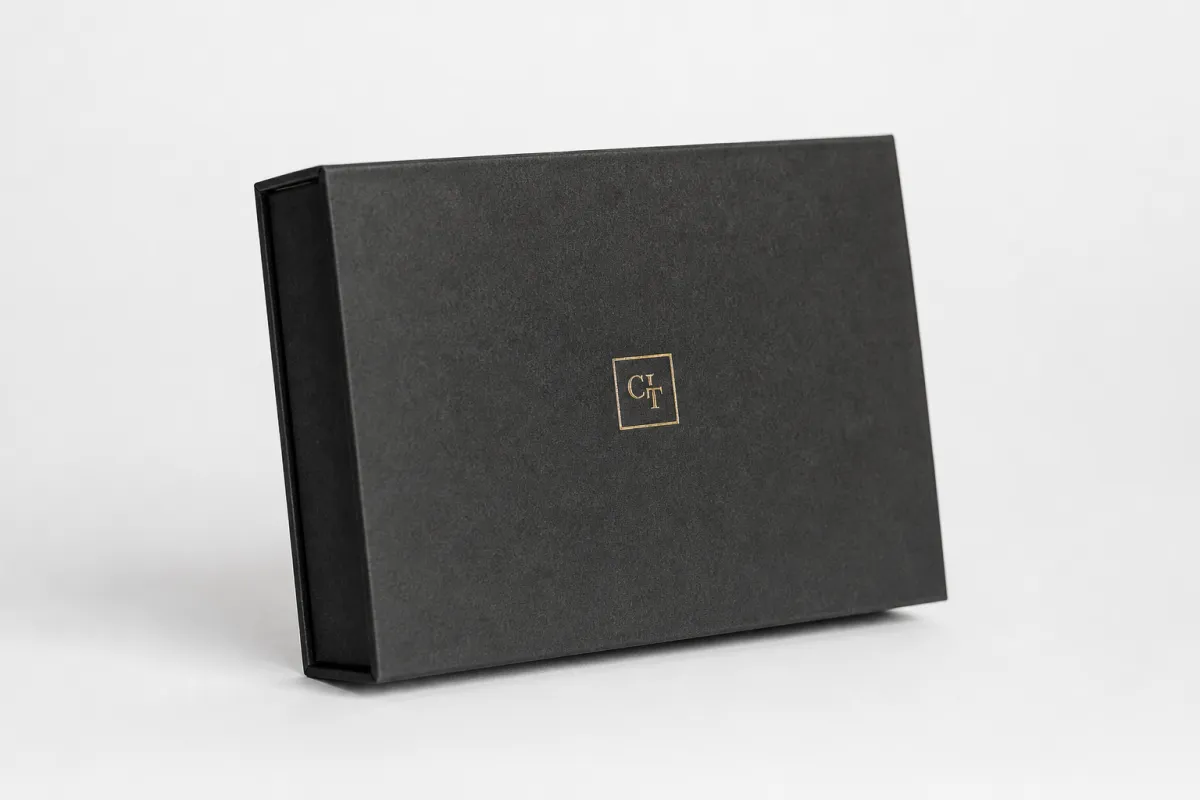
Custom Rigid Boxes with foil stamping stand out because foil reflects light differently from the surrounding surface. That contrast pulls the eye almost immediately. Gold on matte black, silver on soft white, copper on warm kraft, or a restrained emblem on textured stock all communicate value without a long explanation. People do not need to analyze the box to know it feels special. They just feel it.
The structure matters just as much as the shine. A rigid box with dense board, tight corners, and a clean wrap can look expensive with very little decoration. A weak board or sloppy wrap does the opposite. I have seen brands spend heavily on foil coverage and still end up with packaging that looked tired because the box flexed in transit or the logo missed center by a few millimeters. On premium packaging, small errors are loud. They read like bad tailoring.
Rigid packaging is usually built from chipboard or greyboard around 1.5mm to 3mm thick, depending on the product, the format, and how much heft the brand wants the customer to feel. Folding cartons ship flat. Rigid boxes are built first, wrapped second, then finished. That extra labor changes how the customer interprets the box. The weight, the closure, the sound of the lid, and even the resistance of the surface all influence perceived value. In retail, that matters more than most teams want to admit.
“A foil box only looks expensive when the structure supports it. If the board sags or the logo is off, the foil just makes the flaw easier to notice.”
Gift sets, fragrance, skincare, watches, collectibles, and premium confectionery tend to benefit the most from custom rigid boxes with foil stamping. Limited-edition launches also do well with this format because foil can turn a standard package into something event-like without rebuilding the entire box architecture. If the brand needs packaging that can be seen from a few feet away and still feels worth keeping, foil on a rigid box is a strong choice.
Simple art usually beats crowded art. One emblem, one wordmark, or a single focal panel often looks richer than a surface packed with tiny lines and competing effects. Foil is precise by nature. Precision gets lost when the layout is busy. Give the mark room to breathe and the finish will carry more authority. That is one reason custom rigid boxes with foil stamping often outperform louder, cluttered packaging designs that try too hard.
How Custom Rigid Boxes with Foil Stamping Work
To understand custom rigid boxes with foil stamping, split the box into layers. The base is chipboard or greyboard. A printed or unprinted wrap is glued to that board. Then a heated die transfers foil onto selected areas using pressure and timing. Every layer affects the next one. A textured wrap can soften detail. A board that is too soft can blur the impression. Adhesive applied unevenly can leave ripples, lifted corners, or a lumpy surface that shows through at the end.
The anatomy of the box
Most rigid packaging uses chipboard between 1.5mm and 3mm thick, depending on size, strength needs, and how much heft the brand wants the customer to feel. The outer wrap may be 157gsm art paper, coated stock, specialty paper, soft-touch laminated paper, or a textured sheet chosen for a more tactile retail finish. Inside, the box may hold a paperboard insert, molded pulp, foam, or a tray that keeps the product from shifting. The structure has to hold shape before the foil goes on. Foil follows the surface. It does not rescue a bad one.
How hot foil stamping is applied
The most common method for custom rigid boxes with foil stamping is hot foil stamping. A metal die is engraved with the artwork, usually brass when detail needs to stay crisp. Heat softens the foil film, pressure transfers it to the wrap, and the die leaves a clean mark where the foil bonds. The process sounds straightforward on paper. In production, each variable matters. Temperature, pressure, dwell time, and the paper surface all influence the final result.
Here is the basic production flow:
- The artwork is separated into foil layers and matched to the dieline.
- A foil die is made from the approved vector file.
- The box wrap is printed or prepared in the selected stock.
- The foil press applies heat and pressure to the mapped area.
- The foil area is inspected for edge clarity, adhesion, and alignment.
That inspection step is where many projects succeed or stall. If the logo sits too close to a fold, the foil can crack where the board bends. If the surface is deeply textured, edges can look broken. If embossing is part of the design, alignment has to be tighter still because the stamped area and the relief need to reinforce each other instead of fighting for attention.
Hot foil, cold foil, and finish combinations
Cold foil can work well on certain runs, especially when the job calls for faster transfer or broader metallic coverage. Still, hot foil usually looks sharper on custom rigid boxes with foil stamping because the edge definition feels more deliberate on thick packaging. For luxury branding, that detail matters. It signals care before the box is even opened.
Common finish combinations include foil plus emboss, foil plus deboss, and foil on matte or soft-touch wraps. Those combinations can look exceptional, but only if the substrate cooperates. A smooth black wrap may produce a bright gold mark with high reflectivity. A textured white wrap can mute the same gold and make it feel aged. Silver may read crisp on one surface and flat on another. The same foil can behave like a different material depending on the wrap underneath. Samples are the honest answer, even if nobody loves hearing that.
For brands comparing options, this is the point where custom rigid boxes with foil stamping separate themselves from ordinary custom printed boxes. The finish is not decorative garnish. It is a physical production process with a measurable outcome. Material choice, machine setup, and real-world lighting all affect the result. If packaging has to survive close inspection, the finish has to be treated as engineering, not just art direction.
Custom Rigid Boxes with Foil Stamping Cost and Pricing
Pricing for custom rigid boxes with foil stamping usually comes down to five variables: box size, board thickness, wrap material, foil coverage, and finish complexity. Once inserts, magnets, ribbons, window cutouts, or embossing enter the spec, the quote changes again. That is normal. Buyers run into trouble when they compare a stripped-down sample quote with a fully loaded production spec and act surprised when the numbers do not line up. The quote was never for the same box.
Setup costs matter too. Smaller runs feel expensive because the die, setup, proofing, and machine adjustment are spread across fewer units. A foil die can be minor on a larger order and significant on a short one. Depending on artwork and vendor, setup fees for custom rigid boxes with foil stamping may land somewhere around $100 to $500 or more across tooling, plates, and proofing. Simple dies cost less. Oversized dies, layered artwork, and embossing push the number up.
Per-unit pricing usually drops as quantity rises. A run of 300 to 500 rigid boxes with a basic foil logo and standard wrap might sit in the $3.50 to $8.00 range per unit. At 1,000 units, many buyers see figures closer to $1.80 to $4.50 per unit. Larger runs can fall lower, though only if the spec stays disciplined. Add extra foil panels, special inserts, or elaborate closures and the cost climbs again. Packaging math is not sentimental, and it is not always kind either.
| Order Size | Typical Build | Approx. Unit Range | Best For |
|---|---|---|---|
| 300-500 units | Standard rigid box, single foil logo, basic wrap | $3.50-$8.00 | Sampling, small launches, seasonal gift sets |
| 1,000 units | Rigid box with foil plus optional emboss or insert | $1.80-$4.50 | Mid-size retail packaging runs |
| 3,000-5,000 units | Optimized structure, limited foil coverage, streamlined insert | $0.95-$2.80 | Established product lines and repeat orders |
That table is a range, not a promise. Real quotes depend on how the vendor builds the box, where the product ships, and whether the artwork is prepared correctly. If two quotes look wildly different, compare them line by line: dimensions, board grade, wrap type, foil coverage, insert style, closure method, sample costs, and shipping assumptions. Half the time, the lower number simply removed something important and hoped nobody would notice.
If you want to save money without weakening the design, reduce foil area before you reduce board quality. A tight logo lockup on one or two panels often looks cleaner than covering every surface in metallic decoration. Simplify the art too. Tiny text, detailed borders, and multiple foil colors all add setup time and risk. Spend where the customer looks first: the lid, the brand mark, and the opening side. That gives custom rigid boxes with foil stamping the strongest return on each dollar.
One more buying note: ask for comparable work in the same wrap and foil combination. A polished sales deck can hide a lot. custom rigid boxes with foil stamping can look very different across materials, and a real sample tells you faster than any spreadsheet whether the quote is realistic or just optimistic.
Custom Rigid Boxes with Foil Stamping Process and Timeline
The production path for custom rigid boxes with foil stamping is clear on paper and opinionated in practice. A clean project usually moves through brief, dieline, artwork prep, foil proofing, sampling, approval, mass production, packing, and delivery. Miss one decision early, and the job can slip a week because somebody noticed the logo was facing the wrong direction after the die had already been made. That kind of delay is common enough to be almost ordinary.
Typical timeline stages
A realistic schedule often looks like this:
- Brief and spec review: 1-2 business days if dimensions, quantity, and finish notes are ready.
- Dieline and artwork prep: 2-5 business days, longer if the layout is not final.
- Foil die creation and proofing: 2-4 business days for simple jobs, more for complex marks.
- Sampling or physical proof: 4-7 business days, depending on material availability.
- Production: often 10-18 business days after approval for standard runs.
- Packing and shipping: varies by destination and freight method.
So yes, the project can move quickly if everything is locked. It can also stretch if someone changes the foil color on day four because the brand wanted one more option. That is why firms producing custom rigid boxes with foil stamping usually ask for final dimensions, final quantities, and final artwork before they reserve a production slot. They are not being difficult. They are avoiding a remake because a logo moved six millimeters.
What slows a project down
The delays are predictable: vague specs, changing box dimensions, late logo edits, and indecision about foil placement or foil color. Approval chains can drag too. If the buyer has to route a sample through marketing, procurement, retail, and a founder who likes to redraw things in pen, the timeline drifts fast. A physical sample beats a week of email debate every time.
To shorten turnaround, send vector artwork, final measurements, foil color preferences, and a clear note on whether the box needs embossing, inserts, ribbon pulls, or interior printing. If you already have a product sample or an accurate product photo, include that too. It helps the box maker confirm fit before any cutting starts. For shipping performance, ask whether the final pack should be checked against ISTA test protocols if the product will move through e-commerce or rough freight handling. For sustainable sourcing, paperboard options that carry FSC certification give procurement teams a cleaner paper trail.
Before approval, use a handoff checklist:
- Final box dimensions and closure style
- Exact foil placement and foil color
- Wrap material and finish type
- Insert requirements and interior print notes
- Target quantity, shipping address, and deadline
- Artwork files in vector format with outlined fonts
That checklist is basic, but it saves money. It also keeps custom rigid boxes with foil stamping from turning into a round of “that is not the logo we approved.” Nobody wants that meeting. Nobody.
Key Factors That Make or Break the Finish
The finish on custom rigid boxes with foil stamping is only as strong as the weakest variable in the stack. Artwork complexity is the first problem area. Thin lines, tiny type, compressed lettering, and dense logos are the quickest route to a muddy result. A useful rule: if the foil element is too fine to read at arm’s length on screen, it is probably too fine for production unless the vendor confirms otherwise. That is a good place to be cautious instead of optimistic.
Artwork and placement decisions
Placement changes the experience more than most people expect. A centered logo on the lid is the safest route. Edge placement can feel sharper, but it carries more risk because folds, corners, and seams can interfere with the stamp. Repeated patterns can look rich, yet they also increase the chance of uneven coverage. If the goal is luxury branding, one bold focal point usually beats three competing accents. That is true for custom rigid boxes with foil stamping and for most packaging decisions that try too hard.
Foil color and wrap color need to work together. Gold on matte black is the classic choice because the contrast is immediate and the result reads premium even in dim light. Silver on white can feel restrained and modern. Rose gold can read warm and cosmetic, though it can shift pink if the wrap is too cool. Black foil on a lighter textured stock can be elegant, but it will not shout. That can be exactly right for heritage branding or a quieter product line.
Material and structure quality
Board quality matters more than buyers often want to acknowledge. A beautiful foil stamp still looks rough if the substrate dents, buckles, or scuffs during wrapping. Corners must stay clean, wrap tension must stay even, and adhesive must hold without staining the surface. Soft-touch laminations can look excellent, but the press settings need to be tuned because the coating changes how the foil bonds. Textured wraps can look rich, though the artwork should be simpler because the texture can soften detail.
Structural extras change the finish too. Magnetic closures, ribbon pulls, custom inserts, and embossing all add value, but they also add production complexity. embossing paired with foil can look excellent on a hero logo, especially when the relief stays modest and the foil lands cleanly on top. Push the effect too far and the box starts looking fussy. Keep it too small and the detail disappears. The sweet spot is one strong gesture, not a scrapbook.
For brands comparing retail packaging options, this is where custom rigid boxes with foil stamping outperform many standard product packaging formats: the structure supports a more deliberate visual hierarchy. The box feels important before the customer sees the product. That feeling is not accidental. It comes from precise die cutting, controlled wrapping, and finish choices that still hold up under real light, not just on a rendering.
Common Mistakes With Custom Rigid Boxes with Foil Stamping
The easiest mistake is overdoing the foil. If every panel is shouting, nothing feels premium anymore. The box turns into a shiny speech bubble. One strong foil moment is usually enough. The rigid structure already carries presence, so custom rigid boxes with foil stamping do not need metallic noise on every side.
Art mistakes that wreck the result
Tiny type causes trouble fast. Fine lines, small captions, and dense icon sets can disappear once the stamp hits the press. What looked elegant on a laptop becomes muddy on board. If a logo has hairline strokes, ask the vendor whether the die can hold them at the chosen size. Slightly thicker is usually safer than discovering too late that the line vanished into the wrap texture.
Skipping a physical sample is risky. Screen mockups do not show how light moves across foil, how the wrap absorbs pressure, or how the finish looks in a warehouse compared with a storefront. I have seen buyers approve a design that looked perfect on a monitor and then wonder why the gold felt dull in person. Screens are useful. They are also liars.
Buying mistakes that inflate cost
The lowest quote is often the most expensive mistake. Some vendors cut board quality, reduce foil coverage, simplify the structure, or relax tolerances to hit the number. If the specs are not compared line by line, a buyer can end up paying twice: once for the weak run, and again for the replacement. Ask for clear specs so you can compare custom rigid boxes with foil stamping on board thickness, wrap stock, foil type, insert material, and shipping assumptions.
Another mistake is trusting only the digital proof. A polished render can hide registration problems, surface texture, and sheen differences. Real light exposes them fast. So does a production sample. If the supplier cannot provide one, ask what testing they use internally and how they check registration. A good packaging partner will have a process. A weak one will have confidence and not much else, which is usually a warning sign.
From a packaging buyer’s point of view, the goal is simple: reduce risk before mass production. That means checking the finish under natural light, reviewing edges and corners, and confirming that the foil looks sharp where the product will actually be handled. custom rigid boxes with foil stamping are too visible to wing it.
Expert Tips Before You Order Custom Rigid Boxes with Foil Stamping
Keep the design focused. One strong visual moment is usually enough. A logo, a short brand line, or a single icon with foil can carry more perceived value than a box loaded with decorative noise. If the product is premium, let the materials and construction speak first. That is what they are there for. custom rigid boxes with foil stamping work best when the design respects negative space.
Match the finish to the brand position
Use bright metallics for louder luxury and softer metallics for restrained or heritage branding. Gold is not automatically better than silver, and matte black is not automatically the right answer just because it appears in half the mood boards floating around. Sometimes champagne foil on warm white wrap feels richer than mirror-bright foil. Sometimes a subtle tone is more credible than flash. The choice should follow the product and the audience, not a design cliché.
Ask for real samples, not just renders. If the vendor can show a foil swatch on the same wrap or a comparable stock, take it. Better still, compare two or three combinations side by side under the lighting where the box will actually be sold or opened. A finish that looks dramatic under one lamp may look flat under another. Packaging has a way of humbling assumptions, which is useful if you let it.
Lock the spec before quoting
Before requesting quotes for custom rigid boxes with foil stamping, lock the dimensions, quantity, insert needs, closure style, foil color, and wrap finish. If you also need trays, mailers, sleeves, or related Custom Packaging Products, decide that early so the vendor can price the whole system, not just the box shell. Late changes are where budgets go missing quietly.
It also helps to ask which parts of the project are standard and which are custom. Standard board sizes, common foil colors, and simple lid styles are easier to price. Custom molds, complex inserts, and multi-step finishing add cost and time. If the goal is a controlled launch, simplicity is often the smarter luxury move. Not flashy. Just smart.
One last practical note: if the box will ship individually, ask for transit protection and testing recommendations. For heavier products, a box that looks beautiful but scuffs in freight is not a win. custom rigid boxes with foil stamping should look good on the shelf and survive the ride there. That is the actual job, and it is the part people sometimes forget while chasing the shine.
Custom rigid boxes with foil stamping are worth the effort when the brand needs a stronger first impression, but the best results come from careful specs, clean artwork, and realistic expectations about cost and timing. Treat custom rigid boxes with foil stamping as a production system instead of a pretty surface, and the box will do what it should: make the product look worth opening, keeping, and remembering. The practical takeaway is simple: choose one clear focal point, confirm the material in a real sample, and lock the spec before the first die is made. That is how the finish stays sharp from render to shelf.
What foil type works best for custom rigid boxes with foil stamping?
Hot foil usually gives the sharpest edge and the most controlled finish on rigid packaging. The right choice still depends on the wrap texture, artwork detail, and the look you want under real lighting. Ask for foil samples on the same stock before you approve the final run of custom rigid boxes with foil stamping.
How much do custom rigid boxes with foil stamping usually cost per unit?
Unit price depends on size, quantity, board thickness, foil coverage, and extras like embossing or inserts. Smaller orders usually carry higher unit costs because setup gets spread across fewer boxes. Compare the same dimensions, board grade, and finish details or the numbers will not mean much for custom rigid boxes with foil stamping.
How long does the custom rigid boxes with foil stamping process take?
The timeline usually includes dieline prep, artwork approval, foil proofing, sampling, production, and shipping. Changes to artwork, dielines, or foil placement are the most common delay. If you send final files early and approve samples quickly, custom rigid boxes with foil stamping can move a lot faster.
Can you combine embossing with custom rigid boxes with foil stamping?
Yes. The combination can look excellent when it is used on one focal logo or mark. It does add setup complexity, and alignment becomes more important. Always test embossing on the final wrap material, not just on a screen mockup, before moving ahead with custom rigid boxes with foil stamping.
What should I prepare before requesting a quote for custom rigid boxes with foil stamping?
Have final dimensions, quantity, artwork files, foil color preferences, and finish notes ready. Include whether you need inserts, magnets, ribbons, or interior printing. A tighter spec sheet gives you a faster, more accurate quote for custom rigid boxes with foil stamping, which saves everyone from guessing.

