Buyer Fit Snapshot
| Best fit | Custom Roll Labels Price projects where brand print, material claims, artwork control, MOQ, and repeat-order consistency need to be specified before quoting. |
|---|---|
| Quote inputs | Share finished size, material target, print colors, finish, packing count, annual reorder estimate, ship-to region, and any compliance wording. |
| Proofing check | Approve dieline scale, logo placement, barcode or warning zones, color tolerance, closure strength, and carton packing before bulk production. |
| Main risk | Vague material claims, crowded artwork, missing packing details, or unclear freight terms can make a low unit price expensive after revisions. |
Fast answer: Custom Roll Labels Price: Material, Adhesive, Artwork, and MOQ should be specified like a repeatable production item. The safest quote records material, print method, finish, artwork proof, packing count, and reorder notes in one written spec.
Production checks before approval
Compare the actual filled-product size with the drawing, then confirm tolerance on folds, seals, hang holes, label areas, and retail display edges. Reserve space for logos, QR codes, warning copy, and material claims before decorative graphics fill the panel.
Quote comparison points
Review material grade, print process, finish, sampling route, tooling charges, carton quantity, and freight assumptions side by side. A quote is only useful when the supplier can repeat the same color, closure quality, and packing count on the next order.
Two brands can order the same 3 x 2 inch roll label and still end up with wildly different quotes. That gap usually has nothing to do with luck. custom roll labels price shifts because of material, adhesive, finish, roll specs, and how the labels need to run on the line.
A label is more than a printed sticker. It has to feed cleanly, release at the right speed, stick to the right surface, and hold up in the product’s real environment. Pick the wrong roll format and the labels jam. Pick the wrong adhesive and they lift. Choose stock just because it looks cheap and the reprint bill tends to show up later, wiping out the savings. I have seen that story play out more than once, and it never ends well.
Roll labels earn their place for practical reasons. They move faster for hand application than sheets, they fit applicators better, they keep inventory cleaner, and they cut down on labor headaches in packaging operations that care about speed and repeatability. For branded packaging, product packaging, retail packaging, and even smaller runs of custom printed boxes paired with labels, the right roll label spec often pays back through fewer mistakes. The real task is simple: understand what drives custom roll labels price so you can budget with confidence and ask for a quote that actually means something.
Custom Roll Labels Price: Why Quotes Swing So Much
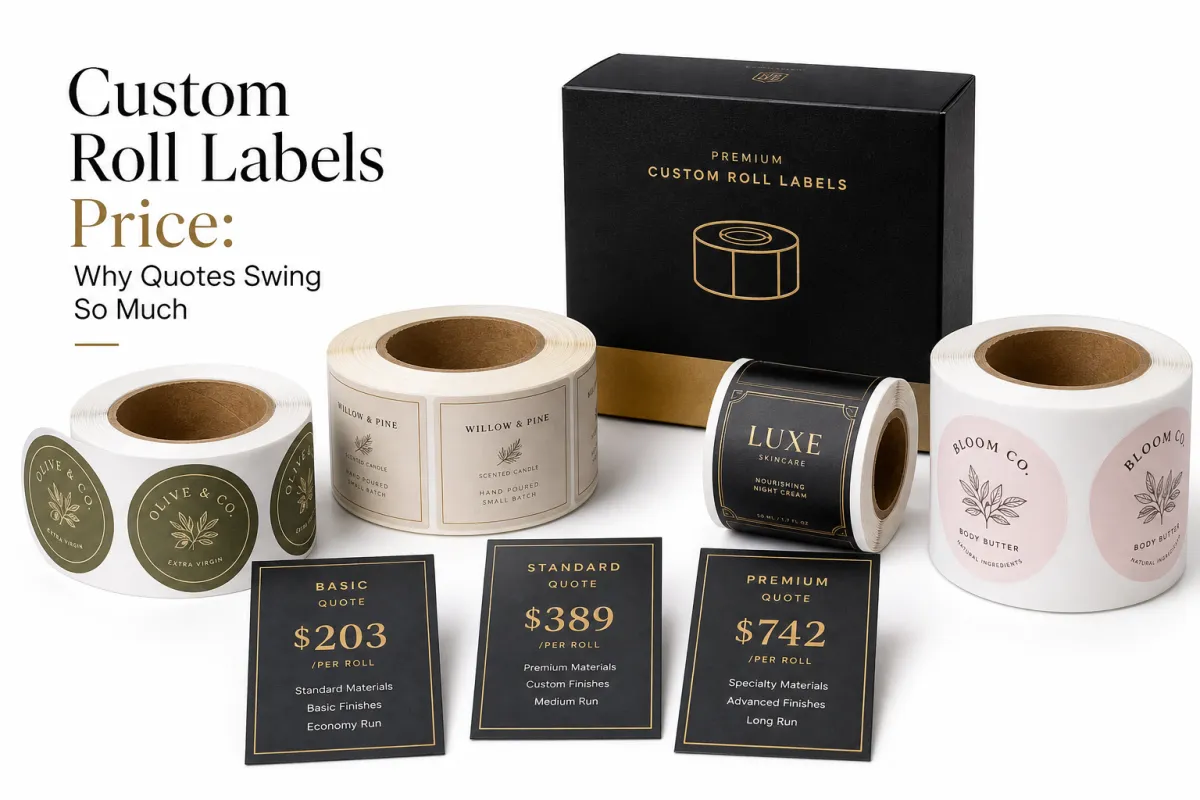
The short answer is plain: custom roll labels price is not a random number. It reflects material choice, press setup, finishing, die cutting, roll configuration, and the handling required to ship a roll that behaves the way you need it to behave. Two jobs can share the same size and artwork count and still land in very different price bands because one is built for a dry shelf product while the other has to survive condensation, cold storage, or repeated handling.
Picture two beverage brands ordering 5,000 labels each. Both want a 4 x 3 inch format. One chooses coated paper with a simple gloss finish for dry indoor use. The other wants white BOPP with a high-tack adhesive, a tighter roll count, and a specific unwind direction for an applicator. The second quote will usually cost more, and the reason is easy to trace. The material is different, the production path is different, and the risk of failure drops only if the spec matches the actual use.
Roll labels also affect operations. A cheap label that peels at the corners creates labor waste, customer complaints, and rework. A roll wound in the wrong direction can stall an applicator and burn time on the line. A label that fades in shipping or under refrigeration can force a reprint before the first sell-through cycle is finished. Once downtime, wasted product, and rush freight enter the picture, the “cheap” option often costs more. That is why I always tell buyers to look at total outcome, not just the first number in the quote.
custom roll labels price also changes based on whether the job is hand-applied or machine-applied. Hand-applied labels allow a little more flexibility. If the core size is standard and the roll count is reasonable, there is room to trim cost. Machine-applied labels are stricter. The roll has to feed consistently, the unwind direction matters, and the outside diameter has to fit the applicator limits. Those checks take time and reduce the room for sloppy assumptions.
A low quote only helps if the labels arrive in the right format, hold on the product, and do not force a second order next month. Cheap failures are expensive, and buyers usually learn that the hard way.
Timing changes the picture too. Rush orders compress production and narrow material choices. Specialty films, custom coatings, and unusual die cuts may need more handling. If you are comparing multiple suppliers, ask whether they are quoting the same material, the same roll count, the same finish, and the same application method. If not, custom roll labels price comparisons are just noise in a clean-looking spreadsheet.
For brands building package branding across a product line, labels often sit beside other packaging choices such as sleeves, cartons, inserts, and Custom Packaging Products. The label should be judged as part of that larger system. A slightly higher priced label that improves shelf presentation, reduces errors, and matches the rest of the packaging design is often the better buy. A bargain label that creates inconsistency is not a bargain.
Custom Roll Labels Price Breakdown: Materials, Adhesives, and Finish
Material is usually the first place custom roll labels price shifts. Paper is the lower-cost option for dry goods, short shelf life, and indoor use. It prints nicely, feels familiar, and works well for products that are not exposed to moisture, refrigeration, or abrasion. BOPP and other film stocks cost more, but they bring durability. If the label needs to survive condensation on beverage bottles, bathroom shelves, refrigerated cases, or frequent handling, film is usually the safer choice.
Adhesive changes the math as well. Permanent adhesive is the default for most products because it is dependable and broadly useful. Removable adhesive matters for short-term promotions, sample packs, or containers that need clean removal. Freezer adhesive and high-tack adhesive show up on cold-chain goods, textured surfaces, or packaging that is difficult to bond. The wrong adhesive can turn a clean-looking label into a curling-edge problem, and that usually means custom roll labels price only looked low because the quote ignored the real use case.
Finish is where branding and cost meet. Gloss adds pop and makes colors feel sharper. Matte softens the look and often suits premium, natural, or minimalist branding. Soft-touch and specialty coatings add a more tactile feel, but they also add cost and production steps. Uncoated stock is practical for utility labels or applications where write-in space matters. In packaging design, finish is not just decoration. It changes how the label catches light, how readable the type is, and how the product presents on shelf.
Surface compatibility matters more than most buyers admit. Glass jars, HDPE bottles, PET containers, corrugated mailers, flexible pouches, and coated cartons do not all behave the same way. A paper label can work beautifully on a dry carton and fail on a chilled bottle. A film label can handle moisture well but may be unnecessary on a simple dry product. The smartest custom roll labels price decision is usually the one that fits the actual substrate instead of the one that merely sounds cheapest in a quote thread.
For brands trying to keep materials aligned with sourcing goals, paper stocks can sometimes support FSC-certified options. If that matters to your brand story or retail requirements, it is worth checking the chain-of-custody details at FSC. That is not window dressing; it is a procurement detail. If the claim matters, the paperwork matters too.
| Option | Typical Use | Relative Cost | Practical Notes |
|---|---|---|---|
| Paper, gloss | Dry goods, cartons, short-run retail packaging | Lower | Good print pop, not ideal for moisture or abrasion |
| Paper, matte | Natural brands, write-in labels, utility packaging | Lower to moderate | Softer look, better for readable text and simple branding |
| White BOPP | Bottles, jars, refrigerated items, soaps | Moderate | Durable, moisture resistant, strong all-around option |
| Clear BOPP | Minimalist packaging, premium product labeling | Moderate to higher | Lets the container show through, but artwork needs clean contrast |
| Specialty finishes | Premium retail packaging and branded launches | Higher | Better shelf impact, more setup and finishing cost |
The tradeoff is simple. The lowest cost stock is not always the lowest cost outcome. If a paper label needs to be replaced twice because the product sweats, the custom roll labels price you thought you saved gets eaten by reprint costs, labor, and freight. Buyers focused on retail packaging usually figure that out quickly. The label has to look good, but it also has to behave.
Material selection should also connect to the rest of the packaging system. A premium jar label may need to match a carton, a sleeve, or a shipper used in branded packaging. If the label is the only piece that feels cheap, customers notice. If you are pairing labels with Custom Labels & Tags, keep the stock and finish decisions aligned so the line feels intentional rather than pieced together.
From a packaging buyer’s point of view, the best way to control custom roll labels price is to decide what the label must survive, then work backward. Shelf life, temperature, moisture, handling, and brand positioning all matter. That order of operations saves money because it avoids under-specifying the label or paying for a premium feature you do not need.
Specifications That Change the Price Before Printing Starts
Most quote surprises happen before ink hits the substrate. custom roll labels price depends heavily on the spec sheet, and a spec sheet only works if it is complete. Size is the obvious piece. A larger label uses more material, more ink, and often more finishing attention. Shape matters too. A simple rectangle is easy. A circle is still straightforward. A custom die shape with tight corners, intricate cut lines, or unusual proportions can increase setup and finishing time.
Roll configuration matters just as much. Buyers Need to Know label quantity per roll, core size, outside diameter, and unwind direction. If the labels are for hand application, the roll can often be sized for convenience and shipping efficiency. If they are for an automatic applicator, the roll needs to fit the machine exactly. A wrong core or unwind direction may seem minor on paper, then cost a half day of troubleshooting on the line. That is a rough way to learn custom roll labels price is tied to production reality, not just artwork.
Artwork coverage affects the quote in practical ways. Full-bleed, high-coverage designs can require more ink and more careful color control. That does not mean you should avoid bold graphics. It means you should know they are not free. Narrow type, fine detail, and layered gradients can also increase proofing attention, especially if color accuracy matters for package branding. If your labels need to match a set of custom printed boxes or a wider product packaging system, consistency matters more than shaving a corner off print complexity.
Print method is another major variable. Digital printing is common for short runs, fast changes, and variable data. It usually has a setup advantage for lower quantities. Flexographic or similar production methods make more sense at higher volumes where the per-unit cost can drop once setup is spread across enough labels. That is why custom roll labels price changes so much as quantity rises. The press time, tooling, and finishing setup are not the same at 500 labels and 50,000 labels.
Application method can shift the whole spec. Hand-applied labels tolerate a little more flexibility. Machine-applied labels need stricter consistency. If the roll is going through an applicator, the labels have to separate cleanly, track evenly, and behave predictably under tension. That is not a luxury detail. It is part of the job the label is expected to do.
There is also the quality side. Reputable suppliers usually work from proof approval, not guesses. If you want the quote to be useful, send accurate dimensions, art size, quantity, and a clear note on whether the labels will be hand-applied or machine-applied. A quote without those details is usually a rough estimate, and rough estimates can make custom roll labels price look better or worse than it really is.
For buyers who care about shipping performance, it helps to remember that labels are part of the package journey too. If the product will travel through rougher distribution, testing resources like ISTA are worth knowing. They do not price your labels, but they do reinforce a simple point: packaging has to survive the trip, not just the photo shoot.
Costs, MOQ, and Quote Inputs for Custom Roll Labels
Let’s break the number down without the sales fog. custom roll labels price usually includes material, adhesive, print method, finish, size, quantity, roll configuration, and shipping. If a quote leaves out one of those pieces, the buyer should ask questions before comparing it to anything else. A good quote is a matched spec, not a polite guess.
MOQ stands for minimum order quantity, and it exists for a practical reason. There is setup work, file checking, press preparation, finishing, slitting, rewinding, and packing. A very small order still has to go through those steps. That is why the per-unit cost is often higher at lower quantities. The setup burden gets spread across fewer labels, so custom roll labels price rises. That is not a trick. It is production math.
Here is how the scale usually behaves. Smaller runs cost more per label. Mid-size runs often hit a better balance between cash flow and efficiency. Larger orders usually lower the unit cost and cost per thousand labels, but they also tie up more cash and take more storage space. There is no magic number that works for every brand. A startup shipping 200 orders a month has different needs than a brand that burns through labels weekly. Smart buying is about matching quantity to usage, not chasing the biggest pallet just because the unit cost looks prettier.
If you want an accurate quote, send the basics in one clean package:
- Label size and shape
- Artwork file or clear design reference
- Total quantity needed
- Material preference
- Finish preference
- Adhesive type
- Roll count, core size, and unwind direction if known
- Hand-applied or machine-applied use
That list sounds basic because it is. It also prevents quote drift. If the supplier has to fill in missing details, they usually quote conservatively. Conservative quoting is not a punishment; it is risk management. Even so, it can make custom roll labels price look higher than it needs to be if the buyer never supplied the right info in the first place.
The best buyers also separate quote variables before asking for price. Compare paper versus BOPP. Compare gloss versus matte. Compare standard permanent adhesive versus freezer adhesive. Compare 2,500 pieces versus 10,000 pieces. That is the only clean way to see where the money is going. Otherwise you are comparing apples to oranges and calling it sourcing strategy.
Here is a practical range example for a common small-to-mid run label, just to make the math less abstract. A simple paper label might land in a lower band, while a white BOPP version with stronger adhesive and more careful finishing could cost meaningfully more per unit. Add specialty finish or tighter roll specifications, and custom roll labels price moves again. Exact numbers depend on artwork coverage, quantity, and application needs, but the pattern stays the same.
Buying decisions are easier when you view labels as part of the broader retail packaging equation. A premium label on a weak bottle, a great carton with a bad closure, or a clean label system with sloppy inventory discipline all create friction. If you need a wider packaging mix, start with Custom Packaging Products and build the label spec around the rest of the line instead of forcing the line to adapt to a bad label choice.
One more note on value. If you only look at the lowest custom roll labels price, you may buy more labels than your shelf life supports, or fewer labels than your demand actually needs. Either way, cash gets trapped. The better move is to pick a quantity that matches your sales pace and storage reality, then optimize the spec from there.
Process, Timeline, and Production Steps for Roll Labels
The production path is straightforward if the files are clean. It usually starts with inquiry, then file review, then proof approval, then production, finishing, packing, and shipment. Each step affects custom roll labels price a little because it changes labor, material handling, and scheduling. The smoother the front end, the less friction later. That is true in label printing, carton printing, and almost every packaging job that depends on precise specs.
File issues slow things down more than almost anything else. Missing dimensions, low-resolution artwork, unclear cut lines, and uncertain color expectations create back-and-forth. Late proof changes can also trigger extra checks, especially if the art affects size, bleed, or die placement. Buyers sometimes think the printer is holding things up. The truth is usually less dramatic: the quote cannot turn into a production order until the proof is approved. That delay matters because it can push the job into a different production window and affect custom roll labels price if rush handling is needed.
Typical lead time depends on complexity and load. Simple digital jobs can move faster because the setup is lighter and the print path is shorter. Larger runs, specialty materials, and custom finishes take longer because they involve more steps and more verification. I would rather see a realistic lead time than a shiny promise. A buyer can plan around a 10 to 15 business day window. A buyer cannot plan around wishful thinking.
Proofing deserves its own place in the process. A proof is not just a courtesy PDF. It is the chance to confirm layout, size, colors, copy, barcode placement, and roll direction before production starts. Once labels are printed, a mistake becomes expensive fast. Reprints are the quickest way to blow up a clean budget. That is why proof approval is one of the simplest ways to control custom roll labels price.
Rush jobs are possible, but they come with tradeoffs. Faster turnaround often narrows the material options, reduces schedule flexibility, and can increase cost. If you need a quick reorder, keep the spec unchanged and reuse the same approved file whenever possible. Reorders are where consistency saves money. New artwork, new material, and new roll specs all invite extra time and extra expense.
There is a useful standard here too: packaging and transport should be tested, not assumed. If your labels are part of a broader shipping program, keep an eye on shipping durability standards and lab methods. Organizations such as ISTA are good reference points for distribution testing. They will not tell you the exact custom roll labels price, but they do reinforce the point that packaging failures are usually discovered in transit, not in a sample photo.
Good suppliers reduce risk by keeping the process clear. They should explain proof timing, production steps, and delivery expectations without forcing you to decode every line. When the workflow is clear, the quote becomes easier to trust. That trust matters, because the cheapest order in the world is useless if it arrives late, wrinkled, or wound wrong.
Why Choose Us for Custom Roll Labels
Customers usually want three things: fair pricing, reliable quality, and fewer surprises. That is the real value behind custom roll labels price. Not the headline number. The total experience. A quote should be understandable, the proof should make sense, and the finished roll should match the application method without drama. If a supplier cannot explain those basics, the price is not the problem. The process is.
At Custom Logo Things, the practical value lives in the details that keep projects moving. Clear specs matter. So does roll consistency. So does honest guidance on adhesive and material selection. A label intended for refrigeration should not be sold like a dry-goods sticker just because the latter is easier to print. That kind of shortcut creates waste. Better to make the right call early and keep custom roll labels price aligned with the actual use case.
Strong packaging suppliers help reduce three expensive problems: reprints, feeding issues, and reorder confusion. Reprints happen when the file or spec is wrong. Feeding issues happen when the roll is not built for the applicator or hand-applied workflow. Reorder confusion happens when the first job was not documented well enough to repeat cleanly. A good supplier prevents all three. That is worth more than shaving a tiny amount off the quote and hoping for the best.
Different buyers also need different service levels. Startups often need low MOQ options and a little more guidance. Growing brands usually care about repeatability and better unit cost at moderate volume. Established lines want stable pricing, exact roll specs, and dependable turnaround on reorders. The same custom roll labels price conversation looks different for each buyer, and it should. One-size-fits-all quoting is lazy. It also tends to miss the real business need.
We also understand that labels do not live alone. They sit inside a bigger package system with cartons, mailers, inserts, and shelf presentation. If your labels support product packaging or retail packaging, the label has to match the brand story rather than fight it. That is where smart packaging design shows up. Not in fancy language. In results.
Buyers who need more than labels often want a partner who can think across the entire packaging stack. That is where Custom Labels & Tags fit naturally, and where the rest of the sourcing process becomes easier instead of more fragmented. The point is not to sell more things. The point is to keep the spec consistent so your order does not splinter into mismatched pieces.
If you want an exact custom roll labels price, the goal is not a vague “starting at” number. The goal is a quote tied to your size, material, finish, quantity, and application method. That is the only number that can actually guide a buying decision.
Next Steps to Get the Best Custom Roll Labels Price
The fastest way to improve custom roll labels price is to send complete specs the first time. Start with label size, quantity, finish, material, adhesive, roll count, core size, and whether the labels will be hand-applied or machine-applied. If you already know the unwind direction, include it. If you do not know it, say so. A good supplier can help you sort that out before production starts.
Then compare quotes on the same exact spec sheet. That sounds obvious, but it is where most shopping mistakes happen. One supplier quotes paper, another quotes BOPP, and a third quietly changes roll count. The numbers look different, and the buyer assumes someone is overpriced. Usually the real issue is that the quotes are not equivalent. custom roll labels price only becomes meaningful when the specs are identical.
Ask for a proof. Ask what is included. Ask whether shipping, packaging, and any setup charges are in the number. Those are not annoying questions. They are normal purchasing questions. Clear answers reduce friction later. They also keep the final invoice closer to the quoted amount, which is refreshing in a field where small assumptions can snowball.
If you need to choose in stages, use this order: material first, finish second, quantity third. Material determines durability and the basic cost structure. Finish affects shelf appearance and print feel. Quantity controls unit economics and storage pressure. That sequence usually produces a better buying decision than starting with the lowest possible number and trying to force the spec to fit afterward.
One last practical point. If you want accurate pricing for reorders, keep the approved file, material, and roll specs unchanged. Reorders are where custom roll labels price should be easiest to manage. If every job starts from scratch, you lose the benefit of consistency, and consistency is one of the cheapest ways to control packaging cost over time.
Send the specs, not a guess, and you will get a quote that actually helps. That is the cleanest way to get the best custom roll labels price for your line, your budget, and the way your packaging really runs.
What affects custom roll labels pricing the most?
Material choice, adhesive type, size, quantity, and finish usually drive the biggest swings in custom roll labels price. Lower quantities raise unit cost because setup time gets spread across fewer labels. Special rolls, tighter tolerances, and machine-application requirements can also move the quote.
How can I lower custom roll labels cost without hurting quality?
Keep the design simple, Choose the Right material for the job, and avoid specialty finishes unless they matter to the brand. Order enough volume to improve unit cost without buying more than you can realistically use. Send complete specs so the supplier does not have to quote defensively; that alone can improve custom roll labels price.
What is a typical MOQ for custom roll labels?
MOQ depends on print method, material, and finish, so there is no universal number. Digital runs often support smaller minimums, while larger production methods usually favor higher quantities. If you need a low MOQ, ask for options that match your actual usage window instead of paying for dead inventory. That keeps custom roll labels price tied to real demand.
How long does custom roll labels production usually take?
Timeline depends on proof approval, print complexity, finishing, and current production load. Simple orders can move faster, while specialty materials or custom finishes take longer. The quickest way to avoid delays is to approve the proof quickly and submit final artwork in the correct format. Faster timing can raise custom roll labels price if rush handling is needed.
Do I need different quotes for different label materials or finishes?
Yes, because material and finish change both production cost and the final unit price. A paper label and a BOPP label may look similar in a mockup, but they behave very differently in use. Ask for separate quote options if you are comparing durability, appearance, and budget. That is the cleanest way to evaluate custom roll labels price.

