If you are sourcing a Custom Rubber Patches Supplier china factory, the real question is rarely whether the factory can make the patch. Most can. The harder question is whether the patch will still look crisp after repeated washing, friction, sunlight, rain, and general wear. That is where rubber patches earn their place on workwear, bags, uniforms, and promotional items that need branding to survive actual use, not just a product photo.
Rubber patches sit in a useful middle zone for brand owners. They are more dimensional than woven labels, more durable than many print-only marks, and often more resistant to weather than embroidery alone. For products that need a stronger visual identity without adding too much bulk, that balance matters. It is one reason buyers keep using them for outdoor gear, sportswear, tactical products, kids’ items, and retail packaging add-ons.
The category has also become more practical for small and mid-sized brands. Decent tooling is no longer reserved for huge campaigns, and factories in China can often produce small runs if the artwork is straightforward. The catch is that simplified specs, clear backing choices, and realistic timing tend to separate smooth orders from expensive revisions.
What custom rubber patches actually are, and why brands use them
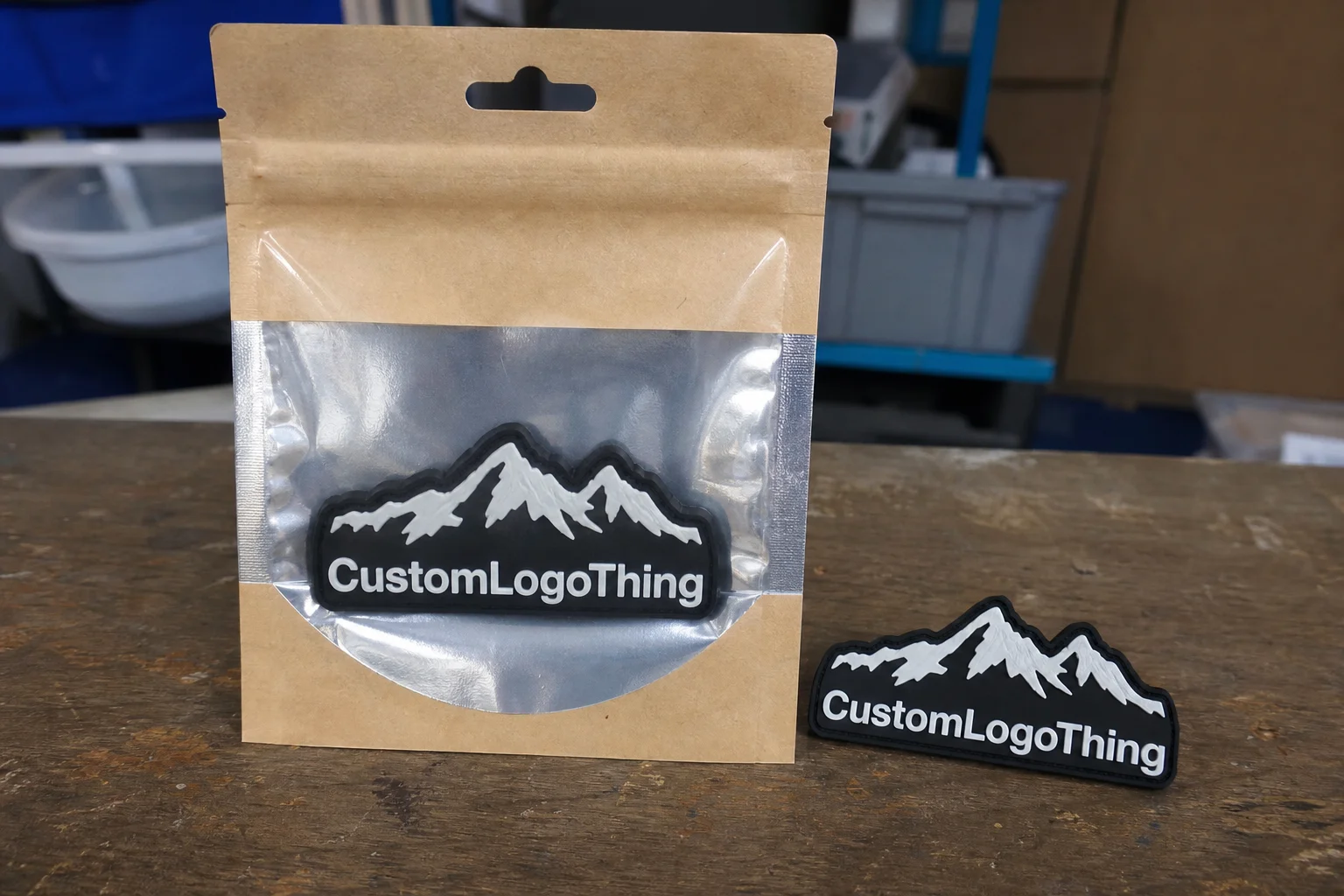
Custom Rubber Patches are molded branding pieces made from materials such as PVC, silicone, or TPU-style compounds. They can be sewn on, heat applied, backed with Velcro, or made with adhesive depending on the end use. The appeal is plain: once the design is molded, the logo remains physically defined instead of relying on surface ink alone.
For buyers comparing decoration methods, the tradeoffs show up quickly. Embroidery has texture but can crowd fine text. Woven labels are clean and light, yet they do not always carry enough visual weight for outerwear, bags, or tactical gear. Rubber patches bring stronger contrast and a slightly premium feel, especially when a logo needs to be seen from a distance.
They are especially useful on products that are washed often or exposed to weather. Think work uniforms, school bags, hiking jackets, tactical vests, gym totes, and promotional merchandise that must keep its branding intact after repeated handling. If your product range also includes Custom Packaging Products, a rubber patch can reinforce the same brand identity across apparel and insert pieces without adding much production complexity.
- Best for: outerwear, uniforms, bags, kids’ wear, sportswear, promotional goods
- Common materials: PVC, silicone, TPU-style compounds
- Common attachments: sew-on, iron-on, Velcro, adhesive, safety-pin style
The buyer mistake is usually not selecting the wrong look. It is selecting a look that cannot survive the product’s actual use. A patch that still reads clearly after twenty wash cycles is usually better branding than one that looks impressive on day one and degrades by week six.
Material choice affects both feel and compliance. PVC often gives a firmer molded shape and can hold stronger color separation. Silicone tends to feel softer, more flexible, and slightly more premium in hand, though the price is often higher. TPU-style compounds sit somewhere in between, but the exact performance depends on the supplier’s formula and curing process. The supplier should be able to state the base material, thickness range, and recommended use case without hedging.
How a China factory turns your artwork into a finished patch
A reliable custom rubber patches Supplier China Factory usually follows a predictable production path: artwork review, mold making, color matching, material injection or filling, curing, trimming, backing application, and final inspection. The process sounds simple. In practice, the early artwork stage is where most of the hidden risk appears.
The mold defines the patch’s character. Raised sections become the visible logo areas, while recessed areas create background depth or border separation. If the artwork uses hairline details, the factory may need to simplify them slightly so the mold can reproduce them cleanly. Small text below about 2.5 mm can become unreadable unless the line thickness is handled carefully. That is not a sales issue; it is a tooling constraint.
Backings change the final use case more than many buyers expect:
Common backing types and where they fit
- Sew-on: best all-around choice for jackets, bags, uniforms, and most apparel
- Iron-on / heat-applied: useful for quick application, though garment fabric compatibility must be checked
- Velcro-backed: common for tactical gear, removable IDs, and event uniforms
- Adhesive-backed: good for temporary placement or light-duty branding
- Safety-pin style: niche use for event badges or temporary promotional items
Good factories do not skip the proof stage. They will usually send a digital layout or a physical sample before running a larger order. That sample is the point where buyers can catch awkward border spacing, color drift, oversize thickness, or a backing type that does not suit the garment. A sample that looks “close enough” often becomes expensive once multiplied across a bulk order.
“The sample is not just a sample. It is the factory’s proof that your artwork is manufacturable at the size and thickness you actually want.”
Inspection should happen before packing, not after a shipment lands. At minimum, the buyer should confirm dimensions, edge finish, color separation, backing application, and consistency across the batch. For iron-on and adhesive styles, a peel test or simple application test on the intended fabric can reveal problems that a photo never will.
Communication changes the result more than polished sales language. A slight adjustment in border thickness, logo height, or background texture can alter mold cost and final readability. For packaging-led brands, the patch should also fit the rest of the visual system rather than feeling like a separate object that happens to share the same logo.
Cost, MOQ, and unit pricing factors buyers should compare
Pricing for a custom rubber patch quote is usually shaped by six variables: patch size, number of colors, mold complexity, backing type, quantity, and packaging method. A small two-color sew-on patch will usually cost far less than a shaped patch with eight colors, raised lettering, and Velcro backing. The factory is not guessing at those numbers; each added layer increases setup or handling time.
MOQ logic is straightforward once you look at the supplier side. Tooling, sample work, and inspection effort are partly fixed, so the supplier spreads those costs across the order. That means the unit price typically falls as the quantity rises. Low-volume orders are still possible, but they carry a higher per-piece cost because the mold and setup cost do not shrink just because the order is smaller.
Buyers often focus too hard on the ex-factory number and ignore the rest. A quote that looks cheaper at first can become more expensive once sampling, mold charges, freight, customs handling, and rework are added. If the patches are part of clothing labels, branded packaging, or private-label launch kits, compare the total landed cost, not only the patch price.
Here is a practical comparison buyers can use as a reference point. These are typical ranges for small-to-mid volume orders; exact pricing changes with artwork, size, and finish.
| Patch spec | Typical MOQ | Approx. unit price | Main cost driver |
|---|---|---|---|
| Simple 2-color sew-on patch, 70 mm | 300-500 pcs | $0.18-$0.28 | Basic mold, low color count |
| Medium logo, 4-5 colors, 80 mm | 500-1,000 pcs | $0.24-$0.42 | Color filling and edge detail |
| Complex shape, 6+ colors, Velcro backing | 1,000 pcs+ | $0.38-$0.68 | Mold complexity, removable backing |
| Glow-in-the-dark or metallic effect | 500-1,000 pcs | $0.45-$0.85 | Special compound or finish |
Custom shapes, mixed sizes, and special effects can change economics quickly. A glow-in-the-dark patch or metallic edge generally requires extra material handling. A very thin logo with multiple cutouts can increase mold precision and scrap risk. In many cases, simplifying the design saves more than bargaining for a few cents off the unit rate.
Packaging also affects the total. Individual polybags, paper backing cards, barcode stickers, and sorted assortments all add labor. None of those items are expensive in isolation, but they matter when an order has to be assembled, counted, and packed by hand. For a small brand, that can be the difference between a quote that fits and a quote that quietly overruns the budget.
Process and timeline from inquiry to shipment
A well-run order usually moves through seven steps: inquiry, artwork review, quote, sample or digital proof, mass production, inspection, and shipping. If the supplier is organized, the process feels controlled. If not, each step turns into back-and-forth emails asking for information that should have been requested up front.
Typical timing depends on mold complexity and seasonality, but a practical planning range looks like this:
- Artwork review and quote: 1-2 business days
- Sample or digital proof: 3-7 business days
- Sample revision, if needed: 2-5 business days
- Mass production: 7-15 business days after approval
- Inspection and packing: 1-3 business days
- Freight: 3-7 days by air, 18-35 days by sea depending on route
That schedule can stretch quickly if the artwork is unclear or the factory is in peak season. Sample turnaround is usually faster than bulk production, but a slow sample loop can still push the whole order back by a week or more. Air freight helps when timing matters, yet on small orders it can eat margin quickly.
A clear spec sheet reduces the risk of misquotes. Include size in millimeters, PMS references if available, backing type, intended fabric, preferred tolerance range, quantity, and packaging method. One document can save several rounds of clarification and reduce the chance that the factory quotes the wrong construction.
For buyers handling multiple branded items, the same discipline applies across labels, inserts, and custom printed boxes. The better the spec, the lower the coordination cost.
One practical planning point: if the patches must arrive for a seasonal launch, add buffer time for sample approval, factory holidays, and freight disruption. A lead time that looks safe on paper can still slip if the artwork is revised late or if the supplier starts production before confirming the final backing or thickness.
Key quality factors to check before you approve a supplier
Material feel is not cosmetic. A good patch should feel flexible, not brittle, and it should not carry a strong chemical odor after curing. If the compound feels too stiff, it may crack sooner when sewn onto curved surfaces or washed repeatedly. For apparel use, that matters more than a bright product photo.
Logo fidelity is the next test. Check whether small text is readable, whether corners stay crisp, and whether color blocks remain separate instead of bleeding into one another. A supplier who can reproduce a 3 mm line cleanly is usually safer for detailed branding work than one whose sample only looks good on broad shapes.
Durability testing is where trust gets built or lost. Ask what the factory already tests, or request evidence of:
- Wash testing for sewn or heat-applied patches
- Peel strength for adhesive and heat-activated backings
- Abrasion resistance for bags and workwear
- Temperature tolerance for garments exposed to heat or cold storage
Compliance questions matter too. Children’s products may need to align with CPSIA expectations. Buyers shipping to Europe often ask about REACH-related material control. Many brands also request OEKO-TEX-related documentation even when it is not strictly required, because downstream retailers often want more traceability than the minimum. If the supplier is vague about raw material composition, that is a warning sign.
There is also a difference between a supplier that makes a nice sample and one that can repeat it reliably. Repeatability is the real test. A single good photo does not prove that the factory can hold the same border height, gloss level, or color density across multiple batches. Ask for close-up production images, sample history, or inspection records if the order matters to your line.
For broader handling and distribution thinking, resources from the Association for Packaging and Processing Technologies and the ISTA are useful references. Rubber patches are not pallets, but the same logic applies: damage and inconsistency often appear during transit or repeated handling rather than at the mold itself.
Common ordering mistakes that raise risk and rework
The first mistake is sending artwork that is too small, too low-resolution, or too detailed for molding. A file that looks acceptable on screen can collapse into unreadable detail once translated into a physical mold. Thin lines, tiny lettering, and narrow negative spaces are the usual trouble spots.
The second mistake is approving a sample without checking the actual spec. Buyers often focus on color and ignore backing type, thickness, or edge finish. That is how an iron-on patch arrives when the garment really needed sew-on, or how a logo that looked fine in isolation fails on a thicker fabric.
Another common issue is assuming one patch construction works across every garment type. A patch designed for soft knitwear may not sit well on coated outerwear. The same holds true for application method. Heat-applied backing is convenient, but it is not automatically the best answer for every textile, especially where fabric coatings or waterproofing are involved.
Time assumptions create their own problems. Shipping delays, customs checks, and factory holiday closures can disrupt a plan that looked safe on paper. If the patches must arrive before a product launch, build a buffer instead of trusting the shortest estimate.
Then there is spec creep. Changing size, shape, backing, or color count after sample approval can force a new mold or at least a revised production run. That is where small changes become expensive. A buyer who keeps tweaking artwork late in the process usually pays for the indecision twice: once in delay, once in rework.
A cheap quote can become a costly order if the artwork, backing, and final application method were never pinned down at the beginning.
Expert tips for choosing the right factory and placing the first order
If you are comparing a custom rubber patches Supplier China Factory against two or three others, ask for quotes in the same format. A good quote sheet should separate mold cost, sample cost, unit price, freight assumptions, and any surcharge for special finishes. If those items are bundled together, the comparison becomes misleading very fast.
Start small, but not vague. One hero design and one backup colorway is usually enough for a first order. That keeps risk manageable while still testing the supplier’s ability to hold detail, color, and backing consistency. Once that order is stable, expanding into a larger collection becomes much easier.
It also helps to ask for production photos, pre-shipment inspection images, and a written tolerance range for size and color. A simple supplier scorecard keeps the decision more objective:
- Response speed: do they answer within one business day?
- Clarity: do they quote the actual spec, not a generic version?
- Sample quality: does the sample match the artwork closely?
- MOQ flexibility: can they handle a smaller pilot run?
- After-sales support: do they address issues directly instead of hiding behind vague explanations?
For brands that also source product packaging, labels, or retail packaging, it makes sense to coordinate the patch spec with the broader packaging design system. A patch that echoes the same typography, color family, and visual weight as the carton or tag feels more intentional than one chosen in isolation. Consistency across touchpoints is often what makes a brand look established, even when the order quantities are still modest.
There is one more practical filter: ask whether the supplier understands the end product, not just the patch itself. A factory that knows how the patch will be sewn, heat pressed, or attached is usually more useful than one that only produces a molded sample and leaves application issues to the buyer. This matters most when the patch is going onto waterproof fabrics, stretch materials, or heavier outerwear.
If you want a simple order structure, use this sequence: finalize artwork, define size and backing, request 2-3 comparable quotes, approve a sample, then move to mass production. That approach protects margin, reduces rework, and gives a much clearer read on whether the supplier is suited for repeat orders.
In practice, the best patch programs are rarely dramatic. They are clear on spec, predictable in production, and honest about limits. That is usually where the real value sits.
What should I ask a custom rubber patches supplier China factory before ordering?
Ask for MOQ, sample cost, production lead time, shipping options, backing type, material choice, and whether revisions create extra charges. If the supplier cannot answer those basics clearly, the quote is too early to trust.
How much do custom rubber patches usually cost per piece?
Unit price depends on size, color count, backing, and quantity. A simple patch may land around $0.18-$0.28 at moderate volume, while more complex designs can move into the $0.45-$0.85 range. Always compare total landed cost, including mold, sample, freight, and any customs-related charges.
How long does production usually take for custom rubber patches?
Artwork approval, sample confirmation, production, inspection, and shipping all affect timing. A typical order may need 2-4 weeks before it is ready to ship, and complex molds or sample revisions can extend that schedule.
Which backing is best for clothing labels and apparel?
Sew-on backing is usually the safest all-around choice for garments. Heat-applied, Velcro, and adhesive backings make sense for specific use cases such as uniforms, tactical gear, or temporary branding, but each should be tested against the fabric it will be used on.
How do I know if a factory can make detailed logo artwork correctly?
Look at the sample closely. Small text, thin lines, sharp corners, and color separation should still look clean at final size. Ask for mold photos and close-up sample images so you can verify that the factory can reproduce the artwork consistently before you approve mass production.