Buyer Fit Snapshot
| Best fit | Custom Screen Printed Poly Mailers Bulk projects where brand print, material claims, artwork control, MOQ, and repeat-order consistency need to be specified before quoting. |
|---|---|
| Quote inputs | Share finished size, material target, print colors, finish, packing count, annual reorder estimate, ship-to region, and any compliance wording. |
| Proofing check | Approve dieline scale, logo placement, barcode or warning zones, color tolerance, closure strength, and carton packing before bulk production. |
| Main risk | Vague material claims, crowded artwork, missing packing details, or unclear freight terms can make a low unit price expensive after revisions. |
Fast answer: Custom Screen Printed Poly Mailers Bulk: Material, Print, Proofing, and Reorder Risk should be specified like a repeatable production item. The safest quote records material, print method, finish, artwork proof, packing count, and reorder notes in one written spec.
Production checks before approval
Compare the actual filled-product size with the drawing, then confirm tolerance on folds, seals, hang holes, label areas, and retail display edges. Reserve space for logos, QR codes, warning copy, and material claims before decorative graphics fill the panel.
Quote comparison points
Review material grade, print process, finish, sampling route, tooling charges, carton quantity, and freight assumptions side by side. A quote is only useful when the supplier can repeat the same color, closure quality, and packing count on the next order.
custom screen Printed Poly Mailers bulk often become the first branded surface a customer touches, sometimes before the box, the tissue, or the product itself. That small moment carries more weight than people expect. A mailer is not just a shipping sleeve; it is packaging that travels from warehouse to doorstep and quietly tells the customer whether the brand feels considered, consistent, and ready for scale.
Apparel labels, subscription sellers, accessory brands, and ecommerce teams shipping soft goods tend to get strong value from custom screen printed Poly Mailers Bulk. One print setup can support thousands of impressions, the packaging stays light, and the brand message shows up on every doorstep instead of hiding inside the carton. That kind of repetition builds recognition fast, especially for brands that ship often and want each parcel to feel deliberate without adding a lot of extra cost.
Three variables usually decide the purchase: print quality, material strength, and order economics. Get those right, and custom screen Printed Poly Mailers bulk become a practical sales tool rather than a decorative line item. Miss on those points, and the result is usually weak color, split seams, or inventory that sits too long because the MOQ ran ahead of demand.
Why custom screen printed poly mailers bulk beat plain mailers
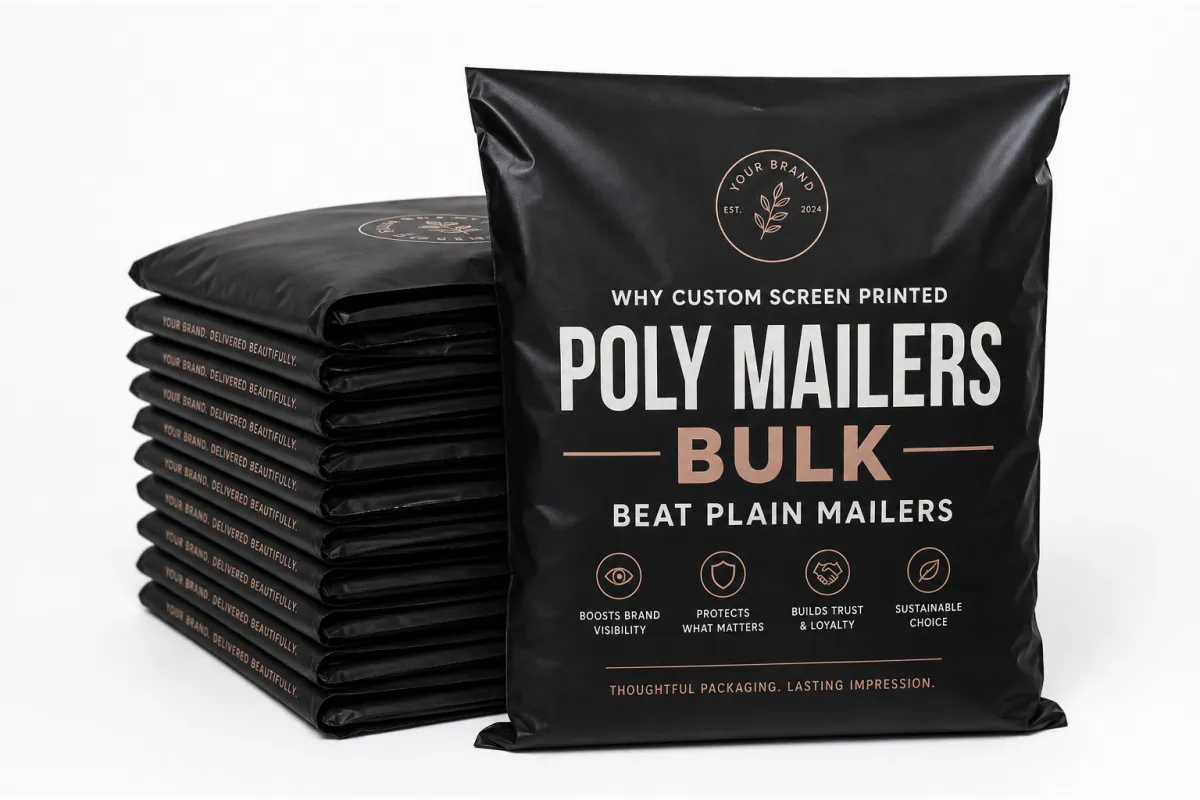
Plain mailers ship product, but they leave brand memory sitting on the table. A custom poly mailer can carry a logo, a short message, a repeating pattern, or a bold color field that makes the package easy to spot in a stack of deliveries. That matters for brands building repeat recognition across retail packaging, product packaging, and the unboxing moment. The outer bag may be thrown away quickly, yet the first visual impression still does its job.
custom screen Printed Poly Mailers bulk also cut down on the generic shipping look that many DTC brands fight against. A plain white or gray bag blends into every other shipment moving through a warehouse. A printed bag stands apart. That difference is more than cosmetic; it shapes how the customer reads the order before opening it, and it can make a modest shipment feel more considered.
Bulk buying changes the math in a good way. Higher quantities usually lower unit cost, spread setup charges across more bags, and keep the print consistent across multiple fulfillment cycles. A team shipping 5,000, 10,000, or more units in a quarter often sees a better cost per impression with custom screen printed poly mailers bulk than with small-run packaging, even when the upfront spend is higher.
The operational upside is just as useful. Poly mailers are light, flexible, and easy to pack. Compared with cartons, they can reduce dimensional weight pressure and simplify packing labor for apparel, socks, towels, soft accessories, and many promotional items. A lighter package often means lower shipping cost, fewer filler materials, and less handling time in the warehouse. That makes custom screen printed poly mailers bulk part of the shipping system, not a decorative extra.
A buyer is not paying for ink alone. The real value sits in repeat visibility, cleaner packing flow, and a sharper presentation that travels from warehouse to doorstep.
The strongest programs treat custom screen printed poly mailers bulk as one part of a larger packaging system. Branded tissue, inserts, labels, and custom printed boxes can all sit beside the mailer when the brand needs a richer unboxing path. The point is not to cover every surface. The point is to create a consistent visual lane so each order feels like it came from the same operation, even when the products inside vary.
If you are mapping out a packaging stack, it helps to look at the full mix of Custom Packaging Products rather than treating every mailer as a one-off purchase. That broader view usually leads to better decisions on size, storage, and reorder timing.
Custom screen printed poly mailers bulk: sizes, materials, and print options
Size is the first spec worth getting right. A mailer that runs too small puts stress on seams and adhesive strips. A mailer that runs too large can look sloppy, create extra void space, and sometimes move the shipment into a higher shipping lane than needed. For most ecommerce applications, custom screen printed poly mailers bulk are ordered in common flat or expansion-friendly sizes such as 6 x 9, 8.5 x 12, 10 x 13, 12 x 15.5, 14.5 x 19, and 19 x 24 inches, with the final choice tied to folded garments, boxed accessories, or multi-item kits.
Film construction matters almost as much. LDPE stays common because it is flexible and cost-effective, while co-extruded poly film can improve puncture resistance and the feel in hand. Typical thickness ranges run from about 2.0 mil to 3.0 mil for standard mailer use, though heavier shipments may call for thicker film. With custom screen printed poly mailers bulk, thickness affects more than durability. It also changes print appearance, handling noise, and how much the bag stretches under load.
Screen printing works well for many branding programs because it lays down color cleanly and holds up at scale. Single-color logos usually give the best efficiency, but multi-color work can still work if the artwork stays simple and registration is tight. Dark ink on light film tends to print well. Light ink on dark film can work too, but it needs more attention to coverage and opacity. Complex gradients and tiny type usually fight the process, since flexible film does not reward overly detailed artwork.
Design placement deserves the same discipline. Centered logos are common, but side placement can work if the brand mark is tall and the mailer has a seam or zipper line to avoid. Leave safe zones away from fold lines, adhesive flaps, and edges that get crushed in transit. A logo that sits too close to a seam may look fine in proof and awkward in production. That is one of the easiest packaging mistakes to avoid, and it is gonna save you from a lot of unnecessary back-and-forth later.
The practical rule is straightforward: keep the artwork bold, keep the message short, and let the bag do the rest. Teams sometimes overdesign mailers because they treat them like poster art. A shipping bag moves, wrinkles, and gets handled by multiple people. It is not a billboard. It is a transit surface that needs clarity more than ornament.
Apparel brands often get the best results from a simple logo lockup, one strong color, and plenty of negative space. Subscription kits may benefit from a pattern or repeat icon. Accessories and small goods often need a bolder logo because the mailer becomes the stage. If you want to compare formats, browse the dedicated Custom Poly Mailers category and compare size choices against your fold depth, insert count, and order mix.
There is also a sourcing angle many buyers miss. If your packaging program includes paper cartons or inserts, look at FSC-certified components where appropriate; FSC provides chain-of-custody standards for forest-based materials at fsc.org. For shipping performance, ISTA testing protocols offer a useful benchmark for package validation and transit stress at ista.org.
Most teams do not need every feature available. They need the right combination. That is why custom screen printed poly mailers bulk should be specified around actual shipments rather than hypothetical ones.
I have seen a lot of good packaging plans get weakened by one small mismatch: a mailer that looked perfect in the mockup but turned flimsy once the actual garment, insert, and adhesive strip were all in play. The fix is usually not fancy. It is sizing the bag to the real packed product and choosing a film thickness that holds up under everyday handling.
Cost, pricing, MOQ, and quote factors for bulk orders
Price is where the conversation gets concrete. For custom screen printed poly mailers bulk, unit cost usually moves with quantity, bag size, film thickness, number of print colors, artwork complexity, and any special finishing such as tear notches or double adhesive strips. Small runs often carry a heavier setup burden, while larger runs spread that cost across more bags. That is why the lowest-looking quote is not always the best program.
MOQ, or minimum order quantity, is the other number buyers should watch closely. A lower MOQ helps when you are testing a launch or managing limited storage space. A higher MOQ can make sense if sell-through is steady and the lower unit cost offsets the larger order. The right answer depends on how fast you ship, how much room you have, and whether your custom screen printed poly mailers bulk will serve one product line or several.
Below is a realistic comparison framework. These are illustrative ranges, not fixed pricing, because actual quotes shift with size, material, print coverage, and freight.
| Order Tier | Typical Unit Range | Common MOQ Profile | Best Fit |
|---|---|---|---|
| 1,000 to 2,499 pieces | $0.42 to $0.68 | Lower MOQ, higher setup share | Launches, test programs, seasonal drops |
| 2,500 to 4,999 pieces | $0.28 to $0.44 | Moderate MOQ with more stable pricing | Growing DTC brands with predictable flow |
| 5,000 to 9,999 pieces | $0.18 to $0.31 | Standard bulk range for many programs | Regular replenishment and multi-week shipments |
| 10,000+ pieces | $0.14 to $0.24 | Best pricing, larger storage commitment | Higher-volume ecommerce and wholesale operations |
That table helps because it shows how quickly the economics can shift. A buyer focused only on unit price may miss the fact that a lower quote comes with a larger MOQ, extra screens, or a longer lead time. Another buyer may accept a slightly higher unit cost because it protects cash flow and reduces dead inventory. In packaging, the cheapest bag is not always the best buy. The best buy is the one that fits the warehouse rhythm.
Quote structure matters too. A clean quote for custom screen printed poly mailers bulk should separate the bag price, artwork or plate costs, setup charges, sampling, freight, and any rush fee. If those items are blended together, it becomes hard to compare suppliers honestly. Buyers should ask whether the quote includes one proof round or multiple, whether shipping is factory-direct or domestic, and whether the price changes if the design moves from one color to two.
A second budgeting lens helps buyers make better decisions. Estimate quarterly shipment volume, then map that against storage space and reorder timing. If you ship 8,000 parcels per quarter, buying 20,000 custom screen printed poly mailers bulk may lock in a lower unit price but create unnecessary storage pressure. If you ship 40,000, that same order may be conservative. The right tier depends on real velocity, not guesswork.
A simple decision rule usually works well:
- Confirm your realistic three-month ship volume.
- Match the mailer size to the product most often shipped.
- Price at least three quantity tiers before deciding.
- Compare landed cost, not only per-piece cost.
- Choose the MOQ that keeps inventory moving instead of sitting still.
For many buyers, custom screen printed poly mailers bulk are most economical in the middle tiers because they balance price and flexibility. That is especially true for brands that also buy other branded packaging items from the same supplier and want planning to line up across Wholesale Programs.
One more point: if a supplier cannot explain why a quote changed, the problem is usually not the market. It is the spec sheet. Clear specs create clear pricing. Vague specs create surprise charges.
And if you are comparing numbers across vendors, do not let a slick unit price distract you from the setup line, freight line, or the part where the order sits at a warehouse for two extra weeks. That kind of delay can cost more than a few cents per bag, especially when the fulfillment calendar is already tight.
Process, timeline, lead time, and production steps
The ordering process for custom screen printed poly mailers bulk should feel structured, not mysterious. A solid supplier will move through quote, artwork review, proofing, screen setup, production, inspection, packing, and delivery in a way that gives the buyer visibility at each step. If any of those stages goes fuzzy, lead time usually drifts.
Production begins with a spec check. That means confirming bag size, film thickness, ink color, print count, and closure style. After that, artwork is reviewed for resolution, line weight, and placement. Once the proof is approved, screens are created and the press run is scheduled. After printing, the bags are cured or dried, checked for print registration and adhesion, then packed for shipment. That is the normal flow for custom screen printed poly mailers bulk, and it works because each stage reduces risk before the next one starts.
Lead time usually stretches for a few predictable reasons. Artwork revisions take longer than buyers expect, especially when a logo was created for web use rather than print use. Material sourcing can add days if the film color or thickness is not in stock. Multiple print colors add setup and inspection time. Peak season demand affects press scheduling. Freight is its own variable. Custom screen printed poly mailers bulk can move quickly, but only when the input data is clean.
If you want shorter turnaround, send final artwork in a print-ready vector format, confirm exact color targets, and approve the proof promptly. A buyer who waits three days to review a proof often adds three more days to the schedule. That sounds obvious, yet it happens constantly. Fast projects usually start with procurement, design, and operations aligned before the quote even goes out.
Samples deserve their own timeline. A sample is not the same as a full production run, and the difference matters. A sample can prove size, print placement, and general feel. Bulk production can still vary slightly because of film lot, ink load, and run conditions. The sample is the checkpoint. It is not the final order. That distinction removes a lot of confusion when custom screen printed poly mailers bulk are tied to a launch with a fixed ship date.
A useful approach is to build the launch calendar backward:
- Set the ship date first.
- Subtract the production window.
- Subtract proof review time.
- Leave a buffer for transit and inspection.
- Keep a small overage for damaged or mispacked units.
That model is more reliable than trying to squeeze everything into the final week. It also keeps branded packaging from becoming a bottleneck inside the fulfillment line. If the mailer arrives late, the whole shipping plan slows down. If it arrives with the wrong print, the cost is even higher because the packaging itself becomes unusable.
For teams comparing suppliers, a few direct questions tell you a lot: How many business days after proof approval? How many screens are included? What happens if the artwork needs revision? Is freight included or separate? Those questions reveal the operational quality behind custom screen printed poly mailers bulk better than any sales pitch ever will.
Timeline planning also benefits from one practical habit: keep a dated proof archive. When a design gets reordered six months later, the old proof, ink spec, and size note save time and reduce the chance of a quiet spec drift. That is one of those small process details that does not look dramatic on paper but prevents a lot of messy rework.
How to judge quality before you place a bulk order
Quality is not a vague feeling. It can be checked. Before approving custom screen printed poly mailers bulk, ask for a sample or proof and look at four things: print alignment, ink opacity, seam integrity, and closure performance. If the design is supposed to sit centered, measure it. If the artwork uses a solid color field, check whether the film shows through. If the seam flexes or the adhesive strip pulls unevenly, the mailer is not ready for live shipment.
The simplest durability test is also the most useful. Load the mailer with the actual product weight, seal it, and handle it the way a packer would. Then check for stretching, splitting, edge abrasion, and stress around corners. That test matters because a mailer that looks fine flat on a table can fail under real load. In packaging, the field test beats the showroom test every time.
A second test is visual. Hold the sample under warehouse lighting, not only under design studio lighting. Some inks look strong on screen but softer on film, especially when the mailer color is dark or reflective. This is where custom screen printed poly mailers bulk need honest proofing. High-contrast art tends to reproduce better. Thin script fonts and tiny details usually suffer.
Ask for transparency from the supplier. You want clear answers on material composition, thickness, MOQ, proof steps, and replacement handling if something fails. You also want the supplier to be candid about what the design can and cannot do. A good packaging partner will tell you that a very fine-line logo may not hold up, or that a two-color print is possible but will increase setup time. That honesty is more useful than a vague promise.
For buyers who validate shipping performance formally, ISTA test methods are worth studying because they give a framework for vibration, drop, and handling simulation. Even if you do not run full lab testing, the standard gives you a better language for discussing transit risk with suppliers and internal teams. The more your vendor thinks in those terms, the better your packaging decision tends to be.
Quality also shows up in brand consistency. A weak mailer can make a polished order feel cheap. A strong mailer can make a modest shipment feel intentional. That is not hype; it is what customers notice. The outer packaging frames the purchase. If the mailer splits, wrinkles badly, or prints unevenly, the entire customer experience takes a hit even when the product inside is fine.
Use this quick checklist before approving custom screen printed poly mailers bulk:
- Logo placement matches the proof.
- Ink is opaque enough for the film color.
- Seams are clean and consistent.
- Closure adhesive sticks firmly without premature peel.
- Size leaves a little tolerance for actual product load.
- Artwork remains legible from arm's length.
If the sample passes those checks, you are in a much better position to place a bulk order with confidence. If it fails, the correction should happen before production, not after cartons are already moving. That is the line between smart procurement and expensive rework.
A quick personal rule of thumb: if a sample still looks crisp after a few rounds of handling, stacking, and resealing, it is usually a good sign. If the print starts to scuff or the adhesive gives up early, I would not rush the order, even if the quote looks attractive. The cheap option gets expensive fast once fulfillment starts.
Why choose us for custom screen printed poly mailers bulk
Plenty of vendors can sell a bag. Fewer can support a shipping program. The difference matters. Buyers ordering custom screen printed poly mailers bulk need more than decoration; they need a supplier that understands size control, print setup, reorder planning, and the everyday realities of warehouse use.
The best supplier relationship feels practical instead of performative. You want consistent print output, clear communication, and specifications chosen for real shipping conditions rather than catalog convenience. If your team needs a mailer for soft goods, apparel, or kit-style orders, the right recommendation is the one that keeps the program easy to run month after month, with fewer surprises and fewer last-minute fixes.
We also work to reduce hidden costs. A lot of packaging problems begin with vague artwork, unclear sizing, or a quote that looks low until freight and setup show up later. A better process defines the bag, the ink, the delivery window, and the reorder plan upfront. That way, custom screen printed poly mailers bulk stay predictable instead of turning into a procurement headache.
What buyers usually value most is not a dramatic promise. It is stability. When custom screen printed poly mailers bulk arrive with clean print, accurate size, and a realistic timeline, the fulfillment team notices right away. The operation runs smoother, the brand looks sharper, and the reorder conversation gets easier.
There is also a strategic benefit. If your company already buys branded packaging across multiple lines, a supplier that understands both mailers and broader retail packaging can help coordinate product packaging decisions across formats. That can mean mailers for the everyday shipment path and custom printed Boxes for Premium or protective items. The result is not only better looks; it is a cleaner system.
We see the same pattern across many programs: long-term results usually come from buyers who care about clarity, not just price. Strong communication, simple reordering, and disciplined specs often matter more than chasing the lowest initial quote. That is especially true in custom screen printed poly mailers bulk programs where the mailer itself is a recurring part of the customer journey.
If you are comparing suppliers, ask how they handle proof support, what data they need to quote accurately, and how they help with size selection. Those answers show whether a vendor is selling a commodity item or supporting a packaging system. The second option usually pays off better over time.
One thing worth saying plainly: not every project needs the fanciest mailer. Sometimes a clean one-color print on the right film is the smart move, and sometimes the better answer is to spend the money elsewhere in the packaging stack. Honest tradeoffs are part of good packaging work, and pretending otherwise helps nobody.
Next steps to order custom screen printed poly mailers bulk
The easiest way to get a strong quote is to send complete information the first time. For custom screen printed poly mailers bulk, that means target quantity, bag size, product type, logo files, print colors, desired delivery date, and any special features such as double adhesive strips or tear notches. The more complete the request, the cleaner the quote.
A short spec sheet saves time. It should list the product dimensions, whether the mailer needs extra depth, what kind of closure you want, whether the artwork is one color or multi-color, and whether the shipment is tied to a launch date. That kind of detail helps the supplier price custom screen printed poly mailers bulk accurately and quickly.
A smart first-order path usually looks like this:
- Choose the mailer size based on your actual product.
- Send vector artwork and note any color priorities.
- Review the proof and confirm placement.
- Approve production only after the sample or proof is acceptable.
- Set a reorder trigger so stock does not run low.
That approach keeps the process under control and avoids the common trap of ordering too late. It also helps the team think beyond a single shipment and plan the next cycle with enough time for production and transit. For most brands, custom screen printed poly mailers bulk work best when they are treated as an ongoing supply item, not a one-time buy.
If you are ready to compare quantity tiers, material options, and shipping timelines, request pricing with your actual spec sheet rather than a rough estimate. That will give you a more reliable answer on MOQ, lead time, and landed cost. It will also help you decide whether one size is enough or whether separate sizes make sense for different product lines.
One last practical point: buy for the next shipment cycle, not for the idea of extra stock. Extra stock only helps if it fits your storage plan and your reorder rhythm. The best custom screen printed poly mailers bulk program is the one that stays in motion, matches the order stream, and keeps the brand visible on every parcel.
A clean takeaway is simple: match the bag to the product, keep the artwork bold, confirm the proof under real lighting, and order at a quantity that your warehouse can actually carry. Do that, and the mailer stops being a shipping afterthought and starts doing useful brand work every single day.
What is the usual MOQ for custom screen printed poly mailers bulk?
MOQ changes with size, print count, and setup complexity. Single-color jobs usually allow lower minimums than multi-color jobs because the screen setup is simpler. The most accurate quote for custom screen printed poly mailers bulk comes from your exact size, artwork, and target quantity rather than a generic minimum.
How long does production usually take for custom screen printed poly mailers bulk?
Timeline depends on proof approval, screen setup, material availability, and current production volume. Simple artwork and quick approvals usually keep lead time shorter. Rush requests may be possible for custom screen printed poly mailers bulk, but they often change pricing and scheduling.
What artwork files work best for screen printing on poly mailers?
Vector files are preferred because they keep edges clean at print size. High-contrast designs print more clearly on flexible film surfaces, especially when the mailer color is dark. Final artwork should match the approved size and color plan before custom screen printed poly mailers bulk go to production.
Can I order different sizes in the same custom screen printed poly mailers bulk program?
Yes, but each size is usually priced and produced as its own item. Mixed-size programs can simplify brand consistency across product categories, though they also add storage and reorder planning. It is smart to compare storage space, unit cost, and fulfillment flow before splitting custom screen printed poly mailers bulk across multiple sizes.
How do I compare quotes for custom screen printed poly mailers bulk?
Compare the full landed cost, not only the unit price. Check MOQ, print setup charges, shipping, proofing details, and whether the quote matches the same material, thickness, and print specs across suppliers. For a fair comparison, custom screen printed poly mailers bulk should be judged on total value, not just the lowest number on the page.

