Buyer Fit Snapshot
| Best fit | small batch custom rigid boxes for premium brands for packaging buyers comparing material specs, print proof, MOQ, unit cost, freight, and repeat-order risk where brand print, material, artwork control, and repeat-order consistency matter. |
|---|---|
| Quote inputs | Share finished size, material target, print colors, finish, packing count, annual reorder estimate, and delivery region. |
| Proofing check | Approve dieline scale, logo placement, barcode or warning zones, color tolerance, and any recyclable or compostable wording before bulk production. |
| Main risk | Vague material claims, crowded artwork, or missing packing details can create delays even when the unit price looks attractive. |
Fast answer: Small Batch Custom Rigid Boxes for Premium Brands: Dieline, Finish, Proof, and Buyer Review should be specified like a repeatable production item. The safest quote includes material, print method, finish, artwork proof, carton packing, and reorder notes in one written spec.
What to confirm before approving the packaging proof
Check the product dimensions against the actual filled item, not only the sales mockup. Ask for tolerance on folds, seals, hang holes, label areas, and retail display edges. If the package carries a logo, QR code, warning copy, or legal claim, reserve that space before decorative graphics fill the panel.
How to compare quotes without losing quality
Compare board or film grade, print process, finish, sampling route, tooling charges, carton quantity, and freight assumptions side by side. A lower quote is only useful if the supplier can repeat the same color, closure quality, and packing count on the next order.
If you are trying to find the best small batch Custom Rigid Boxes, start with the part most quote sheets hide in plain sight: setup, hand assembly, and finishing. Board thickness matters, sure, but a 100-box run can end up priced close to a 250-box run because the same tooling, the same proofing, and the same manual labor still show up on the invoice. That is normal. I have opened enough samples over the years to know the real story usually lives in the corners, the lid tension, and the way the wrap meets at the edges, not in the mockup rendering that looked perfect on a screen.
This review focuses on the best small batch Custom Rigid Boxes in the real sense of the phrase, not the glossy-sales-deck sense. I am looking at what actually lands on the table: lid fit, corner wrap, insert alignment, print consistency, and whether the box supports the product instead of distracting from it. If a supplier cannot make the sample behave like production, that matters more than a polished pitch ever will.
The short answer is simple enough. Domestic makers built for luxury presentation usually win on finish and communication, offshore direct factories usually win on unit cost, and local converters usually win on speed. The math changes less than the marketing does. The sections that follow compare the best small batch Custom Rigid Boxes side by side, then dig into pricing drivers, lead times, and the tradeoffs that matter to a buyer who wants branded packaging to look expensive without turning the launch into a test project.
Best Small Batch Custom Rigid Boxes: Quick Answer
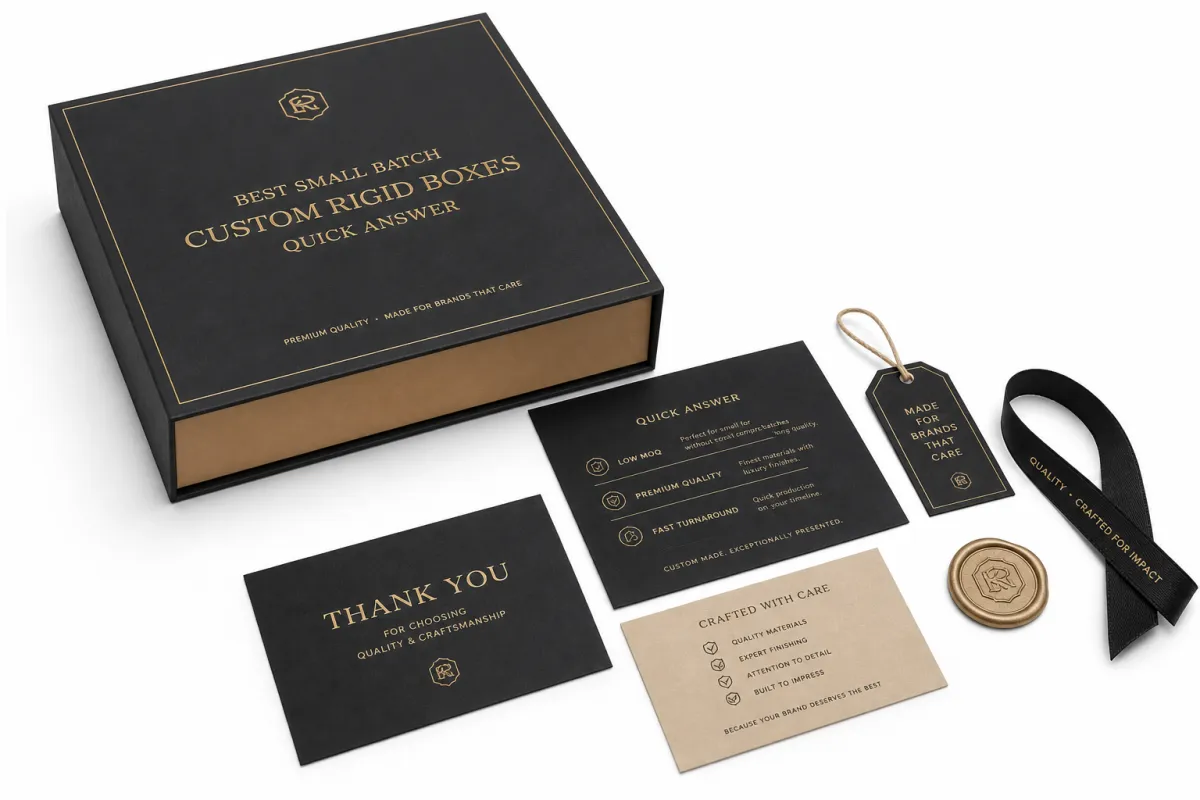
Small orders rarely get gentle pricing. Setup costs, print plates, proofing, and hand assembly tend to outweigh the raw material, which is why a quote for the best small batch custom rigid boxes can feel oddly similar whether the run is 100 units or 250. That is not a quoting error. The structure, wrap material, and finish stack all matter, but the hidden labor is what bends the number upward.
For a packaging buyer, the right choice depends on the job in front of the box. A serum launch, a holiday gift set, and a media mailer do not need the same production path. The best small batch custom rigid boxes for a premium launch often come from a domestic low-MOQ maker because the proofing is tighter and the back-and-forth is easier to manage. A design that is already locked can go offshore and save money. A launch date that cannot move usually favors a local converter. That is the boring truth, and it is usually the right one.
A small rigid box order is rarely expensive because of one giant line item. The cost grows because ten smaller decisions stack together: board grade, wrap paper, foil, insert style, magnet strength, and how much manual finishing the run needs.
That is why I would not judge the best small batch custom rigid boxes by one price line. I would judge them by the sample that lands on the bench: the angle of the lid, the sharpness of the logo, the consistency of the edge wrap, and whether the prototype actually predicts the delivered run. A beautiful sample that turns into a tired-looking production box is a supplier failure, plain and simple.
The comparison below breaks down the supplier types, then the next sections move into the cost drivers that move the quote, the timeline traps that slow small-batch orders, and the practical recommendation that helps you choose the best small batch custom rigid boxes without paying for avoidable do-overs.
- Best for presentation: domestic premium makers
- Best for price: offshore direct factories
- Best for speed: local fast-turn converters
- Best for complex coordination: packaging brokers or studios
Best Small Batch Custom Rigid Boxes Compared: Top Options
Four supplier types deserve a serious look if you want the best small batch custom rigid boxes for a premium brand. Each one can deliver a good result, yet the experience changes fast once you compare MOQ, sample policy, print flexibility, insert options, and response time. A cheap quote is not always the least expensive order. Sometimes it is just the one with the most hidden pieces.
| Supplier type | Typical MOQ | Sample policy | Typical unit price | Turnaround | Best fit | Watch-outs |
|---|---|---|---|---|---|---|
| Domestic low-MOQ manufacturer | 100-300 units | Paid prototype, often $75-$250; sometimes credited | $4.50-$12.00 depending on finish and insert | 2-4 weeks after approval | DTC launches, gift sets, premium retail packaging | Highest first-run cost, limited rush slots |
| Offshore direct factory | 300-1,000 units | One or two samples, usually $40-$180 plus freight | $1.80-$5.50 at workable volume | 4-8 weeks plus transit | Cost-first programs, stable designs, repeat orders | Longer communication loop, freight and spec drift risk |
| Packaging broker or studio | 100-500 units | Varies; may bundle sample, artwork, and sourcing fees | $3.50-$10.00 with markup included | 3-6 weeks | Multi-vendor coordination, complex packaging design, branded packaging programs | Responsibility can blur if something goes wrong |
| Local fast-turn converter | 50-200 units | Digital proof or short-run prototype, often $50-$200 | $5.00-$15.00 | 1-3 weeks | Influencer kits, urgent launches, event packaging | Fewer luxury finish options, narrower structural range |
The differences show up in small, expensive ways. Foil alignment can drift by a millimeter and still catch the eye under bright retail lighting. Corner wrapping can look tight in a sample and loosen slightly once production speeds up. A magnet can feel perfect in the hand sample and then feel weaker after the liner and wrap are fully installed. For the best small batch custom rigid boxes, those are not tiny details. They are the box.
Sample match matters just as much. A good supplier makes the sample behave like a scaled version of the final run, not a fantasy version with extra hand care that disappears later. Good packaging design respects tolerances. Good product packaging respects the product. The strongest vendors understand both, and they do not pretend that premium results come from vague promises.
For buyers building a fuller packaging system, the rigid box should not be treated as a lonely object. If you need complementary packaging options, the Custom Packaging Products catalog is a useful place to line up inserts, outer cartons, and secondary components so the final retail packaging feels planned rather than patched together.
Detailed Reviews: Which Small Batch Rigid Box Option Wins?
Domestic premium maker
For the best small batch custom rigid boxes where appearance is the priority, domestic premium makers usually produce the cleanest result. Communication tends to move faster, proofs are easier to read, and structural changes are less painful. If the design has a tight logo lockup, a delicate foil edge, or a custom insert that needs to cradle a fragile product, that speed of feedback is worth real money.
The downside is easy to see. The first run costs more. A 100-unit order with a printed wrap, soft-touch lamination, foil logo, and a custom insert can land at a number that looks steep if you compare unit price alone. The better comparison is total launch risk. If a domestic maker reduces rework, avoids shipping surprises, and delivers the best small batch custom rigid boxes on schedule, the premium becomes easier to defend.
I especially favor this route for prestige categories: fragrance, skincare, jewelry, premium confectionery, and corporate gift sets. Those categories rely on package branding as much as product function. A box that opens cleanly and closes with the right resistance tells the buyer something about the brand before they even touch the product.
Offshore direct factory
Offshore factories still offer the strongest value when the design is stable and the buyer can manage the process. They can produce the best small batch custom rigid boxes at a lower unit cost than most domestic options, but the savings only work if the specification is already locked. If you are still choosing between paper textures, insert styles, or lid depth, the back-and-forth can erase the advantage quickly.
Spec drift is the biggest operational risk. A quoted 1.5 mm board can arrive as a slightly different grade if the communication is loose. A black wrap can lean cool instead of neutral. A matte finish can come back with more sheen than expected. None of those issues is dramatic by itself, yet each one changes the feel of the box. For premium custom printed boxes, those shifts matter more than most people want to admit.
Offshore is strongest for repeatable programs: seasonal retail packaging, subscription launches with a fixed format, and larger limited editions that do not need much hand-holding. If the buyer has a clear dieline, a disciplined approval process, and enough time to absorb freight, the economics can be very good.
Packaging broker or studio
A broker or studio is not a factory, and that distinction matters. The advantage is coordination. A strong packaging studio can help with sourcing, artwork handoff, insert specs, and vendor management. For the best small batch custom rigid boxes on complicated programs, that kind of support can keep a launch from falling apart.
The weakness is accountability. If the foil is off, the insert is wrong, or the run misses the sample, responsibility can become fuzzy unless the agreement is tight. That is not a reason to avoid brokers. It is a reason to ask who owns the proof, who approves the sample, and who pays for corrections. Vague responsibility costs money, and it usually lands on the brand if nobody names it early.
For brands without an in-house packaging lead, a broker can be the right middle layer. That is especially true for launch kits that combine several pieces: a rigid presentation box, a mailer, tissue, a card, and an outer shipper. The value is coordination. The risk is markup paired with ambiguity.
Local fast-turn converter
When the calendar turns hostile, local converters can save the project. They are often the best path for the best small batch custom rigid boxes if the deadline is tighter than anyone wanted to admit. The tradeoff is a narrower finish menu. You may get solid structure and quick response, but fewer exotic papers, fewer specialty inserts, and less flexibility around magnetic closures or unusually deep lids.
That does not make them second-rate. It makes them tactical. If the launch is for a conference, a retailer meeting, or a time-sensitive media drop, speed can matter more than luxury extras. A strong local converter often decides whether you ship something useful or ship nothing at all.
My practical test is simple: if the box must impress in one moment and then vanish into a shelf or a closet, local speed may be enough. If the box is part of the selling story, the premium domestic or offshore route may deserve the extra coordination. The best small batch custom rigid boxes are the ones that fit the assignment, not the ones with the loudest promise.
For premium brands, the right supplier is the one that can repeat the sample, not just produce a beautiful prototype.
Cost, Pricing, and MOQ for Small Batch Rigid Boxes
Small orders cost more because the work does not scale gracefully. Carton board is only one part of the bill. For the best small batch custom rigid boxes, the quote usually includes board, wrap paper, printing, lamination, foil, embossing, insert material, magnets if used, labor, samples, freight, and sometimes packing or export fees. If a quote leaves out any of those pieces, the quote is incomplete.
Here is a realistic example. A 2-piece rigid box with a printed wrap, soft-touch lamination, one-color foil logo, and a custom EVA or paperboard insert might land around $5.80-$9.50 per unit at 250 pieces from a domestic maker. Push the same spec down to 100 pieces and the price can climb to $8.50-$15.00 because setup and hand assembly are spread across fewer boxes. Offshore pricing can look much lower, yet freight, duties, and a longer correction cycle can narrow the gap.
MOQ is not just a sales tactic. It exists because machines, plates, cutting tools, proofing, and manual assembly need enough volume to make the job economical. That is why the best small batch custom rigid boxes often start at 100 to 250 units, while a standard order may not feel efficient until 500 or more. If a supplier accepts fewer, they usually make up for it with higher labor cost per unit.
Comparing quotes correctly is where many buyers lose money. Do not compare a 2-piece rigid box with a magnetic closure box. Do not compare white board to greyboard with a heavier wrap. Do not compare a loose insert to a die-cut precision insert. Apples-to-apples means matching the same dieline, board grade, finish, insert type, artwork coverage, and shipping terms before deciding which quote is actually cheapest. Otherwise you are gonna chase the wrong number and regret it later.
Typical adders are easy to underestimate:
- Foil stamping: often adds $0.15-$0.60 per unit, plus a plate fee
- Embossing or debossing: often adds $0.10-$0.45 per unit, plus tooling
- Magnetic closure: often adds $0.35-$1.10 per box depending on size and strength
- Custom insert: can add $0.60-$2.40 depending on material and complexity
- Special paper wrap: can shift the price by more than the printing itself
If you want the best small batch custom rigid boxes, ask for the quote to be broken out line by line. That lets you see whether the real cost sits in the board, the wrap, the finish, or the labor. It also makes scope changes easier. Dropping a magnetic closure or changing to a simpler insert can cut price far more than shaving a fraction of a millimeter off the board.
For buyers who want a broader view of packaging economics, two resources help frame expectations: packaging.org for packaging education and materials context, and ISTA for transit-testing logic. If a supplier cannot explain how the box performs in shipping, the cost discussion is only half-finished.
Process, Timeline, and Lead Time for Small Batch Orders
A clean rigid-box order moves through a predictable chain: brief, dieline, structural spec, artwork setup, proofing, sample approval, revisions, production, quality control, packing, and freight. The best small batch custom rigid boxes usually come from suppliers that show each step instead of compressing everything into a vague "lead time" promise. The more visible the process, the easier it is to catch mistakes before they become expensive.
For a domestic run, a realistic timeline can look like this: 2-3 business days for quoting and dieline review, 3-7 days for a sample or prototype if needed, 7-15 business days for production after approval, and a few more days for packing and shipping. Offshore runs often need 4-8 weeks once production, freight handoff, customs, and final delivery are all included. Those numbers move quickly if the order is simple, but insert changes and proof revisions stretch them without much warning.
The delays are usually boring, which is the frustrating part. A magnet spec may take longer than expected. A foil proof may need another round because the logo is too thin. The color match may drift after the first test sheet. Or the supplier may be waiting on a consolidated freight window. For the best small batch custom rigid boxes, the issue is rarely one dramatic failure; it is a string of small delays that add up.
There are also practical design steps buyers skip at their own risk. Keep the bleed correct. Send vector logos. Confirm the safe area. Approve Pantone references if color matters. Decide whether the insert should protect the product during shipping or only hold it in place for display. If the box is part of a ship-and-display strategy, test the packaging design against the product weight, not just the shelf photo.
One planning rule saves a lot of headaches: if the launch date cannot move, order earlier than feels necessary. Small batch rigid boxes do not forgive late starts. A missed proof or a re-cut insert can burn a week very quickly. That is why the best small batch custom rigid boxes are rarely the ones promised the fastest. They are the ones managed with enough time to correct the first mistake.
For brands shipping fragile products, there is another layer. Ask whether the box has been considered against transit logic, not just shelf appeal. If a supplier can speak to crush resistance, insert retention, and carton behavior, that is a good sign. If you are shipping through a fulfillment center, the best small batch custom rigid boxes should also survive stacking, barcodes, and handling, not just the unboxing video.
How to Choose the Best Small Batch Custom Rigid Boxes
The right choice starts with the product itself. Weight, fragility, shelf life, storage conditions, and display value should all shape the box spec. A fragrance vial needs a different insert from a candle. A skincare set needs a different lid tolerance from a jewelry box. The best small batch custom rigid boxes protect the product and make it look more valuable at the same time.
That is where many brands overspend. They buy a finish stack that looks beautiful in a render but adds little to the real market outcome. Soft-touch lamination can be worth it because it improves handling. Foil stamping is often worth it because it sharpens logo visibility. Embossing can be worth it if the brand mark is simple and bold. If the box will be shipped long distances, stacked in warehouse storage, or discarded after a one-time event, expensive finishes may be more decoration than value.
Match supplier type to the job. Presentation-first launches usually fit a domestic premium maker. Cost-first repeat programs usually fit an offshore factory. Deadline-first orders usually fit a local converter. If the project is highly coordinated and involves several components, a packaging studio can help, but only if the scope and responsibility are clear. That is the practical path to the best small batch custom rigid boxes without guessing.
Here is a simple scorecard I use mentally:
- Quality: domestic premium maker 5/5, offshore factory 4/5, broker 4/5, local converter 3-4/5
- Speed: local converter 5/5, domestic maker 4/5, broker 3/5, offshore factory 2/5
- Price: offshore factory 5/5, broker 3-4/5, local converter 3/5, domestic maker 2/5
- Communication: domestic maker 5/5, local converter 5/5, broker 4/5, offshore factory 3/5
- Risk control: domestic maker 5/5, local converter 4/5, broker 3/5, offshore factory 3/5
If you need custom printed boxes for a premium launch, ask for a physical sample before you approve the full run. If you need product packaging for a recurring retail line, ask for a repeatability commitment and a tolerance window. If you need branded packaging for an investor event or influencer kit, ask whether the supplier can hold finish consistency across a small order, because inconsistency stands out more at low volume than at high volume.
FSC certification deserves a mention as well. If the brand story depends on responsible sourcing, ask whether the wrap paper or board can be supplied with FSC chain-of-custody documentation. That is not decorative paperwork. It is part of package branding, and buyers notice more than many suppliers expect.
The best small batch custom rigid boxes do not just look premium in a render. They hold up in real handling, real lighting, real shipping, and real customer use. That is the standard that matters.
Best Small Batch Custom Rigid Boxes: Our Recommendation and Next Steps
My recommendation is straightforward. Choose premium domestic makers for presentation-first projects, offshore factories for cost-first projects, and local converters for deadline-first orders. That is the cleanest way to buy the best small batch custom rigid boxes without getting trapped in a quote that looks low but behaves badly once the hidden costs appear.
If the brand is launching a hero product, prioritize sample fidelity, edge finish, and insert quality. If the brand is testing a market, prioritize speed and clear communication. If the box is part of a long-term retail packaging program, prioritize repeatability, freight stability, and a supplier who can reproduce the same result in a second run without reinventing the spec. The best small batch custom rigid boxes are never the same answer for every use case.
Three next steps make the decision much easier:
- Request three comparable quotes using the same dieline, finish stack, insert type, and shipping terms.
- Order one sample or prototype and inspect lid alignment, corner wrap, and insert fit under bright light.
- Confirm freight, replacement terms, artwork specs, and payment milestones before sending a deposit.
That last point matters more than many buyers expect. Freight can change the landed cost. Replacement terms can change the risk. Artwork specs can change the proof cycle. Payment milestones can change how much leverage you have if the sample is not right. Those details often move the real cost more than the unit price does.
If you keep the comparison honest and the timeline realistic, the best small batch custom rigid boxes become much easier to identify. Pick the option that balances quality, Cost, and Lead Time for the first run, then build from there. That is the least glamorous advice in packaging, and also the one that saves the most money.
What is the best MOQ for small batch custom rigid boxes?
A practical entry point is often 100 to 250 units, but the right MOQ depends on finish complexity, insert type, and whether the supplier hand-assembles the box. The best small batch custom rigid boxes vendor is usually the one that explains setup costs clearly instead of burying them in the unit price. Ask whether samples count toward the MOQ and whether the minimum changes if you simplify the structure or drop special finishes.
Are small batch custom rigid boxes more expensive than folding cartons?
Yes, usually, because rigid boxes use thicker board, more manual assembly, and more finishing labor than a standard folding carton. The gap gets wider when you add magnets, foil, embossing, or custom inserts, which are common in premium packaging. That extra cost can be worth it if the box improves unboxing, protects fragile goods, or supports a premium price point.
How long do small batch custom rigid boxes usually take to produce?
A simple domestic order can move faster, but proofing and sampling still add time before production starts. Offshore orders often take longer because you need to account for production, transit, and customs or freight handoff. For the best small batch custom rigid boxes, the safest plan is to build in extra time for proof approval and shipping delays.
Which finishes are worth paying for on small batch rigid boxes?
Soft-touch lamination is useful when you want a luxury feel without adding a lot of structural complexity. Foil stamping and embossing are worth it when the logo must read instantly and the brand leans premium. Skip expensive finishes if the box will be hidden in shipping, used once for a short campaign, or sold at a price point that cannot absorb the added cost.
How do I compare quotes for the best small batch custom rigid boxes?
Compare the same specs across every quote: board grade, dimensions, finish, insert style, and shipping terms. Watch for missing items like freight, tooling, artwork changes, or samples, because those can make the cheapest quote the most expensive one in practice. A strong vendor should explain the quote clearly and answer revision questions quickly, not just offer the lowest unit price.

