Buyer Fit Snapshot
| Best fit | Printed Poly Mailers for Launches projects where brand print, material claims, artwork control, MOQ, and repeat-order consistency need to be specified before quoting. |
|---|---|
| Quote inputs | Share finished size, material target, print colors, finish, packing count, annual reorder estimate, ship-to region, and any compliance wording. |
| Proofing check | Approve dieline scale, logo placement, barcode or warning zones, color tolerance, closure strength, and carton packing before bulk production. |
| Main risk | Vague material claims, crowded artwork, missing packing details, or unclear freight terms can make a low unit price expensive after revisions. |
Fast answer: Printed Poly Mailers for Launches: Branding That Ships should be specified like a repeatable production item. The safest quote records material, print method, finish, artwork proof, packing count, and reorder notes in one written spec.
Production checks before approval
Compare the actual filled-product size with the drawing, then confirm tolerance on folds, seals, hang holes, label areas, and retail display edges. Reserve space for logos, QR codes, warning copy, and material claims before decorative graphics fill the panel.
Quote comparison points
Review material grade, print process, finish, sampling route, tooling charges, carton quantity, and freight assumptions side by side. A quote is only useful when the supplier can repeat the same color, closure quality, and packing count on the next order.
The package often reaches the customer before the website gets a second look, and that is exactly why Printed Poly Mailers for launches deserve careful attention. A launch shipment is not just a shipping event; it is part of the reveal, carrying the logo, color palette, or campaign message in a format that is light, efficient, and easy to pack.
For a launch team, that matters because the first wave of orders usually carries more visibility than a normal reorder. Every seal, fold, and printed panel becomes part of the brand story, so the mailer has to do two jobs at once: protect the product and make the shipment feel deliberate. If you are comparing options, start with a basic understanding of Custom Poly Mailers and then decide how much print coverage, thickness, and finish your campaign actually needs.
The best launch packaging usually feels planned without slowing fulfillment down. That is the balancing act with Printed Poly Mailers for launches: strong enough for transit, simple enough for the packing line, and sharp enough to support the reveal when the box is not the main event.
Why Printed Poly Mailers for Launches Stand Out at First Shipments
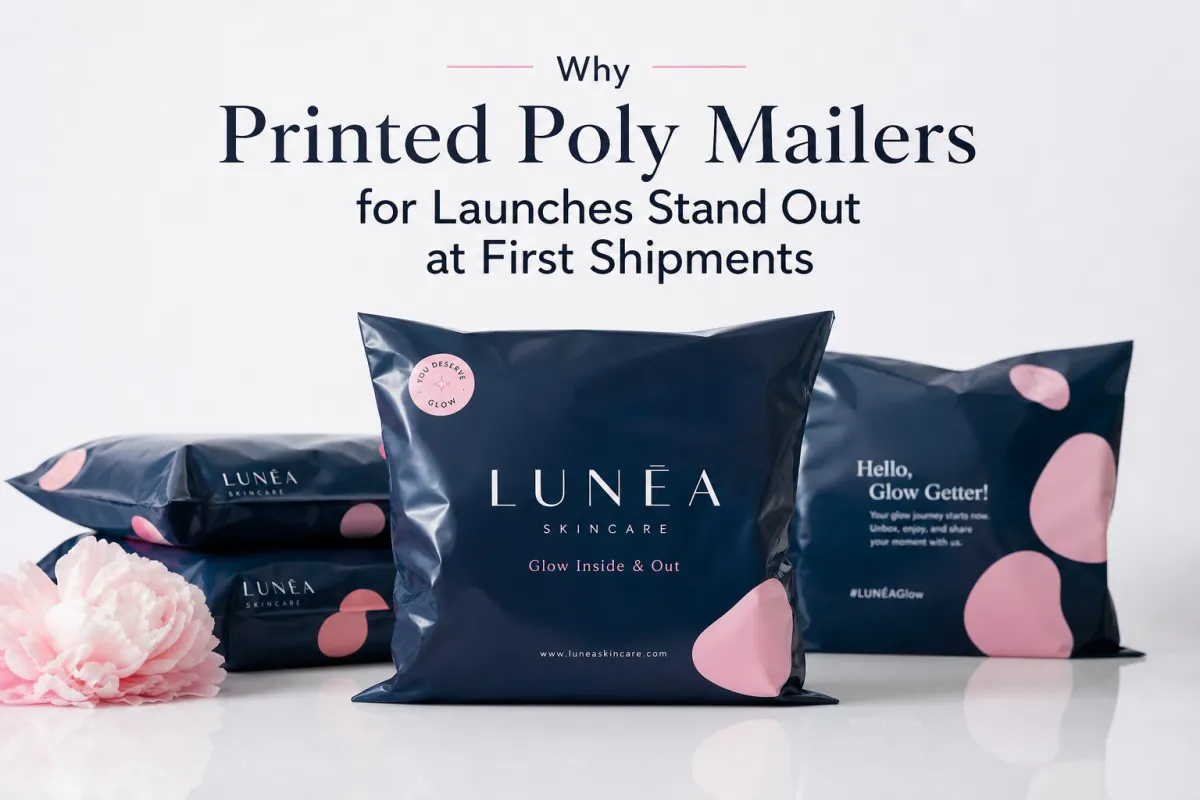
A launch shipment creates a different kind of pressure than a routine refill order. With Printed Poly Mailers for launches, the outer package becomes a visible piece of the campaign, which means the customer sees the brand before they ever touch the product. That first impression can show up in a porch photo, a desk unboxing, or a quick video clip shared with friends, so the mailer needs to look deliberate from the first glance.
Printed Poly Mailers are lightweight polyethylene shipping bags customized with logos, brand colors, launch messaging, QR codes, or a clean graphic mark. In practice, that makes them a useful middle ground between plain shipping and more expensive premium packaging. They do not try to replace the product itself, and they do not need the structure of a box for every order. They simply make the shipment look like it belongs to the brand, not like a generic parcel that happened to pass through a warehouse.
Printed poly mailers for launches stand out because launches are judged differently. A regular order can tolerate an unremarkable outer shell. A launch usually cannot. Teams want excitement, shareability, and a polished reveal that survives the trip through carrier sortation and still looks on-brand when it lands at the door. That is why these mailers are often chosen for apparel drops, accessory launches, sample kits, soft goods, and promotional mailings where speed and presentation both matter.
There is also a practical side that buyers sometimes underestimate. Launch timing is tight, inventory is staged in batches, and the packaging spec often gets finalized late in the process. If the outer mailer is too generic, the shipment feels improvised. If the artwork is too busy, it can print poorly or slow down approval. The sweet spot is usually a clear logo, a controlled color palette, and one or two graphic details that read quickly.
A launch package should look planned even before it is opened. If the outer mailer already feels intentional, the customer starts the experience with confidence instead of hesitation.
That is why printed poly mailers for launches are less about decoration and more about controlled presentation. They tell the customer that the team thought through the details, and that matters a lot when the product itself is still new to the market. The rest of the process comes down to a few practical decisions: size, artwork, durability, budget, timing, and the amount of visual impact the launch actually needs.
How Printed Poly Mailers for Launches Work in Fulfillment
The fulfillment flow is straightforward. Products are packed into the mailer, the opening is sealed, a shipping label is applied, and the parcel enters the normal carrier network with very little extra handling. That simplicity is one reason printed poly mailers for launches fit so well into fast-moving operations. They do not require assembly like a box, and they usually take less pack-out time than a rigid shipper.
The print process matters more than many launch teams expect. Flexographic printing is common for high-volume orders because it handles repeat artwork efficiently and keeps unit cost manageable as quantities rise. Digital printing can make sense for smaller runs, frequent artwork updates, or campaigns that want a different design approach. Either way, the artwork needs to be prepared with the print method in mind, because fine lines, dark fills, and subtle gradients do not always translate the same way across films and inks.
Printed poly mailers for launches also work well because the material itself is naturally useful in shipping. Polyethylene film is lighter than corrugated board, which can help keep dimensional weight down. It also offers water resistance, which is useful when packages sit on loading docks, get caught in weather, or pass through multiple hands. And because the exterior is a smooth printed surface, the brand mark stays visible at every handoff.
Best-fit products usually include apparel, light accessories, flexible kits, folded textiles, and other items that do not need a rigid shell. A launch T-shirt, a scarf, a beanie, a soft bundle, or a small accessory line often travels well in a mailer. Fragile goods are different. Glass, ceramics, hard electronics, and products with sharp corners may need internal cushioning, a rigid insert, or a different outer format altogether. A mailer can be part of the answer, but it should not be asked to do every job by itself.
From a packaging buyer's point of view, the useful question is not only "Will it ship?" but also "Will it run smoothly on the line and still look good after transit?" That is where printed poly mailers for launches earn their keep. They can be attractive without becoming fussy, and they can support a brand reveal without forcing the team to change the whole packing operation.
I have watched launch teams approve a beautiful mailer sample, then discover on the pack line that the opening was just a hair too narrow for the folded garment plus the insert card. Nobody wants to fight a bag like that for eight hours straight. If the fit is off, the line slows down, people get annoyed, and the design that looked polished on a mockup starts feeling kinda impractical in real life.
One more detail matters: the mailer should be sized for the actual packed item, not the idealized product size on the spec sheet. Folded apparel behaves differently once tissue, inserts, or hangtag cards are added. If the fit is too tight, seals can look stressed. If the fit is too loose, the package can look sloppy and shift around in transit. For launch work, that middle ground is what keeps the outer package from undermining the campaign.
Cost, Pricing, and MOQ Factors to Plan Around
Cost is usually the first thing launch teams compare, and for good reason. Printed poly mailers for launches can be a smart brand spend, but the price changes with size, film thickness, print coverage, number of colors, and order quantity. A small run with heavy coverage will almost always cost more per unit than a larger run with a simple one-color logo. That is normal, not a sign that something is wrong.
MOQ matters because launch orders are often uncertain at first. Smaller minimums make it easier to test the look and confirm the pack-out, but they usually carry a higher unit price. Larger minimums can lower the cost per mailer, though they require more storage space and a better demand forecast. For a campaign with a fixed drop date, the right choice is often the one that balances unit cost against the risk of ordering too many or too few.
Printed poly mailers for launches usually cost more than plain mailers, but the extra spend can replace other pieces of branding. A well-designed printed mailer may reduce the need for branded stickers, extra inserts, or manual decoration during pack-out. That is not always the case, but it happens often enough to make the comparison worth doing with real numbers rather than assumptions.
Here is a practical way to think about pricing. The numbers below are broad planning ranges, not promises, and they change with artwork complexity, film gauge, and shipping distance:
| Option | Typical MOQ | Estimated Unit Range | What Drives the Price |
|---|---|---|---|
| Plain poly mailers | 1,000-5,000+ | $0.08-$0.20 | Size, gauge, color, and bag style |
| Printed one-color mailers | 3,000-10,000+ | $0.16-$0.32 | Print coverage, setup method, quantity |
| Printed full-coverage mailers | 5,000-20,000+ | $0.24-$0.55 | Ink coverage, colors, film thickness, finish |
| Premium or specialty finish mailers | 5,000+ | $0.35-$0.75+ | Soft-touch feel, heavy gauge, custom features |
Those ranges are useful only if the quote request is complete. The details that prevent surprises are usually the exact dimensions, material gauge, print colors, whether the design runs on one side or both, finish preferences, shipping destination, sample charges, proof fees, and any rush or split-shipment costs. If a supplier has to guess on those items, the budget can wobble fast.
Printed poly mailers for launches are easiest to budget when the team treats them like part of the marketing plan rather than a last-minute shipping supply. If the launch is one-time, price per unit may matter most. If the launch is part of a continuing product line, repeat ordering and storage become part of the conversation too. I usually tell buyers to consider both the initial drop and the likely replenishment order, because the second order often determines whether the packaging choice was truly practical.
If you need a wider packaging comparison while budgeting, browse the broader Custom Packaging Products catalog and compare the mailer option with inserts, labels, and any support materials the launch may need. That kind of full-picture review is usually more honest than looking at the outer package in isolation.
Production Process and Timeline: From Art File to Delivery
The production sequence is simple on paper and occasionally messy in real life. Printed poly mailers for launches usually move through brief intake, artwork prep, proofing, color review, printing, curing or drying, converting, packing, and shipment. Each step can be quick if the files are clean and the specs are settled, or slow if the artwork keeps changing.
Timeline pressure usually starts with artwork approval. If the logo is not in the right format, if the color references are unclear, or if the launch message is still being revised, the schedule can slip before production even begins. New setups, plate work, and custom color matching also add time. A simple design can move faster than a heavily branded full-coverage mailer, but that depends on the factory's current load and the print method being used.
Printed poly mailers for launches should be ordered with buffer time before ads, influencer drops, and website go-lives. That buffer is not a luxury; it is what keeps the pack-out from waiting on a late proof or a delayed freight movement. In practice, many teams plan backward from the fulfillment date rather than forward from the purchase order date, and that usually gives a more realistic schedule.
Standard lead time is not the same as a rush order. A normal run may allow enough time for proof review, minor adjustments, and a careful color check. A rush order compresses those steps, which often raises cost and reduces room for error. Sometimes the rush is justified, especially for a fixed launch date. But if the schedule is tight because the art file stayed open too long, the launch team ends up paying for indecision.
That is also why launch packaging should be locked before photo shoots and paid media start running. Small changes to a logo lockup, a CTA line, or a QR code can force a reproof. A tiny design tweak may seem harmless on screen, but it can create rework on press. Printed poly mailers for launches reward decisiveness. Final art files, approved dimensions, and a locked quantity make the whole process calmer.
For teams that want a more formal check on shipping durability, the ISTA test procedures are a practical reference point. They are not a shortcut around real-world testing, but they do give structure to questions about drop resistance, vibration, and handling. And if sustainability claims are part of the launch message, the EPA recycling guidance is a safer source than broad marketing language that may not hold up in every local recycling system.
One practical habit saves a lot of stress: request a sample or digital proof before the full run whenever possible. Then check the fit, seal area, color clarity, and how the printed poly mailers for launches look beside the actual product and any inserts. A small proofing delay is far cheaper than discovering a sizing mistake after thousands of units are already on the way.
Common Mistakes That Can Undermine a Product Launch
The most common mistake is ordering the wrong size. If the mailer is too large, the product can swim inside and make the shipment look underthought. If it is too small, the seal can stretch or the contents can bunch up awkwardly. Printed poly mailers for launches need enough room for a clean pack-out, but not so much extra space that the package loses its shape.
Another frequent issue is low-contrast artwork. Busy graphics, thin type, and colors that blend together can make the logo harder to read, especially under warehouse lighting or on a phone camera. A launch package does not need to shout. It does need to read clearly. A strong focal point usually works better than a crowded design trying to say too much at once.
Durability mistakes are just as common. A film that feels fine for a lightweight sample can be too thin for a heavier product, a rough carrier route, or repeated abrasion. Once the package gets rubbed against other parcels, conveyor surfaces, and sorting equipment, a weak mailer can split at the seam or scuff enough to look tired on arrival. That is a bad look for printed poly mailers for launches, because the campaign is supposed to feel new and polished.
Operational oversights can be costly too. Some teams forget to test label adhesion, tear behavior, or how the mailer behaves on automation equipment. Others skip a pack-out trial and discover too late that the product inserts slow the line down. A pretty mailer that makes packers fight the opening every time is not a win. A launch package should support the workflow, not frustrate it.
Running out of stock is the launch-specific mistake that hurts the most. If you under-order, the team may have to switch to plain packaging halfway through the campaign. That breaks the consistency the launch was supposed to create and can make the whole rollout feel patched together. Printed poly mailers for launches work best when the quantity forecast includes the initial drop and a realistic cushion for surprises.
There is also a subtle mistake that shows up in review meetings: assuming the outer mailer alone will solve presentation problems. It will not. If the insert card is dull, the product is wrinkled, or the seal line looks rushed, the outer print cannot cover that up. Launch packaging works as a system. The mailer, the product, the insert, and the pack-out method all have to cooperate.
Expert Tips for Better Branding, Protection, and Unboxing
Choose one strong visual focal point. That might be the logo, a short launch line, or a bold color field that photographs well. In my experience, a clean design reads better than a crowded one, especially on a mailer that customers may only glance at while carrying it inside. Printed poly mailers for launches have a tiny job window to make a visual impression, so clarity beats complexity most of the time.
Think about lighting. Launch packages are often photographed in kitchens, hallways, bedrooms, and studio corners where the light is not perfect. Matte or carefully selected finishes can reduce glare, while a bold but balanced color palette helps the package show up well in photos. If a customer posts the shipment to social media, you want the brand to remain legible even in a quick handheld shot.
Printed poly mailers for launches also benefit from a short message that reinforces the campaign. A QR code can lead to product details or a landing page. A simple hashtag can encourage sharing if the audience is already active online. A short line of copy can remind the customer that the shipment is part of a launch and not just a routine fulfillment pull. Keep it brief. Launch mailers are not billboards.
Testing is the cheapest form of insurance. Pack the product, seal the mailer, and run a small simulation with a few drops, a shake test, or a short internal handling trial. That will show you whether the contents shift, whether the seal stays clean, and whether the visual presentation still feels intentional after handling. If the package survives that test, it is usually a better candidate for the full run.
In launch packaging, a small sample test often reveals more than a long email chain. Fit, finish, seal behavior, and print clarity are easier to trust once you have the actual mailer in hand.
Sustainability claims deserve care. Do not promise that a mailer is recyclable everywhere just because the material can be recycled somewhere. Local acceptance varies, and customers notice when brands stretch the truth. If you mention eco attributes, keep the language accurate to the material and the market. That kind of honesty builds trust, especially during a launch where every detail gets noticed.
Printed poly mailers for launches can support a responsible presentation too, but only if the team chooses the right specs. Sometimes that means using a simpler print layout to reduce ink coverage. Sometimes it means selecting a thickness that avoids unnecessary waste while still protecting the product. And sometimes it means pairing the mailer with a paper insert that fits the story without overcomplicating the shipper.
Launch Checklist: Practical Next Steps Before You Order
Before you request a quote, define the product dimensions, the finished pack-out thickness, the expected order count, and the visual direction. A premium launch may call for a fuller print treatment, while a quieter brand reveal may only need a clean logo and a controlled color palette. Printed poly mailers for launches are flexible, but the best result comes from clear decisions up front.
Gather the basics in one place: logo files, brand colors, artwork placement preferences, shipping destination, target timeline, and the exact quantity needed for the launch plus replenishment. If the order is split into multiple drops, note that early. The more complete the brief, the easier it is to get a quote that reflects the real job instead of a guess.
Ask for a sample or proof, then check fit, seal strength, color clarity, and how the finished package looks next to the product and any inserts. A launch package should feel like a single system, not a stack of separate parts. That is why printed poly mailers for launches are worth reviewing in context, under the same lighting and handling conditions the customer is likely to experience.
A simple approval path keeps things moving:
- Confirm the product size, pack-out thickness, and desired mailer gauge.
- Approve the artwork and check the print placement.
- Verify unit cost, MOQ, and shipping charges.
- Lock the production date and the delivery window.
- Plan receiving so the mailers arrive before fulfillment starts.
If you want to compare packaging formats before deciding, review the broader Custom Packaging Products lineup and weigh the mailer against inserts, labels, and any support materials the launch may need. That comparison often makes the right answer obvious, because printed poly mailers for launches are excellent for many products, but not every product needs the same outer shell.
Here is the cleanest way to think about the whole decision: the outer package should support the reveal, speed up fulfillment, and protect the product without adding avoidable cost or complexity. If the mailer does those things, it is pulling its weight. If it slows the team down or weakens the presentation, the spec needs another look.
Printed poly mailers for launches are not just shipping supplies; they are part of the first customer impression. Choose the size carefully, keep the artwork sharp, test the pack-out, and order early enough for proofing and production. Do that, and the shipment arrives looking like it was meant to be there from the start.
Printed Poly Mailers for Launches That Ship Cleanly and Look Intentional
If the launch is important, the packaging should look like it. Printed poly mailers for launches give you a practical way to make the first shipment feel branded, organized, and ready for the customer's first impression. They are lightweight, efficient, and easy to work into fulfillment, but they still need the right art, the right gauge, and the right quantity plan.
The best results come from straightforward decisions: lock the artwork early, test the fit, confirm the pricing tiers, and leave enough time for proofing and production. That is how printed poly mailers for launches stay useful instead of becoming one more last-minute problem. In the right setup, they make the package look intentional, protect the product in transit, and help the launch carry the kind of visual consistency people remember.
The real takeaway is simple: treat the mailer as part of the launch system, not an afterthought. If the printed surface reads clearly, the fit matches the packed product, and the timeline leaves room for proofing, the package will do its job without creating friction on the line. That is the kind of detail customers may not name out loud, but they feel it right away.
FAQ
Are printed poly mailers for launches better than plain mailers?
Usually, yes, if the launch depends on first impressions. Printed poly mailers for launches create a stronger visual cue because the customer sees the brand, color, or campaign message before opening the package. They still perform the same basic shipping job, so you get branding without switching every order into a heavier box.
How early should I order printed poly mailers for a product launch?
Early enough to cover artwork approval, proofing, and production, plus a little buffer if you need custom colors or a new setup. A sample or proof should be reviewed before the full run whenever possible. For printed poly mailers for launches, the safest schedule is the one that puts delivery before pack-out starts, not after.
What size printed poly mailers should I choose for launch apparel?
Measure the item after folding, bagging, or inserting it, because pack-out thickness matters more than raw garment size. Choose a mailer that lets the product slide in cleanly without forcing the seal or leaving so much extra space that the package looks loose. For multi-SKU drops, test the thickest and thinnest items separately.
Can printed poly mailers for launches protect fragile products?
Sometimes, but not on their own. Fragile items often need cushioning, a rigid insert, or a different outer format. Printed poly mailers for launches can support the presentation, but they should not be expected to solve impact protection if the product can bend, crack, or scratch easily.
What should I include in a quote request for printed poly mailers?
Include exact size, estimated quantity, print colors, one-sided or two-sided printing preference, and the film gauge you want to compare. Also ask for MOQ, unit cost at different quantities, proof timing, production lead time, and shipping costs. If timing is tight, note the launch date up front so the supplier can confirm whether the schedule is realistic.