Buyer Fit Snapshot
| Best fit | Custom Security Poly Mailers projects where brand print, material claims, artwork control, MOQ, and repeat-order consistency need to be specified before quoting. |
|---|---|
| Quote inputs | Share finished size, material target, print colors, finish, packing count, annual reorder estimate, ship-to region, and any compliance wording. |
| Proofing check | Approve dieline scale, logo placement, barcode or warning zones, color tolerance, closure strength, and carton packing before bulk production. |
| Main risk | Vague material claims, crowded artwork, missing packing details, or unclear freight terms can make a low unit price expensive after revisions. |
Fast answer: Custom Security Poly Mailers: Film, Print, MOQ, and Carton Packing should be specified like a repeatable production item. The safest quote records material, print method, finish, artwork proof, packing count, and reorder notes in one written spec.
Production checks before approval
Compare the actual filled-product size with the drawing, then confirm tolerance on folds, seals, hang holes, label areas, and retail display edges. Reserve space for logos, QR codes, warning copy, and material claims before decorative graphics fill the panel.
Quote comparison points
Review material grade, print process, finish, sampling route, tooling charges, carton quantity, and freight assumptions side by side. A quote is only useful when the supplier can repeat the same color, closure quality, and packing count on the next order.
Custom security poly mailers sit in a narrow lane inside the packaging mix, yet they have an outsized effect on how a shipment is received. They are light, flat, and easy to overlook on a sourcing sheet, but they shape the first few seconds of the customer experience long before the product is touched. For apparel, accessories, subscription kits, confidential documents, and other low-bulk items, custom security poly mailers can hide contents, reduce casual tampering, and carry branded cues that make the package feel intentional rather than thrown together.
That combination matters for brands that need presentation and protection to work together. A thin, plain bag can signal cheapness or vulnerability; a well-specified mailer can cut shipping weight, keep the contents out of sight, and move through fulfillment without adding unnecessary friction. From the buying side, custom security poly mailers are not just a print decision. They are a practical balance of privacy, package branding, and landed cost.
Brands often compare them with Custom Poly Mailers that focus more on graphics and appearance, or with cartons and Custom Packaging Products that support broader packaging programs. The right choice depends on what you ship, how your line is set up, and how much risk you are willing to accept if a parcel is opened, crushed, or delayed in transit.
What Are Custom Security Poly Mailers?
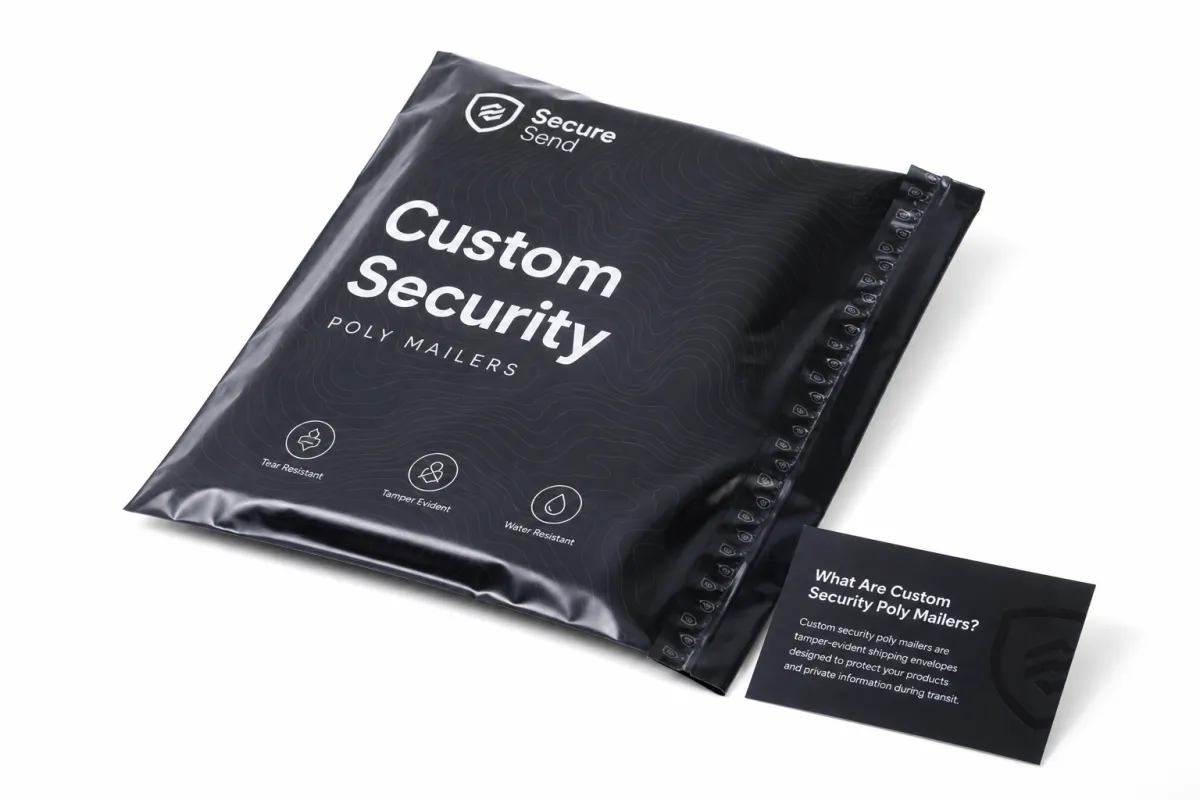
Custom security poly mailers are lightweight plastic mailers designed to conceal contents, resist casual tampering, and display branded graphics at the same time. The security side comes from the structure, not from a label alone. Opaque film keeps the product out of view. A strong closure makes re-opening more difficult. Tear resistance and tamper-evident behavior make unauthorized access easier to spot. Custom printing adds the brand layer on top of that functional shell.
In practice, the outer mailer often becomes the first layer of trust. If the bag looks flimsy, warped, or semi-transparent, the shipment can feel exposed before the seal is even broken. That is a packaging design issue as much as a logistics issue. Better custom security poly mailers address both by pairing brand identity with straightforward protection.
Most are made from polyethylene film, often in a co-extruded construction with an opaque outer layer and a darker inner layer. Thickness is usually measured in mils. For many retail packaging and apparel programs, specs around 2.5 to 4 mil are common, though heavier or more sensitive items may call for more. Some mailers include warning copy such as "If seal is broken, do not accept," while others use printed patterns or brand graphics that make the bag look finished and less generic.
Compared with boxes, the tradeoff is easy to see. Boxes perform better under stacking and compression, and they usually deliver more crush protection. Yet custom security poly mailers often win on shipping weight, storage efficiency, and unit cost for soft goods. They fold flat, take up far less warehouse space, and move through packing stations quickly. That makes them attractive for e-commerce Brands That Ship at scale and watch labor minutes as closely as material cost.
Use cases stay fairly consistent. Apparel, socks, swimwear, soft accessories, documents, and other low-bulk items are natural fits. Subscription products and direct-to-consumer orders also benefit because the mailer can do two jobs at once: concealment and brand presentation. If the goal is a discreet but polished arrival, custom security poly mailers are often easier to justify than custom printed boxes, especially when the contents do not need rigid-wall protection.
They are not the right answer for every shipment. Fragile or rigid products may still need corrugated protection. Higher-value items may call for additional tamper controls or secondary packaging. For the right product profile, though, custom security poly mailers offer a practical middle ground that many operations can adopt without rebuilding the fulfillment line.
How Custom Security Poly Mailers Work
The security story begins with the material stack. A good mailer is more than plastic with a logo on it. It is a controlled combination of outer film, inner film, adhesive, and seal behavior. The outer face carries artwork and handling cues. The inner layer hides the contents. The closure strip bonds the flap to the bag in a way that is hard to reverse cleanly. That is where the real value of custom security poly mailers shows up.
Opaque construction does most of the visual work. It blocks the outline of the item and reduces the chance that someone can identify what is inside at a glance. That alone can make theft less appealing. A small, high-value item in a transparent or weak bag invites curiosity. The same item in a properly opaque mailer is much less visible and far less tempting.
Tamper evidence is the next layer. Most buyers do not need packaging that cannot be opened at all; they need a clear sign if the package was opened and reclosed. In custom security poly mailers, the adhesive usually leaves visible damage or residue if someone pulls the flap away. Some designs go further with tear lines, perforations, or a second-seal layout that leaves an obvious trail. That is useful for products where customers care about privacy, chain of custody, or receiving a shipment unopened.
Custom printing helps with security in a quieter way. A branded warning line, a return-direction cue, or a package ID area can reinforce how the parcel should arrive and be handled. Even a simple message such as "sealed for your protection" feels more credible when the construction supports it. Design and spec have to match. A bag that looks secure but tears at the seam is worse than a plain bag with honest performance.
A mailer is not secure because it says secure. It is secure when the film, seal, and handling cues all support the claim.
Some custom security poly mailers include dual adhesive strips. That matters for reverse logistics. A second strip lets the customer reuse the mailer for returns without hunting for tape. Apparel brands like that because it shortens the return process and keeps packaging consistent on both legs of the journey. Other versions add reinforced seams or a thicker side gusset so the bag can handle awkward pack-outs without stretching at the corners.
A useful comparison comes from box-based systems. Cartons give better protection against crushing and can communicate a Premium Product Packaging feel, but they also add weight, storage volume, and assembly time. By contrast, custom security poly mailers can be packed almost as quickly as a standard bag while still carrying enough structure to resist casual interference. That is why they show up so often in apparel, cosmetics accessories, printed inserts, and other categories where speed and discretion matter.
For brands that need broader packaging design support, the mailer can fit into a larger package branding system. The same logo language, color palette, and warning style can also carry over into inserts, labels, and even Custom Packaging Products like tissue, stickers, or shipping cartons. Consistency matters. Buyers notice when the mailer feels like part of a system instead of an afterthought.
Key Factors That Shape Performance and Pricing
Pricing for custom security poly mailers comes from a handful of variables that are easy to underestimate if you only look at a quote sheet. Material thickness, print coverage, size, security add-ons, and order volume all move the number. Artwork revisions do too. The adhesive system matters as well. A small spec change can shift the unit cost by several cents, and that difference adds up quickly on a large run.
Film thickness is one of the clearest drivers. In the market, a lightweight mailer might sit around 2.5 mil, while a more durable security mailer could move up to 3 mil or 4 mil. Thicker film usually improves puncture resistance and seam strength, but it can also raise material cost and sometimes shipping weight. The right answer depends on the product. A soft tee does not need the same structure as a heavier knit set or a boxed accessory kit shipped inside a mailer.
Print complexity matters more than many procurement teams expect. One-color branding is usually cheaper than full bleed graphics, metallic ink, or multi-panel print layouts. If your brand wants a bold, full-surface package branding treatment, that can still be worth it. Just do not expect a heavy print build and a simple one to cost the same. They do not. That is true for custom security poly mailers just as much as it is for custom printed boxes.
Size is another hidden cost lever. Oversized mailers waste film and create slack, which can let the contents shift in transit. Undersized mailers stress seams, force harder packing, and raise the chance of split edges. The sweet spot is a bag with enough room for insertion but not so much extra space that the product swims inside. For many buyers, sample testing is the only reliable way to find that balance. If the product is bouncing around in the bag, the mailer is gonna work against you instead of for you.
Order volume affects both price and risk. Setup costs spread more efficiently across larger runs, so the unit price tends to improve as quantities rise. That said, overbuying creates its own problem. If your forecast is shaky, a low unit price can trap cash in inventory and leave you with stale packaging after the season changes. That is one reason custom security poly mailers should be priced with the full inventory picture in mind, not just the factory invoice.
Security add-ons change the math as well. Common examples include:
- Extra adhesive lines for returns
- Specialty opaque films
- Tear-strip features
- Reinforced side seams
- Warning text or handling cues
Each one improves the package in a different way. None is free. The smarter buyers compare the added cost with the cost of damage, re-ships, customer complaints, and warehouse time. A slightly more expensive mailer can lower the true cost per order if it reduces failure rates. That is a kkind of boring truth, but packaging people live on those boring truths.
The table below gives a practical comparison point for common options. Prices are indicative only; artwork coverage, film choice, and minimum order quantity can move them noticeably.
| Option | Typical Spec | Indicative Unit Cost at 5,000 Pieces | Best Fit |
|---|---|---|---|
| Standard poly mailers | 2.25-2.5 mil, simple print, basic adhesive | $0.11-$0.22 | Low-risk soft goods and high-volume shipping |
| Custom security poly mailers | 2.5-4 mil, opaque film, tamper-evident seal, custom print | $0.18-$0.38 | Apparel, accessories, documents, privacy-sensitive shipments |
| Custom printed boxes | Corrugated or folding carton, printed exterior, higher compression strength | $0.45-$1.20+ | Fragile products, premium retail packaging, heavier contents |
If you want a practical reference on testing and shipping performance, ISTA is a solid place to start. Packaging engineers rely on test methods because intuition only goes so far. A package can look fine on a quote and still fail after vibration, compression, or drop testing. That is especially true for custom security poly mailers, where seal integrity and film behavior matter more than a glossy mockup.
Sustainability adds another layer to the pricing conversation. Some brands want recycled content or downgauged material to reduce plastic use. That goal can work, but only if the mailer still performs. If the closure fails or the seam splits, the environmental win disappears quickly once the package is replaced and shipped again. For guidance on materials and waste, the EPA recycling resource is useful background reading, even if your final spec stays focused on performance first.
In short, custom security poly mailers are priced by a mix of physics and logistics. Film thickness, print build, sizing discipline, and order volume are the big levers. The real question is not "What is the cheapest bag?" It is "Which spec protects the shipment and keeps the operation efficient at a reasonable landed cost?"
How to Choose Custom Security Poly Mailers for Your Workflow
The right custom security poly mailers for one brand can be a poor fit for another. Product profile comes first. Soft apparel needs different support than confidential documents. A higher-value accessory may justify thicker film and more obvious tamper evidence. A subscription kit may care more about presentation and brand consistency. Start there, because everything else follows.
Next, map the pack-out process line by line. How is the item inserted? Does it need tissue, an insert card, or a barcode label? Is the sealing motion done by hand or by machine? How many seconds does each pack take? If the mailer disrupts that flow, the spec may be right on paper and wrong in the warehouse. That is one of the main reasons custom packaging decisions miss the mark. They look tidy in procurement and awkward at packing stations.
Customer experience matters too. Some brands want a discreet, no-nonsense look. Others want a bolder package branding moment. A black opaque mailer with a crisp logo can feel premium and secure. A more colorful design can feel retail-ready and energetic. Either way, the packaging should match the promise of the product. A luxury accessory shipped in a thin anonymous bag sends mixed signals, while a well-specified bag can support the rest of the product packaging story.
Carrier compatibility is worth checking earlier than many teams do. Weight thresholds, dimensional rules, and label placement all affect how the bag moves through the shipping network. If your order profile is mostly lightweight, custom security poly mailers usually work well. If the product edges are sharp or the item is oddly shaped, you may need a heavier film or a carton-based solution. That tradeoff is part of responsible packaging design, not a failure of the mailer itself.
Sustainability goals should be handled plainly. Many buyers want recyclable materials or recycled content, and that is a reasonable target. A downgauged film that tears during fulfillment is not a sustainable choice in practice, because re-ships and damage claims create more material use elsewhere. Better to specify the lightest film that reliably survives the journey than to chase the absolute minimum gauge. That is true for custom security poly mailers and for most other retail packaging formats.
Here is a useful comparison of decision factors:
- Security level: opaque film, tamper evidence, and closure style
- Product fit: soft goods, documents, accessories, or mixed kits
- Workflow speed: hand packing, semi-automated packing, or high-volume fulfillment
- Branding needs: subtle logo, bold graphics, or premium package branding
- Inventory plan: monthly usage, seasonal spikes, and reorder timing
If you are not sure which direction to take, request samples before you commit. A spec sheet cannot show how the seal feels after the bag is filled, or whether the print reads cleanly against the film color you chose. That is why sample testing matters so much with custom security poly mailers. The bag has to work in the hand, on the line, and in the customer’s kitchen or office when it is opened.
One more point deserves attention: compare the mailer with other formats, not just with itself. Sometimes custom security poly mailers are the right answer because they preserve speed and reduce weight. Other times, a printed carton or a hybrid system is smarter. The best buying decisions usually come from comparing total process fit, not just unit price.
Custom Security Poly Mailers: Process and Timeline
Most custom security poly mailers follow a fairly predictable production path. First comes spec selection. Then artwork. Then proofing. Then manufacturing. Then quality checks and shipment. That sounds straightforward, but most delays happen in the middle, not the beginning. Missing size details, unclear artwork files, or late approval from internal stakeholders can extend the timeline faster than any factory step.
A typical project starts with confirming dimensions, film thickness, adhesive style, and print coverage. After that, the supplier usually prepares artwork placement or a dieline. If the logo file is not clean, or if the brand wants to change the warning text after the proof is issued, the schedule shifts. For custom security poly mailers, that extra round-trip is common because security messaging often involves more than a logo on white film.
Lead time depends on complexity. Straightforward runs may move relatively quickly, while custom sizes, specialty films, extra adhesive strips, and high-coverage print can stretch the schedule. The goal is not to promise a fixed number blindly. A realistic planning window is usually more useful than an aggressive sales estimate. For many operations, simpler custom security poly mailers arrive faster than multi-feature versions, but both still need proof approval and manufacturing capacity.
Sample approval may feel like a delay, but it usually saves time later. If the bag is too short, too narrow, or too transparent, it is much cheaper to catch that during sampling than after 20,000 pieces are already in production. The same goes for seal behavior. A closure that looks fine on a sample sheet may not behave the same once the mailer is filled and pressed flat. Good buyers treat sampling as risk reduction, not paperwork.
Build buffer time into the order plan. Seasonal demand spikes make every procurement mistake louder. If a holiday launch depends on custom security poly mailers, order early enough that a proof revision or a printing delay does not force a rushed backup buy. Emergency packaging is usually expensive packaging, and it rarely supports the brand as well as the planned version.
For teams building a broader packaging program, timeline planning should include other components too. Inserts, labels, tissue, and cartons may all need to arrive together. If you are aligning packaging design across product packaging, shipping materials, and display assets, the mailer should be synchronized with the rest of the system. That is one reason many buyers review Custom Packaging Products alongside the mailer spec instead of treating them as separate projects.
It also helps to think about reorder cadence. A first order of custom security poly mailers is often slower than a repeat order because setup, artwork confirmation, and internal signoff take time. Once the spec is locked, the process becomes easier. Keep the approved artwork, exact measurements, ink colors, and closure notes in one place so the next purchase does not start from scratch.
Most packaging teams underestimate the value of a clean spec sheet. They remember the logo, but not the seal width, material color, or return-strip configuration. Six months later, that missing detail becomes a headache. A single source of truth for custom security poly mailers shortens approvals and cuts rework, which matters more than it sounds when the order volume starts climbing.
Common Mistakes When Ordering Security Mailers
The most expensive mistake is choosing by price alone. A cheap bag is only cheap if it arrives intact, seals properly, and protects the shipment through the carrier network. If it tears, opens, or confuses the pack team, the money you "saved" comes back as damage, re-ships, and customer support time. That is especially true with custom security poly mailers, where the point is to reduce risk, not simply to print a logo on plastic.
Another common error is ignoring seam strength and adhesive quality. Buyers sometimes focus on artwork first because that is the visible part. The invisible part is the one that decides whether the mailer survives. If the closure is weak or the seam is uneven, the package may split under real-world handling. A pretty mailer that fails at the fold is not a branding success. It is an operational problem.
Size mismatch is equally dangerous. Too much empty space creates sloppy presentation and lets the product move. Too little creates stress at the edges and can make packing slower. For custom security poly mailers, the fit should be tested with the fully packed item, not just the naked product. Add inserts, tissue, or accessories if they are part of the final pack-out. The size has to reflect the real order, not the warehouse sample.
Artwork mistakes can make a premium mailer look amateur very quickly. Low-resolution logos, missing bleed, and vague file placement are common problems. If your team is ordering custom security poly mailers with full coverage graphics, you need clean source files and a proofing process that catches edge issues before production. A blurry logo on opaque film can cheapen the whole shipment.
Underestimating order volume is another trap. Packaging demand often moves faster than planners expect, especially during launches or promotions. If the run is too small, you may run out at the worst time. If it is too large, inventory sits around and takes up cash and storage room. Either way, custom security poly mailers need to be matched to actual monthly usage, not just a hopeful forecast.
There is also the temptation to oversell security. A printed warning line does not mean the bag is impervious. Tamper evidence is not the same thing as tamper-proof construction. If your marketing says the package is highly secure, the structure needs to support that claim. Honest wording protects the brand. That is true for custom security poly mailers and for any other product packaging that makes a safety promise.
One more subtle mistake: failing to coordinate the mailer with the rest of the shipping experience. If the outer bag feels premium but the label placement is awkward, or if the return process is confusing, the customer notices the mismatch. Good package branding is consistent. It does not have to be flashy, but it does need to feel deliberate.
Expert Tips for Better Results with Custom Security Poly Mailers
Test closure strength with the real packed product, not just with a sample sheet. That sounds obvious, yet it gets skipped all the time. Once the item is inside the bag, the stress distribution changes. A mailer that closes beautifully on paper may behave differently with a folded hoodie, a boxed accessory, or a stack of inserts. This is where custom security poly mailers reward disciplined testing.
Use branding elements that support trust, not just decoration. Clear color blocking, concise handling cues, and a consistent logo placement can make the package feel more controlled. Subtle print can still feel premium if the layout is clean. In fact, many of the strongest package branding programs are restrained. They look planned. That matters more than shouting across the bag.
Measure total cost, not just purchase price. Storage space, packing speed, claim rates, and return handling all affect the real number. If a slightly better mailer reduces damage and speeds up the line, it can cost less overall than the cheapest alternative. That is a packaging truth many teams learn the hard way. Custom security poly mailers should be judged on landed cost and process fit, not just the invoice line.
Design around the unboxing sequence. The outside of the bag should feel intentional. The inside should be easy to open, easy to inspect, and easy to reuse if returns matter. Good custom security poly mailers make the customer’s first touch feel orderly rather than random. If the package opens cleanly and the contents are protected, the brand gets credit even before the product itself is reviewed.
Keep a spec sheet for every approved version. Record dimensions, film thickness, adhesive type, print colors, and any return-strip detail. That makes reorders faster and keeps the program from drifting. A missing note today can become a production discrepancy later. For high-volume teams, custom security poly mailers are easier to manage when the approved version is documented like a controlled part number.
Ask detailed questions before artwork is finalized. Can the supplier print edge-to-edge? Is there a limit on ink coverage? Are recycled-content films available? Is the return strip standard or an add-on? These are not minor questions. They determine how the mailer performs and how the artwork should be built. The more you know upfront, the fewer compromises you have to make later.
If you are balancing several formats across a brand family, align the mailer with the rest of the system. A web order bag that looks coherent next to shipping cartons, inserts, and retail packaging tells a better story than one that feels improvised. That is where custom security poly mailers can quietly strengthen the wider packaging design language without becoming the loudest piece in the stack.
Next Steps for Ordering Custom Security Poly Mailers
Start with four facts: product dimensions, security needs, monthly volume, and brand requirements. Once those are clear, the rest of the spec gets much easier to define. If the product is soft and low-risk, a simpler version may be enough. If privacy, tamper evidence, or resale presentation matter more, custom security poly mailers deserve a more deliberate build.
Request at least two samples. Side-by-side comparison tells you more than a spec sheet can. Compare structure, seal strength, print clarity, and the way the bag feels once it is loaded. One sample may look fine until you handle the second one and realize the closure pressure is different. That kind of comparison is exactly why sample orders are worth the time for custom security poly mailers.
Build a simple comparison sheet before you place the order. Include price, minimum order quantity, lead time, available thicknesses, print options, and return-strip choices. Then compare the sheets against your actual operational needs instead of against the loudest sales pitch. The best result is usually the bag that protects the shipment, fits the process, and supports the brand at a reasonable landed cost.
Bring marketing, operations, and procurement into the same conversation. Each group judges custom security poly mailers differently. Marketing cares about branded packaging and presentation. Operations cares about speed and failure rates. Procurement cares about cost and continuity. If those priorities are handled separately, you tend to get compromise after compromise. If they are handled together, you get a cleaner decision.
One last practical rule: if the mailer protects the product, fits the workflow, and supports the brand at a reasonable landed cost, it is probably the right choice. That sounds plain, but plain is useful. Custom security poly mailers are at their best when they make shipping simpler, not more complicated.
For brands that want a package that feels more controlled than a basic poly bag, but less heavy and expensive than a carton, custom security poly mailers can be the smartest middle path. They protect the shipment, carry the brand, and keep fulfillment moving. That is a strong combination, and in packaging, strong combinations usually win.
What makes custom security poly mailers different from standard poly mailers?
They usually add opaque construction, tamper-evident sealing, and stronger branding cues. custom security poly mailers are built to hide contents and make unauthorized opening more obvious, while also giving the brand a tailored look.
How do I choose the right size for custom security poly mailers?
Measure the item after packaging, not just the product alone. Leave enough room for easy insertion without excess slack, and test a few sample sizes so the item lies flat and seals cleanly. That is the fastest way to avoid wasted film and stressed seams in custom security poly mailers.
What affects the cost of custom security poly mailers the most?
Material thickness, print coverage, custom features, and order volume are the biggest drivers. Specialty security options usually raise unit cost, but they may reduce loss and re-ship expenses. Artwork changes can also add time and cost to custom security poly mailers.
How long does it take to produce custom security poly mailers?
Timeline depends on whether the order is a standard or highly customized spec. Artwork approval, proofing, and manufacturing capacity are the main variables. Adding buffer time is smart if custom security poly mailers are needed for a seasonal launch or promotion.
Are custom security poly mailers good for returns?
Yes, if they include a second adhesive strip or a return-friendly closure design. They can simplify reverse logistics for apparel, accessories, and other lightweight products. It helps to confirm whether the return strip is strong enough for the return journey before you approve custom security poly mailers.

