Buyer Fit Snapshot
| Best fit | Custom Shopping Bags with Logo projects where brand print, material claims, artwork control, MOQ, and repeat-order consistency need to be specified before quoting. |
|---|---|
| Quote inputs | Share finished size, material target, print colors, finish, packing count, annual reorder estimate, ship-to region, and any compliance wording. |
| Proofing check | Approve dieline scale, logo placement, barcode or warning zones, color tolerance, closure strength, and carton packing before bulk production. |
| Main risk | Vague material claims, crowded artwork, missing packing details, or unclear freight terms can make a low unit price expensive after revisions. |
Fast answer: Custom Shopping Bags with Logo: Film, Print, MOQ, and Carton Packing should be specified like a repeatable production item. The safest quote records material, print method, finish, artwork proof, packing count, and reorder notes in one written spec.
Production checks before approval
Compare the actual filled-product size with the drawing, then confirm tolerance on folds, seals, hang holes, label areas, and retail display edges. Reserve space for logos, QR codes, warning copy, and material claims before decorative graphics fill the panel.
Quote comparison points
Review material grade, print process, finish, sampling route, tooling charges, carton quantity, and freight assumptions side by side. A quote is only useful when the supplier can repeat the same color, closure quality, and packing count on the next order.
Custom Shopping Bags With Logo: Smart Branding Basics
Custom shopping bags with logo do more than carry a purchase from the counter to the door. A bag from a boutique, gift shop, or trade show booth can keep showing up in office lobbies, on trains, in parking lots, and along sidewalks, turning one checkout moment into repeated street-level exposure. That is why custom shopping bags with logo sit right where branded packaging, packaging design, and practical retail presentation overlap.
From a packaging buyer’s point of view, the bag is not just a logo printed on paper. It is a small piece of product packaging with a clear job: hold weight, protect the item, fit the brand, and make the sale feel deliberate. Get those decisions right and custom shopping bags with logo can make a $12 accessory feel more polished than a rushed box ever could. Get them wrong, and the bag becomes the weak point in the whole presentation.
The practical side matters most. We are going to look at how custom shopping bags with logo are made, which materials and finishes change the result, what pricing really depends on, and how to order without paying for avoidable mistakes. If your business also uses Custom Packaging Products, the same logic carries across bags, inserts, and custom printed boxes: the best choice usually fits the product, the customer, and the budget at the same time.
A bag is a moving advertisement, but it is also a carrying tool. If one of those jobs fails, the brand story starts to fray.
In my own work around retail packaging, the bag is often the thing people remember most clearly because it leaves with them. The item inside may disappear into a closet or onto a shelf, but the bag keeps living in the world a bit longer, which is pretty handy for a brand.
What Custom Shopping Bags with Logo Actually Do
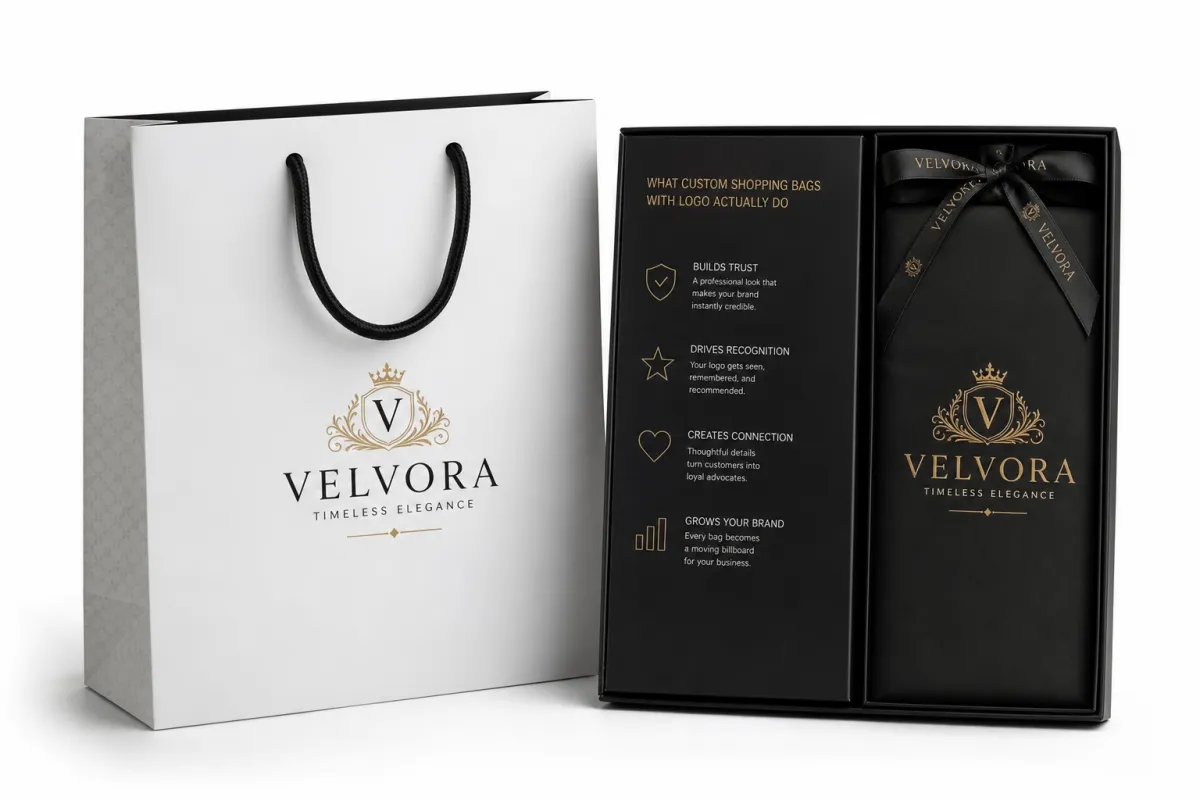
A customer may keep a bag longer than the product that came inside it. That is the quiet strength of custom shopping bags with logo. The bag might live in a closet, ride in a trunk, get reused for lunch, or show up at another store weeks later. Each reuse adds impressions without another media buy, which is why experienced retailers treat bags as a practical form of advertising rather than a throwaway expense.
Custom shopping bags with logo also shape perceived value. A paper bag with a crisp handle and balanced print tells shoppers that the business paid attention to the details. A flimsy bag says something different. In luxury retail, the bag can support the product story almost as much as the product itself. In casual retail, it still adds polish. Either way, the right retail packaging helps the purchase feel complete.
There is a clear difference between a branded bag and a random carrier. Custom shopping bags with logo are built around material, size, handle style, print method, and finish. A small jewelry store, a mid-range apparel brand, and a food gift business should not buy the same bag and expect the same outcome. A 7 x 4 x 10 paper bag works for smaller items; a 16 x 6 x 12 bag fits folded apparel better; a reusable nonwoven tote makes sense when repeat use and higher perceived value matter.
For business owners, the value often shows up in three places. First, the customer experience improves because the packaging fits the item instead of fighting it. Second, the brand looks more consistent across the shelf, checkout, and social photos. Third, the bag becomes a simple extension of the marketing budget. Compared with paid ads, custom shopping bags with logo are modest, tangible, and easy for buyers to remember.
That does not mean every use case calls for the same bag. A farmer’s market vendor may need low-cost paper bags for fast handoff. A cosmetics brand may want a matte coated finish that matches the rest of the packaging design. A pop-up event may need a lightweight reusable tote that customers carry back into the venue. The practical question stays the same: what job should the bag perform after the sale?
And yes, sometimes the answer is a very plain bag. That is not a failure. It just means the packaging has to do a job quietly, without trying to be the star of the show.
How Custom Shopping Bags with Logo Are Produced
The production path for custom shopping bags with logo is simple on paper, though every step changes the result. It usually begins with the bag style, then the dimensions, artwork, print method, proof, and final production. That sounds routine, yet this is where many buyers lose money. One wrong early choice can force the rest of the order to fit around it.
Artwork quality matters more than most people expect. Vector files are usually the safest starting point because they keep edges sharp at different sizes and make color separation easier. A logo pulled from a website or a low-resolution JPEG may look fine on a screen, then blur or pixelate on the bag. With custom shopping bags with logo, that weakness shows quickly because the print area is often large and the material surface reveals shaky artwork.
Print method changes the final look. Screen printing works well for bold, one- or two-color designs because it handles solid coverage efficiently and stays practical on larger runs. Digital printing fits art with gradients, fine text, or wider color variation. Foil stamping, embossing, and spot UV create a more premium feel, though they add steps and cost. If the brand wants clean, everyday visibility, simple ink often makes the most sense. If the goal is a gift bag with a richer finish, specialty effects may be worth the extra spend.
Logo placement is never random. Bag structure affects where the mark should sit. A centered front panel is classic and easy to read. Repeated side-panel branding can create a pattern effect. A smaller mark near the bottom looks understated. Large, edge-to-edge graphics make the bag feel more promotional. With custom shopping bags with logo, the right layout depends on whether the bag should whisper, speak clearly, or stand out from across the room.
Most suppliers provide a digital proof, and some offer a physical sample or a pre-production mockup. This is where spacing, color, handle placement, and structural balance get checked. That proof stage matters because bags behave differently from flat paper. A fold line can cut through a logo. A gusset can distort proportions. A handle tie can interfere with copy. Custom shopping bags with logo may look simple on a quote sheet, then become very specific once the artwork is mapped onto the actual bag.
Production time depends on complexity. A stock-size paper bag with one-color print may move quickly after proof approval, while custom dimensions, lamination, foil, or mixed materials naturally take longer. More steps mean more room for inspection, and more inspection means more control. Buyers who rush this part often pay for it later through reprints or delays.
Materials, Sizes, and Print Choices That Change Results
Material choice is where custom shopping bags with logo stop being generic and start doing real work. Kraft and paper bags fit retail carry-out, gift purchases, and lighter goods. Coated paper feels smoother and usually looks more polished, especially with matte or gloss lamination. Nonwoven polypropylene makes sense for reusable promotional bags. Cotton and recycled textile bags raise perceived value and can survive repeated use, which helps when the customer is expected to keep the bag in circulation.
For paper-based custom shopping bags with logo, weight often falls in the 120gsm to 210gsm range for many retail applications, though heavier constructions are available. Nonwoven bags are often specified by thickness or grams per square meter, and cotton totes are commonly sold by ounce weight. Those numbers matter because they affect hand feel, load capacity, and the impression the bag creates before a logo is even seen. A thin bag can still serve a purpose, but it should not pretend to be premium.
Size is another decision that looks small on paper and large in practice. Too small, and the item bulges or the handles strain. Too large, and the package feels wasteful. Custom shopping bags with logo should match the carried product, not a vague average. A boutique selling scarves and candles has different sizing needs than a store moving boxes of skincare or folded apparel. If the dimensions are off by even an inch or two, the bag can feel improvised, which weakens the brand story.
Handle style matters more than many buyers expect. Twisted paper handles are economical and familiar. Rope handles feel stronger and often look more upscale. Die-cut handles can save space and keep the silhouette clean. Reinforced tops and gussets improve load performance, which is especially useful if the customer is carrying glass bottles, hardcover books, or stacked items. A bag can look beautiful and still fail if the handle is weak.
Print coverage changes how the message lands. A small logo near the center reads as restrained and practical. A repeated all-over pattern turns the bag into a moving graphic surface. Full-panel printing can create strong shelf impact, especially for launches or seasonal events. This is where branded packaging meets packaging presentation: the same logo can feel understated, premium, or promotional depending on how much of the bag it occupies.
Sustainability deserves a clear-eyed view. Recycled content, FSC-certified paper, reusable materials, and durable constructions all help, but a bag only earns the sustainability label if it is actually used enough times to justify its footprint. I usually advise buyers to think about lifespan rather than slogans. A paper bag made from certified fiber is useful. A reusable tote that lasts through 30 or more outings may be even better. The right answer depends on product weight, brand image, and how often the customer is likely to keep the bag.
If you are comparing bag types, this simple lens helps:
| Bag Type | Best For | Typical Order Use | Approx. Unit Cost at Scale | Notes |
|---|---|---|---|---|
| Kraft paper | Retail carry-out, gift shops, lightweight goods | Fast checkout, short-term use | $0.18-$0.40 | Good value, easy to print, often FSC options available |
| Coated paper | Premium retail, cosmetics, apparel | Higher perceived value | $0.30-$0.70 | Better finish, supports richer graphics and lamination |
| Nonwoven polypropylene | Promotional events, repeated use | Reusable distribution | $0.45-$1.20 | Strong branding surface, common for larger print areas |
| Cotton or recycled textile | Premium gifts, eco-focused brands | Longer life, retail add-on | $0.90-$2.50+ | Higher upfront cost, strongest reuse potential |
Those prices are broad ranges, not promises. They move with quantity, print coverage, bag size, and shipping method. Even so, they show how much the material choice alone can change the project. For many buyers, the real decision is not whether custom shopping bags with logo are worth it; it is which format creates the right balance of utility and presentation without overpaying for features the customer will never notice.
For businesses that pair bags with Custom Packaging Products or custom printed boxes, consistency matters. If the box is matte and minimal, the bag should not suddenly become glossy and loud unless that contrast is intentional. Coordinated retail packaging makes the whole purchase feel planned instead of assembled from separate vendors.
Custom Shopping Bags with Logo: Cost, Pricing, and Budget Tradeoffs
Pricing for custom shopping bags with logo is shaped by a few predictable variables: material, size, print complexity, number of colors, finishing, and quantity. Buyers often focus on the unit quote first, but the better question is how the total order behaves once setup, freight, and proofing are added. A bag that looks inexpensive at the factory can turn costly after shipping and prep charges are included.
Setup charges are a classic surprise. Some suppliers bill for printing plates, screen prep, die work, or artwork adjustments. Others build those costs into the quote, though not always. If you are comparing vendors, ask whether the price includes all prep fees and whether artwork changes will trigger another charge. The lowest per-bag number is not always the lowest total spend. That is especially true with custom shopping bags with logo, where a simple quote can hide a lot of small extras.
Quantity changes the economics quickly. Low minimum orders give flexibility, which helps for a new launch or seasonal program. Bulk orders usually lower the unit cost, sometimes dramatically. A run of 500 bags may cost twice as much per unit as a run of 5,000. Even so, bulk is not automatically smarter. If the design will change next quarter, storage and obsolescence can erase the savings. I prefer buyers to think in terms of usage windows, not just volume.
There are also hidden costs that deserve attention: rush production, specialty inks, laminated finishes, sample fees, shipping insurance, and artwork cleanup. Custom shopping bags with logo that appear simple may still need prepress work if the supplied file is not print-ready. If the customer needs a launch date, every extra day in proofing can matter. That is where rush fees can appear with very little warning.
Here is the most useful pricing lens I know: ask for the landed cost per bag. That means the unit price plus freight, setup, and any unavoidable fees divided across the total quantity. Comparing landed cost keeps the conversation honest. It also helps you compare custom shopping bags with logo against other branded packaging choices such as inserts, tissue, or product packaging upgrades that may deliver more perceived value for similar money.
To make budgeting easier, here is a practical rule of thumb. If the bag is meant for daily retail use, spending a little more on durability usually pays off because the item gets handled often. If the bag is for a short event, keep the structure simpler and spend on legibility instead. If the bag is expected to carry heavier goods, do not chase the cheapest material. A weak bag can damage the product, the customer experience, and the brand in one bad handoff.
One more thing buyers sometimes miss: print coverage changes waste as well as price. A large full-panel design can be striking, but it may add ink, longer setup, and more chance of alignment issues. A smaller, cleaner mark may deliver nearly the same brand recall with fewer variables. There is no universal answer. Custom shopping bags with logo should be treated like any other packaging investment: the right spend supports the product and the customer, not the supplier’s easiest production path.
Step-by-Step Ordering Timeline for Custom Shopping Bags with Logo
The smartest orders start with a clear use case. Are the Bags for Retail carry-out, event handouts, gifting, or premium sales? That single question shapes size, material, handle choice, and print coverage. A buyer ordering custom shopping bags with logo for a candle shop, for example, may need a deeper bag with reinforced handles. A trade-show team may care more about large logo visibility and lighter weight.
Step 1: define the spec. Write down quantity, bag size, product weight, handle type, color direction, and any structural requirements. If the item is fragile, note that too. This small document saves time because suppliers can compare apples to apples. It also keeps the conversation about custom shopping bags with logo grounded in the actual use case instead of vague preferences.
Step 2: prepare artwork. Clean vector files are the safest option. If the logo has multiple colors, confirm whether the design should be printed as spot colors, process colors, or simplified to one tone. A good supplier will tell you if the art needs cleanup before production. That is not a nuisance. It is quality control.
Step 3: request quotes and samples. Compare not just price, but response time, proof quality, material feel, and whether the sample reflects the final product well. If a supplier cannot explain the difference between paper weights or print finishes, that is a warning sign. Ask for landed cost. Ask about minimums. Ask how they handle revisions. These questions matter more than a glossy sales sheet.
Step 4: review the proof carefully. Check logo scale, handle clearance, fold lines, copy placement, and color expectations. A proof is not a formality. It is the last chance to catch mistakes before the order becomes physical. For custom shopping bags with logo, a small misalignment can look much bigger on a finished bag than it does on a screen.
Step 5: approve and track production. Simple jobs may ship in about 10-15 business days after proof approval. More complex runs with custom sizes, specialty finishes, or heavy quantities can take 15-25 business days or longer. Freight adds its own timing. If the order supports a store opening or launch, build in a buffer. Buyers who cut it too close often end up paying for rush shipping that wipes out any savings.
Step 6: inspect the shipment. Count the boxes, compare the quantity to the purchase order, and check a sample from different cartons. Verify print quality, handle strength, and consistency across the run. If something is off, report it quickly and with photos. That is the best way to resolve shortages or defects without turning a small issue into a larger one.
For heavier or shipment-sensitive programs, it is worth asking whether the supplier tests packaging according to relevant methods such as ISTA shipping test guidance. Bags are not cartons, but the mindset is the same: test the weak points before the order reaches customers. If the bags are made from paper, you can also ask whether the material source follows FSC certification standards for responsible forestry. Those details do not sell the bag on their own, but they do strengthen the story behind the purchase.
For many buyers, the process feels like a lot of moving parts. It is not, really. It is a simple chain: spec, artwork, quote, proof, production, inspection. The discipline comes from doing each step in order. When custom shopping bags with logo are treated that way, the project tends to stay on budget and the result usually looks more deliberate.
Common Mistakes That Hurt Quality or Waste Budget
The first mistake is choosing the bag only by unit price. That sounds sensible until the bag arrives too thin, too small, or too weak for the product. Then the customer experience drops, and the bag stops doing the work you paid for. With custom shopping bags with logo, price matters, but performance matters more because the bag is part of the brand interaction.
The second mistake is buying the wrong size. A bag that does not fit the product looks improvised. Worse, it can damage the item if the contents are forced in or jostle around. I see this often with apparel, bottles, and boxed goods. The bag should hold the item with enough room for its natural shape, not the other way around. Good packaging design starts with fit.
Artwork problems are another common issue. Tiny logos disappear. Low-contrast colors disappear even faster. Crowded layouts feel messy on a bag that gets seen from several feet away. A file that looks fine on a laptop may not be print-ready. If the brand mark is the hero, give it space. Custom shopping bags with logo are not the place to test a busy composition that barely works at postcard size.
Timing errors can be costly as well. Many buyers forget to account for proof revisions, supplier backlog, or seasonal production spikes. By the time they ask for a faster turnaround, the only solution is rush freight or a compromised spec. That is rarely a good trade. Build the timeline around actual approval and production steps, not wishful thinking.
Overordering and underordering each create their own headache. Too many bags can sit in storage while the design changes or the promotion ends. Too few bags force reorders that may cost more and arrive later. The sweet spot usually comes from campaign length, average weekly usage, and whether the bag has a long shelf life. If the design is evergreen, a larger run may make sense. If it is seasonal, keep it tighter.
There is also a subtle mistake that affects brand perception: using a bag that does not match the rest of the package lineup. If your boxes, tissue, and inserts feel refined but the bag looks generic, the overall impression weakens. Custom shopping bags with logo should support the same visual logic as the rest of the packaging stack, whether that includes Custom Packaging Products, custom printed boxes, or more specialized product packaging for premium orders.
Before final approval, use a quick checklist:
- Does the size fit the product without bulging?
- Is the logo large enough to read at arm’s length?
- Are the handles strong enough for the intended weight?
- Does the finish match the brand tone?
- Is the landed cost still within budget after freight and setup?
That checklist sounds simple because it is. The real work is using it before production, not after. Most quality problems with custom shopping bags with logo are preventable if the buyer treats the bag as a functional item rather than a decorative add-on.
Expert Tips and Next Steps for a Smarter Order
If you want cleaner quotes, build a one-page spec sheet before you contact suppliers. Include dimensions, quantity, material preference, print colors, handle style, finish, and target date. When everyone quotes the same spec, the numbers become easier to compare. That single document often saves more time than a week of back-and-forth emails. It also helps custom shopping bags with logo stay tied to actual needs instead of drifting into vague upgrades.
Ask for a sample pack or a previous production example whenever possible. Photos can flatter a bag. Real samples tell the truth about texture, stiffness, print opacity, and handle comfort. That matters because custom shopping bags with logo are handled by customers, not displayed for a shelf. The first touch often shapes the entire impression.
Think about the bag as part of the full customer journey. Does it make checkout faster? Does it help a gift feel more complete? Does it support a retail moment that the customer might photograph or reuse? These are practical questions, not abstract ones. They sit at the point where packaging becomes marketing. A strong bag can carry the purchase, but it can also carry memory.
Balance sustainability, durability, and cost instead of chasing only one of those factors. Buyers sometimes want the greenest option, the cheapest option, and the most premium option in one order. That rarely happens. A better approach is to choose the material and finish that fit the real use case. If the bag will be reused, durability can justify a higher price. If the bag is for a short campaign, a simpler build may be smarter.
Here is a simple action plan that works well for first-time buyers and experienced teams alike:
- Measure the product or gift set.
- Choose two realistic bag materials.
- Request at least two quotes with the same spec.
- Compare sample quality and landed cost.
- Approve only after checking proof placement and structural fit.
If the project also needs branded packaging support beyond bags, it can help to align the bag order with the rest of the line so the store feels coherent. That may mean matching a matte paper bag to matte boxes, or choosing a reusable tote that echoes the same color system as your shelf labels and wrap. These small choices add up, especially in retail environments where consistency signals care.
My honest view: custom shopping bags with logo work best when they are treated as a tool, not a decoration. The strongest orders are not always the fanciest ones. They are the ones that fit the product, carry well, print cleanly, and reinforce the brand without wasting material or money. If you get those basics right, custom shopping bags with logo can become one of the simplest and most effective parts of your packaging strategy.
The cleanest next move is to measure the item, choose the bag style that actually fits its weight and shape, and approve the proof only after checking handle strength, logo placement, and landed cost. Do that, and the order usually comes in looking intentional instead of improvised.
FAQ
How many custom shopping bags with logo should I order?
Order based on a realistic monthly or campaign estimate, not a guess pulled from last year’s sales. If you are testing a new design, start smaller so you can confirm fit, print quality, and customer reaction before committing to a larger run. For recurring retail use, compare the lower unit cost of bulk orders against storage space and cash flow. That is usually the cleanest way to avoid both shortages and dead stock.
What material works best for custom shopping bags with logo?
Paper or kraft works well for retail and gift purchases where presentation matters and the bag will be used once or a few times. Nonwoven, cotton, or recycled textile options make more sense when reusability and carry strength are more important. Choose the material that matches the product weight, brand image, and budget instead of defaulting to the cheapest option. That simple filter usually leads to better results.
How long do custom shopping bags with logo usually take?
Simple orders can move quickly after artwork approval, but proofing, sampling, and production still add time. Custom sizes, specialty finishes, and larger quantities generally extend the timeline. Build in extra time if the bags are needed for a launch, event, or seasonal rush so you are not forced into rush fees. A few extra days up front can save a lot of stress later.
What affects the price of custom shopping bags with logo the most?
Material choice and bag size usually have the biggest impact on base cost. Print method, color count, and special finishes can add setup or production charges. Shipping, samples, and rush production should also be included when comparing quotes. If you only compare the factory price, the real budget can look much better on paper than it does in practice.
Can custom shopping bags with logo be eco-friendly and durable?
Yes, if you choose recycled content, reusable materials, or a paper stock strong enough for the intended load. Durability depends on the full design, including handle strength, reinforcement, and print method. A bag is only truly sustainable if it holds up long enough to get reused instead of discarded after one use. That is the metric that matters most.

