Buyer Fit Snapshot
| Best fit | Custom Shrink Sleeves for Bottles projects where brand print, material claims, artwork control, MOQ, and repeat-order consistency need to be specified before quoting. |
|---|---|
| Quote inputs | Share finished size, material target, print colors, finish, packing count, annual reorder estimate, ship-to region, and any compliance wording. |
| Proofing check | Approve dieline scale, logo placement, barcode or warning zones, color tolerance, closure strength, and carton packing before bulk production. |
| Main risk | Vague material claims, crowded artwork, missing packing details, or unclear freight terms can make a low unit price expensive after revisions. |
Fast answer: Custom Shrink Sleeves for Bottles: Retail Fit, Compliance Space, Print, and Cost should be specified like a repeatable production item. The safest quote records material, print method, finish, artwork proof, packing count, and reorder notes in one written spec.
Production checks before approval
Compare the actual filled-product size with the drawing, then confirm tolerance on folds, seals, hang holes, label areas, and retail display edges. Reserve space for logos, QR codes, warning copy, and material claims before decorative graphics fill the panel.
Quote comparison points
Review material grade, print process, finish, sampling route, tooling charges, carton quantity, and freight assumptions side by side. A quote is only useful when the supplier can repeat the same color, closure quality, and packing count on the next order.
Custom Shrink Sleeves for Bottles: A Practical Guide
Custom Shrink Sleeves for bottles can do something that still surprises people on the shelf: the same container can carry a fresh identity without changing the bottle itself. That is a big reason they show up so often in branded packaging, retail packaging, and product packaging programs that need more visual force than a flat label can provide. For buyers, the value is easy to see - full-wrap graphics, tamper evidence, and a stronger package branding story in one format.
The catch is that shrink sleeves are never just a decoration choice. They are a packaging design choice, a production choice, and, when artwork is tight, a distortion-control exercise. The best custom shrink sleeves for bottles are built around the container, the fill method, the line speed, and the way the bottle will travel after it leaves the filler. Miss one of those pieces and the sleeve can look excellent in a mockup, then behave differently on the line.
I've seen that happen on real production runs, not just in theory. A three-millimeter change in shoulder shape was enough to move a front-panel logo upward and make a premium beverage look a little off-kilter. That sounds fussy, but it is kinda the whole job here.
"A sleeve is only as good as the bottle data behind it. Loose measurements always show up later in the artwork."
Custom Shrink Sleeves for Bottles: What They Are
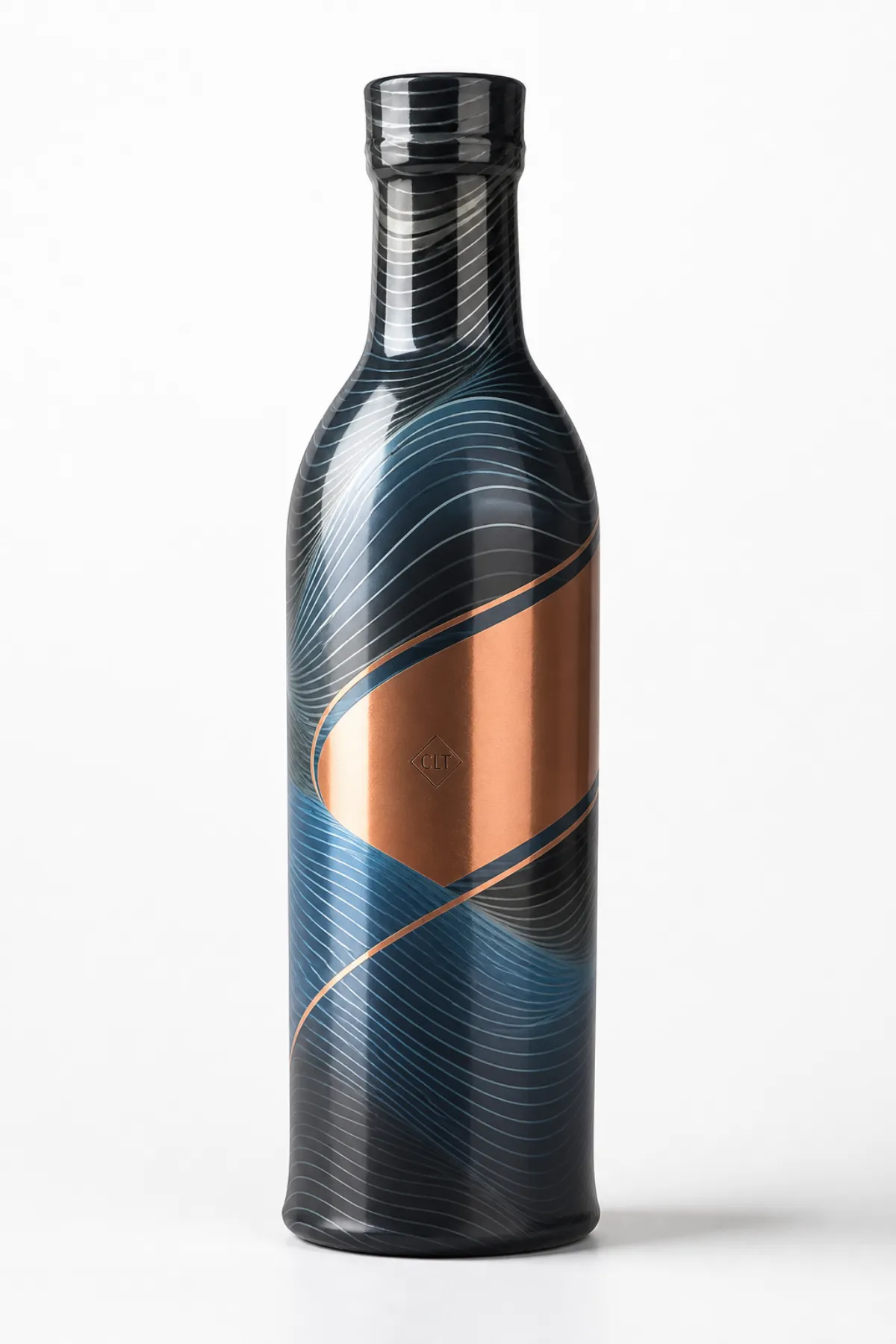
At the simplest level, custom shrink sleeves for bottles are printed film tubes that go on loosely and then shrink with heat until they follow the bottle's curves, shoulders, and neck. Instead of sitting flat like a pressure-sensitive label, the film wraps the container in one continuous graphic field. That matters because a single bottle can offer far more branding space than a front-and-back label system.
Brands choose custom shrink sleeves for bottles for a few straightforward reasons. They want 360-degree coverage, they want strong shelf visibility, and they often want tamper evidence without adding a separate seal. A sleeve can also hide seams, mold lines, or minor container variation better than a rigid label system. The format is not only about appearance. It solves more than one packaging problem at once.
For a packaging buyer, the comparison usually comes down to custom shrink sleeves for bottles versus pressure-sensitive labels or wraparound labels. Pressure-sensitive labels can move faster on simple runs, but they do not always deliver the same dramatic visual wrap. Wraparound labels work well on many beverage and household containers, yet they do not cover shoulders and necks in the same way. Shrink sleeves often win when the brief calls for bold shelf impact, security, and package branding that keeps the product from fading beside competing SKUs.
The format also gives a brand room to turn one bottle family into multiple product stories. A clear bottle can become a premium line, a seasonal edition, or a store-specific version without changing the mold. That flexibility is one reason custom shrink sleeves for bottles are common in personal care, beverage, nutraceutical, and specialty food product packaging. The visual change gets the attention, but the operational gain is just as useful: one bottle, more identities.
How Custom Shrink Sleeves for Bottles Work
The workflow behind custom shrink sleeves for bottles looks simple on paper and more technical in real life. Artwork is printed on shrink film, the film is converted into sleeves, and those sleeves are applied to filled or empty bottles depending on the line setup. After application, heat contracts the film until it conforms to the container. The result should look crisp and centered, but only if the sleeve was planned with the bottle geometry in mind from the start.
Two heat application methods dominate the process: steam tunnels and hot-air tunnels. Steam is often preferred for complex shapes because it can heat evenly around curves and necks. Hot air can work well on simpler containers and is common in many production environments. Either way, the goal stays the same - enough controlled heat to shrink the film without scorching it, distorting the artwork, or pulling the sleeve out of position.
- Collect bottle data. Exact dimensions, shoulder angle, neck profile, label panel height, and any embossed details all matter.
- Build the dieline. The sleeve flat is mapped to the bottle so text and graphics land where they should after shrink.
- Prepare the artwork. High-shrink zones are marked, and the design is adjusted so critical copy avoids those areas.
- Print and convert. The film is printed, cured, cut, and seamed into finished sleeves.
- Apply and shrink. Sleeves are placed on the bottles and passed through heat for final conformity.
- Check the finish. Teams inspect seam alignment, distortion, barcode legibility, and overall fit.
Two technical details influence the final look more than most first-time buyers expect: shrink ratio and seam placement. A sleeve with a 65 percent shrink ratio behaves differently from one with a 30 percent or 40 percent ratio, and the high-shrink zones are usually where graphics stretch or compress the most. Seam placement matters too because a seam that lands on a front-facing panel can interrupt the brand mark, while a seam hidden on the back panel may be almost invisible in retail packaging.
The practical benefits show up quickly. Custom shrink sleeves for bottles can deliver full-wrap coverage, moisture resistance, and a tougher graphic surface than many paper-based labels. They can support tamper-evident perforations, which helps foods, supplements, and some personal care products. They also tolerate condensation and handling better than some label types, which is why custom shrink sleeves for bottles often appear in cold-chain environments and on shelves that get touched constantly.
Custom Shrink Sleeves for Bottles: Key Factors That Affect Results
Bottle geometry comes first
Geometry decides whether custom shrink sleeves for bottles look premium or merely adequate. Straight-wall bottles are the easiest case because the sleeve shrinks in a predictable way. Tapered bottles, heavy shoulders, and highly contoured containers need more careful art mapping. Add embossed logos, ribbing, or a deep base, and the print can distort quickly. I have seen small shape differences - just a few millimeters - move a front-panel element enough to make the whole package feel off.
Artwork needs a shrink map, not guesswork
Small type, fine lines, barcodes, and legal copy need extra attention. If a word crosses a high-shrink zone, it may look sharp on the flat proof and lose readability after heat application. The same risk appears with gradients, metallic effects, and images that wrap around the shoulder. Designers should treat the dieline as a technical document, not a decorative template. For custom shrink sleeves for bottles, that discipline separates a polished result from a reprint.
One common mistake is assuming a pretty proof means the production sleeve will behave the same way. It will not, not exactly. Heat changes the geometry, and the bottle does not care how perfect the mockup looked on screen.
Material choice changes performance
PETG, PVC, and OPS are the most common film families discussed for this format, and each one brings different tradeoffs. PETG is often selected for clarity and predictable shrink behavior. PVC is frequently cost-effective, but sustainability discussions around it are more complicated, and some markets are moving away from it. OPS can work well in some applications, though its fit depends on the container, the tunnel, and the market. Cold-chain exposure, condensation, and surface abrasion all influence which film makes sense. The right answer is never universal; it depends on the product, the route to market, and the shelf-life conditions.
| Film Type | Typical Shrink Behavior | Best Fit | Cost Position |
|---|---|---|---|
| PETG | Good clarity, strong and controllable shrink | Premium retail packaging, contoured bottles, tamper-evident sleeves | Medium to medium-high |
| PVC | Reliable shrink with wide processing familiarity | Budget-sensitive runs, many standard bottle shapes | Lower to medium |
| OPS | Stable for certain geometries, less flexible in some setups | Specific beverage and product packaging programs | Medium |
Sustainability and compliance are part of the spec
Custom shrink sleeves for bottles are increasingly judged through a sustainability lens, and that review is often practical rather than abstract. Local recycling rules may affect whether a sleeve should be perforated, whether a removable tear strip is needed, or whether a certain film can be used in a given market. If a bottle is supposed to enter a recycling stream, the sleeve should not make sorting harder. For broader material guidance, many teams also refer to the EPA's recycling resources at EPA recycling resources when comparing packaging choices.
There is also a compliance angle. If a sleeve carries regulatory copy, nutrition panels, ingredient statements, or barcode data, the artwork cannot be treated like simple decoration. The sleeve must still read cleanly after shrink, and the final package has to satisfy the same legal and scanning requirements as any other product packaging. That holds true whether the container is headed to a warehouse club, a pharmacy shelf, or a direct-to-consumer box packed alongside Custom Packaging Products for a broader launch kit.
Custom Shrink Sleeves for Bottles Cost and Pricing Factors
Pricing for custom shrink sleeves for bottles depends on more variables than many buyers expect. Film type, print method, sleeve dimensions, ink coverage, perforations, and special finishes all affect the quote. So does whether the project needs a security tear, a matte look, metallic effects, or a sleeve that stretches across a very tall bottle. For common runs, a directional range of roughly $0.12-$0.30 per sleeve is realistic for many standard volumes, but the exact number moves quickly if the artwork is complex or the geometry is unusual.
Volume matters because setup costs are spread across the order. A small run may look affordable on paper and still produce a higher unit price because the press setup, conversion, and proofing costs do not shrink with the order size. Many suppliers set practical MOQs around 5,000 to 10,000 sleeves, though that floor is not universal. If you are comparing custom shrink sleeves for bottles across vendors, ask where the breakpoints are. A lower setup price can still lead to a larger total spend if the minimum quantity is too high for the launch.
Hidden costs are where quotes often stop being comparable. Artwork prep, dieline development, digital or physical proofs, applicator changes, test runs, freight, and rush charges can all sit outside the headline unit price. Some suppliers include prepress support and proof revisions. Others bill them separately. If one quote says $0.18 and another says $0.22, the lower number may still be more expensive once setup and shipping land on the invoice. That is why custom shrink sleeves for bottles should be compared as a total project cost, not as a single line item.
The table below gives a practical way to compare common buying scenarios. It is not a universal rate card, because the market moves with material availability, order size, and print coverage, but it helps frame the conversation.
| Scenario | Typical Per-Unit Range | What Drives the Price | Buyer Takeaway |
|---|---|---|---|
| Simple single-color sleeve | $0.12-$0.18 | Lower ink coverage, standard bottle shape, fewer finishing steps | Good for straightforward launches and high-repeat SKUs |
| Full-color retail sleeve | $0.18-$0.30 | Higher coverage, richer graphics, more prepress time | Often the best balance of shelf impact and spend |
| Specialty sleeve with perforation or metallic effects | $0.24-$0.45 | Security features, specialty inks, tighter registration, extra quality checks | Best for premium or highly differentiated product packaging |
Comparing quotes correctly means checking what each supplier includes. Ask whether the price covers proofing, sample sleeves, artwork adjustment, and any test application support. If the bottle is unusual, ask whether the vendor will review photos or dimensional drawings before final approval. For custom shrink sleeves for bottles, that front-end diligence often prevents a costly rework later. If the project extends into cartons or shipper packs, align the sleeve spec with the wider system so the package branding stays consistent.
Custom Shrink Sleeves for Bottles Production Process and Timeline
The production path for custom shrink sleeves for bottles becomes far more predictable when the inputs are clean. It usually begins with bottle specifications, sleeve dimensions, and the application method. From there, the supplier builds the dieline, reviews the artwork, runs proofs, prints the film, converts it into sleeves, and ships the finished lot. In many standard programs, a simple order can move through production in roughly 12-15 business days after approval, but that window expands if sample testing or complex finishes are involved.
Where do schedules slip? Most often in artwork revision cycles and missing container data. A buyer may have a bottle photo and a rough height measurement, but not the exact shoulder angle or neck circumference. That is enough to start a conversation, not enough to lock a print-ready sleeve. Substrate availability can also move lead time, especially on larger orders or specialty films. If the calendar is tight, custom shrink sleeves for bottles should be treated like a critical-path item, not an afterthought.
Line testing can be the biggest hidden variable. A sleeve that looks perfect in a proof may still need adjustment once it meets the real applicator, the fill condition, and the tunnel settings. Heat level, conveyor speed, bottle temperature, and cap profile can all change the final finish. For that reason, suppliers often recommend one of two approaches: either provide enough bottle and process detail to reduce risk up front, or budget time for a test run before launch. The second approach is slower, but it is usually cheaper than discovering a fit problem on launch week.
For distribution-heavy product packaging, it is smart to think beyond decoration and ask how the package will survive the route to shelf. The International Safe Transit Association publishes useful test methods at ISTA, and those standards can help when a sleeved bottle is packed in cartons, display cases, or mixed shipments. That does not mean every project needs a formal lab program. It does mean the best custom shrink sleeves for bottles are planned with transit, condensation, and handling in mind, not just the artwork file.
- Fastest path: final bottle data, final artwork, standard film, no special finishes, and a clear application method.
- Moderate path: a new dieline, a few proof rounds, and a standard shrink tunnel setup.
- Slower path: unusual geometry, sample requests, metallic effects, or line testing before full production.
That is why experienced buyers treat custom shrink sleeves for bottles like a planning project. The more complete the spec sheet, the fewer moving parts the vendor has to guess at. In packaging, guessing tends to show up later as waste, delay, or a shipment of sleeves that no one wants to apply.
Common Mistakes to Avoid with Custom Shrink Sleeves for Bottles
The first mistake is designing from memory instead of using a real bottle sample. A photo can hide contour changes, while a caliper sketch can miss the way the shoulder blends into the neck. Custom shrink sleeves for bottles are especially sensitive to that difference because the film does not stay flat. It reacts to the container. If the bottle is even slightly more tapered than the art team expected, the printed panel can shift just enough to make the package feel off-balance.
The second mistake is placing important copy in high-shrink zones. Logos, small legal statements, barcode bars, and scannable content should be protected from heavy distortion wherever possible. It is tempting to maximize graphic coverage, but practical packaging design means knowing where the shrink will compress. A sleeve that looks bold on a screen can become hard to read if the barcode lands on a curve or if a warning panel wraps around a shoulder.
Seam placement and cap coverage are also easy to underestimate. The seam should be planned early, not adjusted at the end of the approval cycle. The same goes for necking requirements, whether the sleeve needs to extend under the cap, and whether a perforation should create tamper evidence without making opening too difficult. On custom shrink sleeves for bottles, those details belong in the first round of the spec, not the rescue round.
Another common miss is skipping real-world testing. Cold storage, condensation, and line speed can all change how a sleeve behaves. A film that looks stable on a dry sample bottle can show scuffing after refrigeration or handling. If the project will ship through a network with temperature swings, test for the worst likely condition, not just the room-temperature one. That mindset is useful for broader package branding decisions too, especially when the bottle is paired with Custom Printed Boxes or other secondary packaging that must survive the same distribution chain.
Expert Tips and Next Steps for Custom Shrink Sleeves for Bottles
Start with data. Before asking for a quote on custom shrink sleeves for bottles, gather exact bottle dimensions, fill conditions, target order volume, artwork files, and the application method. A supplier can work with a sketch, but a cleaner data package usually means a cleaner response. If the bottle is unusual, send a physical sample. A sample bottle tells the truth in a way a drawing never will.
Ask for a printed mockup when the artwork is detailed or the container is highly contoured. If the project is critical, ask for a shrink sample and, where practical, a line test. Those steps cost time, but they reduce the chance of a correction after production begins. The same logic applies to custom shrink sleeves for bottles and to other packaging formats: if the spec is uncertain, testing costs less than rework.
Build a side-by-side comparison sheet before choosing a supplier. Track material, MOQ, per-unit price, proofing support, turnaround, and whether the quote includes conversion and freight. That sheet turns the conversation from opinion to evidence. It also helps buyers compare custom shrink sleeves for bottles against other branded packaging options without getting distracted by a single headline price.
One final point: keep the sleeve spec aligned with the rest of the package. If the bottle is part of a broader launch, the sleeve should work with the carton, the shipper, and the retail presentation. Consistency across product packaging signals care, and care still matters on crowded shelves. If you are gonna invest in a new bottle format, the sleeve should be designed from the start, not patched on later.
Done well, custom shrink sleeves for bottles are not just a label choice. They are a packaging system choice, one that can improve shelf impact, simplify SKU variation, and support tamper evidence without forcing a bottle redesign. The most reliable next step is simple: lock the bottle data, map the shrink zones, and test the sleeve on the real container before you approve the full run. That sequence saves time, money, and a lot of back-and-forth once production starts.
What bottle shapes work best for custom shrink sleeves for bottles?
Straight-wall and gently tapered bottles are the easiest to sleeve cleanly, but curved and contoured containers can work well with the right dieline and shrink ratio. Heavily embossed shoulders, deep grooves, and unusual neck profiles need extra artwork planning so the graphics do not distort in critical areas. A physical bottle sample is the safest way to confirm fit before production.
How long does the custom shrink sleeves for bottles process usually take?
Lead time depends on artwork readiness, proof approvals, film availability, and order size rather than a single fixed timeline. Simple runs move faster when the customer provides final bottle dimensions and print-ready files up front. Complex finishes, sample requests, or line testing can add days or weeks to the schedule.
Are custom shrink sleeves for bottles more expensive than pressure-sensitive labels?
Often yes on a pure unit-cost basis, because sleeves add conversion and application steps. They can replace multiple label components, add tamper evidence, and create stronger shelf impact, which may justify the higher spend. The real comparison should include labor, inventory complexity, and the number of SKUs the packaging needs to support.
What artwork problems should I avoid with custom shrink sleeves for bottles?
Avoid putting small text, barcodes, or mandatory copy in areas that will shrink heavily around shoulders or curves. Keep key brand marks away from the seam and confirm the dieline with the bottle manufacturer or sleeve supplier. Always review how colors, gradients, and metallic effects will look after the film conforms to the bottle.
Can custom shrink sleeves for bottles support sustainability goals?
Yes, depending on the film choice, perforation design, and local recycling rules in the markets where the product is sold. Some brands choose lighter packaging, reduced label count, or materials that better align with their waste-reduction goals. Sustainability should be evaluated against performance, because a sleeve that fails on the line creates more waste than it saves. For that reason, custom shrink sleeves for bottles should be judged on the whole package, not just the material name on the quote.

