Buyer Fit Snapshot
| Best fit | Custom Size Poly Mailers projects where brand print, material claims, artwork control, MOQ, and repeat-order consistency need to be specified before quoting. |
|---|---|
| Quote inputs | Share finished size, material target, print colors, finish, packing count, annual reorder estimate, ship-to region, and any compliance wording. |
| Proofing check | Approve dieline scale, logo placement, barcode or warning zones, color tolerance, closure strength, and carton packing before bulk production. |
| Main risk | Vague material claims, crowded artwork, missing packing details, or unclear freight terms can make a low unit price expensive after revisions. |
Fast answer: Custom Size Poly Mailers: Film, Print, MOQ, and Carton Packing should be specified like a repeatable production item. The safest quote records material, print method, finish, artwork proof, packing count, and reorder notes in one written spec.
Production checks before approval
Compare the actual filled-product size with the drawing, then confirm tolerance on folds, seals, hang holes, label areas, and retail display edges. Reserve space for logos, QR codes, warning copy, and material claims before decorative graphics fill the panel.
Quote comparison points
Review material grade, print process, finish, sampling route, tooling charges, carton quantity, and freight assumptions side by side. A quote is only useful when the supplier can repeat the same color, closure quality, and packing count on the next order.
Custom Size Poly Mailers: Fit, Cost, and Setup Basics sound boring until you watch a packing line waste time because a bag is a little too big or a little too small. One extra inch can make a shipment look sloppy, burn through film, and push the parcel into a pricier shipping tier. Too tight, and the product gets bullied into the bag like it owes somebody money.
Custom size poly mailers solve a real problem, not a cosmetic one. They control how the product sits, how fast it moves through fulfillment, how it lands in the customer’s hands, and how much material gets tossed along the way. For brands shipping the same kinds of items week after week, the right size can move the numbers and the presentation at the same time. Stock mailers rarely do both.
If your operation already uses broader Custom Packaging Products, the mailer should not live in its own little procurement bubble. Put it in the same conversation as boxes, inserts, labels, and tape. Packaging works better when the whole system is built around the actual product footprint instead of a hopeful guess.
Custom Size Poly Mailers: What They Are and Why Size Matters
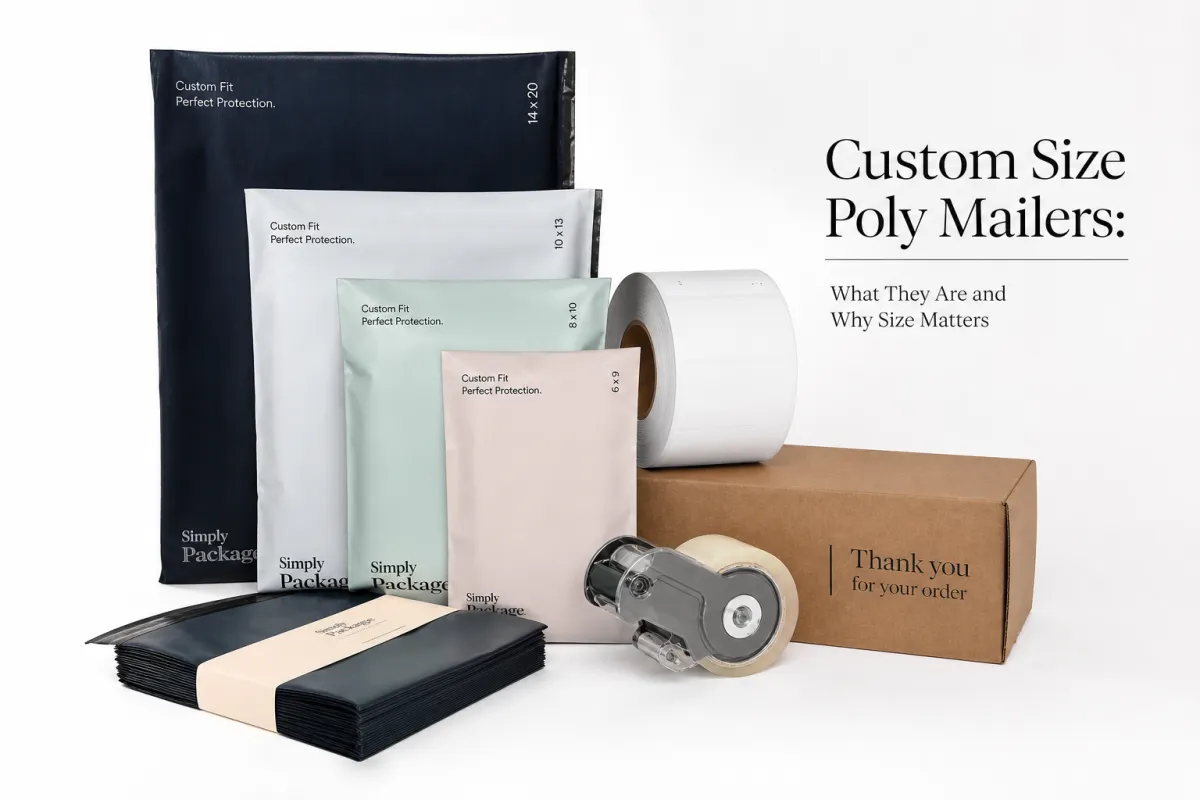
Custom size poly mailers are flexible shipping bags made to a specific width, length, and often gusset profile so they match the product instead of forcing the product to match the bag. Simple idea. Big difference. A stock mailer can leave a shirt floating in dead space. A properly sized mailer holds it flat and steady without stuffing the package full of filler.
Size changes more than protection. It changes how the shipment reads the second someone picks it up. A clean-fitting mailer looks controlled. That matters because customers notice shape before they notice print. A bag with folds, slack, and empty corners can make the whole shipment feel improvised, even if the item inside is fine.
Then there is the cost side, which never stays polite for long. Extra inches use more film. More film means more material, more weight, and sometimes more waste in transit. If the package crosses into a larger carrier size bucket, the bill can jump fast. For apparel, soft goods, and light accessories, custom size poly mailers often cut down on void fill and wasted motion. That is why they show up so often in high-volume retail packaging programs.
The best fit usually comes from stable product dimensions. If an item ships flat, folds the same way every time, or compresses predictably, custom size poly mailers can make a lot of sense. If the catalog changes constantly or the products are rigid and fragile, another format may be the smarter play. Sometimes Custom Poly Mailers are the right move. Sometimes printed boxes win.
Poor fit also creates quiet damage. A soft tee will not file a complaint about extra slack, but customers absolutely notice when an item arrives bent, damp, scraped, or just badly packed. Better sizing does not fix every problem, but it lowers the odds of movement and the kind of minor scuffing that ruins first impressions.
In a few warehouse walkthroughs I have done, the difference between a decent mailer and the right one showed up in the first ten minutes. The oversized bag took longer to seal, took more table space, and looked messier on the outbound shelf. That is the part spreadsheets miss.
How Custom Size Poly Mailers Work in the Shipping Process
Custom size poly mailers are usually made from polyethylene film, often in a co-extruded construction that balances strength, tear behavior, and printability. Suppliers may list thickness in mils, like 2.5 mil or 3 mil. That number matters. It affects puncture resistance, feel, and how the bag behaves under stress. Thin film can save money. It can also become a false bargain if it stretches too much or splits at the seal.
The packing process is straightforward. Product goes in. The item gets aligned. The adhesive strip is closed. The finished pack moves to labeling or dispatch. Tight sizing keeps the product from shifting around in transit, especially soft goods that can slide inside a larger bag. When the fit is right, the item stacks better, scans easier, and moves through a fulfillment line without constant correction.
That kind of simplicity is why custom size poly mailers show up in apparel shipping, light kits, subscription items, and accessory programs. These products usually do not need a corrugated box, but they still need a package that keeps them flat and presentable. For a brand building package branding, the mailer becomes part of the experience instead of a disposable outer shell.
Presentation matters because customers notice order. A bag that fits the product cleanly looks deliberate. It also gives more usable space for print graphics, logos, QR codes, or simple messaging. Packaging teams often treat the mailer like a tiny billboard, especially when the rest of the product packaging is minimal.
A mailer that fits the product, and nothing else, usually looks more expensive than the one stuffed with air.
If you want a technical benchmark for testing and handling, the ISTA standards are a useful reference point. They will not hand you a perfect size, but they do help teams think about vibration, compression, and drop conditions in a disciplined way. That mindset separates a pretty spec sheet from a package that survives actual shipping.
For companies using mailers alongside paper inserts or outer cartons, sustainability claims should be checked against evidence, not wishful thinking. FSC-certified materials, where relevant, can support a cleaner sourcing story, but the packaging still has to do its job. That balance is why thoughtful teams compare custom size poly mailers against other product packaging options before they commit.
One more practical point: if the packaging has to run through an auto-bagger or a high-speed packing table, the mailer shape matters as much as the printed artwork. A nice design that jams the line is not nice for long.
Key Factors That Determine the Right Custom Size Poly Mailers
Choosing custom size poly mailers starts with product dimensions, but not the lazy version. Measure the item the way it actually ships. Folded, bagged, bundled, compressed, sleeved, inserted. Whatever your team really does on a normal day. A hoodie can look one size on a shelf and need something different once it is folded with a hang tag and care card.
Width and length are the obvious numbers. Thickness is where people get tripped up. A product that seems short and narrow can still need a larger bag if it has volume, a folded seam, or a stiff edge that makes insertion awkward. If the packer has to fight the bag, the size is wrong. That is true even when the spreadsheet says the numbers look fine. In a busy warehouse, those seconds pile up quickly.
Material choice matters just as much. A standard co-extruded film may work for light apparel, but denser or sharper items may need better puncture resistance or a heavier gauge. Opacity matters too. Some brands want full coverage so the contents stay hidden. Others want a lighter look or a translucent finish. Either choice changes how the final custom size poly mailers look and how premium the shipment feels.
Branding is the other half of the sizing conversation. A mailer with a large logo, repeated pattern, or bright color block needs enough room for the design to breathe. Too small, and the artwork feels crowded. Too large, and the design floats in a sea of blank film and loses its punch. Good package branding balances artwork, closure placement, and the shape of the bag itself.
Workflow matters too. Ask how the mailers will be stored, loaded, and used. Will they sit in a compact dispenser? Will they pass through an auto-bagger? Do multiple SKUs need one or two standardized sizes instead of a separate bag for every tiny variation? Those questions sound dull until they save a packing team from chaos. The best custom size poly mailers fit the product and the process.
Finish and feel deserve a look as well. Glossy and matte do not read the same. White, black, and metallic-looking film all behave differently under print. Color, finish, and coverage are not just aesthetic choices. They affect how the item looks in hand and how much contrast the logo gets against the background. In retail packaging, those details decide whether a mailer feels polished or merely branded.
And yes, you should check the boring stuff too. Adhesive strip width, seal strength, and the bag's opening orientation can change packing speed more than a fancy print finish ever will. That is the unglamorous truth.
Here is the practical checklist I would use before approving a size:
- Measure the packed product, not the unpacked product.
- Check whether the item compresses or springs back.
- Leave room for easy insertion and a clean seal.
- Confirm how much print area is needed for logo placement.
- Match the film strength to the roughest part of the journey, not the calmest.
Custom Size Poly Mailers Cost: What Drives Pricing
Custom size poly mailers usually get priced from five main variables: dimensions, material grade, thickness, print complexity, and order quantity. Special finishes can push the number further. A small run of unprinted mailers may look simple on paper, but once the dimensions move away from common stock sizes, the setup gets more specialized and the unit price usually climbs with it.
For planning, a useful ballpark for printed custom size poly mailers at moderate volume can land around $0.18 to $0.45 per unit, depending on size, film thickness, and print coverage. Smaller runs can go higher, often $0.50 to $0.90 or more for complex artwork or lower quantities. Unprinted custom sizes can cost less, but they still tend to carry a premium versus common stock mailers because the run is less standardized. Those are rough ranges, not promises. The actual quote depends on the spec.
Minimum order quantities matter because tooling, film conversion, setup, and printing all need to be recovered across the run. That is why the first 1,000 or 2,000 pieces can cost a lot more per unit than the 10,000th piece. Once a buyer understands that, the quote stops looking mysterious. The supplier is spreading fixed setup cost across more units, and custom size poly mailers usually reward larger repeat orders.
There is a comparison many teams miss. A stock mailer looks cheaper until you add the cost of void fill, the labor to stuff oversized bags, the storage footprint, and the rework caused by poor fit. If the wrong size creates waste at packing, the cheaper unit price becomes a nice little lie. Smart buyers compare total shipped-order cost, not just the invoice for the bag.
The table below gives a practical view of common packaging options. Real quotes vary, but the relationship between fit, price, and brand presentation stays fairly consistent.
| Option | Typical Unit Cost | Fit Quality | Branding Surface | Best Use |
|---|---|---|---|---|
| Stock poly mailers | $0.06-$0.18 | Good only if the product matches a common size | Moderate, depending on print area | Simple, repeatable items with flexible dimensions |
| Custom size poly mailers | $0.18-$0.45+ | Strong when the product ships in a repeatable format | High, with tailored layout and sizing | Apparel, soft goods, kits, and accessory programs |
| Padded mailers | $0.20-$0.60+ | Good for light protection, not always ideal for bulkier soft goods | Moderate | Items needing a little cushion, but not a box |
| Custom printed boxes | $0.45-$1.50+ | Best for rigid, fragile, or premium presentations | Very high | Retail packaging, heavier items, and premium unboxing |
Shipping and proofing can change the final number. Freight from the converter or print facility, rush charges, plate costs, proof revisions, and split shipments all show up in the real budget sooner or later. If you want a clean quote, ask for line items. A supplier should be able to explain how size, print, and quantity affect the cost of custom size poly mailers without hiding the math behind vague language.
One practical question is whether the order should include one size or a small family of sizes. Some brands standardize two or three bags that cover most SKUs and skip the cost of creating a different bag for every tiny variation. That strategy works especially well in product packaging programs with steady volume. It does not fit every line, but it often cuts waste and admin friction.
One thing buyers miss: the cheapest quote is not the best quote if the bags arrive with weak seals or inconsistent dimensions. A mailer that fails quality control costs more after the fact. Funny how that works.
Step-by-Step Guide to Ordering Custom Size Poly Mailers
The first step is measuring the product the way it ships. That means more than measuring the item on a table. Measure the folded garment, the accessory bundle, the insert card, the polybag if one goes inside the outer mailer, and the thickness after everything is packed. If a shirt ships with a tissue sheet and a return insert, those pieces count. Custom size poly mailers should match the real shipping footprint, not a cleaner version of it.
Next, build a short sizing brief. Keep it plain. Include product type, dimensions, quantity, artwork needs, preferred film color, finish, closure style, and shipping method. If the product needs a tear notch, extra opacity, or a stronger adhesive strip, say so now. Clear briefs keep quotes from drifting. Brands that treat this like a proper packaging spec usually get better results than brands that send one measurement and cross their fingers.
Then request samples or digital proofs. For custom size poly mailers, a proof is not just about graphics. Check seal placement, edge margins, barcode space, and whether the artwork still looks balanced once the bag is folded and handled. If possible, ask for a sample run or a pre-production sample with the actual material. Screen images hide problems. The warehouse will not.
After that, run a short test with real staff and real items. I mean the people who will actually pack it. They will tell you immediately if the bag is too stiff to load quickly, too slick to stack, or too tight for easy insertion. Operational truth beats guesswork. A packaging buyer may care about spec language, but the fulfillment team cares whether the bag gets through a shift without slowing everyone down.
A simple order path usually looks like this:
- Measure the packed product.
- Define quantity and print requirements.
- Review a quote and confirm material specs.
- Approve a proof or sample.
- Run a small production batch if volume allows.
- Scale after the fit is proven.
If you are building a larger packaging line, coordinate the mailer with labels, cartons, and any internal inserts so the whole shipping kit feels unified. That is where custom size poly mailers can support broader branded packaging goals instead of acting like a standalone purchase. The right size can also simplify purchasing because one spec can serve multiple fulfillment channels.
For many teams, the cleanest place to start is with a quote request that includes real examples, not just numbers. Send photos, folded measurements, and a note about how the package is picked, packed, and sealed. If the item ships in hot or cold conditions, mention that too. Temperature swings can affect adhesives and film behavior more than people expect, especially in places with strong seasonal changes.
Ordering Timeline for Custom Size Poly Mailers
A normal ordering sequence for custom size poly mailers usually starts with consultation, then moves to spec review, quoting, proofing, approval, production, quality check, and delivery. If the project is simple, it can move with little drama. If the artwork is complicated or the sizing is unusual, each stage can take longer. That is normal. Packaging rarely cares about your deadline.
Typical production timelines often land around 12 to 20 business days after proof approval for standard custom runs, with shipping time added on top. Small, simple orders can move faster. Large or heavily printed runs can take longer. Rush jobs may be possible, but they usually narrow material options, increase cost, or reduce customization flexibility. There is almost never a free shortcut. The bill just shows up somewhere else.
Delays usually happen in the same spots. Artwork comes in late. Dimensions get revised after proofing. A buyer decides to change the adhesive strip or color after the quote is already set. Samples need another round because the fit was assumed instead of tested. None of that is unusual, but every revision can push a launch back by days. For custom size poly mailers, the timeline is often shaped less by the press than by decision speed.
That is why planning matters. If a seasonal launch, campaign, or inventory refresh depends on packaging arriving by a certain date, build in a buffer. Brands that wait until the last week usually pay more, accept compromises, or do both. A clean order leaves time for proof review and a backup sample if needed.
There is a useful rule of thumb here: the more specific the bag, the more planning it deserves. A mailer with custom dimensions, multiple print colors, and a particular finish should not be treated like a commodity carton from a shelf. That mindset helps companies managing both custom size poly mailers and Custom Packaging Products across several product lines.
Here is the practical planning window I would use:
- Spec gathering and internal approval: 2-5 business days
- Quote and initial proof: 1-4 business days
- Revisions, if needed: 2-5 business days
- Production: 12-20 business days
- Freight and receiving: 3-7 business days, depending on location
That window is not universal, but it is good enough for real planning. If the order is simple, it can move faster. If the artwork is intricate or the volume is high, expect the calendar to stretch. Either way, custom size poly mailers reward early decisions and punish late ones.
If the project is tied to a launch date, work backward from the day inventory has to be packed, not from the day you want the bags to arrive. That small shift saves a lot of panic.
Common Mistakes and Expert Tips for Better Results
The biggest mistake is measuring only the product and forgetting the rest of the packout. Seams, labels, folded edges, inserts, and any inner sleeve all change the true footprint. I see this mistake all the time because the spreadsheet measurement looks neat, while the real packed item is less cooperative. With custom size poly mailers, the gap between product size and packed size is where bad orders start.
Another common error is chasing the lowest price without checking film thickness, puncture resistance, or seal quality. A bargain mailer that splits at the corner is not a bargain. If the material feels flimsy, ask for a spec sheet. Good suppliers can talk about film gauge, tensile behavior, and seal strength in plain terms. If the answer is just “it should be fine,” keep walking.
My first tip is to standardize wherever possible. Instead of making a different bag for every SKU, see whether two or three sizes can cover the line. That cuts complexity, makes storage easier, and often improves purchasing efficiency. The second tip is to test one size against multiple items. A good mailer can sometimes handle a range of related products, especially in apparel or small accessories. That flexibility is one reason custom size poly mailers sit in such a useful middle ground between stock bags and custom printed boxes.
My third tip is to think about the customer experience and the warehouse experience at the same time. A mailer that looks clean to the shopper but slows packing by ten seconds per unit may not be the right answer. A package that is easy to pack but arrives wrinkled and oversized may also miss the point. The best option balances speed, cost, and presentation. That is the actual packaging job. Everything else is decoration.
There is also a branding trap. Some teams overdesign the bag and forget that shipping labels, carrier stickers, and handling marks will cover part of the surface. If your artwork only works in a perfect mockup, it probably needs another pass.
Here are the warning signs that usually mean the size is off:
- The product slides around after sealing.
- The packer has to force the item into the bag.
- The mailer wrinkles heavily around the contents.
- Artwork gets cut off or crowded by the seal area.
- The bag size changes the way carriers handle the shipment.
If you want a more structured packaging process, build your evaluation around three questions: Does it fit? Does it protect? Does it help the brand look credible? If all three answers are yes, you are probably close. If one answer is no, keep testing. For many businesses, custom size poly mailers are not the final packaging answer forever. They are often the right answer for the next stage of growth.
One last practical point: sustainable packaging claims should match the material and the actual disposal pathway. If the mailer is recyclable in some streams but not all, say that clearly. If you are using paper inserts or fiber-based components, the sourcing side can be backed by FSC information from FSC certification resources. Honest language beats inflated language. Buyers check claims more carefully than they used to.
Custom size poly mailers work best when the size comes from real packing behavior, the cost gets judged against total shipped-order expense, and the timeline is planned before inventory gets urgent. That combination turns custom size poly mailers from a simple bag choice into a practical packaging decision that improves fit, cuts waste, and supports a stronger brand presentation.
If you are deciding between a stock bag and a custom one, start with the item as it is actually packed today. Not the ideal version. The real one. That is the fastest way to know whether custom sizing will pay off or just add complexity for no reason.
Frequently Asked Questions
How do I choose the right custom size poly mailers for my product?
Measure the item in its actual packed form, including folds, inserts, or bundled pieces. Leave enough room for easy insertion without wasting space. Test samples before ordering at scale so you can confirm fit, seal performance, and the way the mailer looks when it reaches the customer.
Are custom size poly mailers more expensive than standard sizes?
Usually yes on a per-unit basis, especially for smaller runs or printed mailers. The higher unit price can be offset by lower filler use, less wasted material, and better SKU-specific efficiency. Final pricing depends on size, thickness, print coverage, and order quantity.
What is the typical turnaround time for custom size poly mailers?
Timeline usually depends on proof approval, material availability, and order volume. Simple orders move faster; custom print jobs and special finishes take longer. Build in extra time for sampling and revisions before production starts, because those steps are the ones that usually shift the schedule.
What products are best suited for custom size poly mailers?
Soft goods, apparel, light accessories, and non-fragile items are usually the best fit. Products that ship flat or compress well tend to benefit most from custom sizing. Heavier or fragile items may need added protection or a different packaging format altogether.
How can custom size poly mailers reduce shipping waste?
They reduce empty space, which can cut the need for filler and oversized packaging. A tighter fit can improve packing efficiency and make storage simpler in the warehouse. Less excess material often creates a cleaner customer experience and better brand presentation, especially when shipping volumes are steady.
Do custom size poly mailers always replace boxes?
No. They make sense for flat, lightweight, repeatable products. If an item is rigid, fragile, or needs better crush protection, a box is still the better tool. The job is to match the package to the product, not to force everything into the same format because it looks cheaper on paper.

