Buyer Fit Snapshot
| Best fit | Custom Size Poly Mailers Order projects where brand print, material claims, artwork control, MOQ, and repeat-order consistency need to be specified before quoting. |
|---|---|
| Quote inputs | Share finished size, material target, print colors, finish, packing count, annual reorder estimate, ship-to region, and any compliance wording. |
| Proofing check | Approve dieline scale, logo placement, barcode or warning zones, color tolerance, closure strength, and carton packing before bulk production. |
| Main risk | Vague material claims, crowded artwork, missing packing details, or unclear freight terms can make a low unit price expensive after revisions. |
Fast answer: Custom Size Poly Mailers Order: Specs, Pricing, Timeline should be specified like a repeatable production item. The safest quote records material, print method, finish, artwork proof, packing count, and reorder notes in one written spec.
Production checks before approval
Compare the actual filled-product size with the drawing, then confirm tolerance on folds, seals, hang holes, label areas, and retail display edges. Reserve space for logos, QR codes, warning copy, and material claims before decorative graphics fill the panel.
Quote comparison points
Review material grade, print process, finish, sampling route, tooling charges, carton quantity, and freight assumptions side by side. A quote is only useful when the supplier can repeat the same color, closure quality, and packing count on the next order.
Custom Size Poly Mailers Order: Specs, Pricing, and Timeline
Placing a custom Size Poly Mailers order is often the quickest way to stop paying for empty air. A mailer that is even a little too large can nudge postage upward on dense parcels, let the product slide during transit, and make the pack-out look sloppier than it should. A Custom Size Poly mailers order solves those three problems at once: tighter fit, cleaner presentation, and a shipping format that is easier to repeat from one run to the next.
That matters because shipping is never only a protection question. It is a cost question, a brand question, and a process question. For apparel, soft goods, subscription products, and return shipments, the right fit can trim film waste, reduce scuffing, and sharpen the first impression at unboxing. A custom size poly mailers order gives buyers more control over parcel footprint than generic stock sizes, and that control shows up in the warehouse as well as on the carrier invoice.
Why Does a Custom Size Poly Mailers Order Pay Off Fast?
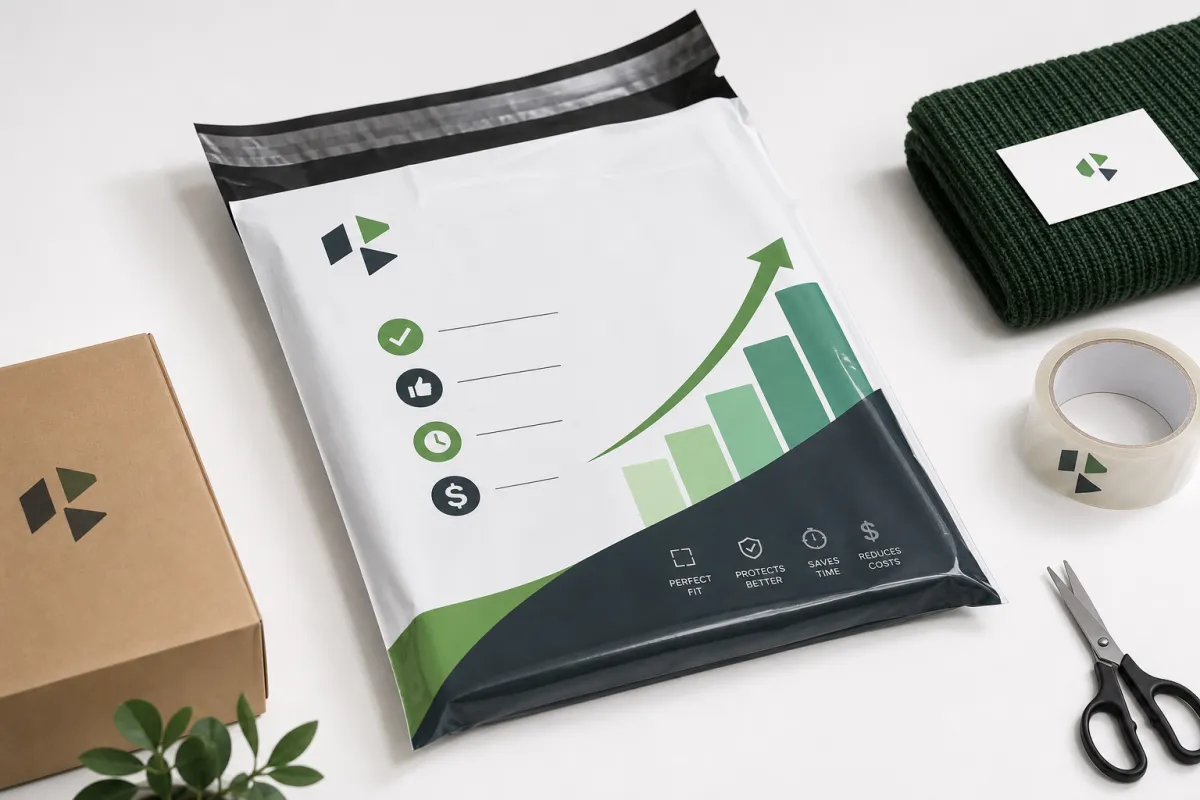
A custom size poly mailers order pays off because shipping math punishes waste. If the mailer is oversized by even half an inch in the wrong direction, the shipment can become bulkier than necessary, which affects carton efficiency, pallet density, and sometimes dimensional weight pricing. On a single parcel, the difference can look tiny. Across hundreds or thousands of shipments, that tiny gap turns into real money.
Fit matters just as much. A package that moves around inside the mailer is more likely to scuff, crease, or crush at the corners. That risk rises fast with soft goods, printed tags, narrow accessories, and items folded tightly for retail packing. A custom size poly mailers order reduces that movement, which means fewer returns tied to presentation problems and fewer complaints about bent edges or loose packing.
Buyers often compare mailers with Custom Poly Mailers in stock sizes or with custom printed boxes. Boxes still make sense for rigid or fragile items, but mailers usually win when the product is flexible, the shipping lane is high volume, and the goal is to keep labor simple. A custom size poly mailers order can create a tighter, more repeatable pack-out than a box-and-fill structure, especially when the item already has its own inner packaging.
From a packaging buyer’s point of view, the business case is easy to defend. Fewer void gaps. Less wasted film per shipment. More consistent parcel dimensions. Cleaner package branding at unboxing. Those are not abstract wins. They influence freight, labor, and how the customer reads your product packaging the moment it lands on the doorstep.
“A good mailer should disappear in transit. If the customer notices the package for the wrong reason, the size or structure is probably off.”
A custom size poly mailers order also fits common business models. Apparel brands use them for tees, hoodies, and folded sets. Subscription companies use them for flat, recurring shipments. Beauty and wellness sellers use them for soft accessories, refill packs, and lightweight ecommerce packaging. Return shipments are another strong use case, because a dual-seal format can simplify reverse logistics without forcing the buyer into oversized packaging.
Teams often make the same mistake: they buy by catalog dimension instead of by packed product dimension. They measure the item on a table, then forget the seam allowance, closure flap, and any protective insert. A custom size poly mailers order works best when the final packed shape is the starting point, not the afterthought.
Custom Size Poly Mailers Order Options and Materials
The material choice behind a custom size poly mailers order usually starts with co-extruded polyethylene film. That is the standard because it is lightweight, moisture resistant, and efficient to print. For many apparel and soft-goods programs, a typical film gauge falls in the 2.5 to 3.5 mil range, though thicker constructions can make sense if the contents have sharper edges or if the package will see rough handling in transit.
Recycled-content blends are increasingly common as well. They can support broader sustainability goals without forcing a move to heavier packaging. If a brand is trying to improve its environmental profile, it is worth checking whether the supplier can document recycled content, source reduction, or a material recovery claim that is actually supportable. For broader context on waste reduction priorities, see the EPA guidance on reducing waste and the ISTA testing standards used to evaluate shipment performance.
Structure matters as much as film type. A custom size poly mailers order can be built with a standard single seal, a tamper-evident closure, or a dual-adhesive return strip. That last option is especially useful for retail packaging programs that expect exchanges. Buyers often overlook it, then ask for it after launch. Planning for returns early is cheaper than retrofitting the format later.
Finish is another decision that affects brand presentation. Glossy mailers read as bright and promotional. Matte finishes often look more modern and hide scuffs better in transit. If the brand uses a muted design language, matte can support that better than high-shine film. If the design needs stronger color impact, gloss may deliver better saturation. This is where packaging design becomes a shipping choice, not only a visual one.
Print options range from a single logo in one color to full surface graphics, warning text, QR codes, and return-address placement. A custom size poly mailers order can also include utility marks, like handling instructions or packing identifiers. If your team is building a larger branded packaging system, the mailer should fit alongside cartons, inserts, and labels so the entire package branding story stays consistent.
Here is a quick comparison of common material and construction choices:
| Option | Best For | Typical Strength | Tradeoff |
|---|---|---|---|
| Standard co-extruded polyethylene | Apparel, flat accessories, subscription shipments | Lightweight, moisture resistant, cost efficient | Less puncture resistance than thicker builds |
| Thicker gauge film | Bulkier soft goods, sharper edges, longer transit lanes | Better tear resistance and handling tolerance | Higher material cost and slightly more weight |
| Recycled-content blend | Brands with sustainability targets | Comparable performance when specified correctly | May require more careful proofing and supplier validation |
| Dual-adhesive return mailer | Retail programs, exchanges, reverse logistics | Useful for outbound and return use | Extra setup detail and slightly more print planning |
For teams comparing custom printed boxes against a custom size poly mailers order, the right answer usually depends on product stiffness, damage risk, and brand expectations. Mailers are not a replacement for everything. They are the better tool when the item is flat enough, the shipping profile is high volume, and the brand wants a cleaner, lighter pack-out than a corrugated structure would allow.
Specifications to Lock In Before You Quote
The specifications behind a custom size poly mailers order need to be complete before anyone can quote accurately. The first number is the flat width. The second is the usable length. The third is seal allowance, which is where many briefs go wrong. A mailer that looks large enough on paper can still fail in production if the adhesive flap and sealed edge were not counted correctly.
Dimensions should be based on the product in its final shipping state. If the item is folded, bagged, tissue-wrapped, or slipped into an inner sleeve, measure that version instead of the raw product. A custom size poly mailers order built from the wrong reference size can cost money twice: once in rework, and again in shipping inefficiency.
Film thickness needs to match the contents. Lightweight apparel may perform well in thinner film, while items with rough seams, zippers, or harder edges often need extra gauge. Some buyers ask for tensile or puncture performance references using ASTM test methods such as ASTM D882 for tensile strength or ASTM D1709 for dart impact. That does not mean every mailer needs a lab report, but it does help to know what kind of protection the film is expected to provide.
Print-ready specs matter just as much. A custom size poly mailers order should identify logo placement, ink coverage, color count, bleed area, and restricted zones near seals or seams. If the artwork includes a QR code or variable return information, the placement must survive folding and handling. Small details can be the difference between a polished package and one that looks improvised.
Operational details belong in the brief too. Ask about perforation needs, return-strip layout, load weight, and whether the mailer must fit a packing line, a hand-pack station, or a shipping cart. If the team packs in a fast-moving environment, even a few millimeters of mismatch can slow labor. A custom size poly mailers order is easier to scale when the physical workflow has been mapped before production starts.
Use this checklist to keep the quote request clean and comparable:
- Flat width and usable length: Include the finished size and the seal allowance.
- Thickness target: State the film gauge or the product weight range.
- Print details: Identify colors, logo placement, and any regulatory or handling text.
- Closure style: Choose single seal, tamper-evident seal, or dual-return strip.
- Pack-out format: Note whether the item is folded, bagged, boxed, or sleeved.
- Use environment: Mention the transit lane, warehouse handling, and storage conditions.
If you are already mapping broader product packaging changes, it helps to compare the mailer spec with any other branded formats in the line. A team revising apparel bags, inserts, labels, and mailers at the same time usually gets a cleaner result than a team revising each item separately. That is one reason a custom size poly mailers order often sits inside a wider packaging design update rather than standing alone.
Do not ignore tolerances. Even a well-run custom size poly mailers order needs a realistic range for film and seal variation. If your packing process is automated, ask what tolerance the supplier can hold across the run. If your team hand-packs, make sure the closure area still seals without strain when the product is at the upper end of the size range.
Pricing and MOQ for the Order
Pricing for a custom size poly mailers order is driven by four main factors: size, film thickness, print complexity, and quantity. Larger dimensions use more film. Thicker constructions use more resin. More colors mean more setup. Smaller orders spread those costs over fewer units, which is why the unit price can look steep at low volume and much better at scale.
The minimum order quantity is usually tied to manufacturing efficiency. A custom dimension often requires special setup, and print work may require plates or additional prepress steps. That is why a custom size poly mailers order often carries a higher MOQ than stock mailers. The supplier has to run enough units to justify the changeover and still keep production efficient.
As a practical range, smaller custom runs may land in a higher unit-cost band, while larger runs can move down sharply. For example, a simple one-color mailer at 5,000 pieces may price much higher per unit than the same construction at 25,000 pieces. A useful quote might read something like $0.18 to $0.28 per unit at 5,000 pieces, depending on size and print coverage, with lower rates at larger quantities. That is why a custom size poly mailers order should always be quoted in tiers.
Here is a working comparison buyers can use when evaluating a custom size poly mailers order:
| Run Size | Typical Unit Price Range | Setup Sensitivity | Best For |
|---|---|---|---|
| 1,000-2,500 pieces | Higher unit cost, often due to setup spread | Very sensitive to print color count and film gauge | Pilot launches, testing, limited drops |
| 5,000-10,000 pieces | Moderate unit cost, better balance of price and flexibility | Still influenced by dimensions and artwork coverage | Growing brands, repeat campaigns, seasonal replenishment |
| 25,000+ pieces | Lowest unit cost in most cases | Setup becomes less visible per piece | High-volume ecommerce and recurring programs |
A good quote request should let suppliers compare like with like. A custom size poly mailers order is only easy to evaluate when the request includes exact dimensions, quantity, print details, delivery location, and preferred launch date. If any one of those pieces is missing, the quote can look attractive at first and then drift once the real production details appear.
Buyers should also ask for tiered pricing. The difference between 5,000 pieces and 10,000 pieces can be meaningful, and a jump to 25,000 may lower the unit price enough to justify carrying a little more inventory. If your business uses Wholesale Programs, compare the mailer quote against the overall packaging program rather than against a single purchase order in isolation. That is where cost control becomes visible.
The honest answer on MOQ is that it depends. A simple custom size poly mailers order with limited print may have a lower threshold than a multi-color promotional run with complex branding. If the order includes a special return strip, a unique matte finish, or a recycled-content blend, the production floor may need a bigger run to stay efficient. That is normal, not a warning sign.
Process and Timeline
The workflow for a custom size poly mailers order usually follows a clear sequence: discovery call, specification review, quote, proof approval, production, quality check, and freight booking. That sequence sounds straightforward, but delays usually appear when the buyer has not locked the dimensions, artwork is not print-ready, or someone changes the spec after proofing. The more complete the brief, the smoother the schedule.
Timelines need to be handled with realism. Stock inventory ships faster because the size already exists and the print is already done. A custom size poly mailers order takes longer because the supplier has to confirm the spec, prepare the art, run the job, inspect the output, and then schedule transit. In many cases, 12 to 15 business days from proof approval is a reasonable planning target for production, but that can change with complexity, seasonality, and freight.
Proof review is not a formality. It is the moment to confirm exact size, print placement, color count, barcode or QR readability, and any return-strip behavior. A custom size poly mailers order should not move to production until the proof matches the intended launch use. A rushed approval can create a costly mismatch that is harder to fix after the film is already printed.
Freight booking also matters. If the order is going by truck, rail, or consolidated freight, transit time can be just as important as production time. A buyer planning a seasonal launch should build in a buffer for artwork revisions, sample review, and shipping. That is especially true when the mailers need to arrive before a campaign start or a retail packaging rollout.
From a procurement perspective, the safest rule is simple: treat the schedule like a chain with several links, not a single lead-time number. A custom size poly mailers order can move quickly when the spec is clean and the approvals are fast. It can also slip when one missing detail triggers another round of correction. The real timeline is the sum of those decisions.
Here is a realistic planning sequence for a custom size poly mailers order:
- Day 1-3: Gather product measurements, quantity, print brief, and delivery needs.
- Day 3-5: Review quote tiers and confirm the working spec.
- Day 5-8: Approve artwork and proof details.
- Day 8-18: Production, inspection, and packing.
- Day 18-25: Freight transit, depending on destination and shipping method.
If you are building a branded packaging calendar, keep in mind that a custom size poly mailers order should be scheduled the same way you would schedule labels, inserts, or custom printed boxes. All of those items depend on the same inputs: dimensions, graphics, and launch timing. The fewer surprises in the brief, the more reliable the shipment date.
Why Buyers Choose Us for Custom Mailers
Manufacturing control is the real advantage behind a custom size poly mailers order. When the production process is handled with discipline, the mailer dimensions stay consistent, the print registers more cleanly, and the buyer sees fewer surprises at receiving. That matters to procurement teams that care about repeatability as much as price.
Support also matters. Many buyers do not need a lecture; they need help sizing the package correctly, cleaning up artwork, and reviewing the proof without getting lost in technical details. A good custom size poly mailers order should reduce internal back-and-forth, not add to it. The best suppliers make the brief easier to finish and the launch easier to manage.
Compared with generic stock mailers, a custom size poly mailers order gives you better fit, better brand presentation, and less packaging waste. That is true whether the product is sold through ecommerce, retail packaging, or a subscription channel. The package looks more intentional because it was built around the product instead of forcing the product to adapt to a random size.
For teams building a broader packaging system, it helps to think in tiers. Stock mailers can handle some jobs. Custom Packaging Products can handle a much wider range. A custom size poly mailers order sits in the middle of that decision tree: more controlled than stock, lighter and simpler than corrugated, and more efficient than over-specifying the pack-out. That is why it keeps showing up in budget reviews.
Reliability is another reason buyers return. Procurement teams want repeatable specs, clear communication, and a reorder process that does not require rebuilding the entire brief every time. A well-documented custom size poly mailers order creates that repeatable path. Once the dimensions, print file, and closure style are locked, reordering becomes much less painful.
There is also a brand reason that should not be ignored. Branded packaging does not need to be flashy to work. It just needs to look deliberate. A clean, sized-right mailer reinforces the same signal as a well-designed insert or a carefully printed label: the company pays attention. A custom size poly mailers order makes that message visible before the customer even opens the package.
For buyers who are comparing channels, the question is rarely “Can a mailer work?” It is “Which mailer spec gives the best mix of protection, cost, and appearance?” That is the real value of a custom size poly mailers order. It lets the brand tune the package rather than accepting a one-size-fits-most compromise.
Next Steps for Your Order
Start by measuring the product in its final packed form, not just the raw item. That means folded, sleeved, bagged, or boxed if that is how it will ship. A custom size poly mailers order built from final packed dimensions is more likely to close correctly and protect the contents without excess slack.
Then gather the key inputs: quantity, thickness target, print requirements, closure style, delivery destination, and preferred timeline. If you already know the use case, say so. A custom size poly mailers order for seasonal apparel does not need the same spec as one for a subscription refill pack or a return shipment program.
Samples can be useful before a larger run. So can a proof, especially if the artwork includes small text, barcodes, or return details. Some buyers even prefer a small pilot run first, because it exposes fit problems early. That is cheaper than discovering the issue after a full custom size poly mailers order has already landed in the warehouse.
If the project is part of a larger launch, line up the mailer with any related product packaging changes. Labels, inserts, and outer packaging should feel like one system, not three separate decisions. That kind of consistency helps package branding, and it makes the final customer experience feel more intentional.
For teams that need a broader packaging conversation, it is worth comparing the mailer brief against other programs and support options, including FAQ guidance and any internal reorder rules. A custom size poly mailers order should be placed only after the dimensions, print, and timeline are confirmed. That is the point where the brief stops being a draft and becomes a working production instruction.
The best buyers treat the order as a controlled purchase, not a guess. They verify the size, check the print, confirm the MOQ, and plan the lead time with enough buffer to handle transit and revisions. If you do that, a custom size poly mailers order becomes less of a sourcing problem and more of a repeatable packaging asset.
FAQs
How do I choose the right custom-size poly mailers for my product?
Measure the product after it is folded, bagged, or boxed for shipping, not just at the raw item stage. Add room for the adhesive seal and a little clearance so the mailer closes cleanly without stressing the seams. Match film thickness to product weight and edge sharpness so the mailer protects the shipment without adding unnecessary cost. That is the simplest way to keep a custom size poly mailers order from being too tight or too loose.
What is the minimum order quantity for custom size poly mailers?
MOQ depends on the size, print complexity, and film construction, since custom tooling and setup costs are spread across the run. Larger quantities usually lower the per-unit price, while very small runs can be less efficient than stock mailers. Ask for tiered pricing so you can compare the unit cost at different quantities before committing to a custom size poly mailers order.
How long does a custom size poly mailers order take?
Lead time usually includes proof approval, production, quality checks, and freight transit, so the full timeline is longer than buying stock inventory. Artwork revisions and missing spec details are the most common reasons for delays. Build buffer time into your launch schedule if the mailers are needed for a campaign, seasonal drop, or product launch. A well-planned custom size poly mailers order is much less stressful than a rushed one.
Can I print logos and return details on custom poly mailers?
Yes, most custom mailers can include logos, return addresses, QR codes, handling instructions, and brand messages. Keep important text inside the printable area and away from seals, edges, and high-wear zones. Confirm color count and artwork format early so the proof matches the final production setup. That keeps the custom size poly mailers order aligned with your branding goals.
What do you need for a quote on custom size poly mailers?
Provide exact dimensions, target quantity, film thickness goal, and any print requirements. Include the shipping destination and desired delivery window so freight and production timing can be estimated correctly. If you already have artwork, send it with the brief so the quote can reflect the real production requirements. The more complete the brief, the more useful the custom size poly mailers order quote will be.
When the size is right, the material is matched to the product, and the timeline is set with room for proofing, a custom size poly mailers order becomes one of the simplest packaging upgrades a brand can make. It protects the shipment, tightens the presentation, and gives the buyer a cleaner cost structure to work with. If your next custom size poly mailers order needs a precise quote, start with the final packed dimensions, lock the print details, and move only after the spec is fully confirmed.

