For a skincare launch, a hang tag looks simple right up until the proof exposes the weak points. That is why Custom Hang Tags for skincare launches Factory Audit Questions matter: they tell you whether a supplier can hold color, protect small type, place a clean hole, and keep the same standard from sample to shipment.
Hang tags do more than carry a price or SKU. In retail packaging and branded packaging, they help define whether a line feels premium, clinical, natural, or giftable, and they often have to survive handling during kitting, shelf stocking, salon display, and influencer mailer assembly. If the finish scuffs easily or the barcode will not scan, the launch feels less controlled than the design promised.
I treat a hang tag as a small audit tool. A factory that can manage a clean tag run usually understands the basics behind product packaging discipline: prepress review, proof approval, finishing tolerance, and packing method. A factory that stumbles on a tag may also stumble on custom printed boxes, insert cards, or any other retail packaging piece that needs tighter control.
The practical question is not whether the tag looks good in a mockup. It is whether the supplier can produce it consistently, on schedule, and without turning every correction into a new delay.
Why a launch tag can expose a factory problem early
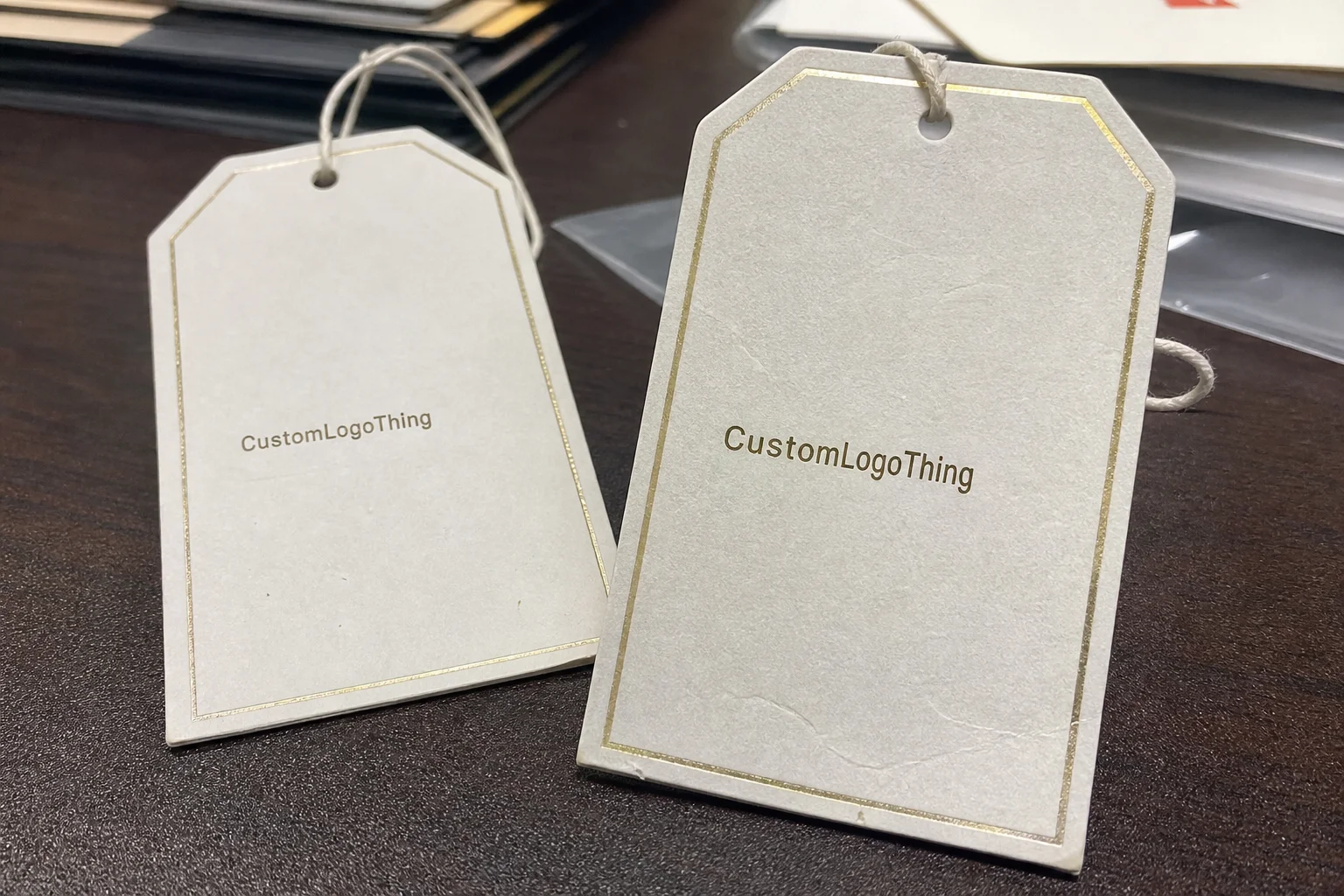
A hang tag is small, but it is not forgiving. Fine serif type, tiny ingredient claims, QR codes, and compliance lines expose weak prepress habits quickly. If the factory cannot keep a 4 pt disclaimer readable or place a hole cleanly without creeping into copy, that usually signals thinner process control than the sample suggested.
From a buyer’s point of view, the tag also carries a lot of brand meaning. A clean matte tag with crisp registration makes the line feel intentional; a tag with fuzzy edges, a dinged corner, or an off-white stock can make the whole launch look rushed. That matters in skincare, where consumers often judge quality through package details before they ever read the ingredients.
The risk is that a supplier can produce a beautiful one-off proof and still fail at a real run. Sample work is slower, more manual, and usually checked more carefully than production. The real test is whether the factory can repeat the same color, finish, and cut tolerance across hundreds or thousands of pieces without drifting.
This is also why I compare hang tags with the rest of the launch kit. If the same supplier is handling labels, cartons, and inserts, consistency matters even more. The tag should sit naturally beside the Custom Labels & Tags page you already planned for the line, and it should match the rest of the Custom Packaging Products in tone and finish. If those details do not line up, the shelf story breaks.
“A hang tag does not need to be flashy. It needs to be accurate, durable enough for handling, and consistent enough that the buyer trusts the rest of the launch.”
One more practical point: a tag often gets touched more than a carton. Buyers, store staff, warehouse teams, and sometimes consumers all handle it directly. That makes abrasion resistance, edge quality, and hole strength matter in a way many first-time packaging teams underestimate. The best supplier will talk about those issues without waiting to be prompted.
Custom hang tags for skincare launches factory audit questions: what to ask
If you want to use Custom Hang Tags for skincare launches Factory Audit Questions as a supplier filter, start with the basics and then move into process detail. You are not trying to catch anyone out. You are trying to see whether the factory understands launch pressure, document control, and the fact that a skincare tag often carries both brand language and regulated copy.
Begin with the person who checks artwork before it goes to plate or digital output. Then ask what they verify: bleed, safe area, barcode quiet zone, PMS references, overprint risk, hole clearance, and whether any text sits too close to a crease or punch. If the answer is vague, the factory may be relying too heavily on the customer to catch mistakes.
Useful audit questions are specific because they reveal how the factory thinks, not just how it sells.
- Who signs off on the final proof before print starts?
- How do you verify barcode readability and QR code contrast?
- What tolerance do you hold for hole placement and die-cut registration?
- Do you keep an approved master sample for reference during production?
- How do you document reprints or remake responsibility if an error is found?
- Can you provide material and ink details if a retailer asks for FSC or recycled-content support?
A mature supplier answers with process, not reassurance. If they say they keep a signed approval file, retain a master sample, and perform in-line checks at set intervals, that tells you they are used to repeat orders and launch windows. If they only say “we will take care of it,” keep pressing.
Compliance-minded buyers should also ask about paper stock and finish claims. If the tag is supposed to use FSC-certified paper, request the chain-of-custody documentation the factory can provide. If a coating or lamination is being added, ask whether it affects recyclability or the feel of the brand. The FSC guidance helps separate a marketing phrase from a documented paper claim.
Shipping and packing matter too. Ask how finished tags are packed: flat packed, banded, strung, or boxed loose all carry different damage risks. If the tags are going into a subscription kit or retail counter display, ask whether pack counts are verified by weight or by count-and-scan. That sounds minor, but off-count cartons waste time during launch prep.
For teams that work across multiple packaging formats, it is also smart to ask whether the supplier understands how the tag should coordinate with custom printed boxes, inserts, and sleeve graphics. When the tag is designed as part of a larger product packaging system, the supplier should be able to speak about consistency in paper tone, finish, and visual hierarchy, not just a single component.
A factory audit does not need to be theatrical. It needs to identify where the supplier is disciplined and where it is guessing. That difference becomes visible fast once you ask about artwork control, production checks, and packing method.
Materials, coatings, and finishes that hold up in real use
Material choice changes everything. A 350gsm C1S board gives a clean print surface and a more polished retail feel. Uncoated stock feels softer and more natural, which works well for botanical, apothecary, or ingredient-led branding. Kraft can look honest and earthy, but it will mute color and make fine type less crisp. Premium white board usually gives the sharpest results when the design uses small text, linework, or a precise logo lockup.
From a packaging design standpoint, the finish should match the skincare story. A matte aqueous coating keeps glare down and holds up reasonably well against scuffing. Soft-touch lamination adds a more tactile, premium feel, but it can show fingerprints on darker colors and is not always the best choice if the tag is handled heavily. Spot UV, foil, and embossing add visual interest, yet each one increases setup complexity and can change how the tag behaves during die-cutting and packing.
In practice, the right choice depends on where the tag will live. A tag attached to a bottle sold in a humid bathroom may need better resistance to curl and edge wear than a tag used only inside a gift box. A salon retail tag may need to stay legible after being touched dozens of times. That is why some buyers pay more for a coating that protects type and corners, even if the visual effect is less dramatic.
Attachment details matter just as much as paper. A cotton cord fits a natural brand tone, but it may slow assembly if the factory has to thread each piece by hand. Elastic loops are efficient for certain bottle necks, yet they are not ideal for every package shape. An eyelet can reinforce the hole and reduce tearing, especially on heavier stock. If the tag is long and narrow, the supplier should check whether the hole placement is far enough from the edge to avoid pull-out.
For buyers who want a simple comparison, this frame is usually enough to narrow the field before sample approval.
| Material or finish | Best for | Typical tradeoff | Relative cost pressure |
|---|---|---|---|
| Coated cover stock | Sharp graphics, barcode clarity, bright color | Less natural texture | Moderate |
| Uncoated textured paper | Natural, apothecary, heritage positioning | Lower color punch, softer detail | Moderate |
| Kraft stock | Eco-leaning or rustic package branding | Muted color, limited white ink effect | Often moderate to higher |
| Soft-touch lamination | Premium skincare launch kits and gift sets | Higher setup and possible fingerprinting | Higher |
| Foil or embossing | Luxury accents and high-visibility retail packaging | More die and setup complexity | Higher |
If you need a broader reference for handling and distribution, the ISTA site is useful even for light package components. The principle is simple: if a package component will be handled, it should be judged against real handling, not just admired on screen.
I also recommend asking whether the factory has a documented check for coating and ink compatibility. Some combinations look fine on a proof but rub or scuff too easily in production. That is especially common with dark solids, metallic accents, and soft-touch films. If the supplier has seen those issues before, they will usually warn you early. That is a good sign.
Process and lead time from proof to packed cartons
The production path for a hang tag is straightforward on paper and full of small traps in real life. It begins with dieline review, then artwork prep, proofing, color signoff, and print setup. After that come finishing steps such as coating, lamination, foil, embossing, die-cutting, hole punching, and finally packing. If the job includes assembly with cord or string, that adds another labor step that can shift the schedule.
Lead time depends on more than print capacity. Paper availability, specialty finish availability, and the complexity of the tag all change the timeline. A straightforward flat-printed tag on standard stock may move through production in roughly 10 to 15 business days after proof approval. Add foil, soft-touch lamination, custom stringing, or a tight color match, and the schedule can stretch further. If a supplier quotes the same lead time for every build, I would question whether they are really accounting for the job details.
The approval sequence should be tight. Before release, confirm artwork, dimensions, bleed, pantone targets, barcode readability, hole position, coating choice, and final count. If the tag includes claims about ingredients, sustainability, or dermatology positioning, those claims should be checked against the approved copy deck before print begins. Once the press run starts, small changes become expensive quickly.
Sample timing is not the same as production timing. A sample can be hand-checked and adjusted. A production run must survive repetition, packing, and transit. That is why I like to add buffer time for a proof round and, if the finish matters, a physical sample before full release. For items tied to retailer appointments or influencer seeding, that buffer is not optional.
There is also a practical reason to keep the factory loop short. Every extra round of artwork correction increases the risk of file drift. One team changes the barcode, another adjusts the logo size, and suddenly the proof is no longer the same file that got approval. Good document control is not glamorous, but it keeps the launch from slipping.
If the supplier is also handling label or carton work, ask how they coordinate across SKUs. A small inconsistency between the hang tag, label, and carton can make the whole line feel less finished. That is where product packaging becomes a system rather than a set of parts.
Cost, MOQ, and quote drivers that change unit price
Pricing for hang tags is driven by a handful of variables, and buyers save time when they ask for quotes in a clean, comparable format. The biggest levers are stock weight, size, print sides, finish complexity, quantity, and assembly method. A simple flat tag on coated cover stock will almost always land below a tag with foil, soft-touch lamination, and stringing.
MOQ matters because setup costs have to be spread across the run. On a small run, the press setup, die, and finishing prep take a larger share of the unit price. On a larger run, that fixed cost gets diluted, but then you need tighter planning so you do not overbuy inventory that sits after launch. For many skincare teams, the right answer is not the cheapest piece price; it is the quantity that matches actual sell-through and reorder risk.
Here is a practical pricing frame for buyers comparing suppliers on the same spec.
| Run size | Likely unit price pressure | What usually drives it | Best use case |
|---|---|---|---|
| 1,000 to 2,000 | High | Setup, proofing, and finishing start-up costs | Pilot launch, limited edition, test market |
| 5,000 | Moderate | Better spread of setup across the run | Main launch with moderate reorder risk |
| 10,000+ | Lower per unit, higher total commitment | Volume improves efficiency, but inventory risk rises | National rollout or multi-channel launch |
When you compare quotes, compare the whole offer, not just the headline number. One factory may include proofing, one may charge separately for revisions, one may quote flat packed tags while another assumes stringing is included, and one may add a packing fee for carton labeling or shrink wrapping. The gap can look small until you total the extras.
Ask for at least two quantity scenarios, such as 2,000, 5,000, and 10,000 pieces, so you can see where the price curve bends. That makes it easier to decide whether the lower unit price at a higher volume actually fits the launch calendar. For a fast-moving skincare launch, the cheaper price is not always the smarter move if it creates storage, obsolescence, or delay risk.
Material substitutions can change the quote more than people expect. A paper upgrade, a coated liner, or a stronger reinforcement at the hole can change the cost enough to matter, especially on small runs. Honest suppliers will show that adjustment clearly rather than hiding it in a vague lump sum.
Common mistakes that trigger reprints or launch delays
Most reprints start with a preventable file issue. Type is too small. The logo sits too close to the trim. Bleed is missing. The barcode was exported at low resolution. Or someone updated the copy after proof approval but did not recheck the dieline. These are ordinary mistakes, but on a hang tag they are expensive because they affect the entire run.
Color is another common trap. Warm neutrals, soft blush tones, deep charcoal, and nearly-black backgrounds can shift just enough to feel off-brand if the screen is not calibrated or the proofing process is loose. Skin care buyers often care more about subtle tone control than dramatic saturation, because the brand is trying to communicate calm, clarity, or clean formulation. A small shift can make the package look cheap even if the print quality is technically fine.
File prep problems also slow everything down. Missing fonts, linked images instead of embedded art, and poorly built dielines can force the factory to pause and ask for corrections. That is time you lose before the run even begins. If the supplier has to rebuild your file structure, you are already behind.
Assembly details create another category of delay. A tag may print perfectly and still miss launch because the team did not confirm how it would be attached in packout. If the cord length is wrong, the eyelet is too small, or the hole placement conflicts with the bottle neck, the warehouse may have to improvise. That is how a simple accessory becomes a bottleneck.
For teams that want to tighten the process, the best fix is not more hope. It is a stronger approval checklist.
- Confirm final artwork against the approved copy deck.
- Review the dieline with trim, bleed, and hole placement marked clearly.
- Check barcode and QR code scans on the proof.
- Lock the paper stock, coating, and attachment method before release.
- Request a retained sample or master reference for the run.
That level of discipline is ordinary in serious retail packaging work, and it should be ordinary here too. The best custom hang tag programs borrow the same logic used for carton and label control: documented approval, measurable tolerances, and a clear answer to who owns the fix if something drifts.
Next steps before you request samples or place the order
Before you ask for samples, assemble the brief in one clean package. Final artwork. Dieline. Quantity bands. Stock preference. Finish preference. Attachment style. Target ship date. If the factory receives all of that together, the quote will be more useful and the proof process will move faster.
I also recommend asking for a written spec sheet before production release. It should record size, paper weight, finish, print method, attachment method, packing format, and approved quantity. That document becomes the reference if the reorder happens later, or if another team member needs to match the launch program.
If the finish is part of the brand promise, request a physical sample. Screen proofs can hide texture, edge feel, and coating behavior. A tag that looks premium on a monitor can feel ordinary in hand if the stock is too thin or the coating is too glossy. That is especially true for branded packaging meant to support a higher-priced skincare line.
Comparing two or three suppliers against the same brief will tell you more than any sales pitch. Watch how they answer technical questions. Watch how they talk about tolerance, proofing, and packing. A strong supplier gives you specifics, not generic comfort language. That is the real value of Custom Hang Tags for skincare launches factory audit questions: they help you see which factory can actually support the launch, not just quote it.
For teams that want a wider packaging view, the same discipline applies across labels, cartons, and inserts. A tag is one component, but it should fit cleanly into the full product packaging plan so the launch feels deliberate from the first box to the last shelf-facing detail.
What should I ask in custom hang tags for skincare launches factory audit questions?
Ask who reviews artwork, how color is controlled, what proof is retained before production, and how barcode checks are handled. Also confirm who pays for a reprint if a factory-side error slips through.
How far ahead should I order skincare launch hang tags?
Build enough time for artwork approval, proof review, and freight. For a simple run, a realistic window is often 10 to 15 business days after proof approval, while complex finishes or tight launch dates need more buffer.
What affects custom skincare hang tag pricing the most?
Quantity, stock choice, print sides, finishing, and assembly method usually move price more than minor artwork edits. MOQ and setup costs matter most on smaller runs, while specialty finishes raise cost at almost any volume.
Which materials work best for premium skincare hang tags?
Coated cover stock is a strong choice for crisp print and clean retail presentation. Uncoated or textured stock works better for natural positioning, while kraft supports an earthy look if you can accept softer color reproduction.
What files should I send with a hang tag quote request?
Send the final dieline, print-ready artwork, size, quantity, finish notes, and the attachment method you want. Include your target ship date so the supplier can quote a realistic schedule instead of a generic estimate.
If you are comparing suppliers for a launch, treat the tag brief as a small factory audit. The questions that expose weak control on paper, color, finishing, and packing are the same questions that protect your launch schedule. And if you keep the brief tight, custom hang tags for skincare launches factory audit questions will do what they are supposed to do: help you choose a supplier that can deliver clean, consistent retail-ready work, not just a pretty sample.


