Buyer Fit Snapshot
| Best fit | Custom Sleeve Labels for Boxes projects where brand print, material claims, artwork control, MOQ, and repeat-order consistency need to be specified before quoting. |
|---|---|
| Quote inputs | Share finished size, material target, print colors, finish, packing count, annual reorder estimate, ship-to region, and any compliance wording. |
| Proofing check | Approve dieline scale, logo placement, barcode or warning zones, color tolerance, closure strength, and carton packing before bulk production. |
| Main risk | Vague material claims, crowded artwork, missing packing details, or unclear freight terms can make a low unit price expensive after revisions. |
Fast answer: Custom Sleeve Labels for Boxes: Design, Cost, Timing should be specified like a repeatable production item. The safest quote records material, print method, finish, artwork proof, packing count, and reorder notes in one written spec.
Production checks before approval
Compare the actual filled-product size with the drawing, then confirm tolerance on folds, seals, hang holes, label areas, and retail display edges. Reserve space for logos, QR codes, warning copy, and material claims before decorative graphics fill the panel.
Quote comparison points
Review material grade, print process, finish, sampling route, tooling charges, carton quantity, and freight assumptions side by side. A quote is only useful when the supplier can repeat the same color, closure quality, and packing count on the next order.
Custom Sleeve Labels for boxes can turn a plain carton into retail-ready packaging in a single production step, which is why so many brands choose them before committing to fully printed cartons. The base box stays simple; the sleeve carries the color, messaging, seasonal graphics, and package branding. For a buyer trying to protect margin and move quickly, that split matters more than most people expect.
From a packaging buyer’s point of view, custom sleeve labels for boxes sit between a naked corrugated mailer and expensive Custom Printed Boxes. They add a branded face without forcing every box into a new SKU, and they can be revised for launches, promotions, or retailer requirements with far less waste than a full carton change. That is a practical advantage, not just a design detail.
The real appeal is flexibility. Custom Sleeve Labels for boxes can make one base package work for a subscription kit this month, a holiday gift set next month, and a limited-run promotion after that. In a market where product packaging has to do more jobs with fewer components, that kind of reuse is one of the cleanest ways to keep inventory under control while still improving the shelf story.
I have seen this play out in a packaging review room more than once: a team brings in a carton that looks ordinary on its own, then places two sleeve concepts on top and suddenly the room treats the same box as a premium product. The structure did not change. The perception did. That gap is why custom sleeve labels for boxes remain such a useful middle path.
What custom sleeve labels for boxes actually do
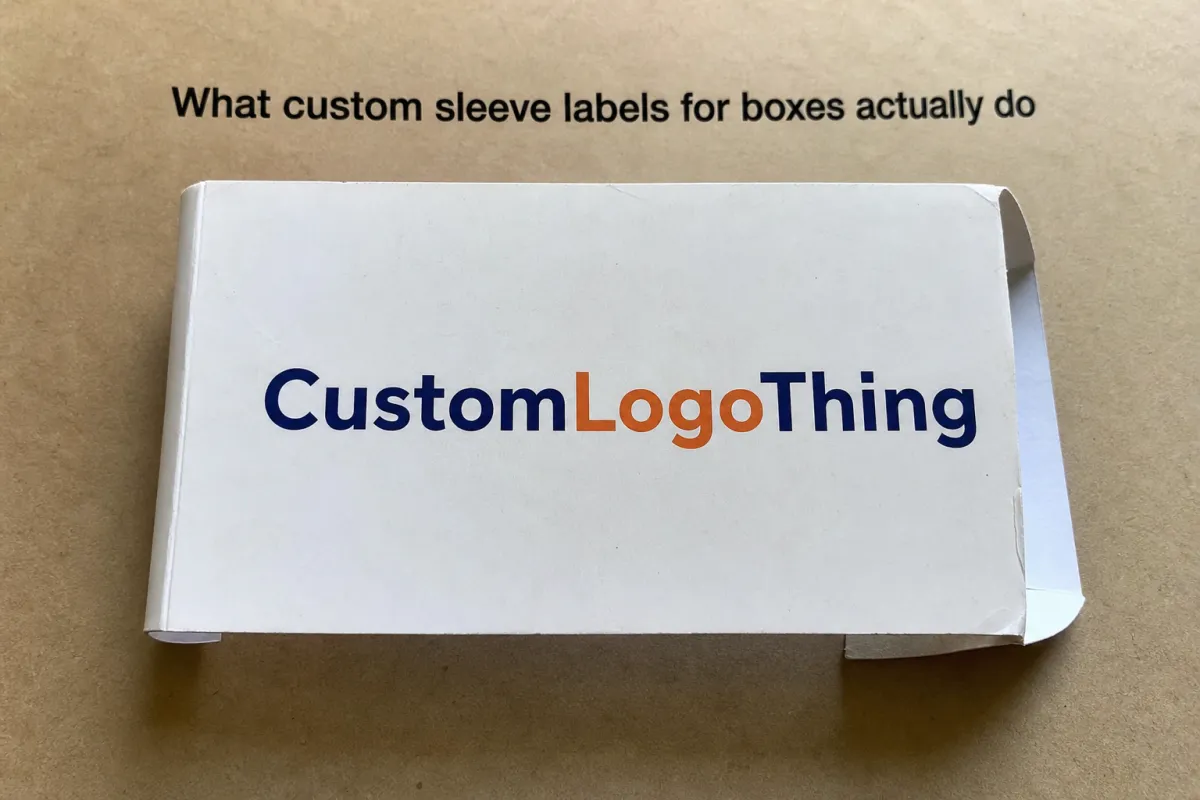
Picture a basic retail scenario. A brown mailer box arrives from the supplier looking functional, but not especially persuasive. Add custom sleeve labels for boxes around that carton and the same structure suddenly carries a brand name, a product claim, a QR code, a campaign visual, or a seasonal message. The box itself has not changed, yet the customer experience changes immediately. That is why sleeves show up so often in branded packaging plans.
A sleeve is usually a separate printed component that wraps around, slides over, or bands across a box. It can be a fully enclosed wrap, a slip-on band, or a label-style layer with an adhesive seam. Custom sleeve labels for boxes do not replace the carton; they sit on top of it and give the base structure a visible identity. In practice, that means one packaging system can support several versions of the same SKU without replacing the whole box every time the artwork changes.
Brands choose custom sleeve labels for boxes for a few very practical reasons. First, the commitment is lower than with fully printed cartons. Second, versioning is easier, so one box format can support multiple flavor calls, regional variants, or retailer-specific promotions. Third, the sleeve can carry visual energy while the inner box stays plain and economical. That mix often protects margin, especially for e-commerce and subscription brands where packaging design needs to look premium but still stay inside a disciplined unit cost.
There is also an unexpected upside. A good sleeve can create the impression of a more expensive package without forcing the inner carton to become expensive. For a brand selling gift sets, sample kits, or seasonal bundles, that matters because the unboxing moment is what people remember. Custom sleeve labels for boxes help deliver that moment with less structural waste than a fully decorated carton system would require.
Common use cases include subscription kits, e-commerce mailers, retail display packs, gift packaging, and limited-run campaigns. You also see custom sleeve labels for boxes on trial packs, influencer mailers, and any product packaging that needs fast localization. If a brand expects its artwork to change often, sleeves are usually easier to manage than a full box print program. That is why many packaging teams treat them as a bridge between basic packaging and a fully customized launch.
One small but important detail: the sleeve should support the box, not fight it. A strong design can still fail if the sleeve blocks a closure, hides a tamper feature, or becomes damaged in transit. Good package branding is not only about appearance. It is about keeping the graphic layer aligned with how the carton is opened, stored, stacked, and shipped.
In practice, the best sleeve programs are often the least dramatic operationally. They do not create extra handling steps, they do not slow pack-out, and they do not force the warehouse to manage a fragile special case. Quiet efficiency is part of the value. That is easy to miss until a team compares the labor line between a simple sleeve and a more complex decorated carton.
How custom sleeve labels for boxes are made and applied
The production path is straightforward, but each step can create trouble if the brief is loose. Custom sleeve labels for boxes usually begin with a dieline, then move through artwork setup, material selection, proofing, printing, finishing, cutting, and either flat packing or assembly. The cleaner the handoff at the start, the fewer surprises later. That sounds obvious, yet it is one of the most common reasons projects slow down.
There are three basic sleeve styles buyers should understand. A wrap sleeve fully surrounds the box and often uses a seam on the back or underside. A slip-on band is looser and depends on fold geometry or friction to stay in place. An adhesive-backed label sleeve acts more like a large-format label that wraps partway around the carton. Custom sleeve labels for boxes can be built in each of these formats, but the best choice depends on the carton shape, the filling method, and how visible the seam can be on shelf.
Application also matters. Short runs are often hand-applied, which keeps tooling low and gives flexibility during pilot production. Medium volumes may use semi-automated placement to improve consistency and reduce labor strain. High-volume packaging lines need sleeves that work with line speed, consistent fold memory, and a predictable position during pack-out. If the sleeve adds ten seconds per unit, the labor cost can overtake the print savings very quickly.
Fit is where many projects go wrong. The box dimensions are only the starting point. You also need to think about tuck flaps, depth, score lines, board thickness, and whether the sleeve will sit on an empty box or a fully packed one. Custom sleeve labels for boxes that fit perfectly in a mockup may behave differently once product weight, inserts, and shipping pressure come into play. A two-millimeter shift can be invisible on a screen and very visible in hand.
Scuff points deserve attention as well. If the sleeve sits where cartons rub against each other in transit, the most beautiful design can arrive with worn corners or marred ink. For that reason, packaging design should match the physical journey, not just the sales image. In retail packaging, the sleeve often does double duty as both a visual asset and a light protective face, which means finish selection and fold direction matter more than buyers expect.
If the box is part of a broader packaging system, keep the sleeve logic consistent across the line. That makes it easier to order matching Custom Labels & Tags for inserts, outer cases, or add-on pieces, and it also simplifies brand control across multiple SKUs. A fragmented packaging system costs time. A disciplined one gives you options.
One detail that separates average jobs from well-run ones is how the dieline is checked. A clean dieline is not just a PDF with cut lines drawn on it. It should show seam placement, glue area if needed, panel sequence, and the true finished size after board thickness is accounted for. That extra half hour of review can prevent a week of rework.
Custom sleeve labels for boxes pricing: what changes the quote
Pricing is where expectations and reality often diverge. Custom sleeve labels for boxes can be very economical in moderate and high volumes, but the quote depends on several variables that work together rather than one single price driver. Size, material, print coverage, finishing, quantity, and cut complexity all influence the final number. A clean two-color sleeve on standard stock is a very different job from a heavy full-bleed sleeve with foil, soft-touch coating, and custom windows.
Quantity changes everything because setup costs have to be spread across the run. A sleeve job with die cutting, plate setup, and press make-ready may look expensive at 500 units, yet the same job can fall sharply at 5,000 or 10,000 units. That is not a sales line; it is basic manufacturing math. Custom sleeve labels for boxes usually become much more efficient as the run grows, especially when the design stays stable and the production line can keep moving without interruptions.
Material choice has a major impact too. Paperboard, SBS stock, kraft, coated sheets, and specialty substrates each bring a different mix of feel, stiffness, ink behavior, and price. If a brand wants a natural look, kraft can be a strong choice. If the goal is crisp color and sharp photography, coated stocks usually perform better. For teams that care about sourcing, FSC-certified paperboard can support a responsible materials story, although the certification needs to be verified on the actual paper spec rather than assumed from the quote.
Finishing upgrades can move the cost more than people expect. Foil stamping, embossing, debossing, soft-touch coating, spot varnish, matte lamination, and high-gloss lamination all add both value and labor. Sometimes that premium is worth it. Sometimes it is just expensive decoration on a carton that never needed it. For custom sleeve labels for boxes, the smartest finish is the one the customer can actually see and feel during the unboxing moment.
| Material / Finish | Typical Use | Approx. Unit Cost at 5,000 | Approx. Unit Cost at 20,000 | Notes |
|---|---|---|---|---|
| 16 pt SBS C1S | Retail packaging, promo sleeves | $0.18-$0.28 | $0.10-$0.18 | Sharp print, efficient for standard artwork |
| 18 pt kraft | Natural or eco-forward branding | $0.20-$0.31 | $0.12-$0.20 | Texture reads well, but colors print differently |
| Soft-touch laminated board | Gift sets, premium product packaging | $0.28-$0.45 | $0.16-$0.28 | Higher tactile value, more finishing cost |
| Foil + emboss package | Luxury launches, signature editions | $0.35-$0.60+ | $0.22-$0.40+ | Tooling and finishing add time as well as cost |
Those ranges are ballpark figures, not promises. A short-run digital job can cost more per unit than a long-run offset run, and a highly customized sleeve can go far beyond the numbers above if it includes windows, unusual folds, or specialty adhesives. The hidden costs are what trip up buyers: sample rounds, freight, rush production, artwork revisions, and rework caused by a missed dimension. Custom sleeve labels for boxes can be budget-friendly, but only if the spec is tight before the quote goes live.
There is a useful comparison here with full carton decoration. A fully printed box often raises the baseline cost of every unit, even when the brand only needs a seasonal change twice a year. Custom sleeve labels for boxes can preserve a simpler base carton and move the creative cost to the surface layer. That is one reason they are common in branded packaging systems with frequent campaign turnover.
Another way to think about the quote is this: a sleeve buys adaptability, while a fully printed box buys permanence. That difference matters most for brands with frequent artwork changes, retailer-specific runs, or product lines that split into many variants. If the packaging changes every quarter, locking that change into the carton can become an expensive habit.
Process and timeline: from proof to finished sleeves
Most sleeve projects follow the same path. A brief comes in. The supplier confirms dimensions. A quote is built. A dieline is reviewed. Artwork is checked, proofed, and approved. Then production starts, followed by finishing, cutting, packing, and shipment. Custom sleeve labels for boxes move fastest when that chain is clean and nobody is waiting on missing information from another department.
Delays usually happen in predictable places. The first is incomplete carton data. If the supplier only has one sample box and no measured tolerance, the sleeve may need to be revised after proofing. The second is artwork uncertainty. Files with low-resolution images, missing bleeds, or unlabeled layers invite back-and-forth. The third is slow approval. One packaging manager may be ready, but procurement, brand, operations, and sales all want a look. That can turn a two-day proof cycle into a two-week wait.
For many standard jobs, a realistic timeline is 12-15 business days from proof approval to shipment. Simpler custom sleeve labels for boxes on standard stock can move faster if the artwork is final and the cut is uncomplicated. Larger runs, specialty finishes, and heavier board choices often stretch that timeline because setup and finishing need more machine time. Rush work is possible in some cases, but only within production capacity. Nobody should promise a five-day turnaround on a complex sleeve if the press schedule is already full.
Good ordering behavior shortens the schedule. Provide exact box dimensions up front, including any closure height or tuck depth. Name one internal decision-maker if possible. Lock the design before production starts. If multiple product versions are needed, decide that early rather than after plates or cutting rules are set. Custom sleeve labels for boxes are much easier to manage when the brief answers the annoying questions before they are asked.
The packaging buyer’s goal is not only speed. It is dependable timing. A sleeve that arrives on Tuesday but misses a launch on Friday is not a success. That is why companies running retail packaging programs often keep a calendar with artwork freeze dates, proof review windows, and freight cutoffs. Better schedule discipline usually beats last-minute heroics.
ISTA testing standards can also be useful when the sleeve is part of a shipping pack that has to survive distribution. The sleeve itself may not be the entire transit package, but the finished carton should still behave properly under vibration, compression, and handling. If the outer presentation fails in the shipment chain, the shelf story never gets a fair chance.
In one project I reviewed, a packaging team approved a beautiful sleeve before anyone checked the tuck depth on the production carton. The sleeve fit the render perfectly and missed the real box by a few millimeters. That sounds minor until you are staring at 4,000 units that will not close cleanly. Small dimensional assumptions are where budgets quietly disappear.
Key factors that decide fit, durability, and shelf impact
Fit starts with measurement, but it does not end there. A carton’s length, width, and depth matter, yet so do seam allowance, score placement, closure style, and whether the sleeve is applied before or after the box is filled. Custom sleeve labels for boxes can look perfect on a flat mockup and still feel awkward on a filled carton if the board thickness was not part of the original calculation. That is why dimensional tolerance belongs in the spec sheet, not in an afterthought email.
Structural compatibility is the next issue. Some boxes need extra room for tuck tabs, inserts, thumb notches, or automated packing equipment. If a sleeve sits too tightly, it can snag during application or bunch at the corners. If it is too loose, it can drift and lose alignment. In practice, the best sleeve designs account for the exact way the box is built, closed, and handed off to the pack line. That is especially true for product packaging that has to look neat on a shelf but also survive a rough distribution chain.
Visual hierarchy affects shelf impact more than many buyers realize. A logo that looks strong in a design file may disappear if it lands on a fold, near a seam, or inside a busy panel. Product name, claims, QR code, barcode, and regulatory copy should each have a clear role. Custom sleeve labels for boxes are at their best when the front panel can be read from arm’s length and the side or back panels carry supporting information without fighting for attention. Good package branding behaves like a conversation: one voice leads, the others support.
Durability is not only about strength. It is also about how the printed surface behaves during handling. If the sleeve needs scuff resistance, a matte lamination or a tougher coated stock may help. If moisture is a concern, the finish choice becomes even more important. If the box moves through automated packing, the score memory has to hold after repeated handling. Custom sleeve labels for boxes are a graphic system, but they are also a mechanical one.
For shipping-focused programs, some teams benchmark the final package against ASTM or ISTA protocols, especially when cartons face compression, vibration, or drop risk. That does not mean every sleeve must pass a lab test on its own. It does mean the package should be evaluated as a unit. A beautiful sleeve with poor fold behavior or weak rub resistance can still create a quality issue, even if the box structure underneath is sound.
One more point: the sleeve and the box should feel like they belong together. A heavyweight soft-touch sleeve on a flimsy carton can create a strange mismatch. The customer notices that. People may not articulate it, but they feel it. From a packaging design perspective, the outer layer should reinforce the message of the base structure, not contradict it.
“The best sleeve is the one nobody has to think about during packing. It lines up, it stays put, and it still looks right after shipping. Anything less turns into rework.”
That quote holds up because the strongest packaging systems usually disappear operationally. The line keeps moving, the print looks deliberate, and the carton opens the way the brand intended. The final customer only sees the result, but the warehouse, the packer, and the reordering team feel every weak decision along the way.
Common mistakes that cause wasted sleeves and delays
The first mistake is measuring only one sample box. Box suppliers can vary slightly from run to run, especially when different corrugate thicknesses or paper grades are involved. Custom sleeve labels for boxes need tolerance, not wishful thinking. If the sleeve is built to one exact sample and the next carton is just a little different, the fit can go off fast. That is how a small dimensional miss becomes a pile of unusable inventory.
The second mistake is weak artwork preparation. Low-resolution images, missing dieline layers, and unmarked bleeds are still common. They slow proofing and can trigger production changes late in the process. A supplier can fix a surprising amount, but not everything. If the file is messy, the schedule becomes messy too. For custom sleeve labels for boxes, clean artwork is not a luxury item. It is part of the manufacturing input.
The third mistake is ordering before testing. A mockup may look fine in a PDF and still fail in hand. It may buckle at a fold, hide a closure, or cover a useful panel. Some buyers are tempted to skip a pilot run to save money, but that usually shifts risk into the main production order. A fifty-unit test is cheaper than a five-thousand-unit reprint. Every time.
The fourth mistake is a mismatch between finish and box quality. A premium foil sleeve on a low-grade carton can feel inconsistent. A heavy sleeve on a light box can feel awkward and wasteful. Custom sleeve labels for boxes work best when the surface finish, the stock weight, and the inner carton all support the same brand promise. That alignment matters in retail packaging, where people compare products quickly and with very little patience.
The fifth mistake is ignoring reprint exposure. If the first run is built with shaky measurements or a half-finished design system, future orders become harder to manage. A simple pilot should verify not just appearance but repeatability. Brands that order custom sleeve labels for boxes regularly know this well: the real cost of a bad spec is not the first box. It is the second, third, and fourth time the mistake has to be repeated.
A practical check before approval is simple: fit, readability, scuff resistance, line speed, and shelf presentation. If all five are acceptable, the job is probably safe. If even one is questionable, fix it before the run becomes expensive. That is the difference between a controlled packaging program and a very expensive experiment.
There is also a quieter mistake that rarely appears in the quote: not assigning ownership. When packaging, operations, and brand all assume someone else will catch the error, the error survives. A single person or small sign-off group should own the dieline, the proof, and the final carton sample. Without that, even good custom sleeve labels for boxes can turn into a coordination problem instead of a packaging solution.
Expert tips and next steps for a better order
Start with a one-page spec sheet. It Should Include exact box dimensions, target quantity, material preference, finish preference, application method, shipping method, and the date the artwork must be final. Custom sleeve labels for boxes move faster when the supplier does not have to reconstruct the brief from fragments. A tidy spec sheet also makes it easier to compare quotes from different vendors without getting lost in vague language.
Ask for a physical sample or prototype if the sleeve must fit tightly, wrap a complex shape, or survive automated packing. A printed mockup is useful, but a real sample tells you much more about scoring, friction, and handling. This is especially true for branded packaging that will be stacked, shipped, and opened repeatedly. The closer the sample is to production materials, the better the decision you can make.
Build a comparison set before you approve the order. Request pricing for two or three material and finish combinations so you can see the trade-off between appearance, durability, and unit cost. A lot of teams default to the most attractive option, then discover that a slightly simpler sleeve would have delivered nearly the same shelf impact at a better budget level. Custom sleeve labels for boxes should be chosen like any other packaging investment: by balancing visual return against actual operating cost.
Use a test checklist that covers the real use case. Does the sleeve fit after the carton is filled? Is the branding readable from a few feet away? Does the print rub off under normal handling? Does the line still run at speed? Does the sleeve sit correctly next to your other Custom Packaging Products? A good checklist avoids emotional approvals and replaces them with something better: evidence.
For teams that reorder often, keep the approved dieline, artwork version, stock choice, and finishing notes in one place. That record makes future custom sleeve labels for boxes easier to reorder, easier to quote, and easier to standardize across SKUs. The best packaging programs do not rely on memory. They rely on clean documentation.
One final habit helps more than people expect: compare the sleeve against the larger system. If the inner carton, inserts, labels, and outer shipper all feel like different projects, the customer notices that fragmentation. If they feel like one package family, the whole line becomes stronger. That is where custom sleeve labels for boxes can do real work. They are not just a decorative layer. They are a controllable way to improve product packaging without rebuilding the whole box strategy from scratch.
If you are planning a sleeve order now, the best next move is practical rather than flashy: measure three finished boxes, build the dieline to the tightest safe tolerance, and approve a printed mockup on the actual stock before volume production starts. That sequence catches fit problems, finish issues, and application headaches while they are still cheap to fix.
The practical takeaway
Custom sleeve labels for boxes make sense when you need visual impact, frequent version changes, or a more premium presentation without moving straight to fully printed cartons. They are especially useful for subscription kits, seasonal gift sets, retail packaging, and campaigns that need package branding to change faster than the base box can. The strongest programs start with accurate measurements, clear artwork, and a realistic view of fit, finish, and production timing.
If the goal is to protect margin while still improving shelf impact, custom sleeve labels for boxes are one of the most flexible tools available. They can be economical, they can look sharp, and they can simplify future reorders if the system is documented properly. The important part is not guessing. It is specifying the job well enough that the sleeve fits the box, the budget, and the launch date.
Frequently Asked Questions
How do custom sleeve labels for boxes compare with full box printing?
Sleeves usually cost less to change because they keep the base box simple and let you update branding without replacing the whole carton. Full box printing can look more integrated, but custom sleeve labels for boxes are often better for seasonal runs, promotions, and multi-SKU packaging systems. The right choice depends on how often the artwork changes and how much structure you want in the base carton.
What materials work best for custom sleeve labels for boxes?
Paperboard and coated paper stocks are common when you want a polished print surface and sharp branding. Kraft or uncoated stocks work well for natural, premium, or eco-forward positioning. The best material depends on how much scuff resistance, stiffness, and moisture protection the box needs, along with the look you want for branded packaging.
How long does it take to produce custom sleeve labels for boxes?
Simple runs move faster when artwork is final, dimensions are clear, and the sleeve uses standard materials and finishes. Complex finishes, special cuts, or larger quantities usually extend the timeline because setup and finishing take longer. For many projects, 12-15 business days from proof approval is a practical planning range, although custom sleeve labels for boxes with specialty features may take more time.
What affects the price of custom sleeve labels for boxes the most?
Quantity, material, print coverage, and finishing choices have the biggest impact on unit cost and total budget. Rush orders, sample rounds, and design revisions can add expense even when the printed piece itself seems simple. A clear spec sheet usually gets you a cleaner quote because it reduces guesswork and back-and-forth on custom sleeve labels for boxes.
Can custom sleeve labels for boxes be used on different box sizes?
Yes, but each box size usually needs its own measured sleeve dimensions unless the design is built with a lot of tolerance. If you use multiple box sizes, you may need variant sleeves or a modular design system that keeps branding consistent. Test each size before final production so the sleeve does not slide, wrinkle, or cover important closures, especially in retail packaging and e-commerce programs.
Used well, custom sleeve labels for boxes give a brand a practical middle path: more presence than a plain carton, less commitment than a full print program, and far more flexibility than most teams expect. The safest next step is to verify the carton dimensions, review a physical mockup, and document the approved spec so the next reorder behaves the same way as the first.

