Custom Slider Lock Bags with warning label solve a practical packaging problem: the bag needs to be easy to open and reseal, but the message on the outside has to stop the handler long enough to notice it. That combination shows up in sample kits, controlled inventory, retail packaging, and any workflow where a plain zipper pouch does not communicate enough on its own. The warning is not decoration. It is part of the packaging function.
For buyers, these bags sit in a useful middle ground. They are more structured than a basic press-to-close pouch, less rigid than a box, and often more economical than moving everything into custom cartons. That makes them a good fit for product packaging that has to do real work without pushing the whole program into a higher-cost format. The key is to specify the warning correctly and build it into the bag, not treat it as an afterthought.
In practice, the best results come from treating the closure, film, artwork, and warning copy as one system. If any one of those elements is weak, the package looks finished but behaves unfinished.
Why Warning-Labeled Slider Bags Solve Real Packaging Problems
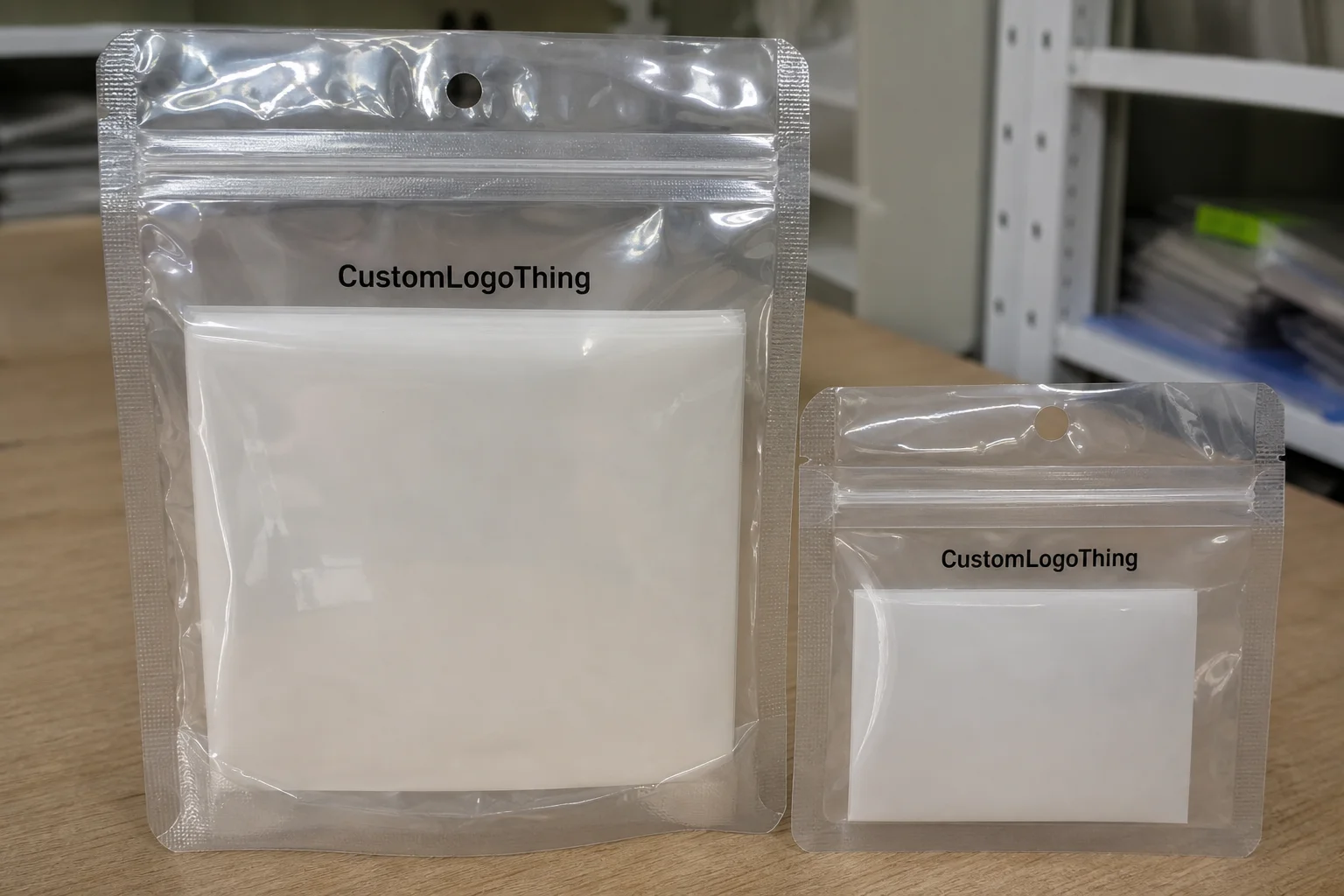
A slider lock bag uses a track and moving slider to open and close the pouch with more control than a loose seal or basic zipper. The action is clearer, and on a packing line or in a warehouse, that matters. People can tell at a glance whether the bag is closed, partly open, or ready for reuse. That small difference reduces handling errors, especially when the same package is opened more than once.
Add a warning label and the bag becomes a communication tool as well as a container. The warning may be about handling, age limits, storage, tamper awareness, product separation, or internal controls. Whatever the wording, the package now sends a message before the user touches the contents. That is useful in retail packaging, compliance-driven programs, and any operation where the wrong assumption costs time or money.
The warning only works if it is readable in the real world. If the text is too small, hidden by the fill level, or printed too close to a seam, it gets lost. If the film is glossy and the ink contrast is weak, the message may look fine in a proof and vanish under warehouse lighting. Buyers sometimes focus on the artwork first and forget that the warning has a job to do. That usually shows up later as rework.
“A warning panel should be designed for the conditions it will actually face, not for how it looks in a render.”
That matters just as much for internal supply packaging as it does for retail-facing formats. If the label is part of a controlled workflow, clarity beats decoration every time. If the bag is part of package branding, the warning still needs enough space and contrast to stand on its own.
For broader packaging programs, these bags can sit beside Custom Labels & Tags or other Custom Packaging Products when the project needs a consistent set of materials across multiple SKUs.
How the Slider Lock and Warning Label Work Together
The closure and the warning should be specified together. A slider gives repeat access and a more obvious close point than a loose fold or simple adhesive closure. That makes the bag easier to use with gloves, easier to reopen in a busy environment, and less likely to be left partially sealed. If the bag is being handled often, that is a real operational benefit, not just a convenience feature.
The warning can be integrated in several ways, and the right choice depends on volume, message stability, and the way the bag will be handled.
- Direct print: The warning is printed on the film itself. Best for recurring orders and stable copy.
- Adhesive label: Useful when the text changes, quantities are smaller, or the warning has to be variable.
- Pre-printed panel: Good for fixed artwork and a cleaner look across every unit.
- Inserted card or insert label: Works for some kits, but the message is easier to miss than an external warning.
Placement needs more thought than most buyers expect. The text should be visible before the bag is opened and still visible when the pouch is partially full. If the fill level rises above the centerline, low-positioned copy can disappear. If the bag has a thick slider track, gussets, or reinforced seams, the warning panel needs margin so the copy is not squeezed into a bad location.
Contrast is another detail that gets underpriced. Dark text on a light panel is still the safest read. If the bag film is tinted or the artwork is busy, the warning should be isolated visually. A small, elegant warning often fails where a larger, plain panel succeeds. For compliance-heavy applications, the warning deserves the best real estate on the bag face.
Direct print and adhesive application also behave differently during production. Printed copy is usually cleaner on repeat runs and reduces labor. Labels offer flexibility, but they add a step and can create consistency issues if the surface energy, adhesive, or storage conditions are wrong. That is one reason buyers should ask for a side-by-side quote instead of assuming the cheaper print method is the better total cost.
Materials, Printing, and Quality Checks
Most of these bags are built from polyethylene film or a layered plastic structure chosen for the product weight, handling environment, and clarity requirements. For many pouch applications, film thickness often lands in the 2.5 mil to 4 mil range, but there is no universal best choice. A light sample kit does not need the same wall strength as a heavier product or a bag that will be packed, shipped, and reopened many times.
Slider style matters too. Standard colors and standard parts usually cost less and move faster than custom-matched components. A custom slider color may be useful for branding, but it should earn its place. If the bag is serving an internal control purpose, a standard slider often makes more sense and keeps the unit price in check.
Printing also affects both cost and consistency. A one-color warning panel is usually more predictable than full-coverage graphics. If the project needs package branding and warning copy on the same face, keep the hierarchy clean so the warning does not compete with the logo. On flexible packaging, too much artwork can make the important message harder to read. That is one of the few times where restraint improves both design and function.
Quality control should cover more than visual approval. Buyers should ask how the bag will be checked for closure performance, print registration, seal integrity, and label adhesion if the warning is applied separately. A sample that looks good on a desk can still fail after carton movement or repeated opening. Useful checks include:
- Slider movement across the full length of the track
- Seal consistency at the edges and corners
- Warning visibility at actual fill level
- Ink adhesion or label bond after handling
- Legibility under normal warehouse or retail lighting
If the bag will ship loose in cartons or be handled alongside other goods, it is reasonable to ask for transport durability guidance. For buyers who care about shipping abuse, the ISTA testing library is a practical reference for common transit methods and package performance expectations. It is not the only framework, but it is a sensible place to start when the bag has to survive more than a simple shelf presentation.
Sustainability claims should stay accurate and specific. If the program uses paper inserts or mixed components, verify what can actually be certified and what cannot. The FSC site is a useful reference for paper sourcing, but it should be used to confirm facts, not to decorate a spec sheet with vague environmental language.
Cost, Pricing, MOQ, and Unit Cost Factors
Pricing follows a familiar pattern. Bag size, film thickness, slider style, warning method, print coverage, and quantity all affect the final number. A clear 2.5 mil bag with a simple warning panel is one cost structure. A larger 4 mil bag with full-color branding and a separately applied warning label is another, and it will usually be materially higher.
For smaller custom runs, buyers often see prices land around $0.18 to $0.45 per unit for simpler builds. Larger quantities generally lower the unit cost, but fixed setup costs still matter. Proofing, plate or print preparation, and label application do not disappear because the order is small. That is why low-volume custom work can feel expensive even when the raw material use is modest.
MOQ usually reflects the real economics of production rather than arbitrary policy. Print setup, material waste, cutting, and any extra handling for labels all push the minimum order up. When the warning is applied separately, labor becomes a bigger part of the price. That is normal, and it is one reason buyers should compare total cost instead of chasing the lowest line item.
| Option | Best for | Typical setup impact | Tradeoffs | Cost signal |
|---|---|---|---|---|
| Direct-printed warning | Repeat runs, stable copy, clean presentation | Higher upfront setup, lower handling | Less flexible if text changes | Best unit cost at scale |
| Adhesive warning label | Variable text, lower quantities, fast changes | Extra labor and label application | Can scuff or peel if the surface is wrong | Higher unit cost on small runs |
| Pre-printed warning panel | Branded packaging with fixed compliance copy | Moderate setup, cleaner presentation | Less room for artwork elsewhere | Middle ground |
| Insert card warning | Kit packaging, informational retail packaging | Low print setup, separate assembly step | Easier to miss, less durable | Lowest print cost, not always lowest total cost |
The most common overspending mistakes are easy to spot after the fact. Buyers choose a bag that is too large, specify a thicker film than the product actually needs, or spend on full-coverage artwork when the warning panel should have been the priority. None of those mistakes improve function. They only inflate the quote.
For buyers building an inner and outer system, the slider bag may only be one layer of the package. A simple labeled pouch can work inside a larger set of custom printed boxes, especially when the outer carton handles presentation and the bag handles containment. That separation often produces a better cost-to-performance result than trying to make one format do everything.
Process and Lead Time from Spec Sheet to Shipment
The production path is straightforward if the buyer sends complete information. It usually starts with the brief, then material selection, artwork proof, sample review or pre-production approval, bulk production, and packing. When the brief is incomplete, every step slows down. Most delays are self-inflicted by missing dimensions, undecided warning copy, or late artwork changes.
For a clean run, a typical lead time often falls around 10 to 15 business days after proof approval. More complex projects can run longer if they include special film, multiple print colors, custom labels, or another proof round. That is not a problem so much as a reflection of the production steps the project actually requires.
Sampling is worth doing whenever the bag will be handled frequently or the warning has to remain visible after filling. A digital proof can confirm layout, but it will not tell you whether the slider feels stiff, whether the warning disappears behind product, or whether the text is still legible once the bag is in use. A physical sample answers those questions quickly.
If the bag needs to fit into a broader branding system, compare it with the rest of your packaging line. Flexible packaging does not have to copy the look of a box exactly, but it should belong to the same visual family. If your outer packaging uses a restrained color palette and clear hierarchy, the slider bag should follow that logic without forcing box-style graphics onto a pouch.
For teams that handle recurring orders, a repeatable spec sheet saves time and prevents version drift. Once the dimensions, film gauge, warning copy, slider style, and artwork references are locked, future runs are much easier to quote and approve. That is also where procurement gets cleaner, because the next buyer does not have to reconstruct the project from old emails.
Step-by-Step Spec Checklist Before You Request Quotes
If the goal is an accurate quote, send a complete spec the first time. Partial requests almost always lead to back-and-forth revisions, and revisions cost time. A good brief makes the pricing conversation faster and more reliable.
- Bag dimensions: Width, height, and gusset depth if the pouch needs one.
- Film gauge: Common ranges are 2.5 mil to 4 mil for many applications, but the correct choice depends on weight and handling.
- Slider color and style: Standard components usually cost less than custom-matched parts.
- Warning text: Keep it short, readable, and specific.
- Artwork files: Vector files are usually easier to proof and print cleanly.
- Product weight: This affects structure, seal expectations, and long-term durability.
- Use case: Retail, internal storage, sample kit, or compliance packaging.
- Performance needs: Moisture protection, tear resistance, food contact compatibility, or hang-hole reinforcement.
The use case should drive the spec, not the other way around. A warehouse label pouch needs durability first. A retail item may need shelf presentation and package branding first. A compliance-driven bag may need warning visibility above everything else. If those priorities are not decided early, the spec can get bloated quickly.
Write the warning copy for fast reading. Long, legalistic text is often a poor fit on a small panel. If the message cannot be compressed without losing meaning, the bag may need more face area or a different format entirely. That is a packaging decision, not just a copywriting one.
Ask for a digital proof that shows the warning at actual scale. Tiny mockups hide problems with font size, margin, and seam placement. If the bag will be opened often or handled under pressure, request a physical sample as well. A sample is especially useful when the warning has to remain legible after the bag is partially filled.
Common Mistakes That Waste Money or Create Rework
The first mistake is obvious once it happens: the warning cannot be read. The copy is too small, the contrast is too weak, or the text sits where product fill hides it. That is not a minor design issue. It means the label failed to do its job.
The second mistake is assuming the slider makes the whole bag durable. It does not. A good closure on a weak film still leaves you with a weak package. If the product is heavy, sharp, or handled repeatedly, the film and seals need to match the load. Otherwise the closure may survive while the pouch itself does not.
The third mistake is skipping proof review on the exact warning language. If the copy is wrong, the rework cost can be larger than the original print run, especially when MOQ has already been hit. That is one of the least forgiving errors in custom packaging because the fix often means inventory loss.
The fourth mistake is ignoring how the warning is applied. Adhesive labels can work, but only if the surface and storage conditions are right. If the bag will face abrasion, stacking, or cold storage, test the bond before ordering volume. An attractive label that peels during transit is just waste with better typography.
Another common problem is buying the wrong package format entirely. A warning-labeled slider pouch may be the right answer, or it may be only one layer in a broader structure. If the product needs a stronger outer presentation, a pouch plus custom printed boxes may make more sense. The useful question is not which format looks best on paper. It is which format reduces error, protects the product, and keeps the workflow simple.
Expert Tips for Better Buyer Decisions
Start with the lightest structure that still protects the product. Overbuilding is the fastest way to burn margin. A thicker film, a premium slider, and heavy artwork all sound reasonable in isolation, but they should each earn their place through a real need.
Use contrast aggressively on the warning panel. A clean, readable panel usually does more for the package than a decorative treatment ever will. If the film is colored or the design is busy, isolate the warning so it reads immediately. The eye should not have to hunt for the message.
Ask for separate quotes on direct print and applied labels if the bag will be reordered. For recurring runs, direct print often wins on labor and consistency. For short runs or changing copy, labels can be the more practical path. The right answer depends on how often the wording changes and how much manual handling the operation can absorb.
Treat the bag as part of a system, not a one-off item. That means the warning, closure, material, and artwork should all support the same use case. It also means the bag should fit into your broader branded packaging standards, so each new SKU does not become a special case.
When a company buys these repeatedly, a reusable spec template is worth more than a last-minute quote chase. A clean template reduces errors and makes the next order faster to approve. It also protects against version drift when someone new takes over purchasing.
- Keep the warning short and visible.
- Match film thickness to product weight and handling.
- Confirm whether the warning will be printed or applied separately.
- Request proof at actual size.
- Compare the bag against the rest of your product packaging, not just against other pouches.
That is the practical way to source Custom Slider Lock Bags with warning label: decide the use case first, build the warning into the spec, compare print methods honestly, and verify the result with a proof or sample that reflects the real bag. The package should help the process, not introduce a second one.
What are custom slider lock bags with warning label used for?
They are used when a resealable bag needs a visible warning for handling, storage, or compliance messaging. Common applications include retail goods, controlled inventory, sample kits, and product separation where the warning helps prevent mistakes.
Are printed warning labels better than adhesive labels on slider bags?
Printed warnings are usually better for repeat production because they look cleaner and reduce extra handling. Adhesive labels are practical for smaller runs or variable text, but they add labor and depend on the right bag surface and storage conditions.
What affects the price of custom slider lock bags with warning label?
The main drivers are bag size, material thickness, slider style, print complexity, and whether the warning is printed directly or applied as a separate label. Quantity matters too, since setup and handling costs weigh more heavily on small runs.
How long does production usually take?
A simple run often lands around 10 to 15 business days after proof approval. More complex artwork, custom labels, special materials, or additional proof cycles can extend that timeline.
What information should I send to get an accurate quote?
Send the finished bag size, quantity, film thickness, slider color, warning copy, artwork files, and the intended product use. If there are compliance or performance requirements, include them early so the quote reflects the real build.


