Buyer Fit Snapshot
| Best fit | Custom Soap Boxes With Window projects where brand print, material claims, artwork control, MOQ, and repeat-order consistency need to be specified before quoting. |
|---|---|
| Quote inputs | Share finished size, material target, print colors, finish, packing count, annual reorder estimate, ship-to region, and any compliance wording. |
| Proofing check | Approve dieline scale, logo placement, barcode or warning zones, color tolerance, closure strength, and carton packing before bulk production. |
| Main risk | Vague material claims, crowded artwork, missing packing details, or unclear freight terms can make a low unit price expensive after revisions. |
Fast answer: Custom Soap Boxes With Window: Design, Cost, and Fit should be specified like a repeatable production item. The safest quote records material, print method, finish, artwork proof, packing count, and reorder notes in one written spec.
Production checks before approval
Compare the actual filled-product size with the drawing, then confirm tolerance on folds, seals, hang holes, label areas, and retail display edges. Reserve space for logos, QR codes, warning copy, and material claims before decorative graphics fill the panel.
Quote comparison points
Review material grade, print process, finish, sampling route, tooling charges, carton quantity, and freight assumptions side by side. A quote is only useful when the supplier can repeat the same color, closure quality, and packing count on the next order.
Walk through a crowded soap aisle and the buying pattern shows up almost instantly: the eye decides first, the hand decides second. A bar that looks convincing from the front earns a pause. A bar that looks dull, cramped, or unclear gets skipped. In that narrow gap, custom Soap Boxes with Window can turn a plain block into a product people trust before they touch it.
Retail buyers use the same logic, only with more pressure behind it. They inspect the opening, judge whether the package protects the soap, read the claims, and estimate how the carton will behave from ten feet away and from the back room. I have sat through more than one shelf review where a buyer picked up the sample, turned it under store lighting, and made a decision in under 20 seconds. That speed is not vanity; it is how packaging gets judged in real life. This piece is written for teams sourcing Custom Printed Boxes for fragrance, skincare, and gift retail, with the focus kept on structure, cost, timeline, and risk rather than packaging theater. A clear-window design is not just a decorative choice; it is a sales control point.
What Are Custom Soap Boxes With Window?
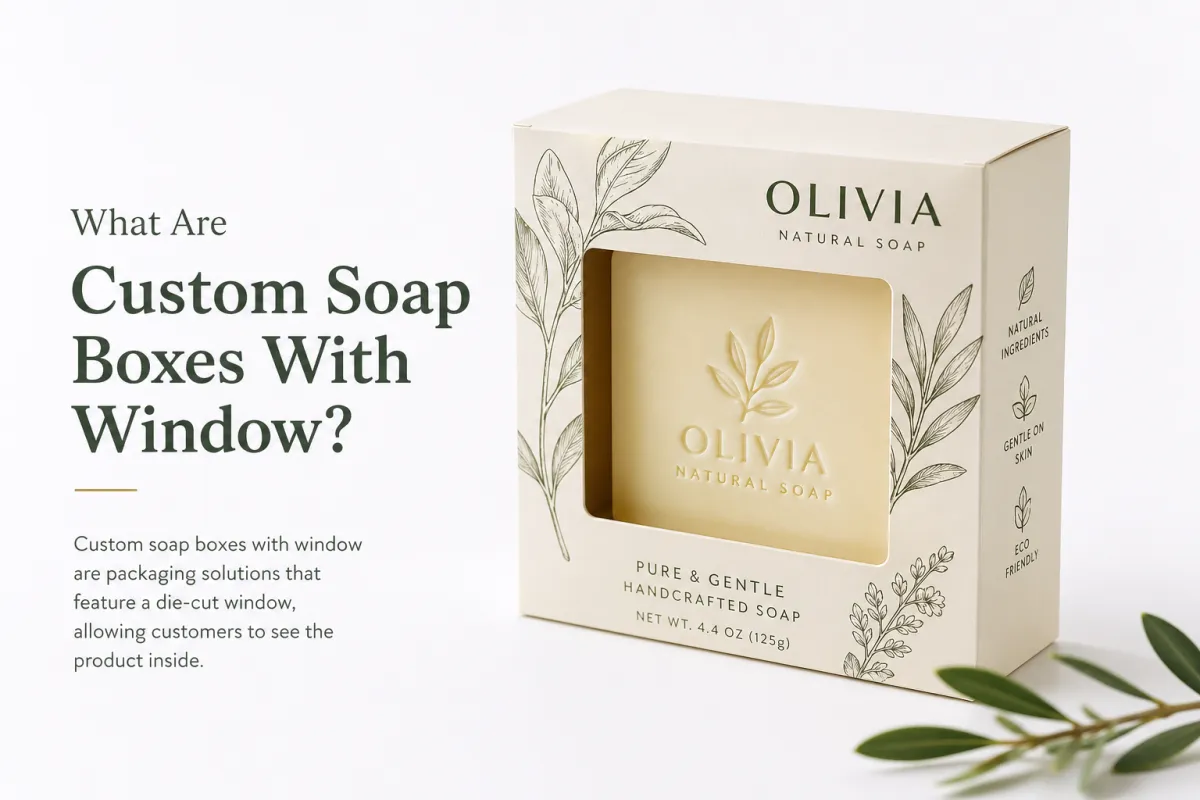
Custom soap boxes with window are cartons designed to reveal part of the product while keeping the brand in control of the presentation. Most of the time, they are folding cartons or tuck-end styles with a die-cut window covered by clear film or transparent paper. The carton still carries the brand message, but the opening does the persuasion work. Specialty shops, farmers markets, and e-commerce fulfillment teams all respond to visible cues such as color depth, swirl pattern, texture, and apparent size. That is why clear window packaging has become a practical alternative to fully sealed wraps for many soap categories.
That visibility is not a decorative extra. It changes behavior. A transparent insert area tells the buyer, within seconds, whether the soap is creamy, dense, translucent, or heavily pigmented. A lavender-saffron blend, for example, can gain credibility from a visible swirl long before the scent is sampled. For products whose quality signal is mainly visual, custom soap boxes with window often do more work than a fully closed carton, especially when shoppers compare by color consistency and edge finish.
Two broad construction families tend to show up. The first is lightweight folding cartons, often printed on 250 to 350 gsm stock with natural or coated finishes. The second is a more rigid or semi-rigid build, with stronger geometry and a reinforced front panel. In both cases, the window is cut into one face and covered with film using glue, heat seal, or overlamination. Custom soap boxes with window work best when the exposed area looks honest and clean rather than staged. In many launch tests, the line between premium and gimmick is exactly how much of that opening is framed, held, and repeated consistently across the range.
When this format works best
- Artisan or hand-poured soap with visible swirl, inclusions, or logo carving
- Gift-ready bars and seasonal launches where shelf differentiation drives the sale
- Scent-led lines where customers want a visual link between fragrance family and package identity
- Premium brands where partial transparency reinforces value perception
If the bar has a reason to be seen, this style usually earns its place. If the product is visually flat, inconsistent, or hard to present cleanly, a solid carton may protect the brand better. That tradeoff is plain, and a bit boring, but it matters. One format sells the product; the other sometimes just exposes problems.
The opening should show only what helps the sale. Expose enough of the bar to prove the product is real, not enough to surrender control of the top-of-pack story. Texture, a corner of embossing, a hint of swirl, or a realistic slice of size can carry the message. Overexposure weakens narrative control, and teams usually discover that only after the shelf mockup is already printed. The best custom soap boxes with window keep attention where brand, promise, and quality cues align.
How Do Custom Soap Boxes With Window Work on Shelf?
Retail packaging is a stack of tradeoffs. Custom soap boxes with window need to protect, communicate, and sell in a single glance. Start with the structure: board strength and die shape determine whether the carton stays rigid, whether the frame around the cutout keeps attention on the product, and whether the film edges remain neat after handling. A weak panel around a large opening bows quickly. Too much radius on the die can crack if the board or coating is underspecified. That is how a promising prototype becomes a costly correction once the first warehouse pull exposes the flaw.
Film choice matters just as much. Buyers often assume all clear films behave alike. They do not. PET film and PVC alternatives differ in haze, gloss, and migration behavior. A matte soap under a glossy film can look wet and tired. A translucent soap under a hazy film can lose the details that made it interesting in the first place. The best match depends on the bar body, the visible top section, and how dense the print sits around the opening. This is where die-cut window packaging design is won or lost.
Branding still carries the most weight. The customer may see the soap, but if the remaining panels are chaotic, the window becomes a good idea trapped inside a weak frame. Strong packaging design uses the opening as the anchor, then keeps the side panels organized by brand, scent family, key benefit, and claims. That is the difference between a retail solution and a novelty cutout. In plain terms, windowed soap packaging succeeds when the outside and inside narrative are written by the same team, not two departments racing each other.
Why visibility affects conversion
Uncertainty slows buying decisions. In shelf tests, clearer product signals usually lead to longer handling time, and even a few extra seconds can matter in a crowded aisle. Once the bar is visible, questions shrink fast: Is it handmade? Is it brittle? Does the color hold through the whole bar? The opening answers those questions before the shopper has to ask them. A tidy display window works like a pre-check.
Window types usually fall into three groups:
- Partial window: Controlled and premium-looking. Strong for brand-led lines because it leaves more room for identity and claims.
- Full-front window: Bold, high-visibility, and direct. Suited to product-led lines and seasonal items that need fast display recognition.
- Side window: Subtle and functional. Useful on narrow shelves and in formats where front-panel copy still needs space.
"If shoppers can verify the bar in one glance and still read the message in three seconds, the shelf starts working for you."
The shape changes the signal. A wide full-front opening often reads as open and value-driven, while a narrow side opening leans premium and restrained. Partial windows work well for refill or compliance-heavy ranges because they preserve room for legal and brand copy that still has to fit. One window style can quietly change the price perception of a product without touching MSRP, and that can matter more than adding one more foil spot on the top edge.
Key Factors That Shape Cost and Pricing
Packaging budgets decide whether a launch stays on schedule. The main cost drivers usually fall into five buckets: board type, box style, print coverage, window size and shape, and finishing steps such as lamination or spot varnish. From there, pricing usually splits into tiers. A lightweight kraft carton with moderate print costs less than coated stock with a large front cutout and additional finishing. The same product can move from margin-positive to difficult to justify depending on how often you revise film grade and clear panel geometry.
What pushes the quote up
Material grade is the first lever. Common choices include:
- 250-280 gsm uncoated or lightly coated board for eco-positioned, cost-conscious runs
- 310-350 gsm coated or duplex board for sharper color and firmer edges
- Rigid board up to 1.2 mm equivalent for gift-oriented and damage-prone channels
Window size and shape follow close behind. A rounded rectangle usually costs less to tool than a scalloped or highly organic cut. A larger front opening increases die cost and rejects more easily if tolerances slip. Tight ovals and custom curves can add cost through setup and inspection alone. Print coverage matters too. Moving from two colors to full bleed or four-plus color work can raise the quote quickly, especially at lower volumes. In practical terms, a custom clear-window package only remains efficient when the display benefit justifies added die complexity.
Hidden costs that surprise first-time buyers
A quote that looks clean on the first page can still conceal a few line items. These belong on the spreadsheet from the start:
- Dieline and tooling: often $120-$450 depending on complexity
- Proofing and digital correction: typically $40-$150 per cycle
- Sample packs: $80-$250 per run, depending on size and shipping
- Film or lamination upgrades: $0.05-$0.18 per piece
- Freight and pallet handling: shaped by stack stability and moisture control
Unit price alone can mislead. A setup fee of $350 spread across 500 boxes with a $0.40 print-and-build cost lands near $1.10 per unit after setup is absorbed. Push the same structure to 5,000 pieces and the unit can fall closer to $0.45 before shipping, depending on stock and film. The volume curve matters more than most teams expect because fixed costs disappear in layers. The math is not glamorous, but it is often what makes custom soap boxes with window commercially viable beyond the prototype.
| Option | Typical structure | Window style | Unit cost at 500 pcs | Unit cost at 2,000 pcs | Unit cost at 5,000 pcs |
|---|---|---|---|---|---|
| Kraft fold-up | 250-300 gsm, minimal coating | Partial front | $0.42 - $0.58 | $0.33 - $0.46 | $0.25 - $0.34 |
| Coated premium carton | 310-350 gsm coated | Full front or side | $0.60 - $0.88 | $0.45 - $0.69 | $0.34 - $0.55 |
| Rigid style with insert | Higher stock, reinforced closure | Custom shape window | $0.95 - $1.45 | $0.73 - $1.05 | $0.58 - $0.82 |
A useful rule for teams: spend where customers can see or feel the difference, not where only internal reviewers notice it. Strengthen the frame around the opening before adding a second matte varnish. Reinforce board integrity before piling on foil effects. The best packaging decisions usually avoid paying for finish work that the market barely registers. This is especially true for custom soap boxes with window in refill or multipack formats, where consistency beats spectacle.
Standards still matter. Brands shipping through rough parcel networks usually benefit from thinking in terms of ISTA handling assumptions and ASTM-style compressive logic. A clean sustainability story can help too, especially if the board carries FSC chain-of-custody support through FSC. Buyers in larger accounts often read that detail as a sign that the supplier understands the rest of the supply chain, not just the print file. One honest disclaimer here: recyclability claims depend on local recovery systems, so a green icon on the box should match what actually happens in the market you are selling into.
Custom Soap Boxes With Window: Process and Timeline
The fear around timing is real, especially for holiday launches and seasonal drops. A disciplined workflow keeps the order moving. First brief to first shipment can be straightforward, but only when the variables stop moving early enough to matter. A display window packaging project that allows shape drift after proofing can slip quietly and then become expensive.
Workflow from brief to final packing
- Design brief: lock dimensions, style, carton orientation, scent line-up count, and compliance text.
- Spec package: include barcode position, legal panel needs, and any special claims.
- Dieline approval: confirm fold lines, window clearance, and glue flaps.
- Artwork prep: submit print-ready files with embedded fonts and color specs.
- Proofing: review digital proofs for scale, contrast, and spelling.
- Sample production: inspect the first physical pieces under light and humidity simulation.
- Mass production: run with batch QA and visual spot checks.
- Final packing: carton, stretch film, and freight packaging built around the soap's movement profile.
If the bar dimensions are still shifting, the schedule slips quickly. A 3 mm change in width can force a window recut and a fresh sample round. That can add 3 to 6 business days when the rest of the file is stable. If artwork and structure are both moving, a 7 to 10 day delay is common. The package seems simple from the outside; the production calendar says otherwise, which is why teams should test mockups in real-use conditions before locking artwork for custom soap boxes with window.
How revisions change timing
Revisions do not all cost the same. A spelling correction in the scent name may take one round. A structural change to the window shape can add another. Custom dies make this even more visible because each adjustment affects tooling and prepress together. Teams usually do better when they reserve two revision windows: one for copy and one for the structure. That keeps late panic changes from bleeding into production. The same logic applies to clear window packaging: if the frame fails, no amount of corrected copy can recover the shelf impact.
Lead-time ranges, by complexity
- Simple fold-up, standard shape, ready artwork: 10-15 business days for final production + 3-6 days freight
- Mid complexity, partial custom window, one sample cycle: 15-22 business days + shipping buffer
- Custom die window + inserts or premium finish: 3-5 weeks, depending on proof and testing
A time buffer helps more than a heroic rush order. Add one to two weeks during peak retail periods, especially when international fulfillment is involved. If the launch is tied to a campaign date, ask for a protected arrival window that lands before fill day plus three days. That small cushion prevents a lot of last-minute unpacking pressure. This matters even more for custom soap boxes with window because a missed timing window can erase the merchandising advantage.
Before placing an order for custom soap boxes with window, use this checklist:
- Final bar dimensions in millimeters, including average tolerance from production variation
- Fill weight and intended destination shelf orientation (flat stack vs. front-facing display)
- Brand assets: logo lockups, type hierarchy, sustainability seals, fragrance descriptors
- Regulatory copy in required format, including ingredient and country labeling expectations
- Target run size and preferred freight route
Step-by-Step Guide to Designing the Right Box
A good package begins with the soap, not the artwork file. If the measured bar is 2.7 cm tall and the carton leaves 2.5 cm of clearance, the launch can stall at QC before it reaches the shelf. For custom soap boxes with window, dimension planning happens before typography starts. This is less about creativity and more about reducing friction points that appear after approval.
1) Measure the product physically, not by assumption
Use calipers and weigh the final finished bars. Labels, wraps, twine, and shrink layers all count. Keep this formula in view:
Internal cavity length = bar length + 2-3 mm for easy loading and humidity variation.
Clear opening width = visual target + 1-2 mm on each side to prevent clipping when the film shifts after handling.
That small amount of math matters more than a polished mockup. Soap can vary by one to two millimeters depending on pressing pressure and curing conditions. Conservative cavity planning protects the run from avoidable friction later. The same logic applies if you are using a window insert package style with nested support, where tolerances add quickly.
2) Pick board style by brand position
The market usually tells you which board you can defend. Natural and ethical lines often do better with kraft or recycled-looking stock because the material story matches the product story. High-contrast, image-heavy scent lines usually need coated stock for cleaner registration and sharper edges. Gift-focused ranges often feel more substantial in rigid or semi-rigid structures with internal support.
Branded packaging works best when the structure and the opening carry the same mood. Matte kraft with a soft-clear window and minimal foil can feel handcrafted. Coated board with a precise front cut can feel modern, sharp, and controlled. That is not taste for its own sake. It is positioning built into material choice and one of the biggest reasons custom soap boxes with window can support a premium narrative without feeling loud.
3) Place the window for maximum persuasion
Not every section of a bar helps sell it. A cross section can look interesting in a render and underperform on shelf. Find the visual centerpiece: the marbling in a botanical soap, the embossed logo, the layered pigment line, or the texture on the top surface. Position the opening so the most attractive half is visible while the less flattering section stays hidden for structural protection. The top of the bar usually carries more visual variety; the bottom often shows seams and edge artifacts.
4) Build artwork with one reading order
In strong packaging design, the eye should move in sequence: brand first, then category, then variant, then claims. Resist the urge to stack every message on the front. Keep legal text compact and legible. For Custom Printed Boxes to perform, the eye needs to register the brand in under a second, then move to the scent cue, then the benefit callout.
Use the same font logic across a line. Six scents in one range should feel like one system, not six unrelated labels. A single fragrance family with multiple versions needs clear and specific variant language. Keep the barcode and date area visible in retail lighting, not hidden where a cashier has to guess. This is especially important for custom soap boxes with window because shoppers read the carton while moving; they do not pause to decode a dense hierarchy.
5) Approve with real lighting and real shelves
Screen proofing only gets you partway there. Test under daylight, warm indoor light, and retail strip lighting. A color that feels rich under monitor calibration can flatten under mixed LEDs. A product with a mild green cast in the office may turn muddy once it sits under warm fixtures. A pilot with 8 to 12 prototype units is a sensible safeguard before full approval. It costs time and saves rework, which is usually the better exchange.
Before ordering, compare sample sets through the Custom Packaging Products lens and check whether the final color and window position still read after box compression. If a side-by-side review helps, many teams also request Window Pack Options before signing off on the final build.
Common Mistakes to Avoid With Window Soap Packaging
Many packaging failures start with confidence bias: the sample looked fine, so the launch should be fine. Transport, humidity, and repeated handling do not care about that assumption. A few early checks can prevent the expensive version of the lesson. For custom soap boxes with window, risk usually appears at the edge: cut geometry, film shrink, or moisture drift.
Window geometry that breaks in use
An opening that is too large weakens the top rails. Once the frame collapses, the package loses shape and a premium product starts looking discounted. Keep the bridge widths between cut edges generous. A wider frame around the clear section usually works better than a bigger reveal, especially on boards under 280 gsm. This is not less visual impact; it is cleaner engineering.
Ignoring environmental stress
Soft or oily soaps can bloom slightly or develop surface sheen in warm conditions. If the opening is too exposed, the finish can look inconsistent after production. A simple interior band, tissue wrap, or scored insert can stabilize appearance and reduce handling marks. The window helps visibility, but it does not replace product care. A clear-view carton needs humidity planning as seriously as color planning.
Overcrowded front and back panels
Too much copy kills conversion quietly. People scan boxes; they do not read brochures in the aisle. If the upper half of the carton is packed with claims, the product disappears inside its own message. Every line should earn its space. Anything not legally required and not category essential can usually go.
Color approval without hard proof
Never approve final color on screen alone. Coated and natural boards shift color in different ways, and the presence of clear film changes what the eye sees at the opening. A green that looks balanced in design software can come back looking olive or gray once printed. Build that into the proof plan before the run is locked. It is a simple discipline that keeps custom soap boxes with window out of expensive rescue cycles.
Expert Tips and Next Steps for Custom Soap Boxes With Window
The format works well, but only when testing stays disciplined as volume rises. The strongest teams treat the opening as a retail signal, then keep experimentation fast and inexpensive. If you run the process as a hypothesis, not a guess, custom soap boxes with window become a controllable launch tool.
Use the opening to reinforce the brand story
Good custom packaging does more than reveal a bar. It gives the line a visual argument. If the soap carries a cocoa-bean swirl, frame that swirl. If it has an herbal top layer, line up the logo so the exposed area feels deliberate. Random visual drama around the cutout tends to weaken the story rather than strengthen it. The opening should support package branding and category promise at the same time.
Test in three environments, not one
Run quick checks in three places:
- White counter, bright light: confirms color and contrast baseline
- Warm retail aisle light: confirms whether the product still feels premium near other bars
- Competing display set: confirms whether the visual hierarchy survives direct comparison
If the windowed pack performs in all three, the buying signal is usually stable enough to move forward. In many batches, this is where custom soap boxes with window either prove themselves or fail quietly before manufacturing expands.
Use samples as decision data, not branding theater
Request a three-pack sample set: one with a slightly smaller window, one with a larger window, and one with alternate board. Compare them for stackability, scuff resistance, and color stability. Teams that work this way often cut later sample iterations by 30 to 50 percent because the key decision was already made before production. That is not flashy, but it keeps the budget from wandering.
Make ordering simple and ordered
Once the bar dimensions and style direction are clear, follow this sequence:
- Confirm final bar dimensions and tolerance bands
- Choose board stock and window film
- Request dielines and sign-off windows
- Collect at least two production quotes for different quantities
- Order samples, not full production, and wait for light-based approval
That path keeps custom soap boxes with window under control and reduces budget surprises.
One field reality keeps showing up: quality is never fixed. A lavender shower bar and an exfoliating charcoal block do not need the same box, even if both are technically soap. The right carton and the right opening should be chosen for the product and the use case each season, not just once. Teams that treat custom soap boxes with window as a product family variable avoid the mismatch that happens when every bar gets the same template.
Takeaway: If a clear-window carton is going to earn its keep, it has to do three things at once: show the bar honestly, hold its shape under real handling, and leave enough room for the brand story to breathe. Start with exact bar measurements, choose the window size last rather than first, and approve samples under actual shelf lighting. That small discipline is usually what separates a box that sells from a box that merely looks pretty in a mockup.
FAQ
Are custom soap boxes with window better than solid soap cartons?
Custom soap boxes with window often improve shelf appeal because buyers can see color, texture, and craftsmanship before opening the pack. They perform especially well for lines where visual identity is a real differentiator. A solid carton still makes sense when light protection, maximum privacy, or tighter moisture control matters more than front-facing merchandising. The right choice depends on formula stability and the route the product takes through the store and warehouse.
What materials are best for custom soap boxes with window packaging?
Paperboard and kraft stock are common because they print well and fold predictably. Most teams pair them with clear film windows; sustainability claims are stronger when the film is recyclable or plant-based. Board weight should match bar mass and shipping distance. Heavier bars often need stronger board and sometimes a slim internal support insert to keep the pack from deforming. For these use cases, a die-cut window with proper framing tends to hold better in transport than a broad, unsupported opening.
How much do custom soap boxes with window cost per unit?
Pricing depends on size, board type, print coverage, window shape, and run volume. Dielines and sample production add fixed cost to the first order. After that, unit pricing usually drops sharply as quantity rises. The cleanest way to find the break point is to request quotes at 500, 2,000, and 5,000 units and compare landed cost, freight included. These figures are directional rather than universal; suppliers, finishes, and freight zones can move them a lot.
How long does it take to produce window soap boxes?
Simple orders move quickly when artwork and dimensions are finalized. A standard run with a simple cutout may arrive in about two to three weeks, while custom die work and special structures can extend the timeline to four to six weeks. Revisions are the usual source of delay, especially when the window shape changes midstream. Build in time for proofing, sampling, and seasonal freight spikes.
Do custom soap boxes with window protect handmade soap from damage?
The answer is yes, if the structure is designed properly. A stable carton, correct clearance, and controlled fill weight reduce movement and scuffing. Softer soaps often benefit from an inner wrap or insert. A window is not a sealed barrier, so it still needs careful handling and storage planning to keep the bar looking right. In humid warehouses, a little extra board strength can save a lot of ugly returns.

