Buyer Fit Snapshot
| Best fit | Custom Spot UV Packaging Boxes projects where brand print, material claims, artwork control, MOQ, and repeat-order consistency need to be specified before quoting. |
|---|---|
| Quote inputs | Share finished size, material target, print colors, finish, packing count, annual reorder estimate, ship-to region, and any compliance wording. |
| Proofing check | Approve dieline scale, logo placement, barcode or warning zones, color tolerance, closure strength, and carton packing before bulk production. |
| Main risk | Vague material claims, crowded artwork, missing packing details, or unclear freight terms can make a low unit price expensive after revisions. |
Fast answer: Custom Spot UV Packaging Boxes: Design, Cost & Process should be specified like a repeatable production item. The safest quote records material, print method, finish, artwork proof, packing count, and reorder notes in one written spec.
Production checks before approval
Compare the actual filled-product size with the drawing, then confirm tolerance on folds, seals, hang holes, label areas, and retail display edges. Reserve space for logos, QR codes, warning copy, and material claims before decorative graphics fill the panel.
Quote comparison points
Review material grade, print process, finish, sampling route, tooling charges, carton quantity, and freight assumptions side by side. A quote is only useful when the supplier can repeat the same color, closure quality, and packing count on the next order.
Custom Spot UV Packaging Boxes: Design, Cost & Process
Custom Spot UV packaging boxes can turn a plain carton into something people notice almost immediately, especially when a matte surface gives way to a sharp, glossy accent that catches retail lighting at just the right angle. That contrast does the work. The structure stays familiar, while the finish creates the first impression. For a brand buying product packaging, that means the box is doing more than holding the product; it is shaping what the shopper sees first, how premium the pack feels in hand, and whether the printed design reads clearly from a few feet away.
From a packaging buyer's perspective, custom spot uv packaging boxes are a finishing choice rather than a structural box type, which is why they fit many folding carton formats. They pair well with cosmetics, supplements, electronics, gifts, and seasonal retail packaging because the gloss can highlight a logo, product name, pattern, or emblem without flooding the whole panel with shine. Used with care, they sharpen hierarchy, strengthen branding, and add perceived value without pushing the design into loud territory.
What Custom Spot UV Packaging Boxes Do on the Shelf
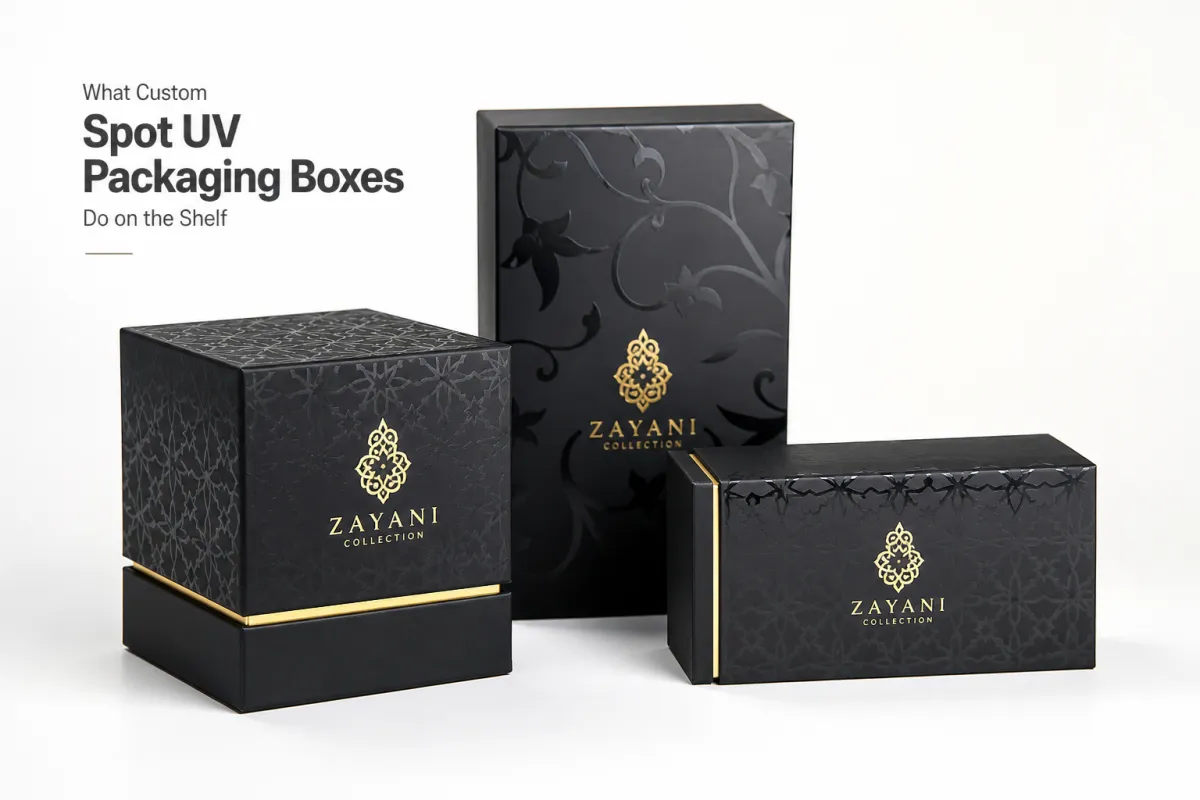
Picture a matte carton sitting between two dozen similar products. Nothing about it is weak, but nothing pulls the eye either. Then a gloss patch lands on the logo or product name, and the package suddenly looks deliberate. That is the real shelf job of custom spot uv packaging boxes: they create a visual pause. In retail packaging, even half a second of attention can earn a pickup, and pickup is where the sale starts.
Spot UV is a clear, high-gloss coating applied only to selected parts of the printed surface. The rest of the box might stay matte, soft-touch, satin, or lightly varnished, so the gloss reads as contrast instead of a full flood coat. That contrast can be subtle or dramatic depending on the base finish, the artwork, and the lighting in the store. On custom spot uv packaging boxes, the effect is usually strongest when the gloss follows a purposeful shape such as a logo mark, a product silhouette, or a pattern that frames the focal point.
The coating itself is not magic. Placement matters more than anything else. If the gloss supports the print hierarchy, custom spot uv packaging boxes can make the design look sharper, more expensive, and easier to understand from a distance. If the gloss is scattered everywhere, the box starts to feel busy and the premium effect slips away.
"A good gloss accent should guide the eye, not fight the print."
That is why the finish works so well for branded packaging in categories where the shelf story needs to land quickly. Cosmetics often use it for a logo, a monogram, or a metallic-looking pattern. Supplements use it to separate the brand name from a wall of copy. Electronics use it to make the outer carton feel more refined without changing the structure. Gift packaging uses it to signal value before the box is even opened. In each case, custom spot uv packaging boxes are doing the same job: creating contrast, steering attention, and making the carton feel considered rather than generic.
Used well, custom spot uv packaging boxes also help a product photograph better. The gloss catches highlights in a way that reads cleanly in ecommerce images, retail displays, and promotional mockups. That matters more than many buyers expect. A box that looks strong in person but photographs flat can weaken product packaging across the sales chain, while a box that reads clearly on screen and on shelf tends to carry the design farther.
For brands trying to balance premium feel with practical production, custom spot uv packaging boxes are a useful middle ground. They add class without the cost of heavy embellishment, and they work with many custom printed boxes styles, from tuck end cartons to sleeve boxes and rigid-feel folded cartons. The goal is not to cover everything; it is to accent the right thing.
I have watched a lot of packaging specs get overcomplicated, and this finish is one of the easiest places to overdo it. A strong spot UV box usually starts with a quiet base and one very clear focal point. That simple move, honestly, does more than a dozen decorative ideas crammed into one layout.
How Custom Spot UV Packaging Boxes Are Made: Process and Timeline
The production path for custom spot uv packaging boxes usually starts with artwork setup and ends with inspection, but a few control points decide whether the final result looks crisp or careless. The first is substrate selection. The second is how the spot UV mask is prepared. The third is how the finish is applied relative to printing, lamination, die cutting, and folding. Miss one of those, and the final carton can be technically correct while still looking off.
The basic sequence is straightforward. Artwork is prepared, a dieline is confirmed, the base sheet is printed, the coating is applied to selected areas, the finish is cured, and the carton is then die-cut, folded, and packed. On custom spot uv packaging boxes, the spot UV layer is usually separated from the rest of the artwork by a dedicated mask file or plate file. That file tells the finisher exactly where the gloss should land. Clean file preparation matters because the coating is only as accurate as the registration information behind it.
There are two common workflows. One uses a matte-laminated carton with spot UV applied on top, which gives strong contrast and a soft-to-gloss tactile change. The other uses a direct coating on printed board that already has the right surface characteristics. The laminated route is common for premium retail packaging because the matte base makes the gloss pop more clearly and helps protect the print during handling. For many custom spot uv packaging boxes, that combination is the easiest path to a controlled, refined finish.
Typical timing depends on quantity, artwork readiness, and whether the project needs custom dies or samples. A simple run can move in roughly 10 to 15 business days after proof approval if the board is standard and the art file is clean. Add a custom structure, soft-touch lamination, embossing, or multiple UV zones, and the schedule can stretch. First-time orders often need more time because the buyer wants to see a sample panel or a press proof before moving into full production. That extra step is not wasted time; it is a quality check that protects the launch.
Delays usually happen in the same places. File corrections take time. Color matching takes time. Waiting for coating or lamination capacity takes time. Even a small mismatch in the spot UV mask can push the production window if the team has to rebuild the file. For custom spot uv packaging boxes, the fastest projects are the ones where dimensions, finish stack, and print intent are decided before the artwork goes live.
For shipping-sensitive programs, some buyers also reference industry testing groups such as ISTA, which publishes transit-test standards that help packaging teams check performance before cartons enter distribution. If the outer pack has to survive pallet movement, warehouse stacking, or parcel handling, the surface finish should be evaluated alongside the structure. Pretty packaging that fails in transit costs more than a slightly more cautious specification.
Packaging education resources from groups such as packaging.org can also help teams align design decisions with real manufacturing constraints. That matters because custom spot uv packaging boxes are not only about appearance; they are about producing a finish that stays aligned, cures correctly, and survives normal handling without scuffing or peeling.
When buyers ask about lead time, I usually split the answer into artwork turnaround and shop turnaround. Artwork turnaround depends on how quickly the team can confirm the mask, the proof, and the dieline. Shop turnaround depends on machine queue, board availability, and finishing complexity. For custom spot uv packaging boxes, those two clocks rarely move at the same speed, so the safer move is to build some buffer into the launch schedule instead of assuming each step will run in a straight line.
Material, Finish, and Design Factors That Change the Result
The board underneath the finish changes the final look more than many buyers expect. SBS board is a common choice for clean print and smooth coating response. C1S and C2S stocks can also work well, especially if the print side is optimized for sharp detail and the non-print side is part of the structure plan. Kraft-style stocks create a different feel altogether; the natural fiber look can be attractive, but it tends to mute gloss contrast unless the design is built for that effect. On custom spot uv packaging boxes, surface smoothness and stiffness both matter because the coating reads best on a stable, even panel.
The finish stack matters just as much. Matte lamination usually gives the strongest visual separation because the gloss patch sits against a soft, low-reflection field. Soft-touch lamination makes the contrast feel even more tactile, which works well for luxury skincare, specialty foods, and gift product packaging. Satin finishes sit between matte and gloss and can still support spot UV, but the effect is less dramatic. If a brand wants bold contrast, custom spot uv packaging boxes usually perform best with a matte or soft-touch base.
Artwork complexity deserves close attention. Thin lines, tiny type, tight halftones, and delicate gradients are risky because the coating may not hold the detail the way ink does. If the spot UV shape is too small, it can break up or look inconsistent from panel to panel. If it crosses a fold or crease, the finish may crack, dull, or appear misregistered after the box is assembled. In packaging design, the coating should sit on stable areas that do not flex sharply during use.
Structural layout affects the result too. Panel size, fold direction, tuck flap positioning, and glue zones all influence where the gloss can live. A front panel is usually the safest place for the hero accent. Side panels can support secondary graphics or a repeat pattern. Back panels often carry content-heavy information and are not always the best place for a finish that should attract attention. With custom spot uv packaging boxes, the cleaner the visual map, the stronger the outcome.
Lighting matters more than screen previews suggest. A design that looks elegant under soft office light may appear much bolder under retail LEDs or warmer store lamps. That is why sample viewing should happen under multiple light conditions. A quick mockup can tell you whether the gloss patch is too wide, too narrow, or too close to the edge. In real product packaging, what the customer sees on a phone screen, under warehouse light, and on shelf can be three different experiences.
If sustainability goals are part of the brief, ask early about fiber sourcing and recycling compatibility. FSC-certified board can be a fit for many programs, and the FSC site is a useful reference point for certified material claims. That does not make every custom spot uv packaging boxes project automatically greener, because the full finish stack still needs to be considered, but it does help buyers ask better questions about the paperboard itself.
Embossing can also work alongside spot UV when the design needs more depth. A raised logo with a gloss accent often feels more premium than either treatment by itself, but the two should not compete. The best results happen when one effect leads and the other supports. On custom spot uv packaging boxes, that usually means embossing defines the form and UV defines the shine.
One more practical point from the production side: the smoother the board and the cleaner the print, the easier it is for the gloss to sit exactly where it should. I have seen a lot of otherwise solid artwork lose its polish because the substrate was a little too textured or the coatings were asked to do too much work. That is not a dramatic failure, just a quiet one, and quiet failures are the annoying kind.
Custom Spot UV Packaging Boxes Cost and Pricing Factors
Pricing for custom spot uv packaging boxes depends on more than the gloss itself. Board grade, box size, print coverage, number of coated areas, lamination choice, and finishing complexity all shape the quote. MOQ is a major factor too. Small runs carry a higher unit cost because setup work, plate creation, masking, and machine-ready time are spread across fewer pieces. Larger runs usually lower the per-unit price, sometimes sharply, because the fixed production steps get amortized across the order.
As a working range, a small custom carton with basic print and a simple spot UV accent might land around $0.75 to $1.80 per unit at 1,000 pieces, depending on size and finish stack. At 5,000 pieces, that same style may move closer to $0.28 to $0.65 per unit. At 10,000 pieces or more, the unit price can fall further if the board is standard and the UV area is straightforward. Those are not universal numbers, but they are realistic enough to help buyers judge whether a quote sits in the normal range.
The extra charges usually come from the same handful of places. A custom die costs money. A press proof or sample adds cost. Rush scheduling can add cost. Premium coatings can add cost. Unusual structures can add cost. None of that is surprising once you have spent time around folding cartons, but it is still where many first-time buyers get caught off guard. For custom spot uv packaging boxes, the finish is only one line item in a much wider manufacturing picture.
| Option | Typical Order Size | Typical Unit Range | Best Use | Notes |
|---|---|---|---|---|
| Matte carton with one spot UV area | 1,000 to 3,000 | $0.75-$1.80 | Launches, gift sets, small retail runs | Lower complexity, strong contrast, good for logo focus |
| Soft-touch lamination with spot UV | 3,000 to 10,000 | $0.32-$0.85 | Beauty, wellness, premium consumer products | Tactile and visual contrast, more premium feel |
| Custom structure with multiple UV zones | 5,000 and up | $0.40-$1.10 | High-visibility retail packaging and seasonal campaigns | More setup, more registration control, more finishing time |
Those price bands make more sense if you compare like with like. Check whether the quote includes printing, coating, die cutting, folding, shipping, and sampling. Ask about the base board, too, because a slightly heavier sheet can improve rigidity and shelf feel without changing the final unit cost very much. A quote for custom spot uv packaging boxes only helps if everyone is talking about the same spec.
I also tell buyers to think in value terms rather than lowest bid terms. A box that saves three cents but looks flat on shelf can underperform in retail. A slightly higher spec that pulls attention faster, photographs better, and reduces reprint risk often pays back more than the cheapest option. That is especially true for branded packaging that has to carry both product messaging and visual credibility.
If you are comparing product families, review the structure and finish options together instead of separately. Our Custom Packaging Products page is a good starting point for that kind of comparison because it keeps the box style conversation tied to the finishing conversation. For custom spot uv packaging boxes, those two pieces should always be reviewed as one system.
Step-by-Step Ordering Guide for Custom Spot UV Packaging Boxes
The cleanest order process starts with the product, not the decoration. Measure the item carefully, confirm weight, and decide how much protection the box needs during shipping and shelf handling. If the package will hold inserts, trays, or windowing, account for that before the art file is built. Custom spot uv packaging boxes perform best when the size, structure, and finishing plan are set before anyone starts polishing the graphics.
Next comes artwork prep. Build a separate spot UV layer or mask file that marks the exact areas to coat. Keep the shapes clean, well aligned, and easy to identify. Avoid tiny type and hairline elements if the gloss needs to stay reliable across a production run. A good printer or converter will tell you the minimum practical line thickness, but a safe design usually leaves a little breathing room around the coated shapes. That one habit prevents a lot of frustration with custom spot uv packaging boxes.
Then choose the finish stack with purpose. A matte or soft-touch base makes the gloss stand out. A gloss base makes the contrast subtler. Embossing adds depth; foil adds metallic emphasis; die cutting can create windows or reveal shapes; each of those affects the final reading. If the goal is a premium reveal, build a hierarchy: one primary logo or emblem, one secondary pattern or band, and not much else. That is often the smartest use of custom spot uv packaging boxes.
After that, request a proof or sample. This step is not optional if the design relies on precise registration, layered effects, or fine detail. A digital mockup helps, but a physical sample tells the truth about gloss level, alignment, and feel. I would rather see a buyer adjust the layout by a few millimeters before production than discover a misread accent after the cartons are packed. The sample stage is where custom spot uv packaging boxes either prove the design or expose the weak spots.
Before final approval, confirm the boring details. Quantity. Carton style. Packing method. Shipping timeline. Palletization if needed. Special handling notes. Those items are not glamorous, but they are where jobs stay on schedule. If the launch date is fixed, write the buffer into the plan now instead of hoping the line stays open. That is the kind of habit that keeps packaging design projects from becoming avoidable headaches.
- Lock the product dimensions and target carton style.
- Build the dieline and spot UV mask together.
- Choose the board, coating, and lamination stack.
- Review a sample or proof under real lighting.
- Approve the final spec sheet only after checking schedule and packing details.
If you need to compare box families before committing, review the structure options in our Custom Packaging Products catalog and map them against the finish you want. That approach makes custom spot uv packaging boxes easier to quote, easier to approve, and easier to produce without last-minute changes.
Common Mistakes With Custom Spot UV Packaging Boxes
One of the most common mistakes is putting spot UV on artwork that is too small or too close to a fold. The coating can blur, crack, or look uneven if the shape does not have enough room to print and cure cleanly. Another mistake is using gloss everywhere because the team wants the box to feel premium. Too much shine can flatten the hierarchy and make the package look cluttered rather than refined. The best custom spot uv packaging boxes usually reserve the effect for one or two focal areas.
Another issue is treating the board, lamination, and UV layer as separate decisions. They are not separate in the final hand. A matte finish on one stock can read very differently from a matte finish on another. A soft-touch coating can make a logo feel almost velvety, but it can also show handling marks if the material spec is too light. Buyers who review the system as a whole tend to make better choices and get more consistent custom printed boxes.
File setup mistakes are also common. Missing mask layers, poor registration, low-resolution artwork, and vague coating instructions create avoidable problems. A finisher cannot guess which area should carry the gloss if the file does not say it clearly. That sounds basic, but it is the kind of detail that separates a smooth job from a painful one. In production, clarity is money.
Rush orders add another layer of risk. They can be necessary, especially for a product launch that has a hard date. But skipping samples, skipping proof checks, or changing the design late in the schedule can lead to results that do not match the original intent. With custom spot uv packaging boxes, speed helps only when the file and spec are already stable.
Finally, some brands expect the gloss to fix weak design. It rarely does. If the typography is crowded, the logo is undersized, or the panel arrangement is confusing, a glossy patch will not rescue the carton. It may even make the weaknesses more obvious. The coating should support a good packaging design, not carry the whole burden by itself.
There is also a tendency to ignore how the box will be handled after it ships. If cartons are stacked tightly, rubbed in transit, or packed into a display tray with sharp edges, the finish needs to survive that reality. A finish that looks great in a photo but scuffs on the line is not premium. It is just fragile.
Expert Tips and Next Steps for Better Custom Spot UV Packaging Boxes
My first recommendation is simple: give the gloss one job. Use it to frame a logo, emphasize a product name, highlight a pattern break, or create a subtle texture cue, but do not spread it across every possible surface. Custom spot uv packaging boxes work best when the gloss acts like a spotlight rather than floodlighting. The eye should know where to go within a second.
Second, test contrast with a simple mockup before final approval. A screen mockup can lie a little because monitors brighten and flatten surfaces in ways that physical cartons do not. A sample panel under store-like lighting tells you whether the shine is too strong, too weak, or placed too high. That one test can save a lot of back-and-forth on custom spot uv packaging boxes and keep the final result tied to actual retail conditions.
Third, gather your quoting information early. If you have the exact dimensions, the finish stack, and the target quantity, most of the important decisions fall into place faster. Those three details shape board choice, die cost, unit Pricing, and Lead Time. Buyers who arrive with those numbers usually get better quotes and fewer revision cycles.
Fourth, think about the launch sequence. If the packaging is part of a holiday push, a new line introduction, or a trade show reveal, the schedule should include proof time, correction time, and shipping time. That sounds obvious, but it is where many teams cut too close. Custom spot uv packaging boxes are worth the effort only if the cartons arrive before the product needs them.
A short checklist helps at the finish line:
- Confirm the dieline and final dimensions.
- Approve the spot UV mask against the printed artwork.
- Check packaging orientation, panel sequence, and tuck direction.
- Review the proof under bright and warm light.
- Verify the production schedule against your launch date.
Buyers who want to move faster usually do better when they decide the structure, the finish, and the timing together instead of treating them as separate purchases. That approach keeps custom spot uv packaging boxes aligned with the real product, the real retail setting, and the real budget. It also prevents the common trap of choosing a finish first and then trying to force the rest of the packaging to fit around it.
Handled that way, custom spot uv packaging boxes become more than a nice effect on a carton. They become a controlled design tool that sharpens retail packaging, supports branded packaging, and helps the product present itself with confidence. If you get the board, the mask, and the production timeline right, custom spot uv packaging boxes can deliver the kind of shelf presence most brands are after. The practical takeaway is simple: start with one clear gloss focal point, confirm the finish stack on a real sample, and lock the production schedule before artwork drifts into the weeds.
FAQs
What are custom spot UV packaging boxes used for?
They are used to make selected design elements stand out with a glossy contrast against a matte or uncoated background. That makes them a strong fit for premium retail products, gifts, cosmetics, supplements, and any product packaging that needs more shelf presence. In practice, custom spot uv packaging boxes help direct attention to the logo, product name, or key graphic without changing the whole carton finish.
How do I prepare artwork for custom spot UV packaging boxes?
Create a separate spot UV layer or mask file that clearly marks the exact coating area. Keep the shapes clean, aligned, and away from tiny type or very thin lines. It also helps to ask for file setup requirements before sending artwork so the printer can match the coating to the printed design accurately. That step matters a lot with custom spot uv packaging boxes because registration is what keeps the gloss where it belongs.
What affects the price of custom spot UV packaging boxes the most?
Box size, board choice, quantity, and the number of spot UV elements usually drive most of the price. Lamination type, Custom Die Cutting, proofing, and rush production can also change the final quote. Higher quantities generally reduce unit cost because setup work gets spread across more cartons, which is one reason custom spot uv packaging boxes are easier to justify at larger volumes.
How long does production usually take for custom spot UV packaging boxes?
The timeline depends on artwork approval, proofing, coating setup, and whether special materials are involved. Simple projects can move faster, while first-time custom jobs often need extra time for samples and corrections. If your launch date is fixed, build in buffer time. Delays most often come from file revisions or approval changes, not from the spot UV process alone.
Can spot UV be combined with other finishes on custom boxes?
Yes. It is often paired with matte lamination, soft-touch lamination, embossing, or foil stamping for a layered premium effect. The key is to balance the finishes so they complement each other instead of competing visually. A sample or proof is the best way to confirm that the combined effects look clean and intentional on custom spot uv packaging boxes.

