Buyer Fit Snapshot
| Best fit | custom stand up pouch pricing for packaging buyers comparing material specs, print proof, MOQ, unit cost, freight, and repeat-order risk where brand print, material, artwork control, and repeat-order consistency matter. |
|---|---|
| Quote inputs | Share finished size, material target, print colors, finish, packing count, annual reorder estimate, and delivery region. |
| Proofing check | Approve dieline scale, logo placement, barcode or warning zones, color tolerance, and any recyclable or compostable wording before bulk production. |
| Main risk | Vague material claims, crowded artwork, or missing packing details can create delays even when the unit price looks attractive. |
Fast answer: Custom Stand Up Pouch Pricing: What Really Drives Cost should be specified like a repeatable production item. The safest quote includes material, print method, finish, artwork proof, carton packing, and reorder notes in one written spec.
What to confirm before approving the packaging proof
Check the product dimensions against the actual filled item, not only the sales mockup. Ask for tolerance on folds, seals, hang holes, label areas, and retail display edges. If the package carries a logo, QR code, warning copy, or legal claim, reserve that space before decorative graphics fill the panel.
How to compare quotes without losing quality
Compare board or film grade, print process, finish, sampling route, tooling charges, carton quantity, and freight assumptions side by side. A lower quote is only useful if the supplier can repeat the same color, closure quality, and packing count on the next order.
Two quotes can land for the same matte pouch and still sit 30% apart. That is Custom Stand Up pouch pricing in the real world, and the spread usually means one supplier adjusted the film structure, zipper, print method, or minimum order quantity instead of "accidentally" inventing a lower number. I have seen buyers chase the lowest line item, only to discover the quote was built on assumptions they never agreed to. That kind of surprise is not rare; it is just wrapped in tidy spreadsheet formatting.
From a packaging buyer's point of view, that gap is not a mystery. It is a stack of material cost, print setup, conversion labor, waste, freight, and supplier risk. Once you understand how custom stand up pouch pricing is built, you stop reading quotes like a hopeful spreadsheet tourist and start reading them like someone protecting margin, shelf appeal, and launch timing.
Cheap is not cheap if the pouch seals poorly, the print looks muddy, or the shipment misses the launch window. Small misses get expensive fast in branded packaging. A weak pouch can hurt product packaging on the shelf, and a flat finish can undercut package branding even when the artwork looked sharp on screen. Nobody wants to explain a shelf return because the zipper felt flimsy or the seal line wandered off by a few millimeters.
Here is the blunt version: custom stand up pouch pricing rarely comes down to size alone. It reflects what the bag has to do, how it is made, and how much uncertainty the supplier is carrying for you.
Custom Stand Up Pouch Pricing: Why Quotes Vary So Much
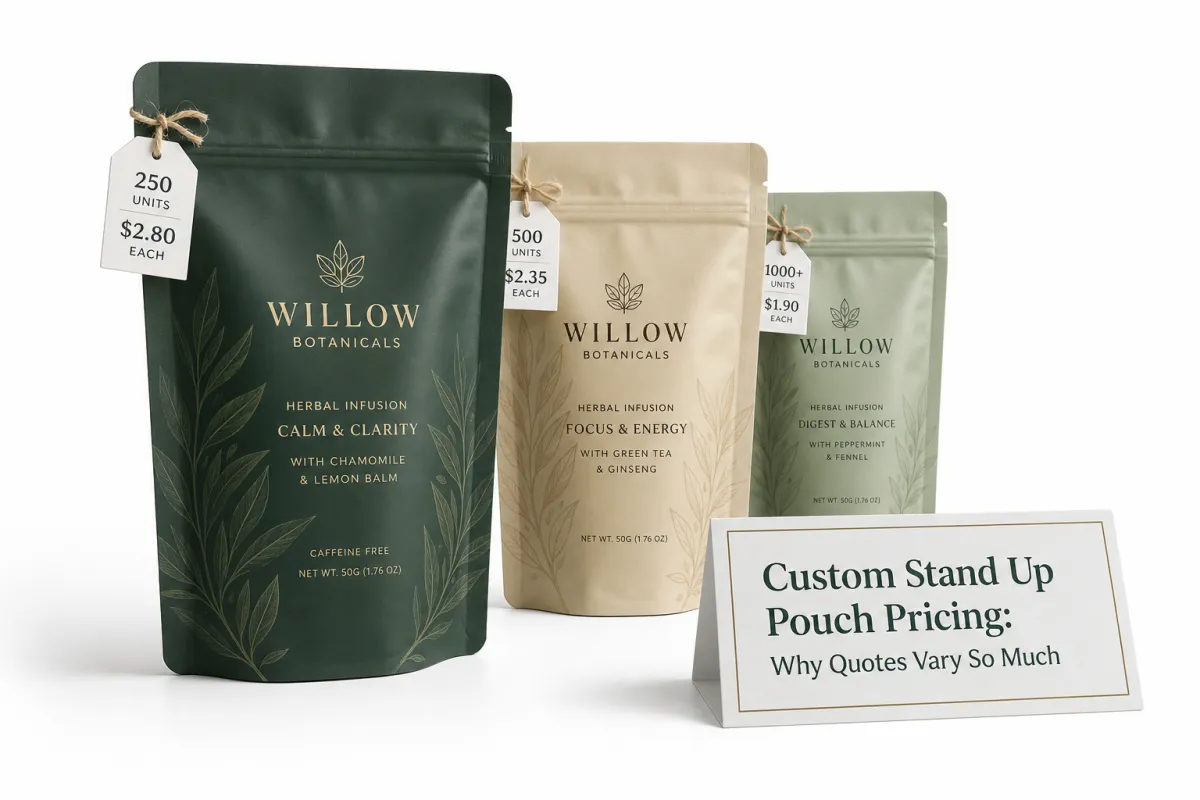
Picture a coffee brand asking three vendors for the same-looking matte pouch: same dimensions, same color palette, same logo, same premium feel. One quote arrives 30% lower. That is not necessarily a miracle. It often means custom stand up pouch pricing is reflecting a thinner laminate, a cheaper zipper, a larger MOQ, or a vendor quietly assuming less print coverage and less quality control.
That is why two quotes can look identical on the surface and still live in different universes. One supplier may be pricing a 120-micron laminated structure with a high-barrier layer, while another is quoting 100 microns with a lighter sealant layer. One may include a tear notch and hang hole, while the other treats them as extras. One may quote ocean freight, the other may leave freight out and hope nobody notices until the carton bill shows up. That is the kind of gap that makes buyers feel like they are comparing the same bag when they are really comparing two different builds.
Custom stand up pouch pricing is also shaped by the supplier's appetite for risk. A shop that runs tight QC and checks seal strength, print registration, and pouch dimensions on every lot will often charge more than a vendor that prints fast and sorts problems later. That extra cost is not fluff. It is labor, rejection loss, and the boring but necessary work that keeps a launch from going sideways. I would rather pay for the checks up front than spend a week cleaning up a defective run later. That is just the honest math of packaging.
If the quote does not list film structure, zipper style, print method, and freight terms, it is not a quote. It is a guess with letterhead.
Buyers also overfocus on the unit price and miss the real question: what does the pouch need to do for the product? For coffee, snacks, powders, pet treats, and supplements, the right barrier level can be the difference between a package that protects flavor and one that only looks good in the mockup. That is where custom stand up pouch pricing connects directly to retail packaging performance. A prettier bag that leaks oxygen or moisture is kinda an expensive decoration.
The first lesson is simple. Do not compare two quotes by looking only at the final number. Compare the build, the assumptions, and the risk hidden inside custom stand up pouch pricing. The lowest price can be the most expensive bag if it causes returns, delays, or a reprint.
How Custom Stand Up Pouch Pricing Works
There is a basic math model behind custom stand up pouch pricing, and it is not glamorous. The supplier starts with substrate cost, then adds print setup, converting, quality control, packaging, freight, and margin. The exact math changes by region and factory, but the pattern stays the same: fixed costs hit hard on small runs, and variable costs dominate once quantities climb.
Order size matters for that reason. A 500-piece run may feel manageable, but custom stand up pouch pricing can look brutal because the supplier is spreading artwork prep, plate or file setup, machine changeover, waste allowance, and inspection across too few bags. At 5,000 pieces, those same fixed costs get diluted. At 20,000 pieces, the unit price usually falls again because the factory can run longer with less changeover pain. I have watched buyers soften up once they see the curve on paper; the first run is simply carrying more setup weight.
Digital and gravure are priced differently
Digital printing usually supports lower quantities and faster changeovers. It avoids some traditional plate costs, which makes it useful for launch tests, limited editions, and brands that need flexibility. Gravure can make sense at scale because the print quality is strong and the per-unit economics improve over large runs. The tradeoff is front-loaded setup. That is why custom stand up pouch pricing often looks friendlier in digital at small volumes and more competitive in gravure once the order gets big enough.
If you want a practical reference point, the packaging education resources at packaging.org are useful for terminology and material basics. Not because they hand you a magic price list. They do not. Because they help you understand what the supplier is actually quoting, which is the part that usually trips people up.
Construction changes the number fast
A single-layer pouch is cheaper than a laminated barrier pouch. That sounds obvious, but buyers still get caught by it. Add a zipper, and the price climbs. Add a tear notch, a euro hole, a spout, a degassing valve, or a matte soft-touch finish, and custom stand up pouch pricing rises again because each feature adds material, machine steps, or rejection risk.
The same happens with print coverage. A one-color logo on natural film is not the same as a heavy-coverage design with white underprint, metallic ink, and edge-to-edge artwork. More ink means more passes, more drying or curing control, and more inspection. That extra work is not free, even if the mockup makes it look easy. And if the artwork uses subtle gradients or photo-heavy panels, the supplier may need tighter registration control than you expected.
Here is the useful part: suppliers often quote ranges instead of one fixed number when your dimensions, film, or artwork are still floating. That is not laziness. It is custom stand up pouch pricing being honest about uncertainty. If the spec is loose, the quote should be loose too.
| Order Profile | Typical Unit Price Range | Setup Pressure | Best Fit |
|---|---|---|---|
| 500 pieces, digital print, simple build | $0.90-$2.20 | High | Sampling, testing, short launches |
| 5,000 pieces, laminated matte pouch with zipper | $0.22-$0.48 | Moderate | Early-stage product packaging with repeat potential |
| 20,000 pieces, optimized structure and repeat artwork | $0.12-$0.32 | Lower | Stable SKUs, scale purchasing, stronger margin control |
Those ranges are not universal. They move with material grade, print coverage, region, freight, and labor. Still, they show the pattern: custom stand up pouch pricing gets friendlier as setup cost gets spread across more units. The slope matters more than the exact penny on the first quote.
Cost Drivers That Move Custom Stand Up Pouch Pricing
If you want to understand custom stand up pouch pricing, you need to know which levers move the number most. Size matters, yes, but not nearly as much as the full build. In practice, the biggest price drivers are film gauge, barrier performance, print method, color count, finish, zipper type, and any add-ons that force the factory to slow down.
Film gauge is a classic example. Thicker does not automatically mean better, but more material usually means more cost. A pouch built for fragile snacks or heavy powder load may need a stronger base layer and a more durable sealant layer. A lighter product may not need that much structure. Buyers who overbuild the pouch often pay for peace of mind they never actually use.
Barrier performance matters a lot too. If your product is sensitive to oxygen, moisture, or light, you may need better barrier materials, not just a prettier outer film. That is where custom stand up pouch pricing starts to separate from simple retail packaging. A pouch for dry tea and a pouch for oxygen-sensitive coffee are not the same job, even if they stand on the same shelf.
Color and finish are not cosmetic freebies
More inks mean more cost. White underprint, metallic effects, soft-touch matte, spot gloss, and photo-heavy artwork can each add time and complexity. If you are trying to build premium package branding, that can be worth it. If you are launching a basic utility product, maybe not. A design that looks rich on a screen can be expensive in print because the factory has to manage coverage and registration carefully.
Packaging design should happen before quote collection, not after. Change the artwork late and custom stand up pouch pricing tends to jump. Change it twice and the supplier may stop being polite about it. That is not attitude; that is the cost of remaking approvals, plates, files, or press checks that were already in motion.
MOQ is where many buyers get surprised
Minimum order quantity is not a nuisance. It is part of the economics. Low MOQ is attractive for testing, but it usually raises unit cost because setup cost is not being spread broadly. Some suppliers will quote low MOQ on digital runs. Others will insist on higher volumes for gravure or larger structures. If you are comparing suppliers, ask what MOQ actually means in their shop. Is it a hard production minimum, or just the point where the price becomes sane?
Freight and packaging can quietly wreck a deal too. A low ex-factory quote is nice until you add cartons, pallets, port handling, customs duty, domestic delivery, and the cost of waiting. For shipping performance and packaging protection, the standards from ISTA are worth knowing, especially if your pouches travel long distances or need secondary packaging that survives rough handling. A packaging program that saves a few cents on the pouch but ignores transport damage can burn through that savings pretty quickly.
Compliance can add cost as well. Food contact requirements, child-resistant features, or specialized barrier testing can all increase custom stand up pouch pricing. If a supplier quotes a lower number but skips testing or avoids certification language, that is not a bargain. That is a future problem wearing a discount sticker.
For paper-based components or sustainable sourcing claims, certification details may also matter. If your pouch program includes paperboard inserts, outer cartons, or eco-positioning, FSC documentation may come into play. That is where the conversation shifts from price alone to the credibility of the whole package. Green claims without paper trail backing are a fast way to create trust issues, and trust is harder to repair than a torn seam.
Custom Stand Up Pouch Pricing Process and Timeline
Custom stand up pouch pricing is tied to time more than most buyers expect. The production path is not just "make bag, ship bag." It starts with quote request and runs through dieline review, artwork proofing, material sign-off, prepress, printing, lamination, curing, converting, inspection, packing, and shipping. Every step can alter cost if the schedule gets tight or the specs are not settled early.
Rush orders cost more because they interrupt the factory's normal queue, force material substitutions, or push freight into air instead of ocean. Air freight can turn a decent quote into a painful one very quickly. If the launch date is fixed, fine. Just understand that custom stand up pouch pricing is almost always higher when speed matters more than efficiency. In practice, a rush order is not just a surcharge; it is a reshuffling of the entire production calendar.
Typical approval checkpoints are not bureaucracy for fun. They are the places where errors get caught before they become expensive. A clean pouch program usually goes through these steps:
- Dieline confirmation with final dimensions and seal areas.
- Artwork proof review for registration, spelling, and bleed.
- Material specification sign-off for barrier, finish, and zipper choice.
- Sample or prototype review if the launch depends on appearance or fit.
- Production release once every spec is locked.
Miss one of those and custom stand up pouch pricing often changes later, sometimes because the supplier had to redo prep work and sometimes because the revised build is genuinely more expensive. Either way, the bill usually gets bigger after the fact, which is never the fun version.
Lead time also changes with construction. Stock-adjacent dimensions and common films move faster. Odd sizes, matte soft-touch finishes, unusual zipper colors, or heavy print coverage move slower. That is normal. It is also why a supplier who takes longer to quote may actually be doing you a favor. They are checking feasibility instead of guessing and hoping your launch can absorb the damage.
For a standard custom order, a realistic production timeline is often 12-15 business days after proof approval for simpler runs, and longer if you are using complex print or a constrained material. Shipping adds its own clock. Ocean freight can be cost-effective but slow. Air freight is fast but expensive. Again, custom stand up pouch pricing is inseparable from schedule choices, which is why timeline conversations should happen before artwork gets locked.
Step-by-Step Guide to Comparing Quotes Without Guessing
The easiest way to waste money is to compare quotes that do not actually match. A clean spec sheet solves most of that nonsense. Include pouch dimensions, fill weight, product type, barrier target, print count, finish, zipper, notch, hole, and target volume. If you do not give the supplier enough detail, custom stand up pouch pricing will drift because each vendor fills in the blanks differently.
That is why the first rule is simple: make every supplier quote the same build. If one vendor assumes a thinner laminate, a different zipper, or a smaller print area, the comparison is fake even if the emails look tidy. You are not comparing apples to apples. You are comparing a full apple to a shrug.
Here is a practical way to score the offers:
- Unit cost for the exact same structure.
- Setup fees for artwork, plates, tooling, or proofs.
- Freight and delivery terms, including carton and pallet assumptions.
- Payment terms that affect cash flow.
- Reorder path if the SKU becomes a repeat item.
- Sample quality if you need to judge finish and seal integrity.
Then look at total landed cost, not just the headline number. Custom stand up pouch pricing gets distorted fast when one supplier hides freight inside the quote while another leaves it out. If you are buying for retail packaging, landed cost is the number that matters because that is the number that touches margin. A pretty quote with missing costs is still an incomplete quote.
There is also a strategic reason to request a sample or prototype. If the pouch is launch-critical, a slightly higher quote can still be the smarter choice if it comes with better seal strength, cleaner graphics, or a smoother reorder process. The cheapest bag is not smart if it tears in transit or makes the shelf look cheap. That is just expensive in a different outfit.
To keep the comparison honest, some buyers create a one-page scorecard for custom stand up pouch pricing. They assign weights to print quality, lead time, communication, sample accuracy, and landed cost. That sounds like overkill until you avoid one bad supplier and save an entire campaign. Once you have been burned by a loose quote once, you stop thinking scorecards are fussy.
| What to Compare | Good Practice | Red Flag |
|---|---|---|
| Material spec | Same laminate, same barrier, same finish | One quote uses thinner film without saying so |
| Print method | Digital vs. gravure clearly identified | "Full color" with no process detail |
| Freight | FOB or landed terms stated up front | Freight missing until the invoice stage |
| MOQ | Same quantity quoted everywhere | One supplier quietly assumes a larger run |
| Reorder price | Separate repeat-run estimate provided | No visibility on future pricing |
Once you compare like for like, custom stand up pouch pricing becomes much less mysterious. The spread usually makes sense, and the right choice is usually the one that balances cost with execution confidence, not the one that wins by a penny on an incomplete spec.
Common Mistakes That Inflate Custom Stand Up Pouch Pricing
The most common mistake is changing specs while quotes are still open. Every revision can trigger fresh prepress work, new material checks, or a reset on production assumptions. That is how custom stand up pouch pricing sneaks upward one awkward email at a time. A buyer thinks they are just adjusting the zipper. The supplier sees another round of work, another proof, and another chance for something to go sideways.
Another mistake is over-designing the pouch. Too many finishes, too many colors, too much ink coverage, and too many nonessential add-ons can make the bag look premium in theory and expensive in practice. If the product is moving through retail packaging channels, the design needs to earn its place. Fancy is not the same as effective.
MOQ gets people too. A low quantity feels safe, but if the unit cost is high enough, you can wreck your margin before the product ever reaches customers. That is especially painful for early-stage brands using custom printed boxes for shipping and Stand Up Pouches for the primary pack. The whole package system needs to work together, not fight each other on cost.
Poor artwork files are another easy way to inflate the number. Low-resolution graphics, missing bleed, confusing spot colors, and dieline misalignment create extra labor. If the supplier has to clean up your files, custom stand up pouch pricing may include that labor whether you like it or not. Design teams sometimes act shocked by this. Printer teams do not. A clean file package can save more than a clever discount ever will.
And then there is the classic trap: comparing FOB pricing to landed pricing. If one quote includes freight, import handling, and domestic delivery while another does not, the cheaper one is not cheaper. It is incomplete. That is not a nitpick. It is basic math, and the math is usually where the truth lives.
Weak communication is another cost driver. If a supplier takes days to answer, sends vague proofs, or keeps changing assumptions, the hidden cost is delay risk. Delay risk hurts launch windows, and launch windows are where branded packaging either helps the story or drags it through mud. Slow feedback can also lead to rushed approvals, which is how errors sneak into a final order. Nobody wants that.
Here is the simplest way to avoid the trap: lock the spec, clean the artwork, clarify freight, and ask the supplier to separate setup from unit cost. That one move makes custom stand up pouch pricing easier to compare and harder to manipulate accidentally or otherwise.
Expert Tips for Smarter Custom Stand Up Pouch Pricing
If you want better numbers, design for manufacturability first. A clean structure with fewer exotic extras often gives the best balance of cost, speed, and shelf appeal. The prettiest pouch is not always the one with the best economics. In package branding, restraint can be profitable, and that is not a bad place to land.
Test two pricing paths before you commit: launch quantity and scale quantity. That gives you a clearer picture of where custom stand up pouch pricing improves and where you might need to renegotiate later. A lot of buyers only ask for one number, then act surprised when the repeat order looks different. It usually does. Asking for both numbers up front gives you room to think instead of react.
Lock the specs before asking for quotes. Suppliers price certainty better than ambiguity. A one-page spec sheet with dimensions, film structure, finish, zipper, barrier target, and artwork notes will get you better answers than a loose email that says same as last time, but nicer. That phrase is a tax on everyone's patience.
Use a quote scorecard. Weight print quality, communication, sample quality, lead time, and total landed cost. If the lowest bid scores badly on all the things that actually matter, it is not a win. It is a future headache with a discount attached. The low number only matters if the bag still performs like the product needs it to perform.
Do not ignore reorder logic. Some vendors will quote aggressively on the first run and less aggressively later. Others will stay steadier across repeat jobs. If your product has a stable SKU, ask for the repeat-run price now. Custom stand up pouch pricing is not just a launch decision. It is a supply chain decision.
Think about the broader packaging system too. If your stand up pouch sits beside custom printed boxes or other retail packaging elements, the finishes and colors should feel intentional together. The pouch does not need to match everything perfectly, but it should belong in the same brand family. Bad coordination makes product packaging look improvised, which is a strange choice after paying for custom work.
One practical rule helps a lot: simplify wherever the customer will not notice. If a heavy metallic effect does not improve shelf conversion, skip it. If a zipper color is invisible behind the artwork, use the standard option. If a window cut does not help the sell story, leave it out. That is how custom stand up pouch pricing stays under control without turning the pouch into a boring brick.
For buyers who need sustainable sourcing language, check whether paper components carry credible documentation, such as FSC claims, and whether the supplier can back up any eco claims with actual specs. A vague green pitch does not lower cost. It just raises the odds of trouble later. Honest documentation is worth more than a polished sales line, and it is usually less messy to defend if questions come up later.
If you need a wider packaging lineup, our Custom Packaging Products page is a useful place to compare pouch options with other product packaging formats. The goal is not to buy the fanciest thing. It is to buy the right thing at a number that still lets the business breathe.
One final buying habit saves a lot of money: ask the supplier to explain what would have to change to lower the price by 10% and what would change to improve performance by 10%. Those answers tell you more than a polished quote ever will. That is the practical heart of custom stand up pouch pricing. It reveals where the real cost sits, which tradeoffs are flexible, and which ones are baked into the build.
FAQ
Why does custom stand up pouch pricing vary so much between suppliers?
Suppliers may be using different film structures, zipper types, print methods, or MOQ assumptions even when the pouch looks similar. Freight, setup fees, and quality control standards can also change the final number a lot. The best comparison is a matched spec sheet, not a side-by-side glance at two emails. That is the only way custom stand up pouch pricing starts to mean something useful.
What MOQ should I expect for custom stand up pouch pricing?
Lower MOQs usually mean higher unit cost because setup is spread across fewer pouches. Digital printing can support smaller runs more efficiently than traditional methods in many cases. If you are testing a product, a higher unit price may still be smart if it reduces inventory risk. Custom stand up pouch pricing at low volumes is often a tradeoff between cash control and per-unit efficiency.
How much do printing and setup fees affect custom stand up pouch pricing?
They can be a major part of the total cost on smaller runs, sometimes more than the film itself. More colors, more artwork changes, and special finishes usually increase setup work and price. Ask for a quote that separates setup from unit cost so you can see where the money is going. Otherwise, custom stand up pouch pricing becomes a blur of half-truths.
What features raise unit cost the fastest on a stand up pouch?
Barrier upgrades, special finishes, and high ink coverage usually move the price up quickly. Add-ons like zippers, valves, tear notches, and custom windows also push cost higher. The cheapest-looking design is often the one with the fewest nonessential extras, and that is usually where custom stand up pouch pricing stays under control.
How do I compare quotes without missing hidden costs?
Compare the same size, material, print method, and finish across every supplier. Include freight, samples, setup charges, and payment terms in your total landed cost. If one quote seems too low, ask what was removed or downgraded before you celebrate. That simple step keeps custom stand up pouch pricing honest.
Is the lowest custom stand up pouch pricing always the best choice?
No. The lowest quote is only useful if the pouch performs, arrives on time, and can be reordered without a mess. A bag that fails seal testing, ships late, or prints poorly can cost more than a slightly higher quote from the start. Cheap is only cheap when the rest of the build holds together.
What Smart Buyers Do Next
Custom stand up pouch pricing gets much easier once you stop treating it like a mystery and start treating it like a spec-driven buying decision. Lock the dimensions. Lock the film. Lock the finish. Then ask for like-for-like quotes and compare landed cost, not just the number at the top of the email. That is how you avoid paying for confusion.
If the pouch is for a launch, a test, or a core SKU, think about the whole system: barrier performance, print quality, shipping risk, and repeat-order economics. That is where custom stand up pouch pricing stops being a guessing game and starts becoming a tool you can actually use. The smartest brands do not buy the cheapest pouch. They buy the pouch that protects the product, supports the shelf story, and still leaves room for margin. That is custom stand up pouch pricing done properly, and it is usually the version that holds up after the first reorder.

