Buyer Fit Snapshot
| Best fit | Custom Sustainable Carton Inserts projects where brand print, material claims, artwork control, MOQ, and repeat-order consistency need to be specified before quoting. |
|---|---|
| Quote inputs | Share finished size, material target, print colors, finish, packing count, annual reorder estimate, ship-to region, and any compliance wording. |
| Proofing check | Approve dieline scale, logo placement, barcode or warning zones, color tolerance, closure strength, and carton packing before bulk production. |
| Main risk | Vague material claims, crowded artwork, missing packing details, or unclear freight terms can make a low unit price expensive after revisions. |
Fast answer: Custom Sustainable Carton Inserts: Materials, Cost, Process should be specified like a repeatable production item. The safest quote records material, print method, finish, artwork proof, packing count, and reorder notes in one written spec.
Production checks before approval
Compare the actual filled-product size with the drawing, then confirm tolerance on folds, seals, hang holes, label areas, and retail display edges. Reserve space for logos, QR codes, warning copy, and material claims before decorative graphics fill the panel.
Quote comparison points
Review material grade, print process, finish, sampling route, tooling charges, carton quantity, and freight assumptions side by side. A quote is only useful when the supplier can repeat the same color, closure quality, and packing count on the next order.
Custom Sustainable Carton inserts are the part of packaging people ignore right up until a shipment arrives damaged. The carton did not fail first. The product moved, got hit, and lost. That is the whole story in plain language.
Good custom sustainable carton inserts stop that movement with paper-based structures instead of foam, plastic trays, or loose filler that adds bulk without much useful protection. They are not glamorous. They do the work.
For brands building retail packaging, branded packaging, or premium product packaging, the insert affects more than damage rates. It changes pack-out speed, shipping cost, presentation, and how the product feels when the customer opens the box. A tidy insert can make a modest package feel intentional. A sloppy one makes even a nice product look rushed.
If you are comparing custom packaging products, this is the part worth sorting out before anyone signs off on a dieline and hopes the sample survives transit. The wrong insert costs twice: once in production, once in returns or replacements. The right one can reduce waste, protect the item, and keep the whole pack looking controlled instead of fragile.
Custom Sustainable Carton Inserts: What They Are
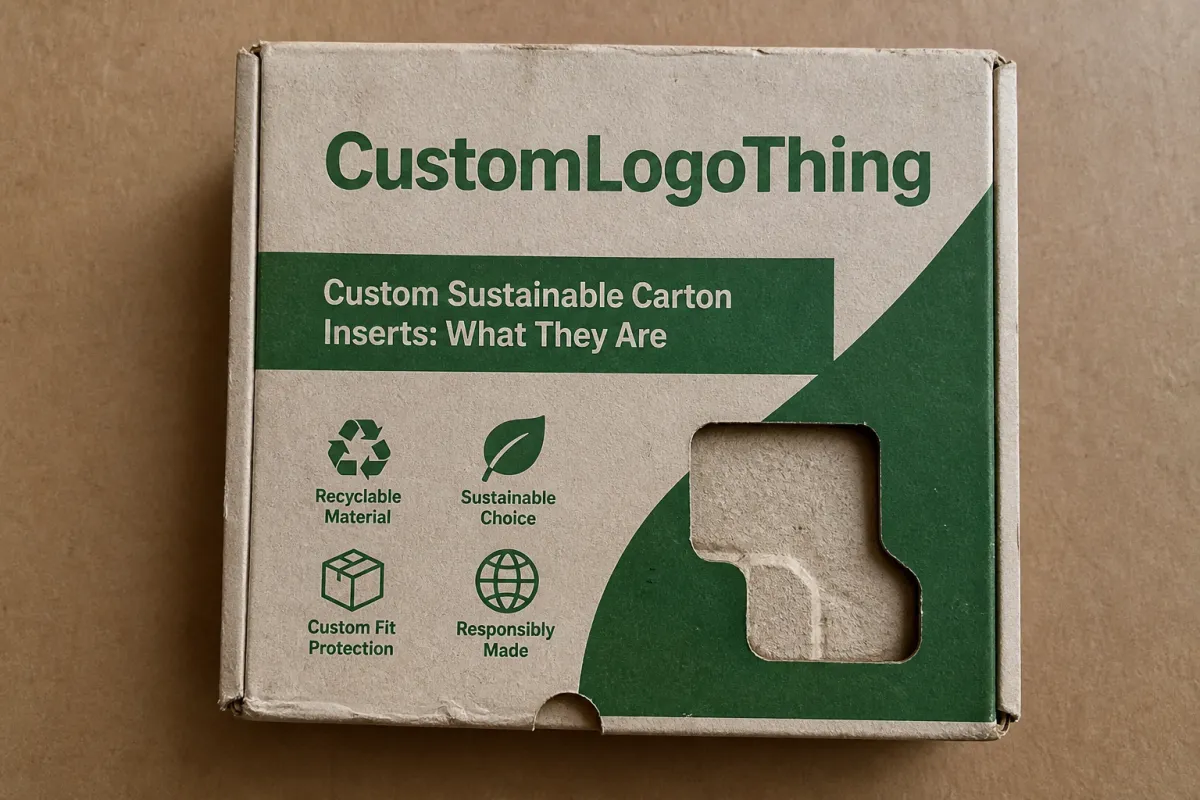
Custom sustainable carton inserts are paper-based structures designed to hold products securely inside a carton. They can be trays, dividers, cradles, sleeves with internal support, or folded retention systems that lock the item in place. In practical terms, they keep the product from bouncing around like loose change in a dryer.
Most are made from fiber-based materials such as kraft paperboard, recycled paperboard, corrugated board, or molded fiber. Some use water-based adhesives, low-impact inks, and light coatings when a project needs moisture resistance or a more polished presentation. Sustainability is not a label you add at the end. It comes from material choice, part count, and how much excess structure the design avoids.
These inserts show up in cosmetics, candles, supplements, glass jars, bottles, premium DTC kits, small electronics, and gift-style retail packaging. They work especially well when the product is fragile, valuable, or expensive enough that bad packaging looks careless. Buyers notice that even if they cannot name the cause.
The tradeoff is real. A more sustainable structure still has to perform. Too thin, and the product shifts. Too loose, and pack-out becomes annoying. Too much board, and you waste material and labor for no gain. That is the sweet spot with custom sustainable carton inserts: protect first, then strip away what does not earn its keep.
“A neat insert that fails in transit is just expensive litter.”
That line tends to land because it is true. Packaging design is not decoration. It has to survive handling, stacking, vibration, and the occasional drop that nobody admits happened.
How Custom Sustainable Carton Inserts Work
The mechanics are straightforward. The insert limits movement, absorbs handling stress, and keeps the product centered so corners, caps, glass surfaces, and lenses do not slam into the carton walls. Once movement is controlled, the package becomes much less vulnerable to drop shock, compression, and vibration.
Think of the insert as a precision buffer. It does not need to be flashy. It needs to fit. A good insert controls lateral movement and vertical bounce. The product should not slide side to side, and it should not float upward and smack the top of the box during a drop or a conveyor transfer.
Different products need different structures:
- Single-item cradles hold one bottle, jar, candle, or device in a fixed position.
- Multi-cell dividers separate multiple units so they do not collide.
- Fold-in locking tabs grip the product with paper tension instead of plastic clips.
- Inner sleeves with supports combine retention and presentation in one structure.
- Nested trays organize kits, accessories, and multi-piece sets without turning the box into a puzzle.
The outer carton matters just as much. A strong insert inside an oversized or weak carton still performs poorly. If the box is too roomy, the product can shift. If the carton walls are flimsy, the insert cannot rescue the design by itself. Buyers often treat the carton and insert as separate purchases, but that misses the point. Good packaging design treats them as one system, sized together.
That matters even more for custom printed boxes with premium graphics. Once package branding becomes part of the buying decision, a crushed corner or sloppy insert can ruin the whole effect. Customers might not know the engineering reason. They still know when the package feels off.
Testing belongs in the development process, not as a last-minute drama. A basic program should include drop tests, vibration checks, and compression testing. The goal is not to collect jargon. The goal is to find out whether the insert protects the product under shipping abuse, not just while sitting neatly on a sample table.
For formal validation, many brands use procedures aligned with ISTA methods or similar performance testing. That matters because parcel networks are not gentle, and “looks fine” is not a protective standard. It is just a hopeful sentence.
Key Factors That Affect Fit, Performance, and Sustainability
Material choice comes first because it changes everything downstream. Kraft paperboard gives a clean look and solid stiffness. Recycled paperboard usually improves the environmental profile, though the surface may be less uniform. Corrugated board adds cushioning and compression strength. Molded fiber can be excellent for support, especially for round or irregular products. Every option carries a different mix of cost, appearance, and recyclability.
Thickness matters more than many buyers expect. Too thin, and the insert collapses during packing or transit. Too thick, and you waste board, raise shipping weight, and make assembly harder. There is a sweet spot, but it depends on product weight, carton size, and how much retention the design creates when the product is inserted. No single caliper works for every SKU. That is why off-the-shelf assumptions miss so often.
Product geometry drives the design. Rounded bottles behave differently from square jars. Sharp corners need more protection than smooth surfaces. Heavier products may need stronger support at the base, while tall items may need tighter retention near the top. Irregular shapes bring their own problems. If one side is wider, heavier, or oddly balanced, the insert has to account for that or the product will twist inside the carton.
Sustainability has tradeoffs, not fairy tales. Higher recycled content can reduce virgin fiber use, but it can also reduce stiffness or create slight surface inconsistencies. That can matter for print quality and tight fit tolerances. If the insert has to look sharp inside premium product packaging, the material choice has to serve structure and presentation together.
Adhesives, coatings, and inks belong in the sustainability conversation too. A recyclable fiber insert with a heavy plastic coating is still awkward to recycle. The same goes for mixed-material add-ons that seem minor but complicate disposal. Water-based inks and light, functional coatings usually keep the structure cleaner from a recycling standpoint, though local rules still vary.
Regional disposal rules matter because what gets accepted in one market may get rejected in another. A paper-based insert may be recyclable in one city and a problem in another because of contamination, coating, or facility limitations. Brands shipping nationally or internationally should check end-of-life assumptions instead of guessing. “Paper-based” is a starting point, not the final answer.
For sourcing decisions, FSC-certified fiber can be worth asking for if the brand has a documented responsibility target. The FSC system is not magic. It does give procurement teams a recognized chain-of-custody framework, and that can simplify vendor review.
The larger point stays simple: a sustainable insert is only sustainable if it fits the product and does its job. A flimsy “eco” insert that drives returns is not a win. It is just waste wearing nicer language.
Custom Sustainable Carton Inserts Cost, MOQ, and Pricing
Pricing for custom sustainable carton inserts usually falls into two buckets: setup cost and unit cost. Buyers get burned when they stare only at the per-piece number and ignore sampling, dieline work, tooling, or structural revisions. The first invoice often reflects development effort more than raw material.
For simple paperboard inserts, a reasonable production estimate at moderate volume might land around $0.12-$0.28 per unit at 5,000 pieces, depending on board grade, cut complexity, print coverage, and assembly method. At higher volumes, simple designs can drop into the $0.06-$0.16 range. Complex shapes, multi-part builds, or specialty finishes push the cost up. Fancy is never free. Annoying, but true.
Minimum order quantities vary by supplier and structure. Prototypes or short runs may start around 100 to 500 units if the supplier handles sampled work, but production MOQs often rise to 1,000, 2,000, or more once die-cutting, sheet yield, and labor are factored in. If a design needs hand assembly, the MOQ can climb fast because labor is usually the most expensive thing in the room after mistakes.
Here is a practical comparison of common options:
| Insert Type | Best For | Typical Material Profile | Approx. Unit Cost at 5,000+ | Notes |
|---|---|---|---|---|
| Folded paperboard cradle | Light to medium products, cosmetics, candles | Recycled or virgin paperboard, minimal glue | $0.12-$0.24 | Clean presentation, fast assembly, good for branded packaging |
| Corrugated divider insert | Multi-item kits, jars, small bottles | Recycled corrugated board | $0.08-$0.20 | Strong protection, usually less premium looking unless concealed |
| Molded fiber tray | Irregular or fragile items, heavier contents | Fiber-based molded pulp | $0.16-$0.35 | Excellent retention, but tooling and appearance need review |
| Multi-part retention frame | Premium DTC kits, electronics, gift sets | Layered board or hybrid fiber build | $0.20-$0.45 | Strong fit control, but assembly time can climb fast |
Pricing should always be compared on the same spec sheet. If one quote is lower because the supplier quietly switched to thinner board, loosened the tolerances, or removed a coating you actually need, that is not a deal. That is a future problem with a friendlier invoice.
Ask suppliers to break pricing into board grade, die-cutting, print, coating, glue, assembly, packing, and freight. That makes it easier to see where the money goes. It also helps you remove the right feature instead of choosing the lowest total and hoping quality survives.
There is also a hidden cost buyers ignore: overdesign. A large insert with too many folds can look impressive and still waste labor. If assembly takes an extra six seconds per unit, that adds up fast at 10,000 units. A design that saves time can matter more than a small board savings. Not glamorous. Still real.
If you are building a broader packaging program, compare insert options against the rest of your system through Custom Packaging Products. That keeps the insert from being optimized in isolation while the carton, Print, and Shipping format move in different directions.
Production Steps, Process, and Timeline
The cleanest projects start with a real spec sheet. That should include product dimensions, weight, fragile points, shipping method, retail display needs, and sustainability requirements. A good spec sheet also notes whether the product has sharp edges, glass surfaces, pumps, caps, batteries, or anything else that changes how the item behaves inside the carton.
Next comes structural concepting and sampling. That is where the back-and-forth usually lives, because the insert has to fit the product, the carton, and the pack-out process. If the structure is beautiful but awkward to assemble, the line will hate it. If it is easy to pack but weak in transit, the returns team will hate it later. Neither outcome is useful.
Before production, review the dieline like your margin depends on it, because it does. Fold lines, locking tabs, print areas, and glue points all need to match the actual product and the actual carton. A surprising number of packaging failures come from drawings that looked fine in a PDF and wrong in real life.
Always test with the real product. Not a foam block. Not a “close enough” dummy. The actual item. Surface texture, weight distribution, and small dimensional tolerances all affect fit. A bottle that is 1.5 mm wider than expected can turn a well-meaning insert into a bruising machine. Tiny gaps matter. Packaging design loves to remind people of that the hard way.
Typical timing looks like this:
- Initial concept and quote: 1-3 business days if the spec is complete.
- Sampling and fit revisions: 5-10 business days for straightforward structures.
- Tooling and production setup: 3-7 business days, sometimes longer for custom dies.
- Full production: often 10-20 business days after approval, depending on volume and queue.
- Shipping and transit: depends on lane, but local delivery is usually faster than cross-border freight.
That timeline can move faster if the design is simple and the supplier has capacity. It can move slower if the spec keeps changing after sampling. That is usually the fastest way to blow up a launch schedule. Teams do it anyway, because confidence often arrives before planning.
Quality control should not be an afterthought. Check board thickness, cut accuracy, fold performance, assembly speed, and pack-out consistency. If the insert is meant to protect 50,000 units, it has to behave like the same part every time, not just on the first ten samples.
A practical quality check also includes a mock pack-out by the actual packing team. That shows whether the design is intuitive, whether the tabs are easy to identify, and whether the insert can be assembled without a training seminar. Good packaging lowers friction. Bad packaging creates process drag and quiet resentment.
Common Mistakes When Specifying Carton Inserts
The most common mistake is choosing a loose fit because it is easier to assemble. Easy does not equal safe. A product that rattles usually arrives scuffed, shifted, or broken, especially in parcel shipping. A little extra tension is usually better than a lot of extra movement.
Another classic error is overengineering the structure. Too many folds, extra layers, decorative cutouts, or “premium” complexity can turn a clean sustainable design into a labor-heavy mess. If the insert needs eight steps to assemble, the line slows down, mistakes rise, and the cost creeps upward for no useful shipping benefit.
Some buyers ignore the actual shipping environment. A package that survives a local handoff may fail in a parcel network, in a distribution center, or on a stacked pallet. Vibration, compression, and corner drops are part of the real world, even if the sample looked perfect in a conference room.
Using the wrong board grade is another expensive mistake. A light product can use a simpler insert. A heavier product may need stronger board or structural reinforcement. Moisture exposure matters too. If the package may sit in a humid warehouse or move through a damp logistics chain, board choice and finish need to reflect that.
Then there is the recyclability assumption. A lot of teams say “paper-based” and stop there. That is lazy. Heavy inks, plastic coatings, mixed-material add-ons, and certain adhesives can reduce recyclability or make sorting harder. If the environmental claim matters, check the full structure, not just the headline material.
Skipping assembly testing with the pack team is probably the most avoidable mistake of all. A design that looks great on a sample table can become slow, confusing, and error-prone at scale. That is how theoretically good product packaging turns into a line problem. The line always finds the flaw. Always.
Short version: if the product moves, the insert is not finished yet. If assembly is clumsy, the design is not finished yet. If the material claims are vague, the sustainability story is not finished yet.
Expert Tips and Next Steps for Better Ordering
Ask for two versions of the design if your volume justifies it: a cost-efficient baseline and a higher-spec sustainable option. That side-by-side comparison makes the tradeoffs obvious. You can see whether a small change in board grade, fold count, or structure actually earns its keep.
Send real product samples, not just dimensions. Tolerances matter. Surface details matter. A glossy bottle, a textured jar, or a slightly off-center cap can change the way the insert grips the item. A good supplier will appreciate the actual sample because it removes guesswork from the first engineering round.
Request a mock pack-out before you approve production. Then do a simple shake test, a drop test, and a stack test on a filled carton. This is not a lab drama. It is a fast way to catch bad assumptions before they become expensive returns. If the product shifts, the design needs work. If the carton bulges, the board or dimensions need revision.
Keep the structure as simple as possible while still protecting the product. Every extra fold, cutout, and embellishment has to justify itself. Simple structures usually assemble faster, cost less, and leave fewer opportunities for error. That is especially useful for custom printed boxes where the insert should support the brand without eating up production time.
Confirm how the insert will ship, store, and be assembled. Flat-packed inserts save space, but they may require more manual labor at pack-out. Pre-formed inserts save time, but they may increase freight or storage cost. There is no universal winner. The right answer depends on volume, labor cost, and warehouse setup.
For brands building a full packaging program, keep packaging design decisions in order: performance first, sustainability second, branding third. That does not mean branding is unimportant. It means a package that looks beautiful and fails in transit is just expensive disappointment.
If your team is also deciding how the insert fits into broader retail packaging or a subscription kit, compare the insert with the carton, print finishes, and packing workflow together. That is where packaging inserts and dividers start to make sense as part of the full system, not as a rushed add-on.
For larger launches, the supplier should be able to talk clearly about standards, not slogans. Ask how the design lines up with compression needs, what test method they use, and whether the structure has been reviewed against ISTA or comparable performance testing. If the answers are fuzzy, that tells you plenty.
One more thing: a cleaner insert is not just about materials. It can improve package branding by making the unboxing feel intentional. A well-fitted cradle or tray makes the product look designed, not merely shipped. That matters for premium DTC brands and anything sold as giftable retail packaging. Clean presentation sells. Clutter does not.
My practical checklist is simple. Start with the product. Then the carton. Then the insert. Then the test. If you reverse that order, you usually end up redesigning the whole thing anyway. That is why custom sustainable carton inserts are worth the effort: done right, they reduce damage, improve presentation, and keep the package honest about its environmental claims.
FAQ
What materials are best for custom sustainable carton inserts?
Paperboard and corrugated board are the most common choices because they are widely recyclable and easy to die-cut into precise shapes. Recycled content can improve the sustainability profile, but the material still needs enough stiffness and compression strength for the product weight. I would choose the board based on the product, not the slogan. Fragile or heavy items usually need stronger structure and tighter engineering.
Are custom sustainable carton inserts recyclable?
Usually yes, if they are made from fiber-based materials and do not rely on plastic laminations or mixed-material construction. Coatings, heavy inks, and certain adhesives can affect recyclability, so the full spec matters. Check local recycling rules in your target markets instead of assuming every paper-based insert is accepted everywhere. Recycling claims get awkward fast when municipal rules do not match the brochure.
How much do custom sustainable carton inserts cost?
Cost depends on board grade, complexity, quantity, print, tooling, and whether the insert needs hand assembly. Simple designs scale better at higher volumes, while small runs tend to carry more setup cost per unit. Ask for itemized quotes so you can see where the money is actually going and cut the features that do not improve protection. If a quote is much cheaper, ask what changed.
What is the typical lead time for custom sustainable carton inserts?
Prototype and sample work can move quickly, but final production usually takes longer because of approvals, tooling, and capacity. Straightforward designs are faster; complex structures, special materials, or printing add time. The quickest way to blow up lead time is changing the spec after sampling, so lock the details before you approve the run. A week lost there can ripple through the whole launch schedule.
How do I choose the right insert design for fragile products?
Start with the product's weak points: corners, caps, glass edges, lenses, or any part that can flex or crack under pressure. Match the insert to the shipping mode and abuse level, then test it with real product weight and real carton dimensions. If the product moves, rattles, or touches the box wall, the design is not finished yet. For fragile goods, “close enough” usually means broken later.
Bottom line: custom sustainable carton inserts work best when you treat them as part of the whole packaging system, not a token green add-on. Start with the product, size the carton around it, and build the insert to control movement without adding unnecessary material. Then test it with the real item and the real shipping lane. If it passes that check, the insert is doing the job it was supposed to do.

