Buyer Fit Snapshot
| Best fit | Sustainable Subscription Boxes Wholesale projects where brand print, material claims, artwork control, MOQ, and repeat-order consistency need to be specified before quoting. |
|---|---|
| Quote inputs | Share finished size, material target, print colors, finish, packing count, annual reorder estimate, ship-to region, and any compliance wording. |
| Proofing check | Approve dieline scale, logo placement, barcode or warning zones, color tolerance, closure strength, and carton packing before bulk production. |
| Main risk | Vague material claims, crowded artwork, missing packing details, or unclear freight terms can make a low unit price expensive after revisions. |
Fast answer: Sustainable Subscription Boxes Wholesale: Pricing & Specs should be specified like a repeatable production item. The safest quote records material, print method, finish, artwork proof, packing count, and reorder notes in one written spec.
Production checks before approval
Compare the actual filled-product size with the drawing, then confirm tolerance on folds, seals, hang holes, label areas, and retail display edges. Reserve space for logos, QR codes, warning copy, and material claims before decorative graphics fill the panel.
Quote comparison points
Review material grade, print process, finish, sampling route, tooling charges, carton quantity, and freight assumptions side by side. A quote is only useful when the supplier can repeat the same color, closure quality, and packing count on the next order.
Why Sustainable Subscription Boxes Wholesale Work
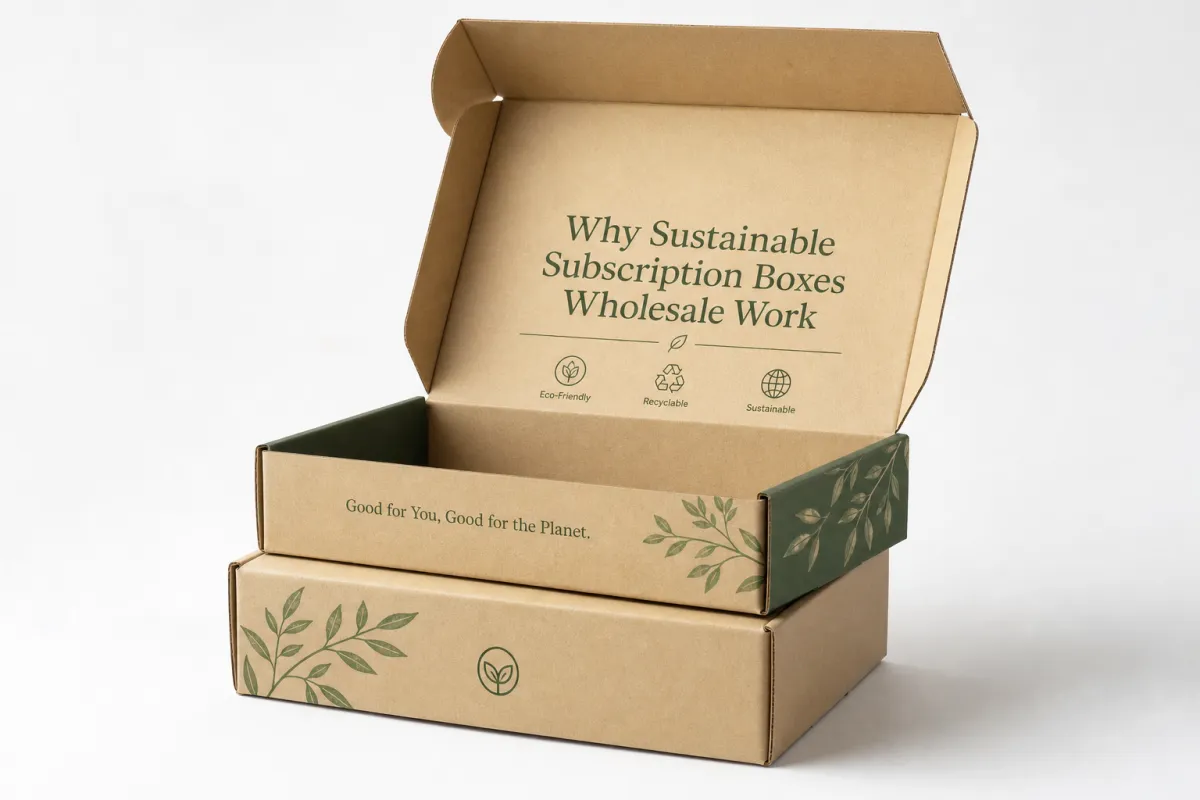
Sustainable Subscription Boxes wholesale make sense because recurring brands need packaging that behaves like part of the operation, not a decorative afterthought. The box has to survive carriers, stack cleanly in the warehouse, and still look intentional when the customer opens it. A cheap box that caves in during transit is not cheap. It is just a future complaint with branding on it.
Monthly fulfillment changes the math. You are not buying a launch piece for one campaign. You are buying the same structure over and over, which means consistency matters as much as appearance. The spec needs to pack fast, reorder cleanly, and show up the same way on run two, run five, and run twelve. That is the real value of sustainable Subscription Boxes Wholesale. Better pricing at scale. Fewer mismatches. Less time spent explaining why the second run looks like it came from another planet.
The sustainability part should hold up under scrutiny. Recycled content matters. FSC certification matters. Recyclable construction matters. "Eco-friendly" by itself means almost nothing. If the box is too flimsy, the team adds void fill, shipping weight climbs, and the material savings disappear somewhere else. Cute idea. Bad outcome.
Sustainable subscription boxes wholesale work best when four things are nailed down: fit, durability, brand presentation, and repeatable production. Miss one of those and the whole program starts bleeding money in places the first quote never showed. Damage rates rise. Replacements creep in. Packing slows down. I have seen teams spend two months fixing a box that looked great in a mockup and behaved badly everywhere else. Real fun. A good box protects the margin as much as it protects the product.
If the box saves fifty cents and doubles the damage rate, it is not a bargain. It is an expensive problem with nice print.
My quick test is simple: if a sustainable subscription boxes wholesale spec packs cleanly, ships without drama, and comes back from reorder looking the same, it is probably solid. If it depends on hope, hand-waving, or a heroic warehouse team, it is not ready. I have worked through enough packaging launches to know that "we'll make it work" is not a production plan.
- Fit: products should sit snugly without forcing extra fill into the box.
- Durability: the structure should survive handling, stacking, and typical parcel abuse.
- Branding: the print should feel deliberate, not like someone rushed it before lunch.
- Consistency: repeat runs should match the approved sample instead of drifting every reorder.
Wholesale buying matters because it turns packaging into a stable system instead of a monthly scramble. A well-set-up program lowers unit cost, steadies quality, and keeps the subscription rhythm from turning into a packaging fire drill. Sustainable subscription boxes wholesale are not just about looking responsible. They are about building packaging that keeps working after the first shipment, and the second, and the twentieth.
Sustainable Subscription Boxes Wholesale Materials and Builds
Sustainable subscription boxes wholesale start with the substrate, because the material decides most of the story. Recycled kraft is the easy favorite. It has a natural look, prints cleanly with simple branding, and fits brands that want low-ink presentation without a lot of fuss. FSC-certified paperboard is another strong option when the buyer needs documentation that the paper came from responsibly managed sources. For heavier kits or rougher transit, corrugated mailers and lighter-duty shippers usually make more sense than a thin carton pretending to be tough.
The most common builds for brands trying to cut waste without weakening the package are Recycled Kraft Mailers, folding cartons, corrugated subscription shippers, and paperboard sleeves. Molded fiber inserts deserve serious attention for fragile kits because they hold items in place without foam. Paperboard dividers and fitted kraft inserts do the same job in a cleaner, more recyclable way. Compostable accessory pouches can help in some setups, but they should earn their place. No need to spray them around like confetti.
If you want material references, the FSC system is documented at fsc.org, and recycling guidance is available from the EPA at epa.gov/recycle. Those sources are more useful than a glossy brochure with a stock photo and a lot of optimism. Sustainable subscription boxes wholesale should be built on documented choices, not a pile of adjectives. If a supplier cannot show where the paper came from or how the structure is supposed to be recycled, I would treat the claim carefully.
The structure matters as much as the substrate. A tuck-top paperboard box can work for light beauty kits or sample sets. A self-locking mailer is better for parcel delivery and repeated handling. Corrugated shippers are the sensible choice for heavier items or mixed assortments. Foldable rigid-look board can create a premium feel, but it is a poor choice if the box will get crushed in transit or stacked in storage for weeks at a time.
There is always a tradeoff. Recycled content helps, but the box still has to survive the trip. A flimsy recycled box that tears and gets replaced is not a win. The strongest sustainable subscription boxes wholesale programs usually balance three things: enough board strength to protect the product, enough restraint in print and coating to keep the package recyclable, and enough structure to make the unboxing feel intentional.
Coatings and inks matter too. Matte aqueous coatings are common because they are easier to live with than heavy plastic lamination. Soy-based or low-VOC inks can support a sustainability story, but they still need to print clearly on the chosen board. Flooded coverage, metallic effects, and specialty finishes push up cost and can make recycling messier. Sometimes that is worth it. Sometimes it is just expensive decoration wearing a strategy costume.
Inserts deserve more attention than they usually get. The outer box gets the photos, but the insert is what stops movement. Paperboard dividers, molded pulp trays, and fitted kraft inserts often do more to reduce damage than making the exterior wall thicker. For sustainable subscription boxes wholesale, the insert often turns a decent concept into a shipping system that actually holds together.
Specifications That Matter for Subscription Packaging
Sustainable subscription boxes wholesale live or die on the spec sheet. A lot of buyers start with the artwork, and that is backwards. The first questions should be size, product weight, ship method, and how the box will be packed. If those are wrong, design cannot rescue the project. A gorgeous box that slows packing by three seconds per unit will still trash the labor budget.
Ask for internal dimensions first. Then check board caliper or thickness, flute type if the box is corrugated, and the closure style. A mailer with a tight dust flap behaves differently than a tuck box or sleeve. If the product shifts in transit, the spec is incomplete. Subscription packaging is repetitive by nature, which means tiny inefficiencies multiply quickly. That is the kind of detail people skip right before they spend weeks fixing avoidable mistakes.
For many sustainable subscription boxes wholesale programs, the important details are not flashy: board weight in gsm or pt, printed coverage, insert count, finish, stacking strength, and whether the inside needs print. Those decisions affect cost, assembly speed, and unboxing quality far more than a pretty mockup. Ignore them and the warehouse will remind you later, usually with language that is less polite than the packaging deck.
Here is the kind of spec review that actually helps:
- Dimensions: internal length, width, and height with product tolerance built in.
- Board strength: enough caliper or flute protection to survive handling and stacking.
- Print coverage: one-color kraft print, full CMYK, inside print, or selective branding.
- Finish: uncoated, aqueous coated, soft-touch, or no coating at all.
- Closure: tuck, self-locking mailer, magnetic style, or fold-and-ship construction.
- Interior support: inserts, dividers, trays, or product-specific cavities.
Shipping-heavy programs need testing. If the box is moving through parcel networks, ask about compression and drop testing, and compare results against ISTA methods such as ISTA 3A or the right distribution profile for the product. ISTA publishes useful guidance at ista.org. For fragile items, that matters a lot more than another round of opinions from the design team. Sustainable subscription boxes wholesale should be judged by transit performance, not by how nice they look on a screen.
Compliance has to stay in the conversation. If the brand makes recycled-content claims, keep the paperwork. If FSC certification is part of the purchase, make sure the documents match the actual product, not just the supplier's general capability. If the package touches food or cosmetics, check whether any label or material rules apply. Nobody wants a box rejected because the mood board looked polished and procurement found a hole in the claim.
One common mistake is choosing a pretty exterior and then discovering the fill process is a mess. Too much empty space means more void fill and higher freight cost. Too little space means crushed corners and slower packing. For sustainable subscription boxes wholesale, fit is not a side issue. Fit is the system. If the product rattles, the box is wrong. If the warehouse has to force the closure, the box is wrong. Pretty is not a substitute for math.
Sustainable Subscription Boxes Wholesale Pricing & MOQ
Sustainable subscription boxes wholesale pricing comes down to a few levers. Material, size, print coverage, insert complexity, and quantity drive most of the cost. If someone tosses out a suspiciously low number without asking about those details, they are guessing or planning to fix the quote later. Neither option is great. I would rather hear a realistic number with assumptions than a bargain that collapses after proofing.
MOQ works the same way. Lower minimums are possible, especially for standard sizes and simple mailers, but unit cost drops as volume rises because setup, waste, and production overhead get spread across more pieces. A small run can make sense for a pilot launch or a seasonal test. A monthly subscription at steady volume should be priced like a real program, not a hobby with a logo.
The useful way to compare sustainable subscription boxes wholesale options is by range, not fantasy. Plain recycled kraft mailers usually sit near the low end. Custom printed FSC paperboard or Recycled Corrugated Boxes land in the middle. Complex builds with multiple parts, specialty inserts, or premium finishes cost more. That is normal. Pretending all structures are interchangeable is how buyers end up comparing apples to shipping crates.
| Box Option | Best Use | Typical MOQ | Approx. Unit Price at 5,000 | Main Tradeoff |
|---|---|---|---|---|
| Plain recycled kraft mailer | Apparel, samples, lightweight kits | 500-1,000 | $0.40-$0.85 | Lowest cost, simplest branding |
| Custom printed FSC paperboard box | Beauty, wellness, curated subscriptions | 1,000-3,000 | $0.65-$1.35 | Good brand presentation, moderate strength |
| Corrugated mailer with insert | Fragile or mixed-product kits | 1,000-3,000 | $1.05-$2.10 | Better protection, higher material cost |
| Foldable rigid-look premium board | High-end gifting and premium launches | 3,000-5,000 | $1.40-$2.80 | Premium feel, more expensive and heavier |
Those numbers are ranges, not promises. Sustainable subscription boxes wholesale can move above or below them depending on print coverage, board grade, insert count, and freight method. A one-color kraft box with a standard dieline behaves very differently from a full-color mailer with inside print, fitted inserts, and a specialty coating. Anyone claiming otherwise is smoothing out the truth for convenience.
Hidden costs matter. Dieline changes eat time. Special coatings add setup. Separate insert production can split the order into two manufacturing streams. Proofing failures mean another round of samples. If the box is designed so tightly that fulfillment needs extra labor to close it, the cheapest unit price turns into a fake win. I have seen that exact mistake more than once, and it is always more annoying than people expect.
That is why smart buyers look at landed cost. Freight, damage risk, assembly time, returns, and reorders belong in the same conversation as unit price. A box that costs ten cents less but increases breakage by three percent is not a bargain. For sustainable subscription boxes wholesale, the best price is the one that keeps the monthly business predictable.
There is a practical way to make pricing easier without wrecking the design. Use standard sizes where possible. Keep print layouts disciplined instead of covering every surface. Reuse one structure across multiple subscription tiers. Order repeat runs instead of reinventing the package every cycle. Buyers who do that usually get better numbers, faster.
Sustainable subscription boxes wholesale pricing gets easier to read when you ask for three versions: a cost-focused build, a balanced branded version, and a premium sustainable build. That comparison shows where the money actually goes and which features are doing real work. It also exposes the features that are just there because somebody liked them in a render.
Process and Timeline for Wholesale Orders
Sustainable subscription boxes wholesale orders usually follow a predictable path: brief, quote, structural review, sample, production, quality check, and shipment. The labels change from supplier to supplier, but the logic does not. You define the box clearly enough for the factory to price it. Then you approve the structure before bulk production starts. That sounds obvious because it is obvious, yet projects still skip one of those steps and pay for it later.
Timing depends mostly on how clean the input is. Final dimensions, ready artwork, and a settled material choice keep the front end moving. If those pieces are still floating around, the schedule slows down. In many cases, quote turnaround lands in one to two business days once the details are complete. Structural review can take another day or two. Sampling often needs five to ten business days, and full production can run around twelve to twenty business days after proof approval, depending on order size and complexity.
That range is normal for sustainable subscription boxes wholesale. What causes delays is not factory magic. It is late changes. Vague measurements. New artwork after the dieline is approved. Sustainability claims that need to be checked after the quote. Small edits sound harmless until they hit the schedule three times in a row.
Sampling is where risk gets cut down. A sample catches fit issues, closure problems, print alignment concerns, and insert mistakes before the full run starts. If the sample is wrong, the correction is usually manageable. If the bulk order is wrong, the correction gets expensive fast. Packaging teams like to pretend the sample is a formality. It is not. It is insurance with cardboard, and the boring part is exactly why it works.
Subscription brands also need the timeline to match the fulfillment calendar. If boxes must arrive before a fixed monthly ship date, buffer the schedule. Receiving, staging, and assembly all take time. Freight can move faster or slower depending on route and service level. Sustainable subscription boxes wholesale should be scheduled around the subscription rhythm, not around optimism and a calendar reminder.
Good communication helps too. The buyer should know who is managing the quote, who approves the proof, and what happens if a material is delayed. Ask for updates in writing. Keep one version of the spec. Make sure the warehouse knows when cartons are arriving and how many pieces per pallet to expect. That small bit of discipline prevents the usual chain reaction of confusion.
- Before quoting: confirm dimensions, product weight, print needs, and target quantity.
- Before sampling: approve the structural spec and any claims tied to recycled or FSC materials.
- Before production: sign off on artwork, dieline, and finish choices.
- Before shipment: confirm freight terms, receiving window, and storage space.
That is the part of sustainable subscription boxes wholesale nobody puts on a glossy cover sheet, but it is the part that keeps a program from slipping. Good packaging is not just the box. It is the sequence that gets the box approved, built, and delivered on time.
Why Choose Us for Sustainable Subscription Boxes Wholesale
Sustainable subscription boxes wholesale should be judged on proof, not slogans. The goal is not to sell the flashiest package in the room. The goal is to match the box to the brand, the budget, and the fulfillment model. That means clear material options, realistic MOQ guidance, and blunt feedback when a pricier build is not earning its keep.
At Custom Logo Things, the packaging conversation stays practical. If a recycled kraft structure will do the job, use it. If a corrugated mailer with an insert is safer, say that plainly. If an elaborate finish looks good but will slow the pack line, that needs to be part of the decision. Buyers do not need theater. They need a box that works every month without adding friction.
Our Wholesale Programs are built around repeat orders and predictable specs, which is exactly what sustainable subscription boxes wholesale require. Our Custom Packaging Products are there for brands that need to compare structures, finishes, and insert styles before locking in a direction. That comparison step saves money more often than not. It also avoids the classic mistake of approving a beautiful sample that the production line hates.
There is also a trust issue. Sustainability claims need documentation. Recycled content should be stated clearly. FSC options should be backed by the proper paperwork. If a package is recyclable only under certain local conditions, say that. If a finish reduces recyclability, do not pretend otherwise. A straight answer is usually more valuable than a polished sentence that says very little.
Operationally, the buyer gets benefits that show up in real numbers. Fewer damaged units. Cleaner presentation. Faster packing. Less filler. Easier reorder management. Fewer emergency calls asking why the second run does not match the first. Sustainable subscription boxes wholesale are supposed to reduce work, not create a new layer of packaging bureaucracy.
Here is the short version: consistent print, sensible sizing, and durable construction beat gimmicks almost every time. The best-looking box in the world is still a bad buy if it fails in transit or slows the line. Good wholesale packaging does not need a speech. It needs to hold up.
If your team is comparing options now, ask for the full picture: structure, print, insert, material proof, and timeline. That is how sustainable subscription boxes wholesale should be bought. Not by chasing the lowest sticker price. Not by falling for a green claim with no paper trail. By choosing a box that does the job and keeps doing it.
Next Steps for Sustainable Subscription Boxes Wholesale
The fastest way to move a sustainable subscription boxes wholesale project forward is to gather the basics before asking for pricing. Get the box dimensions, product weight, monthly quantity, print needs, and any sustainability requirements onto one sheet. Add shipping method, storage constraints, and whether inserts or dividers are needed. That single page will save more back-and-forth than a week of loose emails.
Then ask for two or three quote options. One should be cost-focused. One should balance branding and durability. One can be a premium sustainable build for comparison. That gives you a clean read on the tradeoffs instead of a single number that hides the real differences. For sustainable subscription boxes wholesale, comparison is the point. Otherwise you are just guessing with paperwork.
Sample the box before committing to production, especially if the subscription runs on a recurring schedule. A sample tells you whether the pack line can handle it, whether the closure is intuitive, and whether the products sit where they should. It also gives the marketing team a chance to stop asking for changes that the warehouse will hate. That is usually a win.
From there, lock the spec, approve the proof, and leave enough buffer before the next ship cycle. If freight has to cross regions, add more buffer. If the box includes inserts or specialty finishes, add more buffer again. The subscription model punishes sloppy scheduling. Sustainable subscription boxes wholesale work best when procurement respects that reality.
So the action plan is straightforward:
- Confirm dimensions, product weight, print coverage, and quantity.
- Choose the structure that matches the ship method and damage risk.
- Request sample options and compare landed cost, not just unit price.
- Approve the sample only after fit and closure are checked.
- Place the wholesale order with enough lead time for the next subscription cycle.
If you want sustainable subscription boxes wholesale that look sharp, ship cleanly, and do not rely on greenwashing to justify the price, start with the spec and work forward from there. That approach is boring in the best way. It is also how you get packaging That Holds Up. The takeaway is simple: pick the structure that protects the product, supports the pack line, and can be ordered again without surprises. Everything else is decoration.
What materials work best for sustainable subscription boxes wholesale?
Recycled kraft, FSC-certified paperboard, and corrugated mailers are the most common choices. The best one depends on product weight, shipping method, and how premium the unboxing needs to feel. If the item is fragile, molded fiber or paperboard inserts usually do more good than a pile of void fill. For sustainable subscription boxes wholesale, the material should solve the shipping problem first. A greener material that breaks in transit is not doing its job.
What is a typical MOQ for sustainable subscription boxes wholesale?
MOQ depends on size, structure, and print method, but simpler mailers usually allow lower minimums than complex custom builds. One-color kraft boxes often have more flexible minimums than full-color packaging with multiple components. Ask for tiered pricing so you can see how the unit cost changes as volume rises. That is the clearest way to judge sustainable subscription boxes wholesale quotes. If the first quote looks too perfect, ask what assumptions are hiding underneath it.
How long does production usually take for custom wholesale boxes?
The timeline usually includes quoting, dieline approval, sampling, production, and shipping. Simple repeat orders move faster than fully custom packaging with new artwork or specialty inserts. For sustainable subscription boxes wholesale, build in extra time if the boxes must land before a fixed monthly send-out. A small buffer is cheap insurance. A missing buffer turns into an ugly email chain real quick.
Can sustainable subscription boxes still look premium?
Yes. Clean structure, sharp print, and a good fit matter more than heavy embellishment. A recycled kraft box with disciplined branding often looks better than an overdesigned box that feels flimsy. Premium comes from fit, print clarity, and material quality. That is true for sustainable subscription boxes wholesale and it is not a secret. It just gets ignored when people chase shiny finishes instead of good construction.
How do I compare pricing between different sustainable box options?
Compare the full landed cost, not just the box price. Add inserts, coatings, freight, damage risk, and assembly time into the comparison. The lowest unit cost is not the best deal if it creates more returns or slows fulfillment. That is the real math behind sustainable subscription boxes wholesale. The honest answer is usually less glamorous than the pretty quote, but it saves money.


