Most buyers search for a Custom Swing Tags manufacturer custom logo because the tag does more than carry branding. It is a retail signal, a pricing cue, and often the first tactile interaction a customer has with the product. A shirt, bag, or accessory can feel considered or careless before it is even tried on, and the tag is part of that judgment.
From a packaging buyer’s point of view, the difference is rarely the logo alone. It is the card stock, the print sharpness, the hole reinforcement, the string or fastener choice, and whether the whole piece feels aligned with the rest of the package branding. The same product can read as premium in one tag format and disposable in another. That gap is usually created by production choices, not design theory.
If you also order Custom Labels & Tags or broader Custom Packaging Products, the swing tag should sit inside the same visual system. Consistency matters. A tag that clashes with the garment label, the mailer, or the custom printed boxes creates friction the customer can feel even if they cannot describe it.
Why a custom swing tags manufacturer custom logo order matters
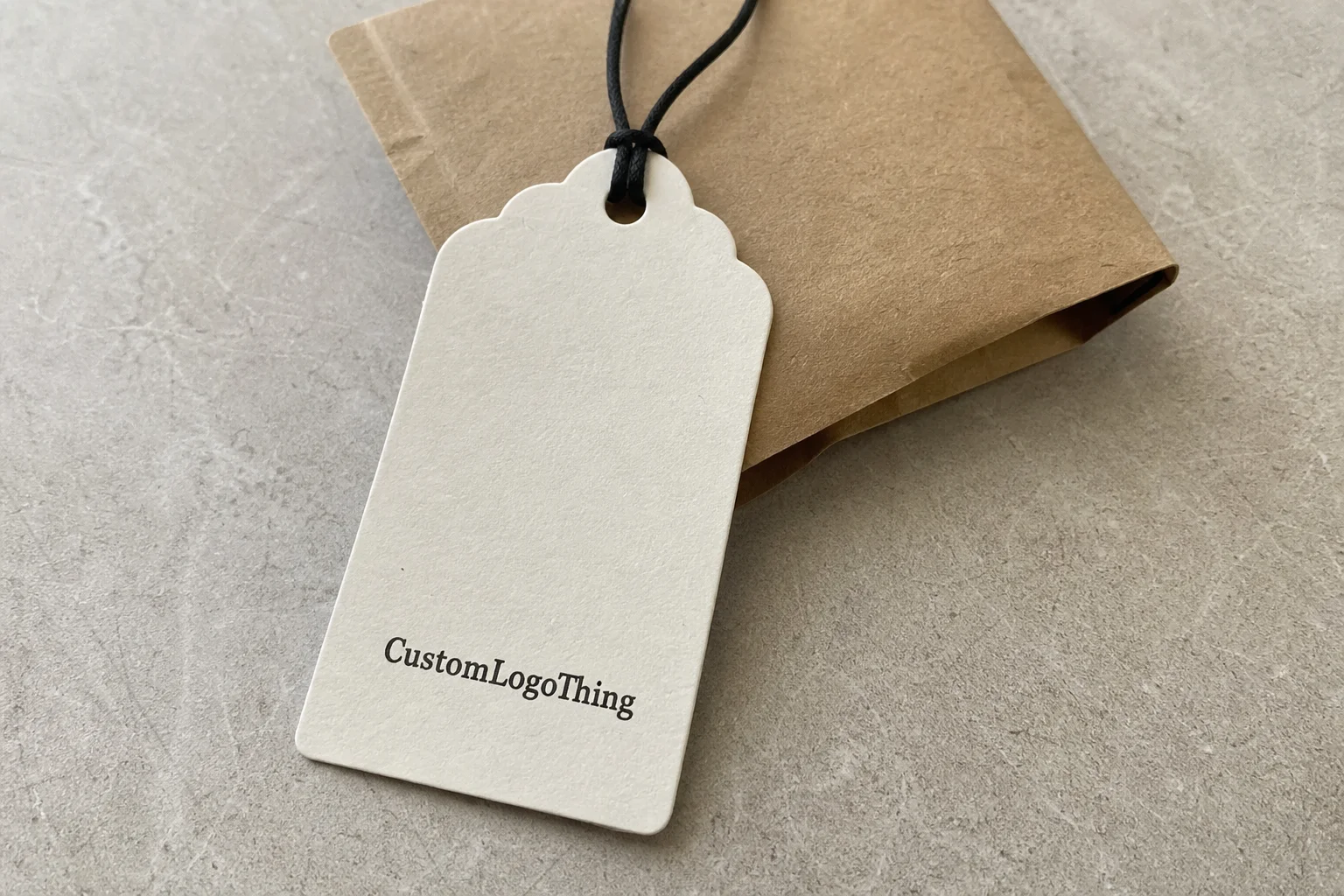
A swing tag is small, but it carries a lot of weight. It introduces the brand, supports product information, and helps the item stand out on a crowded rack. Buyers often treat it as decoration. In practice, it is also part of product packaging, and it can influence how a price is interpreted. A thicker board, cleaner typography, and a better finish can make the same product look more deliberate and more expensive.
Here is the practical version: a plain white tee on a matte, heavyweight tag with crisp black type feels different from the same tee on thin glossy stock with soft edges and a weak hole punch. The product did not change. The perceived value did. That is why a Custom Swing Tags manufacturer custom logo order should be handled as a packaging decision, not an afterthought once the main line is already complete.
In most retail programs, the buyer is asking for a printed hang tag rather than a sewn-in care label or a loose price ticket. The function is to attach brand information to the product in a way that suits the category. A luxury jacket, a denim line, and a cosmetics line all use swing tags differently. The mechanics overlap, but the requirements do not.
Small-format print is unforgiving. Weak stock, low-contrast type, or sloppy finishing shows immediately because there is nowhere for the tag to hide.
That is why packaging teams think of the tag as part of the wider shelf and shipping experience. A good tag should sit comfortably beside the label system, the outer carton, and the in-store display. If the product already travels in branded packaging, the swing tag should extend that language rather than starting a second, unrelated story.
How the custom swing tag process works
The production flow is straightforward, but the details matter. A Custom Swing Tags Manufacturer custom logo order usually starts with a quote based on size, quantity, stock, print sides, finish, and attachment method. After that comes artwork review, proofing, printing, finishing, die cutting, and final pack-out. The job moves quickly when the brief is complete. It slows down when basic questions have to be answered one at a time.
What should a manufacturer receive upfront? Send the finished size, quantity, board preference, print sides, hole style, string or fastener type, and any finishing requests. If the tag needs rounded corners, a custom silhouette, an eyelet, or a reinforced punch, say so early. Those details affect tooling, cost, and timing.
- Dimensions: standard rectangles are usually cheaper, while custom die cuts require tooling and extra setup.
- Stock: paper, coated card, kraft, recycled board, or laminated stock all behave differently in print.
- Print: one side or two sides, CMYK, spot color, or Pantone matching.
- Attachment: string, cotton cord, loop pin, plastic fastener, or reinforced eyelet.
- Finish: matte, gloss, soft-touch, foil, emboss, deboss, or spot UV.
Delays usually come from missing dielines, low-resolution logos, or last-minute color changes. RGB artwork is another classic problem. It looks acceptable on a screen and then shifts in print. If the file is not ready, the schedule slips. That sounds basic because it is basic, and it is still where many missed launch dates begin.
Typical timeline: proof stages often take 2 to 5 business days, standard production commonly runs 7 to 12 business days after approval, and specialty finishing can add extra time. If the tags must move through freight before they reach a warehouse or store, include that transit time in the planning window. A launch date does not care that the tags were only delayed by a few days.
Cost, pricing, and MOQ factors that move the quote
The quote is shaped by a few familiar variables, and none of them are mysterious. Size, stock thickness, print coverage, special finishes, shape complexity, and quantity have the biggest effect on price. A simple one-color tag on heavy board can be very reasonable. Add foil, embossing, soft-touch lamination, and a custom cut, and the cost rises quickly. That is not a pricing trick. It is setup, material, and finishing labor.
MOQ matters because setup costs are front-loaded. A low-volume run can look expensive per unit until those costs are spread across more pieces. For many buyers, the practical test run sits around 500 to 1,000 pieces. Larger retail programs often start making more sense at 2,500 pieces and up. Small-batch launches still work, but the unit price is usually higher.
| Tag Style | Typical Quantity | Approx. Unit Price | What Drives the Cost |
|---|---|---|---|
| Plain matte card tag | 500-1,000 | $0.12-$0.22 | Standard cut, simple print, minimal finishing |
| Kraft tag with one-color print | 1,000-2,500 | $0.10-$0.18 | Common stock, efficient setup, lower print coverage |
| Soft-touch or foil tag | 500-1,000 | $0.35-$0.80 | Lamination, foil plate, extra finishing steps |
| Custom die-cut premium tag | 1,000+ | $0.28-$1.10 | Tooling, unusual shape, heavier board, specialty finish |
Watch the hidden costs too. Freight is obvious. Plates, dies, and custom string are less obvious. Rush fees appear when the timeline is compressed. Variable data, such as numbered tags or unique barcodes, can also add setup time. If you want a clean comparison, ask the Custom Swing Tags Manufacturer custom logo supplier to separate unit cost from setup, tooling, and shipping.
There is a difference between low-cost and low-value. A cheap tag that curls, smudges, or tears at the hole is not saving money. It is weakening the presentation of the product, and possibly the brand. That matters more in retail packaging because the tag is often the first thing a customer touches.
Material and finish choices that change the final look
Material selection affects touch, print sharpness, and durability. Kraft stock signals a natural, less polished look. Coated cardstock gives cleaner ink laydown and sharper type. Recycled board can work very well when the brand wants a lower-impact message, but the texture and natural color shift need to fit the design. If a claim about sustainability or certified sourcing is part of the brief, check the documentation rather than relying on a vague description.
For recycled or responsibly sourced stock, ask for the certification trail that supports the claim. For example, FSC certification guidance is clearer than loose language about being “eco-friendly.” Buyers should assume that claims on a tag may be questioned later, especially if the packaging appears on retail shelves or in ecommerce unboxing content.
Finishes change the brand story quickly. Matte tends to feel restrained and premium. Gloss pushes color harder and suits bold graphics. Soft-touch creates a more tactile surface, but it can be the wrong choice if the brand wants a raw or utilitarian feel. Foil and embossing are useful if the tag needs luxury cues, but they should be used with discipline. Adding every finish available does not create quality. It usually creates noise.
Durability matters more than many buyers expect. Will the tag be handled in store? Packed against other garments? Exposed to humidity during shipping? If the answer is yes, ask about lamination, thicker board, or reinforced hole punching. For rough transit or multi-leg distribution, it is reasonable to ask about packaging test guidance from ISTA shipping standards. The tag is small, but distribution still affects it.
Shape and construction also matter. Rounded corners resist wear better than sharp corners. Custom die cuts create a distinctive silhouette, but they add setup cost and sometimes slow production. A reinforced hole or grommet helps if the tag will be tied on with cord. For a straightforward retail run, a standard rectangle is often the best commercial choice. For a premium launch, a custom silhouette can justify itself if it fits the rest of the package branding.
There is a reason many brands pair swing tags with matching labels, mailers, and custom printed boxes. The tag is one piece of a larger presentation system. It should look like it belongs there, not like it was borrowed from a different brand family with a different price point.
Artwork, branding, and print setup essentials
If the artwork is sloppy, the tag will look sloppy. The file should be built with the correct dimensions, bleed, safe area, and outlined fonts. Logos need enough resolution. Small type needs enough contrast. Fine rules and thin lines are risky because they can disappear or break up during production. A good custom swing tags manufacturer custom logo workflow will flag those issues, but it is faster if the file arrives in usable shape.
The usual file problems are predictable: RGB images, missing fonts, low-resolution logos, and artwork copied from a web page. None of that belongs in production. Vector files are preferable for logos and line art. If the brand uses spot colors, specify whether the job should be converted to CMYK or matched to Pantone. Small-format print can shift more than people expect, so if color is brand-critical, request a physical proof before mass production.
Color matching is not only a technical issue. It is a retail issue. The question is not whether a color can be printed. The real question is whether the tag still looks like the brand under store lighting, at arm’s length, next to competing products. A controlled paper choice, a defined black, and a clear Pantone reference usually beat vague instructions like “make it close.”
Back-side content needs restraint. Care instructions, QR codes, sustainability statements, social handles, website URLs, and barcodes all compete for space. Do not treat the back as free space. It is only useful if it remains legible. If the tag is part of a broader branded packaging system, the back can reinforce trust without crowding the design.
- Good back-side content: care instructions, one QR code, one barcode, short brand message.
- Too much: long copy, multiple QR codes, three fonts, and a barcode squeezed into a corner.
For first runs, it helps to compare the tag against the rest of the About Custom Logo Things workflow and the packaging stack around it. If the tag, label, and outer packaging all point in the same direction, the brand feels intentional. If they do not, the mismatch is visible even when the customer cannot explain why.
Production steps, lead time, and delivery planning
After artwork approval, the order moves through prepress, printing, finishing, cutting, inspection, and packing. That sounds linear because it is linear. The part that changes is where the delay appears. A late approval adds more time than most buyers budget for. So does a revision to color after the proof has already been signed off.
Typical lead times vary with the job. A standard printed tag can move quickly. Add foil, embossing, custom tooling, or extra finishing and the schedule stretches. Larger quantities also take longer because they require more press time and more packing labor. A reliable custom swing tags manufacturer custom logo supplier should give a realistic range, not a best-case promise that falls apart the moment the job enters production.
Shipping planning belongs inside the production plan, not after it. If the tags are traveling with garments to a warehouse, retail location, or fulfillment center, the schedule needs the real transit window. For seasonal launches, the cleanest approach is to work backward from the launch date: final art deadline, proof approval, production slot, pack-out, freight buffer. Miss one of those steps and the whole window compresses.
- Confirm final size, quantity, stock, finish, and attachment method.
- Approve the dieline and send clean artwork.
- Review the proof and lock colors, placement, and back-side copy.
- Build in shipping time so the tags arrive before inventory does.
If the tags need to arrive with other packaging assets, coordinate them with broader Custom Packaging Products so freight is planned as one shipment instead of several disconnected ones. A tag delivery that lands late can hold up pack-out, display prep, and launch timing. It is a small part that can stop a larger process.
Common mistakes when ordering custom swing tags
The first mistake is buying on price alone. That is tempting, especially on repeat orders, but low cost can hide thin stock, weak print, poor die cutting, or a finish that looks cheap under store lights. If the tag feels flimsy in hand, the brand feels flimsy too. Retail customers make that judgment quickly.
The second mistake is overdesigning. Too many finishes, too much copy, too many fonts, and too many claims make the tag harder to read and less believable. The strongest tags usually keep one visual hierarchy: logo first, product name second, supporting copy third. Enough space to breathe matters more than filling every corner.
Third, vague specs create avoidable problems. If the buyer does not define tag size tolerance, hole placement, front and back content, or color expectations, the factory has to guess. Guessing is expensive. So is rework. If the order is a custom swing tags manufacturer custom logo job with a hard launch date, vagueness becomes a scheduling risk.
Fourth, some brands mismatch the tag to the product. A luxury-feeling tag on a low-price item can look forced. A generic tag on a premium product can undercut the entire retail packaging strategy. The tag should match the category, the price point, and the rest of the branded packaging. Otherwise the message becomes confused before the product is even handled.
One more issue gets overlooked: claims. If the tag includes environmental language, use it carefully and support it with documentation. If you mention recycled content, FSC paper, compostability, or carbon language, make sure the statement is accurate and defensible. Packaging teams know this already. The label on the tag is not the place for loose language.
Next steps for a cleaner quote and faster approval
The fastest way to get a useful quote is to send a tight spec sheet. Quantity, size, stock, finish, print sides, attachment method, and exact logo placement should all be clear before the first reply. If you know the delivery date, include that too. A custom swing tags manufacturer custom logo supplier can price a clear brief quickly. A vague one usually triggers extra questions and a slower approval cycle.
Decide the priority before asking for pricing. Lowest unit cost? Fastest turnaround? Most premium presentation? You can usually optimize for two of those, not all three. That is how production works. If the tag needs to support a higher-end brand story, spend money on stock and finish. If the order is a test run, keep the structure simple and let the artwork carry the design.
Ask for a proof that shows both sides, the hole location, and any special finish callouts. If the tag includes a barcode, QR code, or Pantone reference, verify those on the proof. Once production starts, changes become slower and more expensive. That applies to swing tags, labels, and most other print pieces in the packaging chain.
For brands building a full system, the tag should sit beside the label, carton, and mailer as one visual family. That is the difference between a random printed piece and a coherent package branding program. The cleanest orders are usually the ones that treat the tag as part of a larger packaging stack instead of a separate item with separate rules.
For buyers who want to move quickly with a custom swing tags manufacturer custom logo order, send the spec, artwork, and target delivery date together. That produces a quote that can actually be used, rather than a number that looks tidy and solves nothing.
FAQ
What does a custom swing tags manufacturer custom logo order usually include?
Usually it includes printed tag stock, custom sizing or die cutting, logo placement, finishing, and a hanging method such as string, cord, or pin. Buyers should confirm whether artwork setup, proofing, and shipping are included in the quote or billed separately.
How do I choose the right material for custom swing tags?
Pick based on brand position and handling needs: kraft for natural brands, coated board for sharp color, and heavier stock for premium retail presentation. If the tag will be handled a lot, ask about coating or lamination so the edges and print hold up better.
What affects the price of custom swing tags the most?
Quantity, stock thickness, print coverage, special finishes, and custom cutting have the biggest effect on unit cost. Low-volume orders cost more per tag because setup costs are spread across fewer pieces.
How long does production usually take for swing tags?
Standard orders often move faster than specialty jobs, but exact timing depends on proof approval, finishing, and quantity. Custom shapes, foil, embossing, or rush shipping can extend the schedule, so confirm lead time before you commit to a launch date.
What information should I send to get an accurate quote?
Send size, quantity, material preference, print sides, finish, fastener type, and final artwork in a usable file format. Also include the delivery deadline and any must-have details like Pantone colors, barcode placement, or recycled stock requirements.


