Buyer Fit Snapshot
| Best fit | Custom Tear Strip Mailers projects where brand print, material claims, artwork control, MOQ, and repeat-order consistency need to be specified before quoting. |
|---|---|
| Quote inputs | Share finished size, material target, print colors, finish, packing count, annual reorder estimate, ship-to region, and any compliance wording. |
| Proofing check | Approve dieline scale, logo placement, barcode or warning zones, color tolerance, closure strength, and carton packing before bulk production. |
| Main risk | Vague material claims, crowded artwork, missing packing details, or unclear freight terms can make a low unit price expensive after revisions. |
Fast answer: Custom Tear Strip Mailers: How They Work and What They Cost should be specified like a repeatable production item. The safest quote records material, print method, finish, artwork proof, packing count, and reorder notes in one written spec.
Production checks before approval
Compare the actual filled-product size with the drawing, then confirm tolerance on folds, seals, hang holes, label areas, and retail display edges. Reserve space for logos, QR codes, warning copy, and material claims before decorative graphics fill the panel.
Quote comparison points
Review material grade, print process, finish, sampling route, tooling charges, carton quantity, and freight assumptions side by side. A quote is only useful when the supplier can repeat the same color, closure quality, and packing count on the next order.
Custom Tear Strip Mailers: How They Work and What They Cost
One clean pull can make a shipment feel considered. A ragged tear does the opposite. It makes the whole package look like it lost a fight with a box cutter. That is why custom tear strip mailers matter more than the opening feature suggests: they shape the first physical interaction a customer has with your brand, and that moment carries real weight in packaging and package branding.
For apparel, samples, documents, replacement parts, and subscription kits, custom tear strip mailers create a controlled opening experience while reducing knife damage, missed shipments, and the little complaints that quietly pile up in fulfillment. The concept is simple. The choices behind it are not. Material gauge, adhesive strength, print coverage, size, and tear-strip placement all affect cost and how the mailer behaves in transit.
What Are Custom Tear Strip Mailers?
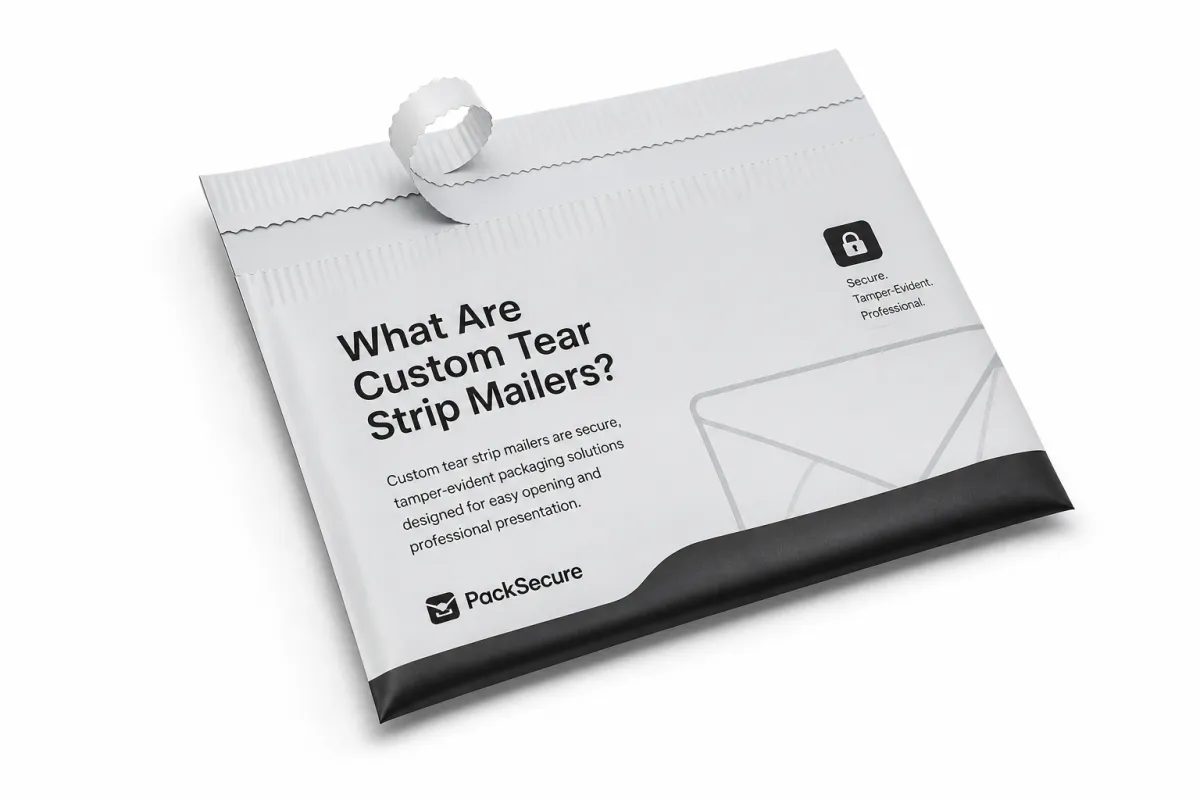
Custom tear strip mailers are protective mailers or pouches with a built-in opening feature that lets the recipient tear the package along a designed path instead of hacking into it with scissors or a blade. That sounds minor. It is not. The opening changes how the package feels, how fast it opens, and how much damage happens during the unboxing process. The clean-opening experience matters in branded packaging because the opening moment often happens before the product is even visible.
Picture the difference between a mailer that opens in one straight motion and one that stretches, splits unpredictably, or requires two hands and a knife. The first feels deliberate. The second feels like a bad compromise. Brands selling apparel, printed literature, samples, small consumer goods, and replacement parts use custom tear strip mailers because the format gives them a controlled reveal without jumping all the way to custom printed boxes, which can cost more, weigh more, and eat up space for low-profile shipments.
From a packaging buyer's point of view, the appeal is practical. Custom tear strip mailers can cut customer frustration, lower the odds of product cuts, and improve consistency in fulfillment. They also fit a wide range of product packaging strategies: direct-to-consumer apparel, subscription inserts, literature packs, promotional samples, and ecommerce replacement kits. The mailer does not need to be flashy to do its job. It needs to open the same way every time, across thousands of units.
One-pull opening is not a cosmetic extra. It is a usability choice that changes how the shipment is judged before the product is touched.
That is why brands pay attention to the strip itself, not just the outer design. A weak tear path, a poorly anchored starter tab, or a strip placed in the wrong zone can turn a good concept into a clumsy one. The feature looks small on a sample board, but it affects speed on the packing line, customer satisfaction after delivery, and how the whole piece of retail packaging performs once it enters the mailstream.
For many teams, custom tear strip mailers sit in the middle of the packaging spectrum. They are more polished than a plain poly bag, but not as rigid or inventory-heavy as more elaborate branded packaging formats. That middle ground is why they keep showing up in product packaging programs: they improve the experience without forcing a brand into a higher-cost structure than the order needs.
I've seen that middle ground matter most in programs that ship both samples and retail orders. A team usually wants something that opens cleanly, stores flat, and does not force the warehouse to babysit every unit. That is a very normal ask. Honestly, it's also where a lot of packaging specs go sideways, because the brief gets written from a brand deck instead of from the packing table.
How Custom Tear Strip Mailers Work in the Mailstream
The construction is usually straightforward, which is part of the appeal. A typical build includes an outer film or paper layer, adhesive seams, a tear initiation point, and a strip that guides the opening path. In custom tear strip mailers, the strip is not decoration. It is a controlled break line. Once the customer pulls the tab, the package opens along a predictable route instead of tearing randomly through the body of the mailer.
Placement matters more than most buyers expect. If the tear strip sits too high, the opening may expose the contents before the customer is ready. Too low, and the package can feel awkward to grip. If the anchor point is weak, the strip can snap before the mailer opens fully. That is where the difference between a good-looking mockup and a usable production item shows up. The best custom tear strip mailers make the opening action feel obvious. The customer should not need a diagram.
There are also more advanced constructions. Some designs combine tamper-evident sealing with the tear strip. Others add a reseal flap, so the customer can keep documents or unused items protected after opening. A few versions support dual-opening behavior, where the same mailer can be opened from either side, though that is usually reserved for specialized programs. In every case, the opening experience should match the product and the channel, not a passing design trend.
- Simple tear strip: fast opening, lower complexity, common for apparel and literature.
- Tamper-evident tear strip: useful where visible opening evidence matters.
- Reseal option: better for documents, samples, and returns.
- Dual-feature design: useful in niche programs, but usually adds cost and setup time.
Material choice changes performance as much as strip design does. Film-based custom tear strip mailers can offer better moisture resistance, stretch tolerance, and puncture protection, especially if the contents may ride through rough sortation. Paper-based versions can support sustainability goals and a more tactile brand feel, but they usually need careful spec review because fiber construction, coatings, and adhesives all affect how the mailer opens and how it holds up in transit.
If you are validating a shipping format, it is smarter to look at recognized test protocols than to guess. The International Safe Transit Association publishes widely used packaging test methods at ISTA, and those methods are useful when a mailer needs to survive drop, vibration, compression, or mixed handling. For fiber-based options, you may also want to check whether a material is sourced through chain-of-custody systems like FSC, especially if sustainability claims will sit on the pack.
In real mailstream conditions, the design has to do two jobs at once. It has to be easy enough to open that customers do not attack it with tools, and strong enough to survive conveyor belts, parcel sorting, stacking, and porch delivery. That tension is the whole story of custom tear strip mailers: they are engineered for convenience, but only after they are engineered for survival.
What Drives Custom Tear Strip Mailers Pricing?
Pricing depends on more variables than most buyers expect. Size is the obvious one, but it is only the start. Substrate choice, print coverage, tear-strip complexity, adhesive system, and order volume all move the number. A simple run of custom tear strip mailers with light print coverage and standard dimensions will usually land far below a fully branded specialty build with heavy graphics, custom sizing, and upgraded materials.
For a practical frame of reference, a basic mailer with a single tear feature and modest branding might fall around $0.18-$0.32 per unit at 5,000 pieces, depending on size and material. A paper-based or higher-coverage construction may sit closer to $0.30-$0.55 per unit. Premium versions with heavier films, specialty finishes, tamper-evident features, or custom inserts can run higher, sometimes $0.60-$1.20 per unit or more. Those are working ranges, not promises, because the final quote depends on artwork, tooling, and supply conditions.
| Build | Typical Spec | Best Fit | Estimated Unit Cost at 5,000+ | Cost Notes |
|---|---|---|---|---|
| Basic poly mailer with tear strip | 2.5-3 mil film, 1-color print, standard size | Apparel, accessories, simple ecommerce shipments | $0.18-$0.32 | Lower setup load; efficient for repeat runs |
| Branded paper mailer with tear strip | Paper-based substrate, light coating, custom print | Documents, samples, lightweight product packaging | $0.30-$0.55 | Often chosen for a more tactile brand presentation |
| Custom poly mailer with advanced opening feature | Heavier film, tamper evidence, higher ink coverage | Retail packaging, subscription kits, returns | $0.45-$0.85 | Higher graphics and QC requirements |
| Specialty recyclable or barrier build | Custom substrate, upgraded adhesive, specialty finish | Programs with sustainability or performance demands | $0.60-$1.20+ | Material choice and supply chain can shift pricing fast |
Tooling and setup are another reason first orders can feel expensive. If the print method requires plates, cylinders, or extra prepress work, the first run absorbs those costs. A repeat run is usually cleaner. That is why custom tear strip mailers can look a little pricey on the first quote and then become more predictable on the second and third orders. Buyers sometimes read that as a supplier problem, but it is usually the math of setup.
There is also the hidden-cost side of the equation. A slightly higher unit price can still win if the mailer saves labor on the pack line, reduces damage claims, or improves the customer experience enough to lower complaint volume. A pack station that gains even a few seconds per order can matter over thousands of shipments. If the tear-strip feature reduces knife cuts to contents, the avoided returns can be worth more than the unit-price difference. That is the part many teams miss when they compare custom tear strip mailers only on piece price.
Freight and inventory space matter too. A mailer that ships flat, stores efficiently, and packs quickly can lower total landed cost even if the print quote is slightly higher. That is where a buyer should think past the line item and compare the full program: purchase price, storage, handling, damage risk, and customer-service burden. If you are already comparing other formats, it may help to review broader options in our Custom Packaging Products lineup or compare against Custom Poly Mailers for a sense of fit and cost tradeoffs.
Honestly, the most useful pricing question is not, "What is the cheapest version?" It is, "Which build gives the right opening experience at the lowest total cost across the whole order cycle?" That answer is often more favorable to custom tear strip mailers than a buyer expects, especially when damage reduction and labor savings are part of the math.
Step-by-Step Process and Timeline for Custom Tear Strip Mailers
The best results start with a tight spec. Before anyone quotes custom tear strip mailers, define the product dimensions, pack weight, ship method, expected handling level, and branding goals. If the mailer needs to support tamper evidence, recycled content, or a specific recovery stream, put that in writing too. A vague brief is expensive because it forces assumptions, and assumptions usually turn into revisions later.
Sampling comes next. A good sample review is not just about print color. It should include fit checks, tear-strip testing, closure integrity, and a look at how the mailer behaves when actually packed with product. If the item has corners, edges, or surface friction, test those conditions. A glossy brochure and a folded garment do not stress the pack the same way. That is why custom tear strip mailers should be sampled with real contents whenever possible, not just with a ruler and optimism.
A typical timeline often looks like this: design approval, material sourcing, converting or printing, finishing, final inspection, and ship-out. A straightforward repeat order may move in roughly 10-15 business days after proof approval, but more complex builds can stretch beyond that if they require new tooling, specialty material procurement, or added testing. Large volumes, color-critical artwork, or paper-based runs with custom coatings can add time too. That is not a flaw. It is what happens when a packaging program gets more tailored.
- Define the spec: size, product weight, graphics, and opening behavior.
- Request samples: compare constructions side by side.
- Test the packout: check fit, speed, and ease of opening.
- Approve artwork: confirm color, copy, and logo placement.
- Run a pilot: validate pack station performance before scaling.
For teams shipping at meaningful volume, a pilot is worth the extra week. A pilot run of custom tear strip mailers can reveal whether the opening is intuitive, whether the fill process slows down, and whether the mailer survives the specific handling path used by your carrier mix. Testing to a method inspired by ASTM D4169 or a relevant ISTA sequence is a sensible guardrail when the shipment has to survive real transit stress rather than a tabletop test. If the pilot fails, it is cheaper to fix the spec before production than after 20,000 units are already in stock.
It also helps to think about the pack line as a system. If the opening feature saves time for the customer but slows the warehouse crew because the mailer is harder to load, the benefit is only half-real. The best custom tear strip mailers work with conveyors, cartons, hand pack stations, and storage constraints. That is the real test: not whether the mailer looks good in isolation, but whether it behaves well in the whole fulfillment flow.
One practical tip from the field: have the same person who will actually pack the order handle the sample. Designers and buyers tend to tolerate more friction than operators do. The warehouse team will tell you fast if the tab is annoying, the seam fights back, or the strip starts fine and then hangs up halfway through. That feedback is gold. Ignore it and you're kinda gambling with your labor budget.
Common Mistakes When Specifying Tear Strip Mailers
The most common error is also the easiest to avoid: choosing a tear-strip location because it looks balanced on the artwork proof, not because it feels right in the hand. A visually centered tab can be awkward to grip. A tab that seems slightly off-center on the mockup may actually improve the opening path. Custom tear strip mailers should be judged by hand, not just by eye.
Another mistake is assuming all tear strips perform the same way. They do not. Adhesive strength, film gauge, paper caliper, and sealing method can all change the force needed to open the package. Two suppliers can both say "tear strip mailer," and the customer experience can still be completely different. That is why spec sheets matter. If you are comparing custom tear strip mailers, ask for the actual construction details, not just a marketing description.
Fulfillment workflow gets ignored more often than it should. A clever opening feature is not useful if it slows pack stations, creates misalignment at high speed, or requires extra training. In a high-volume environment, the most valuable feature is often consistency. A packer should be able to load the mailer fast, seal it once, and move on. If the format creates friction in the warehouse, that friction will show up in labor cost before it ever reaches the customer.
- Bad tab placement: hard to find, awkward to pull, or exposed too early.
- Weak tear path: opens unevenly or stops halfway through the strip.
- Overdesigned graphics: branding crowds the opening area and confuses use.
- Wrong material gauge: too flimsy for transit or too stiff for easy opening.
- Skipped product testing: corners, seams, and weight change performance.
Branding can also go too far. A busy print file can distract from the opening point, and a glossy finish can make the mailer slick in-hand. On paper-based constructions, dense ink coverage can influence recyclability or recovery behavior. That does not mean strong branding is bad. It means branding has to support the package design rather than fight it. The best custom tear strip mailers usually present the brand cleanly, with the opening zone clearly legible and the logo working as a guide, not a burden.
Finally, do not skip testing with the actual product. A soft garment, a rigid box insert, and a stack of documents all behave differently inside the same mailer. Weight, friction, and sharp corners can change both the tear experience and the transit outcome. If the product can shift inside the pack, the tear strip may need a different placement or a stronger build. That is not overengineering. That is basic product packaging discipline.
I've lost count of how many times a neat-looking concept fell apart the minute someone packed a real sample into it. The mailer looked fine on the screen. Then the product moved, the seam flexed, and the tab felt wrong. Not dramatic. Just annoying. And annoying is expensive once it scales.
Expert Tips for Better Tear Strip Performance and Branding
Design the opening experience from the customer outward. That means asking a basic question first: what should the person feel in the first second after they touch the mailer? If the answer is "confused," the design needs work. If the answer is "clear," the rest gets easier. Strong custom tear strip mailers guide the hand naturally toward the tear tab and make the action obvious without a wall of instructions.
Use print hierarchy to support the opening path. A logo can anchor the face of the mailer, but the eye should still know where to pull. Small directional cues, contrasting copy, or a visual break in the artwork can help. That matters in branded packaging programs where the mailer acts as a front-door moment for the brand. Good package branding does not just look attractive. It helps the customer use the package correctly.
Coordinate with operations early. The smartest packaging design can still miss the mark if it ignores how the pack station works. If the fulfillment team uses conveyors, baggers, or manual drop stations, the mailer should be reviewed in that context. If storage is tight, flat-stacking dimensions matter. If the brand is using other formats such as custom printed boxes for heavier items, the tear-strip mailer should fit into the same visual language so the product packaging family feels connected rather than random.
The best opening feature is the one nobody has to explain.
Sustainability choices deserve a practical look, not a slogan. Recyclable content, lower material weight, and FSC-sourced fiber can help, but only if the full construction still performs. A mailer that opens badly or damages product is not sustainable just because it uses less material. That is why many teams now weigh paper-based options against film-based options on real performance data, not assumptions. The right answer can vary by channel, product fragility, and regional recovery systems.
To measure success after launch, do not stop at unit cost. Track opening complaints, damage rates, pack-out speed, and return handling. If the tear strip reduces knife damage but slows packout by 8 seconds per order, that tradeoff may or may not work depending on volume. If customer complaints fall and repeat purchase rates rise, the mailer may be earning its keep in ways that do not appear on the invoice. That is where custom tear strip mailers often outperform plain mailers: they can improve both the operational side and the brand side at once.
For teams building a larger packaging program, it is useful to compare the mailer against other categories in the same family. A brand may use Custom Packaging Products for premium kits, while custom tear strip mailers handle lightweight DTC shipments. That kind of segmentation keeps the system coherent and prevents overbuying a box structure where a mailer would do the job better.
One more thing: do not let the print file bully the engineering. I've seen plenty of specs where the artwork got the last word and the tear path became an afterthought. That's backwards. The opening feature is the actual product here. The graphics should serve it, not the other way around.
Next Steps: Build a Spec, Sample, and Pilot
Start with a one-page spec. Include product dimensions, target ship method, approximate weight, print requirements, opening expectations, and minimum order quantity. If you know what the mailer must not do, write that down too. For example: no blade-required opening, no glossy finish on the pull area, no extra width that increases storage cost. That level of clarity makes quoting custom tear strip mailers much faster and usually improves pricing because the supplier is not guessing.
Then request at least two sample constructions. Side-by-side comparison matters because two custom tear strip mailers may look similar on a screen and still feel very different in the hand. One might open with a light, clean pull. The other might need more force or resist at the seam. That tactile difference is what a sample reveals. It also helps the team compare stiffness, branding presence, and how the mailer behaves with actual product inside.
A small pilot order is the best way to reduce risk. Build a simple scorecard and track five things: pack-out time, opening behavior, damage rate, customer feedback, and return handling. If the pilot includes a few different SKUs, even better. That will show whether the mailer handles a garment, a document, and a sample kit with equal ease or whether the design needs adjustment. A pilot does not need to be large to be useful. It needs to be honest.
Before you ask for quotes, decide which features are must-haves and which are nice-to-haves. That discipline keeps the pricing conversation focused. It also prevents over-specifying the build and accidentally buying features that do not improve the user experience. In many cases, the smartest version of custom tear strip mailers is the one that opens well, prints cleanly, and stores efficiently. Everything else should earn its place.
Brands that balance ecommerce scale, retail packaging expectations, and cost control usually do better when they treat the mailer as part of the product packaging system, not as a standalone consumable. That mindset makes the whole operation easier to manage, from sourcing to packing to customer experience. And if you are comparing formats, the same brief can help you judge whether a tear-strip mailer, a plain poly bag, or a more premium box is the right answer.
Done well, custom tear strip mailers are not just protective. They are easier to open, easier to pack, and easier to scale. That combination is why they keep showing up in practical packaging programs, not just in design decks. The feature is small. The impact is not.
The takeaway is simple: write the spec around the real product, sample with the people who will pack it, then pilot the mailer in actual transit conditions Before You Order at scale. If the strip opens cleanly, the pack line stays efficient, and the cost still fits the full program, you have a format worth keeping.
Frequently Asked Questions
How do custom tear strip mailers differ from standard mailers?
They include a built-in opening feature, so the recipient can access the contents without cutting or tearing the whole package. That small change improves the experience and can reduce damage caused by knives, scissors, or rough opening. In a lot of packaging programs, custom tear strip mailers are chosen when convenience, branding, and controlled opening matter more than using the simplest possible mailer.
Are they more expensive than plain mailers?
Usually yes, because the tear-strip feature adds material, conversion steps, and quality-control checks. The premium depends on size, print coverage, substrate, and order volume; larger runs usually lower the unit cost. Many brands justify the difference by factoring in faster packing, fewer complaints, and a better first impression. The cheapest unit price is not always the cheapest total program.
What products work best in this format?
They work well for apparel, samples, literature, subscription items, replacement parts, and other lightweight products. The best candidates are products that benefit from a clean opening experience and do not need a heavy corrugated shipper. If the product is sharp, unusually heavy, or highly fragile, the mailer design may need reinforcement or a different format altogether.
How long does it take to produce them?
Timeline depends on artwork approval, material availability, and whether you need custom sizing or specialty finishes. A simple repeat order moves faster than a fully new build that requires sampling and proof review. The safest approach is to allow time for samples, revisions, and a small pilot before you commit to a full production run.
Can custom tear strip mailers be recyclable or made with recycled content?
Yes, some constructions use recyclable substrates or recycled content, but the exact recyclability depends on the full material mix. A tear strip, coatings, inks, and adhesives can all affect end-of-life handling, so the full spec matters. If sustainability is a priority, ask for the material breakdown before approving the final design, then confirm whether the chosen build still performs as intended. That is the most reliable way to make custom tear strip mailers both practical and responsible.

