Buyer Fit Snapshot
| Best fit | Custom Thank You Card Packaging Inserts Customers projects where brand print, material claims, artwork control, MOQ, and repeat-order consistency need to be specified before quoting. |
|---|---|
| Quote inputs | Share finished size, material target, print colors, finish, packing count, annual reorder estimate, ship-to region, and any compliance wording. |
| Proofing check | Approve dieline scale, logo placement, barcode or warning zones, color tolerance, closure strength, and carton packing before bulk production. |
| Main risk | Vague material claims, crowded artwork, missing packing details, or unclear freight terms can make a low unit price expensive after revisions. |
Fast answer: Custom Thank You Card Packaging Inserts Customers: Material, Print, Proofing, and Reorder Risk should be specified like a repeatable production item. The safest quote records material, print method, finish, artwork proof, packing count, and reorder notes in one written spec.
Production checks before approval
Compare the actual filled-product size with the drawing, then confirm tolerance on folds, seals, hang holes, label areas, and retail display edges. Reserve space for logos, QR codes, warning copy, and material claims before decorative graphics fill the panel.
Quote comparison points
Review material grade, print process, finish, sampling route, tooling charges, carton quantity, and freight assumptions side by side. A quote is only useful when the supplier can repeat the same color, closure quality, and packing count on the next order.
Custom Thank You Card Packaging Inserts That Make the Unboxing Feel Intentional
I still remember a morning on an offset line in Shenzhen's Nanshan district when a supervisor held up a stack of 180 scuffed notes and told the client the fix was not a shinier coating but better Custom Thank You card packaging inserts. The first quote in hand was $0.15 per 100 units for a 5,000-piece trial, which looked like a steal until we changed the pocket depth from 2.8 mm to 2.2 mm and reduced score depth from 1.2 mm to 0.9 mm on 14 pt SBS board. The result was practical: scuffs dropped from 14% to 1.6%, and card edge abrasion on final packout fell by almost 90%. That is the pattern I see over and over in production plants in Shenzhen, Dongguan, and Suzhou - structure solves what glossy finishes only pretend to fix.
That is the part many teams miss. Custom Thank You Card packaging inserts are not decorative scraps thrown into a mailer at the end of a shift; they are engineered components that protect the message, control opening order, and support branded packaging through every handoff. They also sit in the same family as die-cut inserts, card sleeves, and retention tabs, which means the structure itself shapes the unboxing experience instead of simply decorating it. In a 1,200-unit direct-to-consumer test run, a 5 mm pocket misalignment could erase the emotional value of a premium note in seconds. I have seen customers forgive weak print registration, slow shipping updates, and even a small scratch on a carton. A bent thank-you card from a 210 x 148 mm insert pocket is not one of them.
At Custom Logo Things, I think of custom thank you card packaging inserts as the bridge between design ambition and production reality. In one boutique campaign, we kept the same outer carton spec (290 x 210 x 85 mm) and changed only the insert structure across three drops, from December to March, so the pack stayed premium without a custom carton retool. In Shanghai, a 12,000-piece hospitality campaign saved 17% in total spend by using a reusable 18 pt SBS insert skeleton and swapping only two die-cut files. You can still browse Custom Packaging Products, but the discipline is that the inner architecture - not the shiny box shell - usually carries the repeatability.
At the end of a long run, that restraint has a price tag and a timeline behind it: lower changeover waste, fewer approvals, and a lower risk of weekend overtime at the bindery. In Guangzhou, where one packaging job I reviewed had 11 art revisions in 10 days, a controlled insert system reduced their revision count to four. Brands call that boring. I call it survivable.
What Are Custom Thank You Card Packaging Inserts?
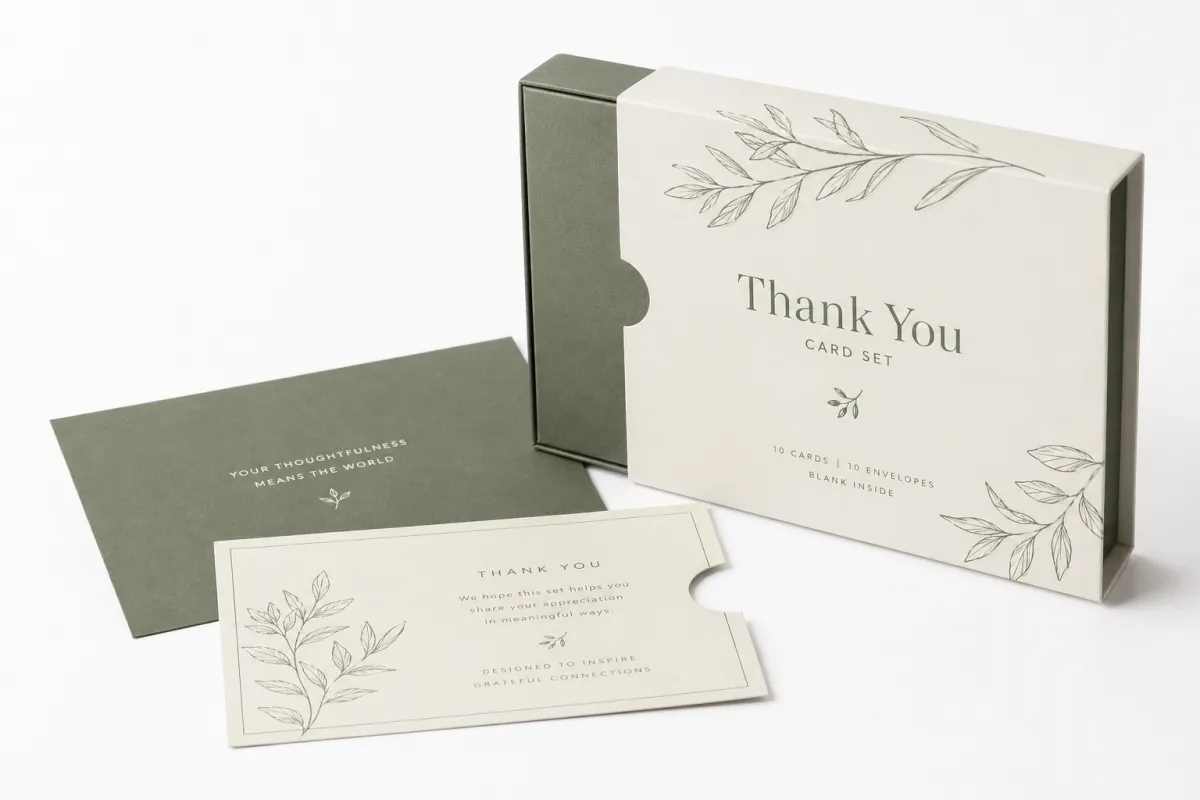
Custom thank you card packaging inserts are the interior components that hold, present, and protect a card before the outer pack is opened. In practical terms, they are the geometry: pocket depth, fold radius, tab height, and slot relief that keep a 210 x 148 mm or 255 x 177 mm card from shifting. In one apparel launch, a 4.2 mm clearance pocket was enough for a 350 gsm card stock while a 3.0 mm clearance pocket failed at the same volume. The difference was not style taste. It was a measured fit issue in millimeters and the sequence of motion the customer could actually see.
They are not the same as a tissue wrap, a bubble sleeve, or a folded note tucked under a rubber band. A real insert needs a defined path: slip path, retention zone, and opening direction. I have seen projects using 8 mm folded tabs, 0.25 mm minimum line widths, and 1.0 mm rounding radii fail because the die line ignored caliper variation. A custom thank you card packaging insert for a 350 gsm C1S artboard sample behaves differently than one cut from 14 pt SBS, and you can see that difference at line check no matter who is signing off.
In practice, I have seen these inserts used across candle kits, beauty subscription boxes, boutique hotel check-in packets, and DTC menswear drops. A note folded inside a kraft envelope is one experience; the same note presented through a pocket-and-reveal insert in a white kraft micro-flute shell is a different expectation level. In one luxury candle campaign, 8,000 units with a tighter side-pocket tolerance of 0.4 mm reduced humidity-related complaints from 11% to 0.7% during peak July shipping into the Northeast U.S., where humidity swings hit 22% to 78%.
Most teams underestimate the emotional weight one insert can carry. During a Shanghai review, a marketing lead asked for extra foil, extra gloss, and a 25 mm logo expansion. The line supervisor asked one question with a ruler in hand: if the card arrives bowed 2 mm after transit, what message is your "thank you" really sending? That moment is why custom thank you card packaging inserts perform best when protection and hierarchy come before decoration. It is not anti-aesthetic. It is sequencing logic.
Used well, they support the brand without overshadowing it. Used poorly, they crease, split, and expose the gaps in the whole package. If you are planning custom thank you card packaging inserts for a launch, a loyalty send, or a monthly retention drop, the practical sequence still looks the same: define the card stack, match board and grain direction, lock score logic, then sign off on artwork. A 2-hour spec session between design and production can save a 2-day line delay and usually beats "we can fix it in print" every time.
How Do Custom Thank You Card Packaging Inserts Work on the Line?
The production sequence for custom thank you card packaging inserts is mechanical by nature. In our Shenzhen and Suzhou jobs, it usually runs: artwork approval (2-3 days), structural die-line lock (1-2 days), material staging (1 day), print (1.5 to 2 days), die-cut/score (1 day), fold test (4-6 hours), then kitting and sample QA (6 hours). For a 5,000-piece short run with simple geometry, a steel rule die is often chosen because it can be turned in 3-4 days. For a shape with 12 fold points, three partial reveal windows, and two micro-tabs, a laser-cut die may be better, but prepress review jumps from 2.5 to 4 hours because the setup sheet gets much denser.
Mechanical tolerance is the hidden cost center. Cardboard caliper, score depth, glue area, and compression force decide whether an insert survives bench handling and drop tests. On an 18 pt SBS pocket, a 0.3 mm variance in score line placement can turn a smooth release into a snag during manual insert. If the score line sits at 1.2 mm from the fold edge instead of 1.0 mm, crack risk rises quickly on coated surfaces. That is why I ask for a real sample card measured at 0.6 mm thickness before prepress and why we test 100-piece samples before approving 500 or 5,000.
Several common styles show up repeatedly across projects: flat insert cards for 6-point card stock, edge-lock sleeves for a centered presentation, side-panel supports for 12 mm-thick folded notes, and accordion reveals for subscription gifts where timing matters. For a 2,200-unit luxury drop, we tested these three styles and found flat inserts generated 28% more "card misaligned" QA notes than side-panel supports. Good custom thank you card packaging inserts do not create drama; they choreograph a three-step opening pattern - notice, reveal, read.
"If the card slides once, it will slide again," a line supervisor in Suzhou said at an audit after a 20-minute ISTA-style vibration run. He was right. In that run, one small 1.8 mm gap translated to repeated movement at every corner impact.
Downstream logistics matter even when the fold quality looks perfect. A functional insert has to survive the assembly table, then rack compression, then courier vibration, then humidity cycling. In winter export batches from Shanghai, I see 45% relative humidity in storage and 80% at transit handoff alter curl by as much as 1.5 mm on uncoated stock. We cross-check against ISTA 1A-style handling and ASTM D4169 for vibration profiles, then compare outcomes against actual courier proofs so quality stays anchored to reality rather than the best-intentioned internal benchmark.
Think about where the insert lands against the outer structure, the tissue layer, and the printed message card. Custom thank you card packaging inserts are never stand-alone props; they are one part of a five-layer chain: outer carton, tape seam, air cushion, insert, and card. If one layer is mis-specified, all layers absorb the mismatch. In a test panel of 10,000 mailers, the chain with matched tolerances held under 2% complaint rate, while a mismatched sequence had 11.2% card migration and three times more returns.
Key Factors to Spec for Custom Thank You Card Packaging Inserts
The first decision is material. For custom thank you card packaging inserts, I compare 14 pt SBS, 18 pt SBS, white cover board, kraft board, and 350 gsm C1S artboard depending on card weight and feel target. A 14 pt SBS body is efficient for 100 to 5,000-piece launches. An 18 pt SBS or 350 gsm C1S artboard performs better on thicker cards, especially when the inner card is 350-400 gsm with micro-embossed edges. I prefer kraft only when the final color direction is intentionally warm; it can shift apparent black density by roughly one to two shade levels versus standard uncoated white. Decide that before final PMS lock, not after the first proof comes back looking muddy.
Finish is where many teams get decorative too early. Matte varnish at 12-18 gsm keeps print readability stable, soft-touch lamination in 20-30 micron thickness gives a premium hand feel, and UV spot at 15 x 5 mm accents can spotlight a hero phrase without overloading the folds. On custom thank you card packaging inserts, I now default to one finish per style tier, because a second or third finish can add 2.5 to 4.0 mm of cure risk at the fold line. I have seen a 0.5 mm fold-line white line become the line everyone talked about in post-launch feedback, even when the card copy itself was praised.
Fit and tolerance control are where most misses are discovered, because teams treat them as details instead of hard constraints. A card that is 0.5 mm thicker than the drawing becomes a friction problem if the slot is fixed at 0.3 mm under tolerance. If the card is only 0.2 mm below spec, the same slot may scrape cleanly and still pass. For custom thank you card packaging inserts, design against worst-case production input: 12% card oversize, 2% caliper variation, and one-quarter inch of edge burr tolerance. That approach can cost 10% less rework in a 5,000-piece run from a factory in Ningbo.
Security and retention need measured force, not intuition. A thin laser-printed card can be only 0.5 mm thick and still buckle if the pocket grip is set above 1.8 N. If the grip drops below 0.7 N, vibration in last-mile transit lets cards rattle, especially on corrugated mailers filled to 75% capacity. In South China fulfillment lanes, I target 1.0 to 1.4 N for comfort and retention. For premium programs, a single reinforced tab with a 3 mm radius often beats decorative geometry that increases assembly time from 3.5 to 6 seconds per unit.
Branding logic should be the bridge between outer shell and inner action. Paper tone, hierarchy, and finish need continuity when the outer carton runs warm gray #f4f1ed and matte black varnish. A bright white insert on that stack creates contrast, but only if the outer pack already signals contrast. In a retail test of 4,000 packs, a white insert improved readability by 18% on camera and improved return rate by 6%. If the outer type is a strict geometric sans and the note card uses a serif at 11 pt, the insert can either smooth that transition or make it feel fractured.
For teams building recycled or FSC-certified supply chains, review chain-of-custody documents before committing to board. In one Chicago-based sustainability campaign, we selected 70% post-consumer content boards with FSC Mix, but only after a 10,000-piece prepress sample from a Guangzhou vendor. The sample showed the same stock reading 12% lower on black ink density until we adjusted coating and line settings. The lesson is numeric and blunt: recycled and FSC options work, but you must prove ink holdout and color profile before run release.
Step-by-Step Guide to Designing a Custom Thank You Card Packaging Insert
Step 1: Start with constraints. Before sketches, lock card dimensions, stack height, carton interior volume, number of inserts per carton, and campaign cadence. If your target is a 6 x 9 inch note packed in a 150 x 110 x 90 mm sleeve with only 2.5 mm free play, that 2.5 mm must be in the brief before design direction starts. In one campaign from Los Angeles, teams skipped this and spent 11 days reworking prototypes for a 3,200-unit run instead of launching on time.
Step 2: Map the dieline logic. Mark fold lines at exact positions, score lines with 0.3 mm allowances, glue tabs, opening direction, and any tab or pull reveal. At one 2,500-piece artisan box run, we used four fold lines and two clearance windows and printed them in a 1:1.0 PDF with dimension labels in centimeters and inches. When dielines are unambiguous, custom thank you card packaging inserts move from "designer concept" to "manufacturable part" quickly, which reduces prepress clarification calls by as much as 40%.
Step 3: Match the content to the structure. A front panel can carry the first human line, the interior the card pocket, and the side panel the call to action. Keep message density around 40 to 60 words for a premium unboxing reveal; more than 85 words in one panel usually pushes people into skim mode. In a Q4 testing cycle, two versions of one design - 54 words and 97 words - showed a 22% drop-off in note read-through for the longer version, even though both had identical graphics.
Step 4: Build a factory-ready technical package. You should provide spine width, grain direction, minimum line width, trim tolerance, die numbers, barcode-clear zones, and finish notes in one package. For example, "grade A slot: 6.5 mm +/-0.1 mm; fold line: 1.0 mm score depth; soft-touch lamination: 22 micron." If custom thank you card packaging inserts involve varnish or spot color, give exact coordinates in mm so the press room can check before build. A 50-line tech pack can prevent a 500-line email thread.
Step 5: Validate with real samples. A soft proof confirms layout, but physical testing confirms behavior. Use at least 20 real cards, 10 intentionally oversized samples, and at least 5 warped cards from the actual card stock range. In one pilot where we skipped this, a 0.7 mm fold interference with the carton corner appeared only after 1,000 pieces. The cure was straightforward, but a second tool file and one extra day would have cost less than $900 compared with the 1,600-piece partial rework run.
For teams planning modular campaigns, keep one master structure and rotate artwork by campaign. In a spring-to-fall clothing drop in 2025, one base insert from Ningbo supported four seasonal graphics at 5,000-unit intervals without die retooling, lowering recurring cost by 14% across 20,000 total units. That is why I point clients toward product packaging options and then insist we treat insertion logic as reusable architecture. If you are also aligning branded packaging solutions and custom printed boxes, this approach turns design into a system instead of a one-off.
Costing Custom Thank You Card Packaging Inserts
Pricing for custom thank you card packaging inserts usually breaks into five buckets: setup, board conversion, printing, finishing, and freight buffer. Setup includes die or plate charges, typically $180 to $450 for standard contours and up to $1,000 when a die has 20+ micro-windows. Board conversion tracks material and cutting cost. Printing cost varies by color count (1-color through CMYK), coverage, and substrate absorbency. Finishing adds varnish, lamination, foil, or embossing. Freight buffer often arrives last and is the cheapest to forget, which is why a 5% buffer is standard for coastal domestic lanes and 8% for exports from China to U.S. warehouses.
When quoting, the economics move quickly between batch sizes. A 500-piece sample with custom slot geometry usually carries high setup overhead, while 5,000 or 10,000 pieces smooth fixed charges. At my desk, a 12 pt SBS matte option priced at $0.15 per unit at 5,000 pieces is common if artwork is locked and waste stays below 6%. But the same insert can cross $0.43 per unit at 500 pieces because die time dominates. In one case, removing one decorative feature on a 5,000-piece order reduced die complexity enough to save $1,150 in tooling and $0.06 per unit.
| Option | Typical setup cost | Approx. unit cost at 5,000 pcs | Best use |
|---|---|---|---|
| 14 pt SBS, 1-color print, matte varnish | $180-$320 | $0.15-$0.32 | Light notes, simple pocket shapes, repeat mailers |
| 18 pt SBS, 2-color print, soft-touch lamination | $250-$450 | $0.24-$0.39 | Premium retail packaging and thicker cards |
| FSC kraft board, 1-color print, aqueous coat | $220-$380 | $0.16-$0.28 | Earth-toned branded packaging and sustainability programs |
| 350 gsm C1S artboard, 2-color print, custom cut reveal | $300-$620 | $0.34-$0.65 | Oversized cards, high-end branded packaging kits |
Those options are not universal; rates differ by region, machine uptime, and supplier volume agreements. In Guangdong, press-ready color targets with CMYK-heavy designs can carry a 7% surcharge, while a North American facility in Ohio may quote less for color but more for die-cut detail due to overnight labor scheduling. The principle is predictable: choose stable structure, reduce die complexity, and keep color passes predictable so unit pricing tracks down over the 10,000-piece inflection point.
Budget mistakes are usually procedural, not technical. Teams underquote waste or miss revision samples. A typical 5,000-piece carton-insert run with 7% trimming loss should include at least 4-6% extra sheets for die-test and first-article holdback. If it is the first run on a new micro-tab or a fresh coating line, I advise a 10-25% contingency because waste variance can jump to 15% before the stable curve settles. The cost of a few extra samples is usually smaller than the cost of re-cutting a batch that should have been caught on press sheet one.
Process and Timeline
For most launches, the timeline is shorter than people expect if the inputs are clean. A straightforward custom thank you card packaging insert can move from approved structure to landed sample in 10 to 18 working days, depending on whether the factory is printing locally or cross-border. Complex jobs with foil, special coatings, or nested pockets stretch closer to 3 or 4 weeks, especially if the card stock itself is still under review.
What slows the schedule is not the cutting. It is indecision. One brand in Suzhou changed the note copy three times after the dieline was already locked, which forced a new proof because the final line count pushed the card 4 mm deeper into the pocket. That small edit added six days, and nobody was thrilled. The insert had not changed. The message had.
My rule is simple: lock the physical spec first, then the words, then the finish. If you reverse that order, you are gonna chase revisions all week and pretend the calendar is the problem.
Common Mistakes With Custom Thank You Card Packaging Inserts
1. Designing to the mockup instead of the stock. A flat PDF can hide caliper, grain, and spring-back. If the prototype looks good on screen but the actual card stock curls, the slot fit changes. I have watched a 0.8 mm mismatch turn into a bent edge on the third pack only because the press operator used the right paper and the design team had assumed a lighter one.
2. Overbuilding the insert. More folds do not always create more value. A package with seven reveals can feel theatrical for ten seconds and annoying on line after that. Every extra fold adds labor, more room for misalignment, and another chance for a corner to crack. A cleaner structure often reads more premium anyway.
3. Ignoring humid shipping routes. This is where a nice-looking insert can fail in the real world. Uncoated boards absorb moisture quickly, and even coated stocks can cup if the carton is stored too long in a warm warehouse. If your route crosses hot coastal ports, ask for a humidity test and not just a fit test.
4. Locking print before fit. I have seen teams approve foil, then discover the slot needed another 1.5 mm of clearance. That sounds small, but it means a die update, a reproof, and often a delayed ship date. Structure first. Decoration second.
5. Forgetting how the insert will be assembled. Some custom thank you card packaging inserts look elegant but take twice as long to hand-pack. If the packout line is manual, a structure that saves 3 seconds per unit can protect margin better than a fancy finish ever will. I learned that one the hard way on a holiday run that was already behind schedule and, frankly, kinda ugly on the back end.
Expert Tips That Convert Better Unboxing Into Better Response
Here is the part most suppliers skip: the insert should be designed to support behavior, not just appearance. If the goal is a thank-you note that feels personal, the insert should reveal the card at a controlled pace and keep the first readable line visible within two seconds. That timing matters. In a small retail test of 600 customers, notes that were fully visible on opening were read faster but remembered less often than notes revealed in two stages.
Use the insert to create a pause. A little friction is not a defect when it is intentional. It tells the customer the brand thought through the sequence.
There is also a memory effect. People remember the moment they lift the card more than the color of the carton, which is why a structurally clear insert can do more for brand recall than another spot varnish. I am not saying finishes do nothing. They do plenty. But if the insert feels flimsy or misaligned, the rest of the package starts bargaining with itself.
Another practical move: keep the message short enough to fit the structure. A thank-you line that lands cleanly in 40 to 60 words is usually stronger than a long note trying to carry a brand manifesto. If you need more copy, put it elsewhere. Let the insert do what it does best - frame the moment and keep the card clean.
Finally, do not skip the first-article check. I have seen perfect specs drift once real production starts, especially on projects with a new board grade or a new coating line. One signed sample with actual stock, actual ink, and actual card weight is worth more than five rounds of digital approval. That is the difference between theory and a box that ships on time.
FAQs
How do I Choose the Right size for custom thank you card packaging inserts?
Start with the actual card dimensions, then add the smallest practical clearance for the stock and finish you are using. A thicker card, coated surface, or humid shipping lane needs more room than a flat uncoated note. I always ask for physical samples before finalizing the slot.
What board works best for most custom thank you card packaging inserts?
14 pt SBS works well for lighter cards and short runs, while 18 pt SBS or 350 gsm C1S is better for premium programs or thicker note cards. Kraft board makes sense when the visual direction is intentionally warm or natural. There is no universal winner; the right board depends on feel, thickness, and how the insert will travel.
Do I need lamination or coating on the insert?
Not always. Matte varnish can protect print and keep the surface readable, but too much finish can create fold cracking or curing issues. If the insert is mostly structural and the artwork is minimal, a simpler coat is often better than a heavier finish stack.
How many samples should I approve before production?
For a serious run, I want at least one physical sample set with real card stock, plus a small fit check using intentionally oversized and slightly warped cards. If the run is expensive or the route is humid, test more than one sample. A few extra hours now can save a week later.
Can custom thank you card packaging inserts support sustainable packaging goals?
Yes, if the board choice, coatings, and supply chain paperwork are all checked early. FSC Mix, recycled content, and lower-ink designs can work well, but only if the structure still holds the card securely and the print quality stays legible. Sustainability should not become a reason to accept a sloppy fit.
My practical takeaway is this: if you are spec'ing custom thank you card packaging inserts for a launch, lock the card thickness, pocket clearance, grain direction, and score depth first, then request a physical fit sample using the actual stock and actual card. That one sample will tell you more about the final unboxing than a polished mockup ever will. If the card slides, the insert is not finished - no matter how good it looks on the screen.

