Need Custom Tote Bags no minimum? That usually means you need branding without committing to a stack of extras that will spend the next six months in storage. For pop-ups, boutique launches, trade shows, sample kits, and small retail tests, low-quantity totes make practical sense. They keep cash available, reduce waste, and get a finished product into circulation without forcing a large inventory decision before demand is proven.
The tradeoff is straightforward. Small runs cost more per bag because the setup, proofing, and handling are spread across fewer units. Decoration choices are also narrower than they are on a larger order. That is not a hidden catch. It is the basic economics of short-run production.
For a small brand, that tradeoff can still be the right move. A tote that matches your packaging and can be used again does more than carry items home. It extends the brand into the street, into the office, and sometimes into a customer’s daily routine. That kind of repeated visibility is hard to get from disposable packaging alone.
Why no-minimum tote bags matter when you only need a few
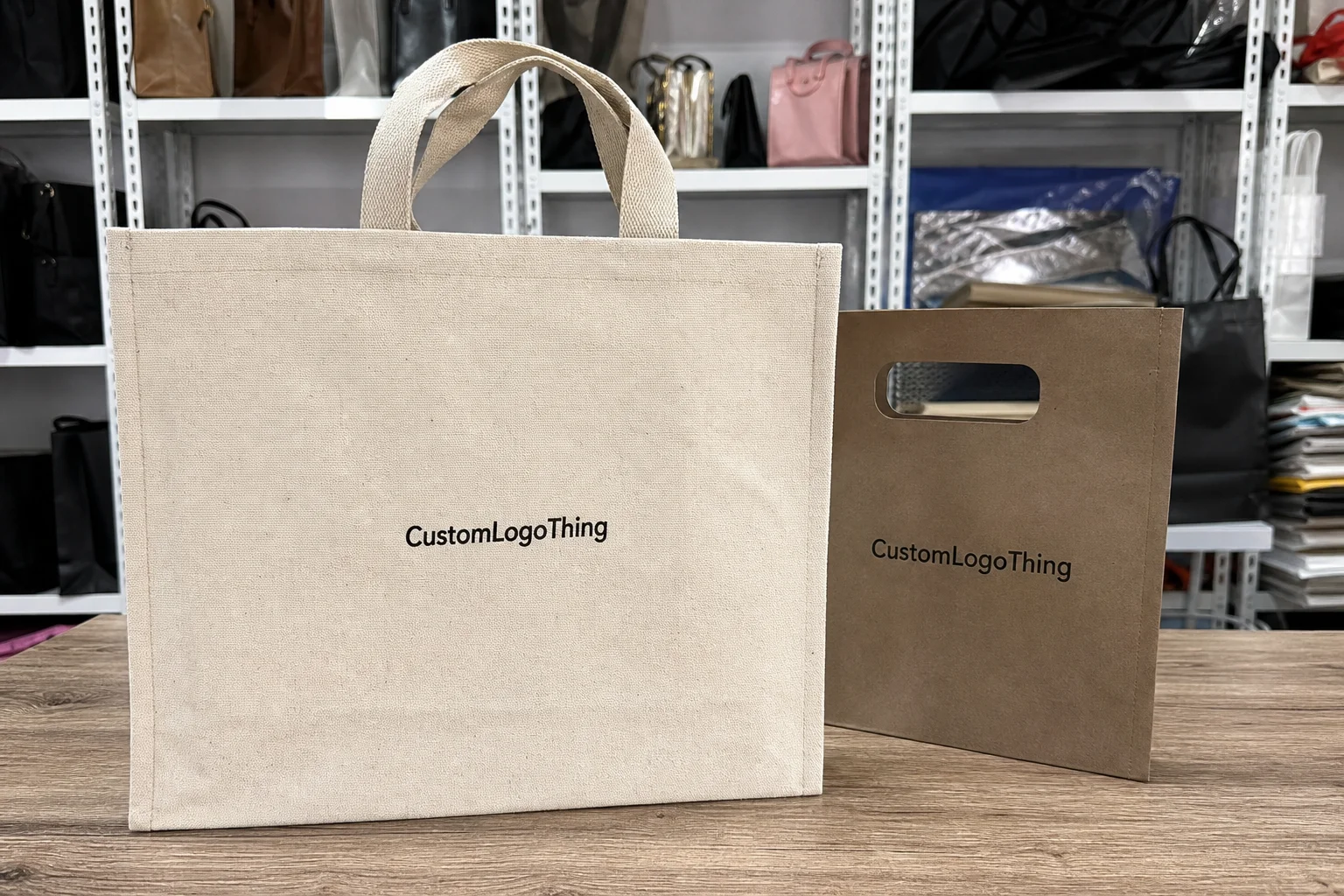
Most small businesses do not need thousands of branded bags waiting in a back room. They need 25 for a market weekend, 50 for a launch event, or 100 to support a limited retail run. Custom Tote Bags no minimum solve that problem without forcing a bulk order that does not match the actual use.
The most common buyers are usually working with a real deadline and a real cap on spend. A neighborhood shop may want bags for a grand opening. A startup may need packaging support for a sample drop. An event team may want a nicer handout than a plain flyer or poly mailer. A subscription brand may want a short run for a pilot program. Different use cases, same goal: make the brand visible at a quantity that fits the job.
“No minimum” does not always mean the same thing from one supplier to the next. Some shops truly accept a single bag or a one-off sample order. Others set a very low floor, such as 10, 25, or 50 pieces. Specialty handles, larger print areas, custom colors, and unusual dimensions can still change the threshold. Buyers should read that detail closely instead of assuming every option is open at zero quantity.
The value is mostly in risk control. You can test a design before scaling, protect cash for higher-priority parts of the launch, and avoid the old problem of overbuying packaging because it seemed like a bargain on paper. Inventory only feels cheap before it starts occupying shelf space.
No-minimum orders are not about squeezing every dollar. They are about buying the right quantity for the actual need, then moving on with less waste and fewer surprises.
If your tote is part of a wider packaging system, it helps to think about it that way from the start. A branded bag can echo the same visual language as your inserts, labels, and shipping materials. That consistency matters more than most buyers expect, especially if the bag is the first thing a customer sees after checkout. A tote that aligns with your Custom Packaging Products can carry the same tone as the rest of the order without requiring a full packaging overhaul.
How custom tote bags no minimum ordering actually works
The process is usually direct. Select a bag style, confirm size and color, upload artwork, review the proof, approve it, and production begins. If the artwork is clean and the supplier keeps blank stock on hand, a short run can move quickly. That speed is one reason small-batch tote orders have become so useful for event work and seasonal launches.
Low-quantity orders usually rely on decoration methods that do not require the heavy setup associated with larger production runs. Digital printing, heat transfer, and simplified single-color branding are common choices. They work because they reduce or remove the screening costs that normally make small orders expensive. That is also why custom tote bags no minimum often come with narrower print options than big-volume orders.
Many suppliers start with pre-made blanks, then add the decoration after the bag is selected. That approach cuts lead time and keeps the order manageable. It also explains why a tote may be available in a standard size and limited color palette rather than as a fully custom sewn item. A true cut-and-sew program, with custom panels or special handles, usually needs more volume to justify the extra labor.
Artwork quality matters a great deal in these short runs. If you are ordering 25 bags, every one of them will be seen. There is no room to hide a weak logo placement, a fuzzy edge, or a color that lands in the wrong shade family. A clean vector file, proper spacing, and a clear approval process are not optional details. They are what make the bag look intentional instead of rushed.
There are also practical limits. No-minimum does not usually mean full freedom on every variable. Gusset structure, reinforced bottoms, woven handle upgrades, custom panel colors, and full-coverage printing can all push the order into a different production category. If a vendor says yes to everything at zero quantity, the proof deserves extra scrutiny. Flexibility has to come from somewhere, and usually it comes from a compromise in material choice, print method, or construction.
For buyers comparing tote bags with other branding pieces, it helps to separate presentation from protection. Boxes are better for structure and shipping discipline. Totes are better for portability and reuse. A tote can replace a paper bag or complement a package, but it does not do the same job as rigid Custom Printed Boxes or heavier product packaging.
Cost and pricing factors that change your quote
Pricing for small tote runs is driven by a few predictable variables: material, size, print method, number of colors, artwork prep, shipping, and turnaround time. If you want a usable quote, ask for those details up front. A vague request like “how much for tote bags” is hard to price accurately and usually leads to back-and-forth that slows everything down.
A 25-piece order will almost always cost more per bag than a 250-piece order, even if the finished tote looks nearly identical. The reason is simple. Proofing, setup, production changeovers, and handling are fixed or semi-fixed costs. Spread them over fewer units, and the per-piece price rises. The raw bag itself may be only a small part of the total.
Here is a practical comparison that reflects the kind of pricing buyers typically see for short runs:
| Bag Option | Typical Low-Quantity Unit Cost | Best For | Tradeoffs |
|---|---|---|---|
| Non-woven tote | $1.20-$2.80 | Promotions, events, giveaways | Lower perceived value, lighter hand feel |
| Cotton tote | $2.50-$5.50 | Retail, boutiques, lifestyle brands | Print detail can vary with fabric texture |
| Canvas tote | $4.00-$9.00 | Premium branding, repeated use | Heavier shipping and a higher total spend |
| Laminated tote | $3.50-$8.50 | Structured presentation, bold graphics | Less soft, not the right fit for every brand |
Those ranges move with size, coverage, and quantity. A single-color mark on a plain non-woven bag is not priced the same way as a full-color print on thick canvas. If a quote treats them as equivalent, something is missing.
Watch for extra charges that do not always appear in the first number you see. Artwork cleanup, file conversion, proof revisions, screen charges, split shipments, and rush fees can all affect the final total. Some suppliers include those costs in the unit price. Others separate them. The important number is the full landed cost, not the headline quote.
It usually helps to ask for pricing at 25, 50, and 100 units. That shows whether the unit cost drops in a meaningful way or stays nearly flat. If the jump is small, order only what you need. If the difference is large, a slightly bigger order may cover future events at a better rate. That is a buying decision, not a branding one.
Material choice matters here too. Non-woven usually makes sense for promotions and event handouts. Cotton and canvas tend to read better in retail or premium settings. The cost difference is not just a budget issue. It changes how the bag feels in hand and how customers read the brand before they ever use it.
For buyers working across different packaging categories, cost also shifts when tote bags are bundled with inserts, labels, or display materials. That is normal. It is also why the cheapest-looking component is not always the cheapest order.
If you want to compare sustainability claims or source paper-based components around the bag, the FSC site is a useful reference point. For packaging durability and transit testing, the ISTA site gives context on how packed items are expected to hold up during shipping.
Process and timeline: from artwork to delivery
The timeline usually follows the same sequence: request quote, receive proof, approve artwork, produce, inspect, and ship. The quote stage is often quick if your information is complete. The proof stage is where schedules are most likely to slip, because that is where missing file details, color questions, and layout corrections surface.
Simple custom tote bags no minimum orders can move quickly when the artwork is ready and the decoration method is straightforward. A basic tote with a one-color logo may ship in roughly 5-10 business days after proof approval. More complex artwork, unusual bag dimensions, or tighter color control can stretch that to 10-15 business days or more. Rush service may shorten the window, but it usually increases cost and reduces flexibility.
The production clock normally begins after proof approval, not when the first email is sent. That catches buyers more than it should. If the file is blurry, the logo needs cleanup, or the proof goes through several revisions, the schedule stretches because the job was still in pre-production. That is not delay in manufacturing. It is time spent getting the artwork ready.
It helps to have the essentials ready before quoting begins: a vector logo file if possible, the desired quantity, the bag size, the material preference, the print colors or Pantone references, the delivery zip code, and the target in-hand date. If the logo file is not print-ready, say so early. That is a normal production issue, and it is easier to solve before the proof stage than after it.
Shipping should be treated as part of the timeline, not an afterthought. Ground freight may work for a local order, but not for a trade show that starts next week on the other side of the country. If the bags have to be handed out by a specific date, build the transit time into the plan from the start. That avoids the familiar problem of a fast production schedule followed by a slow delivery schedule.
Materials, print methods, and quality checks to compare
Material choice should follow the use case. Non-woven is economical and practical for events and promotional handouts. Cotton works well for retail bags and repeated use. Canvas feels heavier and more durable, which makes it a good fit for premium brands or items that need a sturdier carry. Laminated bags can create a more structured, glossy look that suits bold graphics and upscale presentation. Common weights vary by supplier, but buyers often see non-woven in roughly 80-100 gsm equivalents, cotton around 4-6 oz, and canvas closer to 8-10 oz or higher.
Print method affects more than appearance. It changes durability, detail, hand feel, and the kind of artwork that prints well at low quantity. Digital printing works well for multicolor art and short runs. Heat transfer handles detail and can be practical for smaller orders. Screen printing can be cost-effective, but minimums tend to increase once setup is involved. If a supplier claims every method works on every fabric at every quantity, the claim deserves verification through a sample or a specification sheet.
Check the small details that shape the bag
Handle length, seam strength, gusset depth, and reinforcement points matter more than most buyers expect. A tote is not just a printable surface. It is a functional item that has to survive weight, movement, and repeated use. If the bag will carry a catalog, a bottle, or a sample kit, the construction has to support that load without looking tired on day one.
Color consistency deserves the same attention. A logo that looks sharp on a monitor can print muted or muddy on fabric, especially on textured material. If the tote is going to be used for retail or client-facing presentation, ask for a mockup or physical sample if one is available. A digital proof shows layout. A sample shows finish, texture, and how the print sits on the bag.
Quality control still matters on small runs. Look at print alignment, edge sharpness, stitching, and any sign of bleed or distortion before approving the production run. If the bag is meant for retail packaging or visible handoff at a public event, those checks are part of the order, not an optional extra. A low-quantity order only works if the few pieces you receive are worth handing out.
If you are trying to keep the whole brand system aligned, the tote should feel like part of the same family as the rest of the packaging. The bag, insert card, outer box, and label should not look like unrelated items that happened to share a logo. That kind of inconsistency is easy to spot and hard to ignore.
For file and timing questions that go beyond the tote itself, the broader FAQ page is usually the fastest place to confirm accepted artwork formats and proof expectations.
Common mistakes when ordering low-quantity branded totes
The first mistake is under-ordering. People guess low, run out, and then place a second order under a tighter timeline. That usually means a higher unit price and less control over the final result. A small cushion is cheaper than a second emergency purchase.
The second mistake is sending poor artwork. A small image pulled from a website is not production-ready just because it looks fine on a screen. Low-quantity orders expose artwork problems quickly because every bag matters. If the file is not vector-based, or if the linework is too thin for the chosen print method, the output can suffer.
The third mistake is choosing the cheapest material without considering the actual load. A thin bag may be fine for a postcard or flyer, but not for a wine bottle, a folded garment, or a heavier sample pack. Cheap only works if the bag still does the task cleanly.
The fourth mistake is approving a proof too fast. A typo in the brand name, the wrong placement, or a shifted logo can spoil the entire order. Proofing is not a formality. It is the last chance to catch a problem before production starts.
The fifth mistake is forgetting that production time and shipping time are separate. A bag that finishes quickly but arrives late is still late. Back-plan from the date the tote has to be in hand, then allow room for both production and transit. If the schedule is tight, the buffer matters more than the savings from cutting it close.
A better way to approach the order is to start with the use case, then work backward. If the bags are for a trade show, speed and durability matter most. If they are for retail, finish and presentation matter more. If they are meant for samples or giveaways, cost and portability may carry more weight. That order of priorities keeps the project grounded.
Actionable next steps to order custom totes without overbuying
Start by deciding how the bag will be used. Retail bag, event giveaway, employee welcome kit, or sample packaging all point toward different materials and sizes. Once the job is clear, the right tote choice usually becomes easier to narrow down.
Then estimate quantity based on actual demand, not optimism. Use event attendance, weekly sales, or the size of the launch window as your starting point. If you expect 60 hands-on interactions and want a buffer, order 75. If the tote will ship with online orders, look at a normal week and add enough margin to avoid a second rush order.
Before you request pricing, prepare the basic details:
- Logo file in vector format if possible
- Desired quantity
- Bag size and material preference
- Print colors or Pantone references
- Delivery zip code
- Target date
- Any artwork cleanup or layout help needed
Request pricing for at least two material options and two quantity tiers. That makes the difference between the options obvious and gives you a clearer view of the total value. Cotton may cost a little more but feel much better in hand. Non-woven may fit the budget and ship quickly. The right answer depends on how the bag will be used, not just on the per-piece price.
Approve the proof only after checking spelling, placement, color direction, and the shipping timeline. Then place the order and move on. The objective is not to become a packaging specialist. The objective is to get the right bag, in the right quantity, by the date it is needed.
custom tote bags no minimum work best for brands that want control. You buy what you need, test the response, and keep the rest of your budget available for the parts of the launch that actually drive sales. That is the real advantage.
Are custom tote bags no minimum really available from most suppliers?
Yes, but the meaning of “no minimum” varies. Some suppliers accept a true one-off order, while others set a very low floor such as 10, 25, or 50 pieces. Bag style, print method, and customization level can all affect the minimum.
Why is the unit cost higher for low-quantity tote bag orders?
Setup, artwork prep, proofing, and production handling are spread across fewer bags. The work around the tote does not shrink just because the quantity is small. That is why short runs cost more per unit.
What is the best material for small custom tote bag orders?
Non-woven is usually the budget-friendly choice for promotions and events. Cotton or canvas is often better for retail, repeated use, and more premium presentation. The best option depends on carry weight, brand image, and total budget.
How long does a no-minimum tote bag order usually take?
Simple orders can move quickly if the artwork is ready and the proof is approved without delays. A basic run may ship in about 5-10 business days after approval, while more complex orders can take longer. Rush service may be available at a higher price.
What should I send to get an accurate quote for custom tote bags no minimum?
Send your logo file, target quantity, bag size, preferred material, print colors, delivery zip code, and target date. If you need artwork cleanup or are unsure about file quality, mention that too. Clear inputs usually mean fewer quote revisions.


