Buyer Fit Snapshot
| Best fit | Custom Two Piece Rigid Boxes projects where brand print, material claims, artwork control, MOQ, and repeat-order consistency need to be specified before quoting. |
|---|---|
| Quote inputs | Share finished size, material target, print colors, finish, packing count, annual reorder estimate, ship-to region, and any compliance wording. |
| Proofing check | Approve dieline scale, logo placement, barcode or warning zones, color tolerance, closure strength, and carton packing before bulk production. |
| Main risk | Vague material claims, crowded artwork, missing packing details, or unclear freight terms can make a low unit price expensive after revisions. |
Fast answer: Custom Two Piece Rigid Boxes: Board, Finish, Dieline, and Unit Cost should be specified like a repeatable production item. The safest quote records material, print method, finish, artwork proof, packing count, and reorder notes in one written spec.
Production checks before approval
Compare the actual filled-product size with the drawing, then confirm tolerance on folds, seals, hang holes, label areas, and retail display edges. Reserve space for logos, QR codes, warning copy, and material claims before decorative graphics fill the panel.
Quote comparison points
Review material grade, print process, finish, sampling route, tooling charges, carton quantity, and freight assumptions side by side. A quote is only useful when the supplier can repeat the same color, closure quality, and packing count on the next order.
Custom Two Piece rigid boxes do one job with unusual force: they make a product feel considered before the customer has even seen the item inside. Lift the lid on a candle, fragrance bottle, watch, gift set, or compact electronic accessory and the box has already done part of the selling. Weight, structure, and a crisp reveal do a lot of work in those first two seconds. That is a narrow window, yet it shapes memory, price perception, and trust. For premium packaging, custom two piece rigid boxes sit near the top of the list because they turn the package into part of the product story.
There is a practical side too, and buyers sometimes underprice it. Custom Two Piece rigid boxes are built from dense board, wrapped in printed or specialty paper, and assembled with tight corners that give the package its solid hand feel. The structure protects the product, the insert holds it still, and the finish carries the brand. Three tasks. One object. A folding carton can do some of that work, but not with the same gravity. Once a brand sees the difference on shelf and in hand, the appeal becomes obvious.
I have watched teams argue for weeks over typography, only to change their minds after a sample box landed on the table. The design barely changed. The perception did. That is the strange power of rigid packaging: a few millimeters of board and a cleaner opening motion can make the same product feel more deliberate, and sometimes more expensive, without adding a single word. That kind of shift is exactly why custom two piece rigid boxes remain so popular in higher-end retail.
Custom Two Piece Rigid Boxes: What They Are and Why They Stand Out
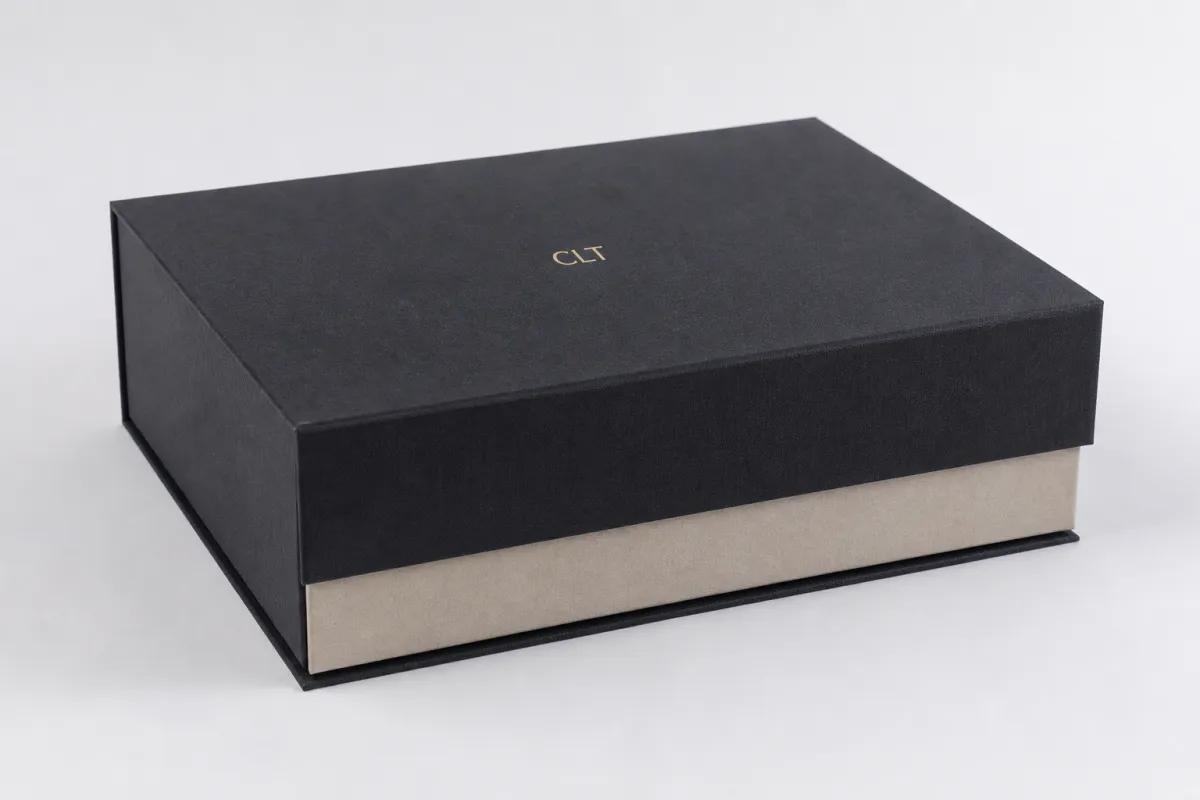
At their core, custom two piece rigid boxes are a separate lid and base made from thick paperboard, usually grayboard or rigid board. The board is wrapped in printed paper, textured stock, specialty paper, or a branded outer wrap, then folded and turned with enough precision that the finished box feels dense and stable. It does not ship flat. It arrives formed, which changes the relationship between product and packaging right away.
That heavier feel is the point. Buyers choose custom two piece rigid boxes because they want the package to communicate value before any copy is read. The lid motion creates ceremony, the base stays firm in the hand, and the outside becomes a broad surface for foil, embossing, debossing, spot UV, or a soft-touch finish. Decoration is only part of the effect. The structure itself is doing branding work.
People often fixate on the word rigid and miss the more interesting detail: control. A good box does not flop, buckle, or rattle. The lid tracks over the base with a measured fit. The product stays composed. That steadiness matters in retail packaging, especially for brands trying to match package behavior with product price. A watch in a flimsy carton feels mismatched. The same watch in custom two piece rigid boxes feels intentionally presented.
The surprise is how refined these boxes can look even though they are built with more material. Many first-time buyers expect bulk and stop there. The real advantage is density plus precision. Proportions can stay elegant. Wrap paper can stay sleek. Corners can look crisp rather than bulky when the build is handled correctly. That is a big reason custom two piece rigid boxes keep appearing in cosmetics, gift sets, electronics accessories, stationery, and curated e-commerce kits.
A rigid box gets judged twice: once by the shelf silhouette and again by the way it opens in the hand.
That second judgment matters more than brands often admit. custom two piece rigid boxes are not just containers; they are a tactile part of the product. They influence shelf presence, unboxing, storage, and the memory a customer keeps after the purchase. If the proportions are right and the fit is calibrated, the box supports both protection and presentation without forcing one to carry the other.
How Custom Two Piece Rigid Boxes Work in Real Use
The lid-and-base relationship is the heart of custom two piece rigid boxes. The lid usually slides over the base with controlled friction, which creates the reveal that customers remember. Too loose, and the box feels cheap or careless. Too tight, and the package becomes frustrating to open. The best result sits in the middle: firm enough to protect, easy enough to lift, and precise enough to feel deliberate.
Every material inside the box plays a role. Rigid board provides structure. Wrap paper provides the visual surface. Adhesive holds the wrap in place. An insert, if the product needs one, keeps movement to a minimum. In custom two piece rigid boxes, those parts need to work as a system. Strong design without accurate fit is just decoration. Accurate fit without strong presentation is just engineering. The good boxes do both.
Presentation-first and protection-first packages often look similar from a distance, then diverge in the details. A presentation-first version of custom two piece rigid boxes may use slimmer board, refined printing, and a more decorative wrap. A protection-first version may use thicker board, deeper walls, and a more engineered insert to reduce movement during shipping. Both can look premium. The difference sits in priority. Brands should decide whether the box exists mainly for display, gifting, or parcel handling before they lock the spec.
Branding is not an extra layer here. It is built into the structure. With custom two piece rigid boxes, the outer wrap can carry full-bleed graphics, spot color, foil, embossing, debossing, spot UV, or a textured stock that signals quality before any ink is visible. That integration is why rigid packaging feels so connected to package branding. The box is not just carrying the message. It is part of the message.
Compared with folding cartons or mailers, custom two piece rigid boxes use more material and usually carry higher freight costs. The tradeoff makes sense when the product price point, brand story, or customer expectation supports it. A folding carton is efficient and widely used. A rigid two-piece structure delivers more presence and a stronger memory. For high-consideration products, that difference can justify the added spend all by itself.
Transit testing deserves a place early in the conversation if the box will move through parcels or distribution. The International Safe Transit Association publishes standards that help brands understand drop, vibration, and compression risk. Their protocols are a practical reference point: ISTA transit testing standards. Buyers who want responsible fiber sourcing often ask for FSC-certified board and wrap as well: FSC certification. Those requests are not trend-driven fluff. They tell you how seriously a supplier thinks about packaging that has to survive the real world.
Cost, Pricing, and MOQ for Custom Two Piece Rigid Boxes
Cost for custom two piece rigid boxes comes down to a handful of variables, and size sits close to the top. A larger box uses more board, more wrap paper, more adhesive, and more labor. Board thickness matters too. A 2 mm build is not the same as 3 mm or 3.5 mm in material use or shipping weight. Add specialty paper, full coverage printing, foil, embossing, or soft-touch laminate and the pricing picture shifts again.
Quantity changes the math in a very ordinary way. A small order of custom two piece rigid boxes usually carries a higher unit price because setup, cutting, wrapping, assembly, and inspection are spread across fewer pieces. As volume rises, those fixed costs soften. A run of 500 boxes will rarely match the per-unit cost of 5,000 boxes, even if the dimensions stay identical. That is normal. It also explains why rigid box pricing should never be compared to folding carton pricing without accounting for labor and finish.
MOQ exists because rigid packaging asks for more setup than a mailer or carton. A custom size, a specialty wrap, a printed insert, or a decorative finish can create extra waste allowance and more production planning. For custom two piece rigid boxes, many suppliers start with a few hundred units for simpler builds, while more complex projects can require higher quantities to justify tooling, sourcing, or hand assembly time. The exact minimum depends on dimensions, finish, and how much manual work the structure needs.
Hidden costs are where many projects drift. Multiple proof rounds take time. Rush orders put pressure on labor. Oversized shipping cartons increase freight. Custom insert development can add sampling and design fees, especially when the product shape is unusual. Even straightforward custom two piece rigid boxes can pick up extra cost if artwork arrives late, because delayed approval tends to push production into a later scheduling window.
| Specification | Typical Use | Approx. Unit Cost Impact | Notes |
|---|---|---|---|
| 2 mm grayboard, printed wrap, paperboard insert | Gift sets, cosmetics, lightweight retail items | Lower to mid-range | Often the best starting point for custom two piece rigid boxes when budget matters. |
| 3 mm grayboard, soft-touch laminate, printed insert | Premium retail, electronics accessories, presentation kits | Mid-range | More stiffness and a richer hand feel, but with added material and finishing cost. |
| Specialty paper, foil stamping, embossing, custom foam insert | Luxury packaging, high-value products, collector editions | Higher | Strong shelf impact, but the labor and finish steps usually push pricing up. |
| FSC paper wrap with minimal print and paperboard cradle | Eco-focused branded packaging programs | Lower to mid-range | Good option when sustainability is a priority and the visual design stays simple. |
As a rough planning range, a simple production run of custom two piece rigid boxes with printed wrap and a basic insert might land around $1.20 to $2.80 per unit at 1,000 pieces, then move closer to $0.70 to $1.60 at 5,000 pieces, depending on size, print coverage, and finish. Specialty paper, magnetic closures, foam, or heavy decoration can push those numbers higher. The point is not the exact figure. The point is that pricing is tied to spec, not just to box type.
One more practical point: compare supplier quotes using the same spec sheet. Two vendors may both say they produce custom two piece rigid boxes, but one quote may include insert development, artwork proofing, and freight while another covers manufacturing only. If the line items do not match, the comparison is already distorted.
Production Steps, Process, and Timeline for Custom Two Piece Rigid Boxes
The production path for custom two piece rigid boxes usually starts with measurements, not artwork. Good dimensions are the base layer for everything else because the lid, base, and insert all depend on them. Once inside dimensions are known, the packaging team can decide whether the product needs a paperboard cradle, a foam cavity, a platform insert, or a deeper base for a taller item. Early sizing prevents rework later, and rework is expensive in rigid packaging.
Material selection follows. Board thickness, wrap paper, adhesive, insert style, and finish all need to match the product and the brand goal. A typical project for custom two piece rigid boxes may move from concept to structural proof, then to a printed sample, then to final production after fit has been confirmed. Specialty decoration makes the proof stage more important because foil, embossing, and complex layouts can behave differently on wrapped rigid surfaces than they do on flat cartons.
Rigid box production often relies on more hand assembly than folding carton work, so the schedule is shaped by wrapping, gluing, drying, and inspection as much as by machine time. A simple project for custom two piece rigid boxes may take around 12 to 18 business days after proof approval, while a project with custom inserts, specialty paper, or several finishes can run longer. Sampling can add another week or more when a structural sample is needed before the final order is released.
Most delays come from familiar places: unclear dimensions, late artwork changes, undecided finishes, and waiting on product samples to confirm fit. Clean schedules usually come from locking box size, insert requirements, and artwork early. With custom two piece rigid boxes, unresolved details become production risks because the box cannot move into final manufacture until fit, print, and finish all agree.
Here is a practical ordering sequence that works well for most projects:
- Measure the product and note the product weight.
- Decide how much reveal or lift the lid should allow.
- Choose the insert style, if one is needed.
- Confirm the print method and finish.
- Approve a structural sample or plain sample before decoration.
- Release artwork and final production files.
- Approve the print proof, then move into production and packing.
If you want a wider view of available formats, finishes, and packaging types, browse our Custom Packaging Products to see how rigid packaging fits alongside other product packaging options. That often makes the decision clearer than trying to compare structures in the abstract. Sometimes custom two piece rigid boxes are exactly the right answer. Sometimes another format fits the product better.
Design, Material, and Fit Factors That Shape Custom Two Piece Rigid Boxes
Fit is where a lot of custom two piece rigid boxes succeed or fail. Inside dimensions need to account for the product, the insert, protective clearance, and the path the lid takes over the base. A box that looks perfect on a drawing can feel too tight once the corner wraps are folded. It can also feel loose if the insert is undersized or the item sits too shallow in the base. Real fit is physical, not theoretical.
Board and wrap choices change the character of the box. A 2 mm grayboard can suit lighter items and tighter budgets, while 3 mm board adds stiffness and a stronger hand feel. Wrap paper may be coated, uncoated, textured, metallic, or specialty dyed. Each option changes print quality, scuff resistance, and the way the finished box communicates value. For custom two piece rigid boxes, the wrap is not a surface treatment in the casual sense. It is the first visible statement the package makes.
Inserts deserve more attention than they usually get. Paperboard cradles are simple, recyclable, and common. EVA foam creates a clean cavity and strong product restraint. Molded pulp or molded fiber can support a more sustainable story. A custom insert should match both product shape and unboxing rhythm because the way the item lifts out affects how the customer feels about the package. That is especially true for custom two piece rigid boxes used in gifting or high-value retail packaging.
Finishing opens another set of choices. Matte lamination gives a softer visual field and usually hides fingerprints better than gloss. Soft-touch lamination adds a velvety hand feel, though it can raise cost and demand care in production. Foil stamping creates sharp contrast, embossing adds relief, debossing adds depth, and spot UV introduces selective shine. All of those techniques can work beautifully on custom two piece rigid boxes, but each one should earn its place because every added finish introduces another step and another possible point of variation.
Sustainability matters too. Recycled rigid board, FSC-certified wraps, and inserts designed to reduce waste can support a more responsible packaging story without flattening the premium look. A well-planned eco-focused version of custom two piece rigid boxes does not have to look plain. It needs disciplined design and honest material choices. When those two are present, the package feels restrained rather than stripped down.
For buyers comparing insert styles, this is a useful way to think about them:
- Paperboard cradle: economical, clean, and easy to recycle; good for lighter products and simpler presentations.
- EVA foam: precise cavity fit and strong hold; useful for fragile items or products with strict placement requirements.
- Molded fiber: better sustainability story and good product restraint; often chosen for brands that want less plastic in the package.
- Die-cut board with printed wrap: a refined middle ground for many custom two piece rigid boxes programs.
Corner treatment separates experienced packaging design from guesswork. If the wrap paper is too heavy for the board geometry, the corners can look bulky. If adhesive or turn-in allowance is off, the edges may fray or telegraph through the finish. Good custom two piece rigid boxes are built with those small details in mind because the eye catches them fast, often faster than the buyer expects.
Common Mistakes to Avoid with Custom Two Piece Rigid Boxes
The most common sizing mistake is measuring the product and stopping there. custom two piece rigid boxes need room for the item, the insert, and the lid-to-base movement. If the measurement ignores insert thickness or the way the lid wraps over the base, the box can end up too tight, too loose, or awkward to open. That kind of error can turn a good product into an annoying one.
Another mistake is overdesigning the outside and underplanning the inside. A striking lid does not matter much if the item shifts, rattles, or arrives damaged. I have seen buyers spend time on foil and spot UV before they know whether the product needs paperboard, foam, or molded support. With custom two piece rigid boxes, the interior structure should be designed alongside the exterior look, not after it.
Finishing errors show up often too. Dark colors can reveal scuffs and corner wear more easily. Fine text can soften if the artwork is too busy or too close to a wrap edge. Metallic effects can look dull if the substrate is wrong. Those are not reasons to avoid decoration. They are reasons to spec custom two piece rigid boxes carefully and approve samples under realistic lighting before the full run starts.
Price shopping by image alone causes trouble. Two quotes for custom two piece rigid boxes may look similar at first glance, but one may use lighter board, a lower-grade wrap, or a simpler assembly standard. Another may include an insert, proofing, and freight. If the spec sheet is not aligned, the comparison is unreliable. Ask for board thickness, wrap stock, insert type, finish method, and carton count before making a decision.
Artwork translation can also catch people off guard. Artwork prepared for a flat carton does not always transfer cleanly to a wrapped rigid surface if corner wraps, live areas, or glue turn-ins are not handled correctly. That matters in custom two piece rigid boxes because the visible image on the finished package may differ slightly from the flat proof. Experienced packaging teams plan for that from the start rather than discovering it after the first sample.
One rule saves a lot of headaches: if the product is expensive, fragile, or presentation-sensitive, sample it. custom two piece rigid boxes are too tactile to approve by imagination alone. A structural sample or white sample tells you more about fit, lid motion, and insert behavior than three rounds of email comments ever will.
Another mistake, and it is a sneaky one, is assuming every rigid supplier builds to the same tolerance. They do not. A millimeter or two of variation may sound trivial on paper, but in a lid-and-base box it can change the opening feel quite a bit. If the package is meant to signal luxury, that feel has to be tuned, not guessed.
Expert Tips and Next Steps for Ordering Custom Two Piece Rigid Boxes
Start with a plain spec sheet. Product dimensions, product weight, insert needs, print method, finish, quantity, and delivery timeline are enough to begin a serious conversation about custom two piece rigid boxes. The clearer that sheet is, the faster the quote comes back and the fewer assumptions a supplier has to make. In practice, clear specs save more money than hard negotiating ever does.
Ask for a structural sample before approving decoration if the product is fragile, high-value, or unusually shaped. That is especially useful for custom two piece rigid boxes carrying glass, metal, electronics, or gift sets with mixed components. A plain sample confirms fit and lid motion before anyone spends time on print or finish. The decorated sample can then focus on appearance instead of solving geometry.
Separate approvals into clean stages. One approval for fit. One for artwork. One for finish. That keeps the project organized and avoids the common trap of trying to solve every issue at the production stage. custom two piece rigid boxes respond well to disciplined approvals because each layer of the build depends on the one before it.
Think past the shelf moment too. Will the box be stored, stacked, or shipped in outer corrugated cartons? Does the product need extra cushioning for parcel handling? Will the insert keep the item still during transit? Those questions matter because custom two piece rigid boxes are strongest as presentation packaging, yet they still need a realistic plan for the rest of the journey. A box can look perfect on a table and still fail in transit if the shipping path was never considered.
If you are comparing suppliers, ask the same questions every time. What board thickness is included? What wrap stock is quoted? Does the price include the insert? Are proofs included? What is the lead time after approval? What freight assumption is built into the quote? Those questions turn custom two piece rigid boxes from a vague idea into a purchase decision. They also make it easier to compare vendors fairly.
For brands building a broader packaging design system, custom rigid packaging often works best as part of a larger set rather than a one-off project. That means thinking about retail packaging, shipping cartons, product packaging inserts, and the way the package will sit on a shelf or in a gift bag. If the outer identity is consistent, the box starts working as branded packaging instead of a simple container. That is the point where custom two piece rigid boxes earn their keep.
My practical advice is simple: compare a few quotes on the same spec, confirm the timeline, request a sample if the product deserves one, and make sure the packaging structure matches the product story. Done well, Custom Packaging Products can give you a clearer view of what is possible, and the right custom two piece rigid boxes will support the product from first impression to final unboxing. If the sample feels right in the hand, trust that signal. Packaging is physical before it is visual, and that part is kinda hard to fake.
What are custom two piece rigid boxes best used for?
They work well for premium retail, gifting, cosmetics, electronics, and any product where presentation matters as much as protection. The separate lid and base create a strong reveal effect, which helps elevate the perceived value of the item inside. They are also useful when a product needs a custom insert or a more protective, shelf-ready structure, which is why custom two piece rigid boxes show up so often in higher-end product packaging.
How much do custom two piece rigid boxes cost?
Cost depends on size, board thickness, wrap paper, printing, finish, insert type, and order quantity. Higher quantities usually reduce unit cost because setup and labor are spread across more boxes. Special finishes and custom inserts raise the price, but they can also improve branding and product security. For most programs, custom two piece rigid boxes land in a wide pricing band, so the spec sheet matters more than the box name alone.
What is the usual lead time for custom two piece rigid boxes?
Lead time varies based on sampling needs, artwork approval, finishing complexity, and production volume. Simple projects move faster than boxes with specialty papers, foil, embossing, or custom inserts. The cleanest schedules come from finalizing dimensions and artwork before production begins, because custom two piece rigid boxes are much easier to run when the details are locked early.
What information should I prepare to get a quote for custom two piece rigid boxes?
Provide inside dimensions, product weight, quantity, intended use, and whether you need an insert. Share artwork files, print goals, finish preferences, and any special packaging or shipping requirements. A clear spec sheet helps vendors quote accurately and reduces back-and-forth during setup, which is especially helpful for custom two piece rigid boxes with multiple finish choices or unusual product shapes.
Can custom two piece rigid boxes be used for shipping as well as display?
Yes, but for transit you usually want added outer protection such as a corrugated mailer or shipper. The rigid box is best at presentation and product presentation protection, while the shipper handles rough transport. If the item is fragile, the insert should be designed to limit movement and absorb shock during shipping, so custom two piece rigid boxes support the product from unboxing to delivery without relying on the rigid box alone.

