Buyer Fit Snapshot
| Best fit | Custom Void Fill Paper Wholesale projects where brand print, material claims, artwork control, MOQ, and repeat-order consistency need to be specified before quoting. |
|---|---|
| Quote inputs | Share finished size, material target, print colors, finish, packing count, annual reorder estimate, ship-to region, and any compliance wording. |
| Proofing check | Approve dieline scale, logo placement, barcode or warning zones, color tolerance, closure strength, and carton packing before bulk production. |
| Main risk | Vague material claims, crowded artwork, missing packing details, or unclear freight terms can make a low unit price expensive after revisions. |
Fast answer: Custom Void Fill Paper Wholesale: Pricing, Specs, and Supply should be specified like a repeatable production item. The safest quote records material, print method, finish, artwork proof, packing count, and reorder notes in one written spec.
Production checks before approval
Compare the actual filled-product size with the drawing, then confirm tolerance on folds, seals, hang holes, label areas, and retail display edges. Reserve space for logos, QR codes, warning copy, and material claims before decorative graphics fill the panel.
Quote comparison points
Review material grade, print process, finish, sampling route, tooling charges, carton quantity, and freight assumptions side by side. A quote is only useful when the supplier can repeat the same color, closure quality, and packing count on the next order.
Custom Void Fill Paper Wholesale: Pricing, Specs, and Supply
Boxes rarely fail because the carton looks weak. They fail because the product slides, bangs around, and turns the inside into a mess. That is why Custom Void Fill Paper wholesale is such a practical packaging buy: it protects margin, cuts returns, and keeps the pack line from acting like a damage-control desk.
Packaging buyers should care about total landed cost, not the sticker price on a roll. Does custom Void Fill Paper wholesale lower damage claims, save labor, and keep freight predictable? Good. Does it feed cleanly, fit the dispenser, and hold the product where it belongs? Better. If it tears, sheds dust, or burns through material too fast, the quote is lying by omission.
Why custom void fill paper wholesale pays off fast
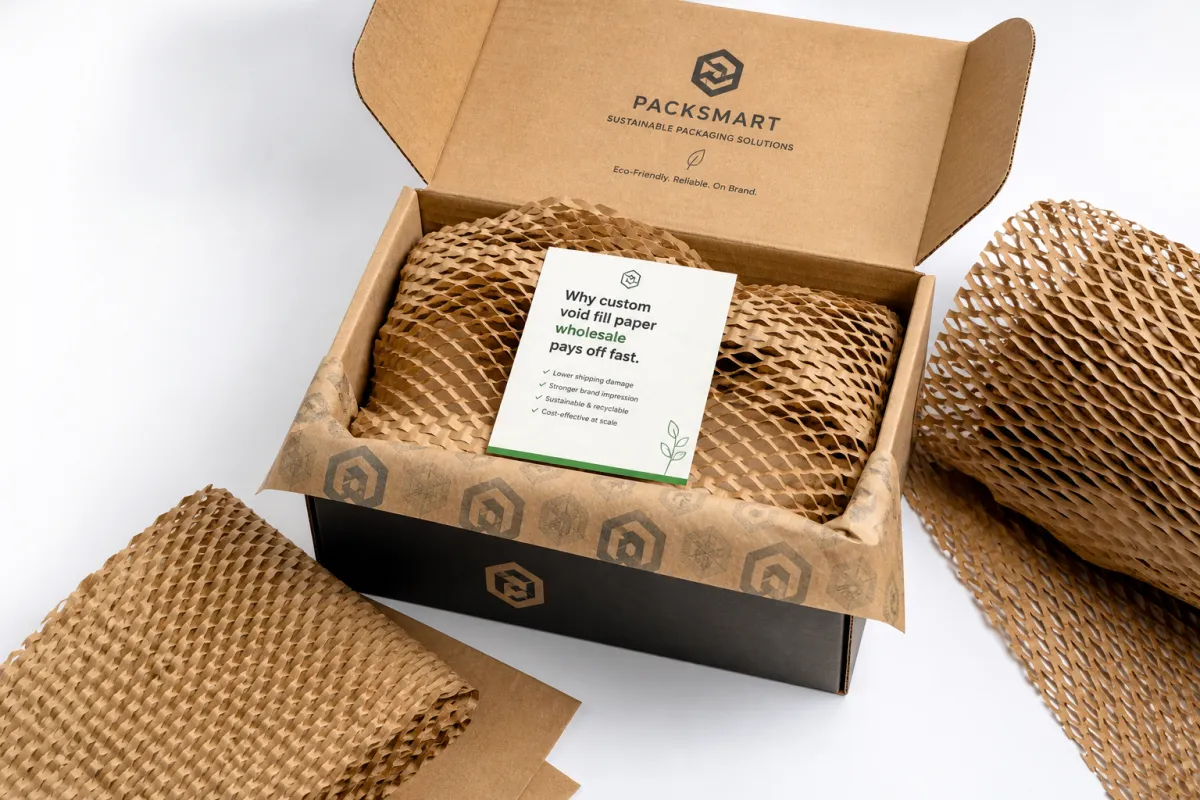
Custom Void Fill paper wholesale pays off fast because most shipping damage starts inside the box, not on the outside. A carton can survive a rough route and still arrive with cracked jars, bent corners, or scuffed product if everything slides around. Paper void fill is not glamorous. It is supposed to be boring. Boring is useful in packaging.
Bulk buying makes sense when the shipment profile stays steady. Think repeat ecommerce orders, mixed-SKU cartons, warehouse packing lines that never really stop, and seasonal spikes that make small packs look expensive in a hurry. In those cases, custom void fill paper wholesale usually beats retail packs because the unit economics stop being theoretical and start showing up on the P&L. A pack station burns through filler faster than most teams expect.
There is a sustainability angle too, and it does not need a speech. Kraft paper is easier to explain than plastic foam. It looks cleaner in the unboxing moment, it is usually simpler to dispose of, and it fits better with branded packaging that is trying to look thoughtful instead of wasteful. If the rest of your packaging already uses recycled corrugate or custom printed boxes, paper void fill supports that story instead of fighting it.
The smart way to judge it is with three numbers: fill speed, damage reduction, and total landed cost. Not roll price alone. I have seen buyers celebrate a low quote and then pay for it in labor because the filler was limp or the roll was a pain to handle. That is a bad trade. Custom void fill paper wholesale works when it saves seconds at the station and cents on the claims side.
If a filler saves a penny but adds 30 seconds per carton, it is not cheap. It is just well dressed.
That is the real buying lens. Fragile goods, subscription kits, retail replenishment, and mixed-product shipping all benefit from paper void fill that does its job without introducing complexity. The trick is getting the right format, the right GSM, and a supplier that understands packaging is not only about the outer box. It is about what happens once the lid closes.
Custom void fill paper wholesale product details
Custom void fill paper wholesale comes in a few formats, and they do not all behave the same once they hit the packing station. Rolls, sheets, fanfold packs, crinkle paper, and dispenser-ready reels all sound similar on a spec sheet. In a warehouse, they are different enough to change throughput, waste, and operator mood. The wrong format slows people down. It also gets blamed for things it did not do. Packaging buyers know the routine.
Rolls are the simplest choice. They work well for manual stations and many dispensers, especially where the team needs a steady pull and predictable fill. Sheets suit smaller cartons or hand-packed retail presentation where the packer wants a clean tuck. Fanfold stacks make sense for high-throughput lines because they store flat and dispense with less fuss. Crinkle paper brings more visual volume, which helps with gift sets, cosmetics, and any product packaging that needs a fuller look without overstuffing the box. Dispenser-ready reels fit operations that want consistent feed with less operator handling.
Customization changes what each format can do. Buyers can usually specify width, length, basis weight, core size, color, bundling, and print. If the goal is package branding, a light logo print or custom wrap can tie the filler back to the rest of the shipment. I would still keep it restrained. More print usually means more cost, more lead time, and sometimes more friction at recycling. Simple tends to win.
Match the paper to the job, not to the sample that looks nicest on a desk. Fragile glass needs a different fill profile than apparel. Subscription boxes need a different speed profile than export cartons. Custom void fill paper wholesale should be chosen around how the carton is packed, how it is opened, and how often the line repeats the same order. If a material jams the dispenser or collapses in transit, the spec is wrong. Sales language does not fix that.
For teams already buying Custom Packaging Products, void fill is usually easiest to standardize alongside outer cartons and inserts. That keeps the presentation consistent and makes forecasting cleaner. If you are building a broader buying program, our Wholesale Programs page is the better place to line up volume, artwork, and replenishment timing before the order gets split into fragments.
Compatibility matters more than people think. A paper spec can look great in a quote and still fail if the core size does not fit the dispenser, the roll diameter is too large for the shelf, or the unwind is uneven. Custom void fill paper wholesale should be checked against the actual station, not just the purchase order.
Custom void fill paper wholesale specifications to compare
Specs matter because they control how the paper performs under load. The first number I check is basis weight, or GSM. Higher GSM usually means more body, more hold, and less material needed per box. Lower GSM can save money, but it may take more paper to stabilize the same carton. That is why custom void fill paper wholesale should be judged by how much space it fills per carton, not by how light it feels in your hand.
Roll dimensions matter just as much. Width, length, outer diameter, and core size all affect dispenser fit and pallet efficiency. A wider roll can speed up packing for larger cartons, while a narrower roll may suit smaller box programs better. Longer rolls reduce changeovers, but they can also push roll diameter beyond what the workstation can handle. Manual lines care about ergonomics. Automated lines care about machine tolerance even more. That is where a lot of reorder headaches start.
Performance specs deserve a hard look. Tensile strength tells you how much pulling the paper can take before it stretches or tears. Tear resistance matters when a packer is moving fast. Spring-back shows how well the paper holds shape after being packed. Dust level matters because nobody wants a packing station covered in loose fibers. Compression behavior matters because void fill gets squeezed under product weight during transit. For custom void fill paper wholesale, these factors decide whether the carton arrives centered or slowly drifting to one side like it forgot its destination.
Sourcing and compliance should not be an afterthought. Ask about recycled content, FSC or PEFC certification, moisture control, and whether the paper is intended for food-safe or non-food-safe use. For buyers who want a clearer handle on sourcing and recycling standards, the FSC site is useful for chain-of-custody basics, and the EPA recycling guidance is a straightforward reference for how paper packaging is handled in general. Standards are not a decorative ribbon. They help buyers avoid surprises.
| Format | Best use | Strength and speed | MOQ impact | Buyer note |
|---|---|---|---|---|
| Rolls | General ecommerce, manual fill, mixed-SKU cartons | Fast to deploy, moderate body | Usually friendly for standard sizes | Good starting point for custom void fill paper wholesale |
| Sheets | Gift sets, retail packaging, hand-tuck inserts | Clean handling, less speed | May rise with print or size changes | Better for presentation than pure throughput |
| Fanfold | High-volume packing lines, flat storage | Efficient feed, good consistency | Often tied to machine setup | Strong choice if the station is standardized |
| Crinkle paper | Premium unboxing, cosmetics, bundles | More visual volume, good cushioning look | Can carry a higher handling cost | Useful when package branding matters as much as protection |
| Dispenser-ready reels | Repeat fulfillment, semi-automated stations | Clean feed, lower handling time | May require tighter specification control | Worth it if labor is the bottleneck |
If you are comparing suppliers, ask them to quote the exact same GSM and the exact same dimensions. Otherwise, the comparison is theater. A lighter paper can look cheaper until the packer uses 20% more of it to keep the load stable. That is why custom void fill paper wholesale should always be measured against performance in the real carton, not against a brochure photo.
For buyers building stronger retail packaging programs, paper void fill is often the quiet part of the spec sheet that protects the flashy part. The outer box gets the attention. The filler keeps the promise.
Pricing and MOQ for custom void fill paper wholesale
Pricing for custom void fill paper wholesale comes down to a small set of levers, and none of them are mysterious. Paper grade, order volume, custom dimensions, print complexity, packaging format, and freight drive most of the number. Change all six variables at once and the quote gets messy. Keep the spec clean and the math becomes a lot easier to read.
At low-to-mid wholesale volumes, a standard kraft spec is usually the least expensive path. Add custom width or print and the price climbs. Add specialty bundling or nonstandard core sizes and the MOQ often climbs with it. That is normal. Setup and tooling have to be paid for somewhere. Buyers sometimes expect custom work to cost the same as a stock reel sitting on a shelf. That is wishful thinking, and not the useful kind.
Use this pricing logic. Ask for three quote levels: a lower-volume test level, a normal reorder level, and a larger pallet or container level. That shows where the breakpoint actually sits. It also tells you whether the supplier is serious about custom void fill paper wholesale or just tossing out one number and hoping nobody asks what it means.
Hidden charges can wreck a good-looking quote. Check setup fees. Check plate costs if print is involved. Check tooling for custom roll dimensions. Check sample charges. Check shipping terms. If the quote says the paper is cheap but freight shows up as a surprise, the landed cost is not cheap. It is just under-explained. Buyers should ask for landed pricing, not only ex-factory pricing, because the truck still needs to get to the dock.
Typical MOQ expectations vary by format. Stock widths may be available at lower quantities. Custom print or unusual dimensions usually require a larger minimum. If you are testing a new line, ask whether the supplier can combine size options within one production run. Not every factory can, and not every factory should. But the question costs nothing, while guessing usually costs money.
The table below gives a practical buying frame. The numbers are not a promise. They are the kind of ranges that help a procurement team stop arguing with itself and start making a decision.
| Order profile | Typical price pressure | MOQ tendency | Best fit |
|---|---|---|---|
| Standard kraft roll, no print | Lowest | Lower MOQ possible | High-volume ecommerce and warehouse packing |
| Custom width, standard kraft | Moderate | Medium MOQ | Cartons with fixed dimensions |
| Custom print or branded wrap | Higher | Higher MOQ | Branded packaging and premium unboxing |
| Special bundle or dispenser-ready reel | Moderate to higher | Medium to higher MOQ | Fast pack stations and repeat replenishment |
For a buyer managing custom void fill paper wholesale across multiple SKUs, the better move is usually to standardize on two or three specs instead of chasing a unique roll for every box size. That keeps forecasting cleaner, reduces leftover inventory, and lowers the odds of buying the wrong filler for the wrong carton. It is not glamorous. It just works.
Process and timeline for custom void fill paper wholesale orders
The order flow for custom void fill paper wholesale should be simple enough that nobody needs a decoder ring. It usually starts with a brief: carton size, packing method, target GSM, color preference, print need, monthly volume, and destination. Then the supplier checks the spec, sends a quote, and confirms whether the request is stock-friendly or truly custom. After that comes sampling or proofing, production, quality control, packing, and freight booking. That is the clean version.
Timing depends on how organized the buyer is. Quotes often land within 24 to 72 hours when the spec is clear. Samples or proofs are commonly ready in 3 to 7 days. Bulk production often runs about 15 to 25 days after approval, though peak season, raw paper supply, and print detail can stretch that. Freight is its own world. Domestic trucking is one thing. Ocean shipping, customs paperwork, and destination congestion are another. Anyone pretending those are the same is either new or selling something.
Three things slow orders down more than they should. First, missing carton dimensions. Second, artwork that needs too many revisions. Third, freight terms that are still open when production starts. If you want the schedule tight, confirm the destination, the incoterms or freight responsibility, and the approval path before the supplier makes the paper. Custom void fill paper wholesale moves faster when the paperwork is boring.
Testing matters too. If the paper will run through a dispenser or packing machine, order a sample or test roll before you commit volume. A spec can look perfect on a sheet and still behave badly in motion. That is where packing-line reality gets louder than the spreadsheet. If the dispenser pulls unevenly, the crew will find out in the first shift, not in the sample room.
Good suppliers also document QC in a way buyers can use. They should confirm caliper, roll width, cut consistency, core fit, and packaging integrity before shipment. For higher-value programs, ask whether the shipment has been checked against transit testing such as ISTA methods or similar internal drop-and-vibration procedures. The point is not to turn a paper order into a science project. The point is to avoid paying for a batch that behaves differently from the approved sample.
For teams that already manage custom printed boxes or other retail packaging, it helps to bundle the approval cycle. Fewer handoffs. Fewer delays. Fewer chances for the wrong version to win. Custom void fill paper wholesale works best as part of a clean approval chain, not as an afterthought once the carton artwork is done.
Why choose us for custom void fill paper wholesale
At Custom Logo Things, the value is consistency. Buyers do not need a dramatic pitch. They need paper that matches the spec sheet, arrives on time, and behaves the same from batch to batch. That sounds basic because it is basic. A surprising number of suppliers still treat consistency like a bonus feature. For custom void fill paper wholesale, it is the whole job.
We pay attention to the details that affect actual use: caliper, cut quality, roll tension, dispenser compatibility, and packaging consistency. If the roll is too loose, the line wastes time. If the cut is sloppy, the station gums up. If the batch drifts from the approved spec, the buyer is left explaining why the filler changed after approval. Nobody likes that meeting. I certainly do not.
Planning matters just as much. A good wholesale partner should help with volume planning, sample review, and freight coordination before the order goes sideways. That means asking the boring but useful questions: how many cartons per month, what box sizes, what fill method, what destination, and how often the customer expects to reorder. Those questions save money later. That is the part of custom void fill paper wholesale people ignore when they obsess over unit price.
Sustainability should be concrete. We look for recycled content options, clean packaging, and process controls that reduce waste before the product leaves production. Simple fiber-based packaging is still easier for many buyers to explain than mixed-material alternatives, especially when the rest of the shipment is built around product packaging that is already trying to reduce plastic. For brands that care about presentation, paper filler also supports the broader look of package branding without making the inside of the box feel cheap.
Compared with generic suppliers, the difference is usually clarity. Clearer answers on MOQ. Clearer sample expectations. Clearer freight terms. Fewer surprise changes. Faster resolution if something is off. That is not flashy. It is just the kind of service a buyer actually uses. If your program depends on custom void fill paper wholesale month after month, clarity is more useful than a vague promise and a glossy sample.
And yes, if the goal is to support a larger branded packaging program, paper void fill can sit alongside inserts, cartons, and other finishing materials without turning the order into chaos. That is where Custom Packaging Products become useful as a broader system, not just a pile of one-off purchases. The best packaging supply chains do not chase isolated wins. They keep the whole carton logic aligned.
Next steps to order custom void fill paper wholesale
If you want custom void fill paper wholesale done properly, gather the basics first. Monthly volume. Carton dimensions. Fill method. Target GSM. Destination. If possible, note whether the paper will be hand-packed, dispensed from a station, or run through a machine. That information turns a vague inquiry into a quote that a buyer can actually use.
Then ask for two or three options. Do not lock yourself into one spec too early. A narrower roll might save money in one station and slow things down in another. A heavier GSM might improve hold strength but raise cost and freight. A custom print might help package branding, but it should earn its place instead of being added because it looks nice in a mockup. Custom void fill paper wholesale should be selected against the carton and the labor profile, not against a mood board.
Always request a sample or test roll before placing volume, especially if the paper will touch a dispenser or packing machine. A small test catches most problems early: roll fit, unwind tension, dust, and fill behavior. That is cheaper than finding out after a pallet arrives and the packing team starts improvising. I have seen teams try to fix a bad spec with tape, scissors, and optimism. It never ends well.
Once the sample checks out, confirm the MOQ, lead time, freight terms, and reorder plan. That last part matters more than people think. The best supply arrangement is the one you can repeat without re-litigating the same spec every quarter. For buyers managing custom void fill paper wholesale, repeatability is what keeps pricing predictable and operations calm.
Final thought: the cheapest quote is not the best quote if it tears, jams, or needs twice the material per box. Pick the spec that protects the product, supports the line, and keeps the carton clean. That is the point of custom void fill paper wholesale, and it is usually the difference between a filler that saves money and one that quietly drains it. Start with the carton, not the brochure. Everything else gets easier after that.
What is the MOQ for custom void fill paper wholesale?
MOQ depends on whether you are buying a stock-style roll, a custom width, or a printed format. Stock widths may start around 500 rolls or carton equivalents, while custom print and nonstandard dimensions usually need a higher minimum. The honest answer is that MOQ changes with roll width, paper grade, and packaging format. If you need a smaller test run, ask whether the supplier can do a mixed-size production plan or a trial order before you commit to full volume. That is the cleaner way to approach custom void fill paper wholesale than guessing and hoping the factory will bend later.
How much does custom void fill paper wholesale cost?
Pricing depends on GSM, roll length, print, volume, and freight. On smaller orders, shipping can matter as much as the paper itself. On larger runs, the unit price drops, but the real savings show up only if the spec is matched correctly to the packing line. Ask for landed pricing at three volume tiers so you can see the breakpoints clearly. The cheapest paper is not cheap if it tears, jams, or uses extra fill per box. That is the part buyers learn the hard way with custom void fill paper wholesale if they do not compare beyond the headline price.
Is custom void fill paper wholesale recyclable?
Plain kraft paper is usually recyclable where local facilities accept paper packaging. Heavy ink coverage, lamination, and coatings can change that, so the spec should stay simple if recyclability is a priority. Recycled content details and disposal guidance are worth requesting before approval. If the paper is part of a broader sustainability goal, keep the design practical and avoid overcomplicating the finish. That usually gives the cleanest result for custom void fill paper wholesale and for the customer who has to dispose of it later.
What sizes work best for custom void fill paper wholesale?
The right size depends on box depth, product fragility, and whether the paper is used by hand or through a dispenser. Smaller cartons usually do better with narrower rolls or compact sheets, while mixed-SKU shipments may need broader formats with more flexibility. Match the roll size to the packing line first, then optimize the price. That order matters. Too many buyers reverse it and end up with a cheap spec that slows everything down. For custom void fill paper wholesale, fit beats theory every time.
How long does custom void fill paper wholesale take?
A normal schedule is quote in 1 to 3 days, sample in 3 to 7 days, and production in about 15 to 25 days after approval. Freight time depends on domestic versus ocean shipping and on the destination market. The fastest path is to approve specs, artwork, and freight terms in one round so the supplier is not waiting on revisions. If the order needs print or custom tooling, add some cushion. The best buyers plan for that instead of pretending custom void fill paper wholesale moves at retail speed.

