Buyer Fit Snapshot
| Best fit | Custom Void Fill Paper Supplier projects where brand print, material claims, artwork control, MOQ, and repeat-order consistency need to be specified before quoting. |
|---|---|
| Quote inputs | Share finished size, material target, print colors, finish, packing count, annual reorder estimate, ship-to region, and any compliance wording. |
| Proofing check | Approve dieline scale, logo placement, barcode or warning zones, color tolerance, closure strength, and carton packing before bulk production. |
| Main risk | Vague material claims, crowded artwork, missing packing details, or unclear freight terms can make a low unit price expensive after revisions. |
Fast answer: Custom Void Fill Paper Supplier: Material, Print, Proofing, and Reorder Risk should be specified like a repeatable production item. The safest quote records material, print method, finish, artwork proof, packing count, and reorder notes in one written spec.
Production checks before approval
Compare the actual filled-product size with the drawing, then confirm tolerance on folds, seals, hang holes, label areas, and retail display edges. Reserve space for logos, QR codes, warning copy, and material claims before decorative graphics fill the panel.
Quote comparison points
Review material grade, print process, finish, sampling route, tooling charges, carton quantity, and freight assumptions side by side. A quote is only useful when the supplier can repeat the same color, closure quality, and packing count on the next order.
Most damage claims do not begin with the carton. They start in the empty space inside it, where a product gets a little too much room to move and the box pays the price. That is the part many teams miss, which is why a Custom Void Fill Paper supplier can affect returns, labor time, and cube efficiency more than packaging buyers first expect. A custom void fill paper supplier is not just shipping paper; it is shaping how quickly a team packs, how firmly a product travels, and how the package feels when the customer opens it. In practical terms, the right void fill acts like quiet insurance for the shipment.
I have watched small changes in void fill specs cut packing friction in half, and I have also seen the opposite: a paper choice that looked fine on the sample table but turned into a nuisance on the line. The difference can be measured in seconds, and seconds stack up fast. A custom void fill paper supplier often sits in a strange middle ground, part product engineer, part logistics partner, part brand editor for the inside of the box. That sounds dramatic, but it is not. Interior protection carries more weight than the label suggests.
For teams building stronger product packaging, the objective is not to buy more paper. It is to buy the right format, at the right price, with the right support so the line keeps moving and the parcel reaches the customer in one piece. That is where a dependable custom void fill paper supplier earns a place beside cartons, tape, shipping inserts, and Custom Packaging Products.
What a Custom Void Fill Paper Supplier Actually Does
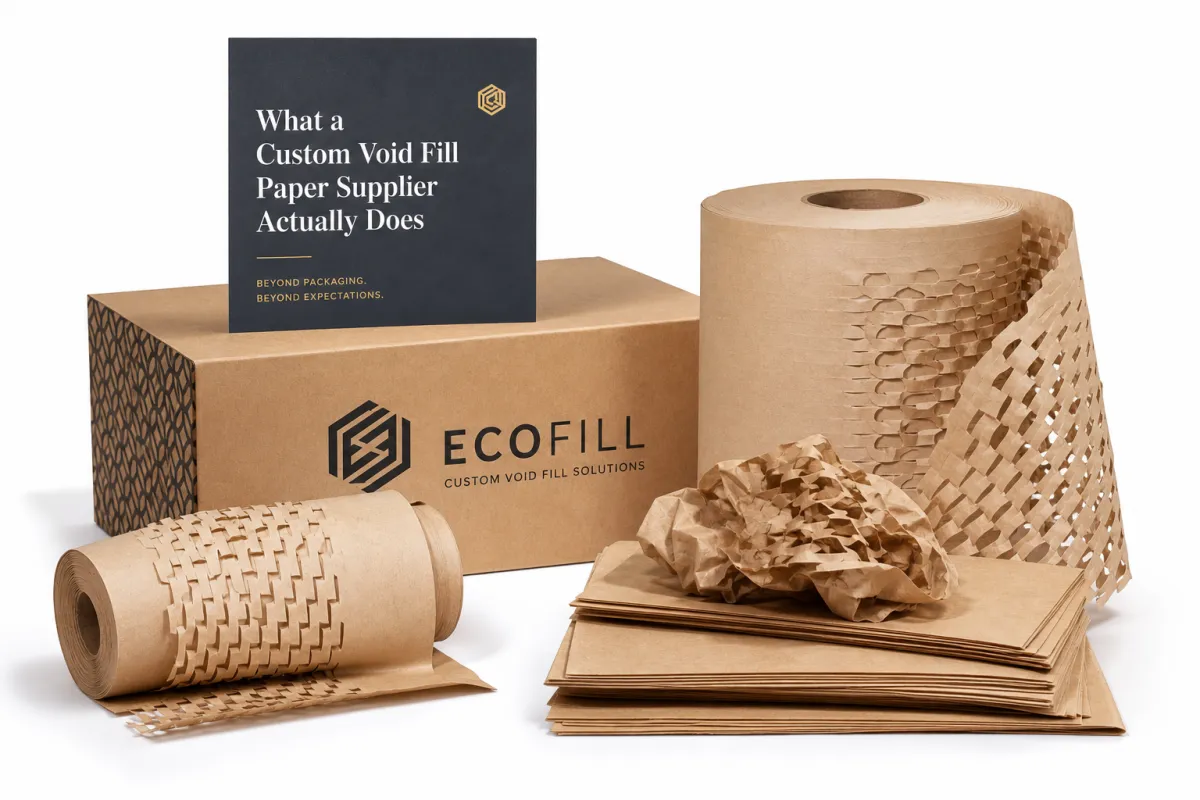
A custom void fill paper supplier turns paper into a packing tool. The formats vary: sheets, rolls, fan-fold stacks, or machine-ready paper that expands and crinkles in a controlled way. The goal is not decoration. The goal is to keep a shipment from rattling around inside the carton, especially in mixed-SKU e-commerce and retail packaging programs where box sizes change from order to order. In that sense, the paper works as dunnage that is lighter and more flexible than many alternatives.
The working definition is simple enough. Void fill paper occupies empty space and slows movement inside the box. A generic office roll can do part of that job. A custom void fill paper supplier goes farther by adjusting width, basis weight, reel diameter, core size, crinkle profile, and dispenser compatibility for a specific packing environment. That difference matters more than people think. The wrong format can slow operators, jam equipment, or create loose fill that looks acceptable on the bench and fails in transit. I have seen that happen in under a week on an otherwise tidy line.
Packaging teams often discover that interior materials affect the unboxing experience just as much as the printed carton does. A supplier that understands branding will ask how the paper should feel, how quickly the pack station runs, and whether the customer sees the insert as part of the presentation. The bridge between protection and presentation is practical, not decorative. A custom void fill paper supplier should be able to speak to both sides without sounding split into two unrelated jobs.
There is also a supply-chain angle that gets overlooked early in sourcing. If a custom void fill paper supplier can standardize paper across several box sizes, the buyer may reduce SKU sprawl, lower storage needs, and simplify replenishment. That matters in high-mix operations where labor is tight and every extra decision slows the packing bench. It also helps when a team wants one protective packaging method that can serve multiple channels without constant re-specification. Less clutter in the warehouse, less mental clutter on the line.
Packaging truth: void fill does not get much glory. It still changes the outcome. When the paper fits the process, packing gets faster, the box stays cleaner, and damage rates often improve without changing the carton itself.
Teams that already invest in Custom Printed Boxes or other branded packaging components should treat void fill as part of the system, not an afterthought. A capable custom void fill paper supplier makes the inside of the package support the outside instead of fighting it.
How Custom Void Fill Paper Works Inside a Pack-Out Line
Inside a pack-out line, void fill paper performs three jobs at once: it fills space, cushions movement, and helps lock product in place during handling and transport. The paper expands as the operator dispenses it, then compresses into a nest that resists shifting. A custom void fill paper supplier that understands this motion can tune the paper so it builds loft without becoming bulky or difficult to control.
Hand-fed paper is the simplest version. It suits lower daily volume, seasonal programs, and start-up operations that need flexibility more than automation. Semi-automated systems add a cutter or dispensing head to improve speed and repeatability. Fully automated setups connect directly to the line and can raise throughput, but they require tighter compatibility. A custom void fill paper supplier needs to know which system is in play, because a roll that looks fine in a sample room may behave very differently once an operator is pulling it at pace.
Paper density deserves more attention than it usually gets. Lighter paper tends to crumple quickly and dispense with less resistance, yet it may not hold shape in larger cartons. Heavier paper often gives better structure, though it can increase drag on the line and tire workers faster across long shifts. A practical custom void fill paper supplier usually recommends a range rather than a single perfect number. For many e-commerce and light industrial programs, basis weights in the 40-80 gsm range are common, but the real answer depends on product fragility and carton geometry. I would treat any supplier that promises one magic number with caution.
Length and crumple pattern matter too. Longer feed lengths can speed larger orders, yet they may overfill smaller cartons if operators are not trained. Tighter crumple patterns can improve top-fill for fragile products, while looser patterns may suit lighter items that only need separation from the carton walls. Two identical boxes can behave very differently depending on how the custom void fill paper supplier configures the roll or sheet format.
Worker fatigue belongs in the analysis. If the paper resists folding, catches in the dispenser, or requires repeated pulls, packing speed drops and fill quality becomes uneven. On a busy line, that inconsistency turns into extra handling, repacks, and occasional damage. A custom void fill paper supplier should ask about pack speed, shift length, and average carton mix before recommending a format. If they do not ask, they are guessing. And guessing in packaging usually costs money.
For buyers comparing materials, a simple tradeoff view helps:
| Option | Typical Use | Strength | Tradeoff | Indicative Cost Shape |
|---|---|---|---|---|
| Stock paper | Low-volume or generic packing | Fast to source, easy to test | Less tuned to your line | Lowest sticker price, but variable fit |
| Semi-custom paper | Growing e-commerce and retail packaging programs | Better width, weight, and dispenser match | Requires more specification work | Often mid-range on unit price |
| Fully custom paper | High-volume branded packaging or specialized product packaging | Best fit, better control, easier standardization | Higher setup effort and planning | May cost more upfront, but often lowers waste and downtime |
Industry testing groups such as the ISTA offer frameworks that help teams think about distribution stress in real conditions rather than guessing. That discipline helps long before a custom void fill paper supplier sends over a quote. It also keeps the conversation grounded in transport reality, not vendor language or shiny sample-room impressions.
Choosing the Right Custom Void Fill Paper Supplier: Cost, Specs, and Support
Price matters, but a custom void fill paper supplier should never be judged on unit cost alone. A quote can look attractive until freight, minimum order quantities, pallet space, dispenser changes, or waste rates appear in the total. That is why total landed cost deserves the real attention. A paper roll that is $0.06 cheaper per unit can become more expensive if it slows packing by three seconds per box or creates repeated changeovers. Three seconds sounds tiny. On a thousand orders, it is not tiny anymore.
Specs are where the useful comparison starts. Basis weight or GSM tells you how much material is in the paper. Roll width affects coverage per dispense. Core size matters if you use a specific dispenser. Sheet length and pack configuration influence speed and fill density. A competent custom void fill paper supplier asks for those details before talking price because the wrong configuration creates hidden costs downstream. That is the sort of thing procurement teams tend to learn the hard way if nobody slows down early.
Support should also appear on the decision sheet. How quickly does the supplier turn around samples? Who answers technical questions? What happens if your reorder window shrinks because orders spike? Those questions sound administrative, yet they reveal a lot about reliability. A custom void fill paper supplier with a capable account team can save more money over a year than one that only offers the lowest opening quote. The cheapest quote is not always the cheapest outcome.
A practical way to think about cost is to look at it in layers. A simple stock conversion may be inexpensive to launch, while a branded or dimension-specific run can add setup expense. For many buyers, the real range ends up somewhere near $0.18-$0.35 per filled-carton equivalent for paper material and conversion, with freight and labor moving the total up or down depending on volume. That is not a universal number, and anyone who tells you it is should probably be asked a few more questions. It is a useful reference point for comparing options without wishful thinking.
Support data can matter as much as the paper itself. If a custom void fill paper supplier can provide FSC documentation, batch consistency statements, or a basic sustainability summary, internal approval usually moves faster. The Forest Stewardship Council explains chain-of-custody expectations clearly at fsc.org, which helps when packaging must satisfy procurement, sustainability, and brand teams at the same time.
Use a comparison framework before signing anything:
- Product spec: GSM, width, core, roll length, sheet format, and dispenser fit.
- Commercial terms: price, freight terms, minimums, and payment schedule.
- Operational support: sample speed, technical help, and reorder communication.
- Brand fit: whether the paper supports package branding and the unboxing experience.
- Risk profile: batch consistency, backorder history, and replacement process.
If your team is weighing broader packaging materials, compare the paper against your other Custom Packaging Products so the interior system and the outer carton strategy support each other rather than compete for budget.
What the Custom Void Fill Paper Supplier Onboarding Process Looks Like
A well-run onboarding process feels structured, not improvised. A strong custom void fill paper supplier should begin with discovery, move into sampling, then shift into a controlled approval process before full production. If those steps disappear, the risk of mismatch rises. Paper that looks right in a photo may behave poorly once your team uses it at real pack speed.
The first discovery call usually covers carton sizes, product weight, fragility, daily and peak order volume, dispenser type, storage limits, and sustainability targets. Expect the supplier to ask about more than paper. That is a good sign. A custom void fill paper supplier that asks precise questions is trying to reduce guesswork, not stretch the meeting.
Sample testing is the stage that decides whether the program works. One box test is not enough. Test multiple carton sizes, at least one fragile item, one mixed-order case, and one package with unusual void patterns. If the pack station uses several operators, include them too. One person’s technique can hide a fit problem that shows up immediately on the next shift. A disciplined custom void fill paper supplier should encourage that kind of testing rather than rush past it.
Typical timelines vary, though a realistic sequence often looks like this: 3-5 business days for sample coordination, 5-10 business days for internal testing, 10-15 business days for production after approval, and a few additional days for freight depending on location. Custom sizes, branding, or dispenser tuning can extend the schedule. A custom void fill paper supplier that gives a clear timeline early usually prevents awkward surprises later.
Documentation is easy to underestimate. Save the approved spec sheet, test photos, operator feedback, and reorder triggers. If carton sizes or daily volume change later, those records make the next sourcing decision easier to defend. A custom void fill paper supplier should support that process by giving you a repeatable approval trail.
For teams focused on Custom Printed Boxes, onboarding should also match the presentation standard. If the exterior carton signals a premium product and the interior paper looks careless, the brand story breaks. That is not cosmetic trivia. It affects retail packaging perception and, in some cases, return behavior.
Step-by-Step: Vetting a Custom Void Fill Paper Supplier
Start with a packaging audit if you want a clean decision. Document carton dimensions, product fragility, current damage rate, average ship weight, daily volume, and how many pack stations are active. A custom void fill paper supplier can only recommend well when the buyer provides real operating data. Specific inputs lead to better recommendations. Vague inputs lead to vague paper.
Request apples-to-apples samples next. Use the same carton mix, the same product mix, the same operator instructions, and the same target pack speed across every candidate. Without a controlled test, you are not comparing suppliers. You are comparing chance. A good custom void fill paper supplier will not object to a fair test because it shows whether the paper performs under your real conditions.
Build a scorecard after that. Keep it simple enough that the team will actually use it. Weight the categories according to your priorities, and compare each custom void fill paper supplier against the same criteria.
- Fit and protection: Does the paper hold product position and reduce movement?
- Speed: Does it support the real pack rate without slowing operators?
- Consistency: Do you see the same result across boxes and shifts?
- Commercial terms: Is the price stable, and are minimums practical?
- Support: Does the supplier answer questions quickly and clearly?
- Sustainability data: Can they provide FSC, recycled-content, or sourcing information if needed?
Run a pilot before the final commitment. A pilot should include enough volume to expose real issues, not just a few test cartons. If the paper behaves well for one afternoon and fails during a Friday rush, you want to know that before rollout. A careful custom void fill paper supplier usually supports a pilot because it lowers the risk of a poor fit.
Define approval criteria in writing. Include acceptable pack time, damage performance, operator feedback, and storage requirements. If you later renegotiate or expand to another facility, that document becomes the benchmark. In packaging procurement, written criteria usually beat memory. That is especially true when the custom void fill paper supplier supports multiple product families or warehouse locations.
If your business already uses a mix of branded packaging components, the best sourcing decisions tend to come from a system view. One supplier may be stronger on the carton. Another may be better on void fill. A mature packaging program figures out how those pieces connect instead of treating every line item as isolated spend.
Common Mistakes When Buying From a Custom Void Fill Paper Supplier
The first mistake is still the most common: chasing the lowest unit price. A custom void fill paper supplier with a bargain quote may still cost more once freight, waste, and labor are added back in. If the paper requires rework, creates more top-fill, or slows the packing station, the cheap option becomes expensive quickly. That is the sort of arithmetic people hate, but the invoices do not care.
The second mistake is under-specifying the paper. Too light, and the fill can collapse or leave movement inside the carton. Too heavy, and operators may fight the dispenser or overpack smaller boxes. A skilled custom void fill paper supplier will help you avoid that trap, but only if you provide enough detail up front. The supplier can only dial in what the buyer is willing to describe.
The third mistake is skipping line testing. Sample papers tested on a desk or in a quiet office do not reveal how they behave during a live shift. That gap creates headaches later, especially if the pack station runs faster than the sample environment. A reliable custom void fill paper supplier should push for line testing because real throughput is what matters.
The fourth mistake is ignoring storage and reorder planning. If the paper takes too much space, or if lead times stretch longer than expected, the buying team may end up over-ordering or expediting at a premium. A thoughtful custom void fill paper supplier will help set reorder triggers so inventory stays healthy without swallowing the warehouse. Nobody wants another pallet mountain just because the packing room ran a little short on paper.
The fifth mistake is treating appearance as separate from performance. Void fill paper can affect package branding more than many teams admit. If the paper tears unevenly, bunches up, or looks inconsistent in the box, it can clash with the rest of the retail packaging experience. That matters most in subscription, premium, and gift-oriented product packaging where the inside of the box is part of the message.
One more issue deserves attention: sustainability claims without evidence. If a supplier says the paper is recyclable or responsibly sourced, ask for the paperwork. Standards and chain-of-custody expectations exist for a reason. The packaging team does not need a slogan; it needs documentation it can defend internally and externally. That part is kinda non-negotiable now.
For teams evaluating sustainability language alongside operational performance, the EPA offers useful background on materials, waste, and environmental considerations. That does not replace supplier documentation, but it helps frame the questions a custom void fill paper supplier should answer.
Expert Tips for Working With a Custom Void Fill Paper Supplier
Start with a scorecard that reflects real business priorities. Weight performance, price, support, sustainability, and lead time according to what hurts most today. If damage claims are the main issue, performance should outweigh a small price difference. If labor is the bottleneck, speed and dispenser fit may matter more. A custom void fill paper supplier that wins on paper but loses on throughput is not actually winning.
Use one test method across all candidates. Same cartons. Same operators. Same product mix. Same target pack speed. That discipline makes the results easier to defend with operations, finance, and leadership. A custom void fill paper supplier should respect the comparison because it removes noise from the decision.
Ask for reorder thresholds in writing before the first production run. Include minimum notice for replenishment, expected shipping windows, and what happens if demand spikes. A supplier that handles those details well usually understands how pack operations work beyond the first shipment. A dependable custom void fill paper supplier should feel like part of your procurement process, not a mystery contact in the background.
Build a 30-day rollout plan. Train staff on the paper format, confirm the packing steps, check box-level results during the first week, and review replenishment during the first cycle. If the paper is used across several stations, compare operator feedback between them. Small differences in technique can change performance enough to matter. That is exactly the kind of issue a practical custom void fill paper supplier can help diagnose when you share the data.
Think beyond the first order. Custom packaging programs usually improve after the second or third replenishment because the team learns where the pressure points are. The first run is only the baseline. A sharp buyer keeps notes on waste rates, labor time, and customer complaints so the next cycle can outperform the last. That is how a packaging choice becomes process knowledge instead of just another SKU.
One final note: if your company uses multiple box families, compare the void fill program against the rest of your Custom Packaging Products so the whole system stays aligned. That is how packaging teams turn a material purchase into an operational advantage.
Choose the custom void fill paper supplier that proves consistent performance at your actual pack-out speed, supports your team with clear specs and quick responses, and helps you protect product without wasting space, labor, or budget. Before you sign, make the supplier run the paper through your real cartons, at your real speed, with your real operators. If it passes that test, you have something worth scaling. If it does not, keep looking.
How do I compare custom void fill paper supplier quotes?
Compare the same specs first: basis weight, roll or sheet size, core type, and any printing or custom conversion work. Add freight, minimum order requirements, and sample costs so you can see the true landed price. Ask how the paper performs at your actual pack speed, because the lowest quote can become expensive if it slows packing or increases waste.
What details should I send to a custom void fill paper supplier for an accurate quote?
Share carton dimensions, product weight, fragility level, and daily or monthly shipment volume. Include your current pack-out method, dispenser type, and any sustainability or brand requirements. If possible, add photos or a short video of your packing process so the supplier can recommend the right format. A little context saves a lot of back-and-forth.
How long does it usually take to switch custom void fill paper suppliers?
Simple stock conversions can move quickly once samples are approved and freight terms are confirmed. Custom formats, branding, or equipment changes usually add time for testing and production scheduling. Plan for a pilot period before a full rollout so you can catch fit issues before they affect shipments.
Is custom void fill paper usually cheaper than plastic void fill?
The unit price can be higher or lower depending on grade, quantity, and freight, so compare total cost instead of sticker price. Paper often wins on sustainability optics and can reduce complaints tied to plastic-heavy packaging. The real financial question is whether the paper lowers damage, labor, or storage costs enough to offset the material price.
What makes a custom void fill paper supplier right for e-commerce orders?
Look for fast replenishment, consistent quality, and formats that work across variable box sizes. Make sure the supplier can support changing order patterns without long delays or awkward minimums. Ask for proof of performance on high-mix shipments, because e-commerce packing is less predictable than steady industrial freight.

