Buyer Fit Snapshot
| Best fit | Printed Void Fill Paper Bulk projects where brand print, material claims, artwork control, MOQ, and repeat-order consistency need to be specified before quoting. |
|---|---|
| Quote inputs | Share finished size, material target, print colors, finish, packing count, annual reorder estimate, ship-to region, and any compliance wording. |
| Proofing check | Approve dieline scale, logo placement, barcode or warning zones, color tolerance, closure strength, and carton packing before bulk production. |
| Main risk | Vague material claims, crowded artwork, missing packing details, or unclear freight terms can make a low unit price expensive after revisions. |
Fast answer: Printed Void Fill Paper Bulk: Pricing, Specs, and MOQ should be specified like a repeatable production item. The safest quote records material, print method, finish, artwork proof, packing count, and reorder notes in one written spec.
Production checks before approval
Compare the actual filled-product size with the drawing, then confirm tolerance on folds, seals, hang holes, label areas, and retail display edges. Reserve space for logos, QR codes, warning copy, and material claims before decorative graphics fill the panel.
Quote comparison points
Review material grade, print process, finish, sampling route, tooling charges, carton quantity, and freight assumptions side by side. A quote is only useful when the supplier can repeat the same color, closure quality, and packing count on the next order.
Printed Void Fill Paper Bulk: Pricing, Specs, and MOQ
If you're buying printed Void Fill Paper bulk, you're not buying dead space. You're buying control. Tight cartons ship better. Loose cartons invite damage, rattling, and those lovely customer emails nobody wants to read twice. The paper itself is only part of the equation. The real win is what happens after it gets packed.
A lot of box damage starts with extra room inside the carton, not with the product. Corners get crushed. Items rub against each other. Glossy surfaces come out scuffed. I've watched teams blame carriers for months when the real problem was a box packed like somebody gave up halfway through. That is why printed Void Fill Paper bulk matters more than it gets credit for. It keeps the product centered, makes the pack-out look intentional, and gives the inside of the box a clean branded surface instead of a pile of filler that looks borrowed from a junk drawer.
For e-commerce orders, fragile kits, subscription boxes, retail ship-outs, and returns packaging, printed Void Fill Paper bulk does three jobs at once: it blocks movement, it fills space quickly, and it gives customers a visible brand moment the second they open the carton. That is a better use of space than loose filler that does half the job and pretends the rest is fine. If the inside of the box matters to your brand, this stuff is doing real work.
Why printed void fill paper bulk beats loose fill
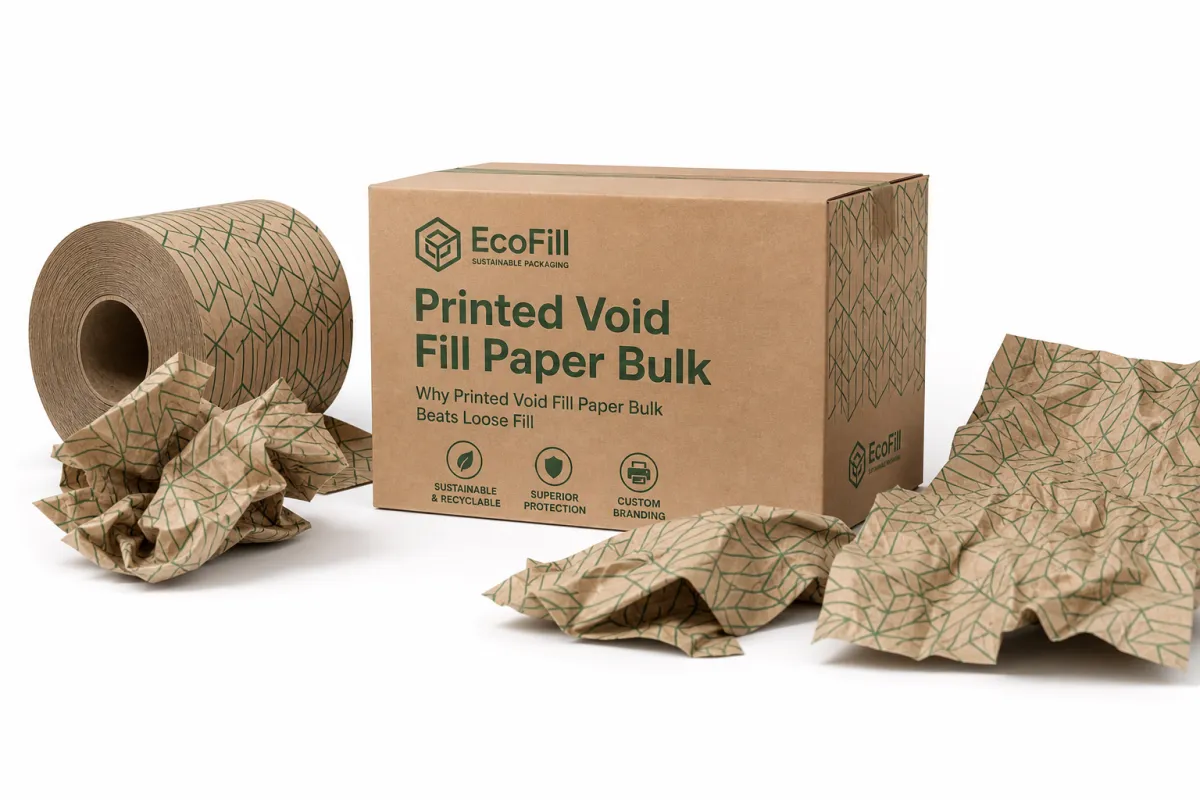
Loose fill has a habit of looking useful while doing very little. The carton appears full. The product still moves. That gap is where dents, cracks, and abrasion show up. Printed Void Fill paper bulk solves a different problem. It creates structure. It gives the packer something predictable to work with instead of a drifting pile of material that settles wherever gravity feels like putting it.
From the buyer side, control is the real win. A roll, sheet, or carton of printed void fill paper bulk is easier to standardize than peanuts, air pillows, or random scraps from the back room. Packers know how much to use. Supervisors know what a correct pack-out looks like. Nobody has to guess whether the box is actually protected or just crowded. That matters more than people admit, especially once volume starts creeping up and a few seconds per box turns into a real labor bill.
There is also the brand side, and yes, people notice it. A short logo repeat, a one-color pattern, or a clean line of copy turns printed void fill paper bulk into a visible part of the package. The outside carton gets the shipment to the door. The inside carton gets remembered. That part is harder to fake.
Practical rule: if the filler is hard to grab, hard to read, or slows a packer by a few seconds per box, the spec is off.
Where does printed void fill paper bulk earn its keep? More places than most teams plan for:
- E-commerce orders where unboxing still affects repeat purchase behavior.
- Fragile kits with glass, ceramics, cosmetics, electronics, or assembled parts.
- Subscription boxes that need a neat interior and repeatable presentation.
- Retail ship-outs that move through distributors before reaching shelves.
- Returns packaging where the product has to survive a second trip.
So no, printed void fill paper bulk is not decorative fluff. It is a low-cost protection layer with a branding job baked in. That is why buyers keep coming back to it after the first round of damage claims reminds them what a bad pack-out really costs. The paper is cheap. The labor waste and replacement headaches are not. And once you've dealt with a week of crushed corners, the "just use whatever" approach starts looking kinda silly.
Printed void fill paper bulk product details and formats
There are a few common ways to buy printed void fill paper bulk, and the right one depends on how the station runs. Rolls make sense for continuous lines with a dispenser. Fan-fold sheets work better for manual packers who need grab-and-go handling. Pre-cut fill is useful when every carton needs a fixed amount. Warehouse cartons keep storage and replenishment simple.
Plain language helps here. If the line moves fast, the material has to move fast too. Pretty print means nothing if the team has to fight the dispenser or tear oversized sheets into awkward shapes. Good printed void fill paper bulk should pull cleanly, compress without falling apart, and hold enough spring to keep the product in place. It should feel predictable in the hand. That sounds boring. It is boring. Boring is good.
Printing is usually straightforward: a repeat logo, a short message, a one-color pattern, or a two-color setup if the brand needs more contrast. More ink coverage usually means more cost. That is not mysterious. More coverage means more setup, more drying time, and more chances for color drift across a large run of printed void fill paper bulk. If someone promises heavy coverage, fast turnaround, and bargain pricing all at once, ask how they are making the math work.
Material choice matters too. Most buyers land somewhere in the kraft paper range, with common weights around 40gsm to 80gsm depending on stiffness and tear resistance. Lighter paper is easier to crumple and faster to pack, but it can feel flimsy around heavy or sharp-edged products. Heavier paper holds shape better and often looks more premium, but it takes more storage space and can raise the unit cost.
For brands that want the quick version, this format map helps:
- Rolls for high-speed workstations with a fixed dispenser setup.
- Fan-fold sheets for manual packing tables, kitting lines, and mixed SKU environments.
- Pre-cut fill for measured pack-outs where every carton needs the same amount of void fill.
- Warehouse cartons for teams that want easy storage and simple replenishment.
One mistake shows up constantly: teams choose the design first and the workflow second. That order is backward. Printed void fill paper bulk should fit the motion of the warehouse, not make the warehouse rearrange itself for the paper. The nicest pattern in the world still fails if it slows the line or creates waste at the station.
If you're comparing options, start with how the pack-out actually works. Heavy products with sharp corners need a stiffer grade. Smaller direct-to-consumer boxes usually work better with lighter paper that packs fast. Mixed orders with changing carton sizes often do well with fan-folded printed void fill paper bulk because the team can use more or less material without touching the equipment.
I've seen teams spend extra money on a fancy format that looked good in a sample photo and then sat like a brick in the actual packing room. That kind of mistake is avoidable. Get the paper that works for the job, not the paper that looks impressive in a mockup.
Printed void fill paper bulk specifications buyers should compare
Specification sheets matter. A lot. Buyers often ask for "paper filler" and then wonder why the sample behaves one way at the desk and another way on the line. Printed void fill paper bulk needs a proper spec review before volume approval, because the wrong width or unwind direction can slow the entire pack station.
The specs worth comparing are the ones that affect labor and freight, not just the ones that look tidy in a quote. For printed void fill paper bulk, that means:
- Paper weight in gsm or lb, with one unit used consistently across the quote.
- Width of the roll or sheet, which affects how much coverage the packer gets per pull.
- Roll diameter, because a large roll may not fit the dispenser or shelf.
- Core size, often 2-inch or 3-inch depending on the holder.
- Unwind direction, which can make or break dispenser compatibility.
- Print repeat, especially if the logo or message must stay readable after crumpling.
- Pallet count and carton pack, which drive freight cost and storage planning.
Width and unwind direction are the tricky ones. They sound minor until the first production run hits the floor. Then the roll turns the wrong way, the packer reaches too far, or the dispenser chews the edge. None of that is a small issue. It is lost time on every single box. A few bad assumptions at spec stage can turn into an annoying mess on shift one.
Compatibility checks should be boring, because boring is what you want. Ask whether the printed void fill paper bulk will fit your packing stations, dispensers, and manual workflow before you approve a large order. If you use a bench dispenser, get the actual measurements. If your team packs by hand, ask for sample photos at working scale, not just a proof flattened into a screen image.
For teams that want a formal benchmark, transit testing and sourcing paperwork keep the conversation honest. If the pack-out ties directly to shipping performance, review ISTA test methods instead of guessing. If procurement wants fiber sourcing clarity, ask for FSC chain-of-custody information and make sure the documents match the supply chain you're actually buying from. Those records are not decoration; they're what keeps the audit trail from turning into guesswork.
Packaging language gets messy fast, so compare quotes carefully. The same printed void fill paper bulk line item can hide very different assumptions about paper grade, print coverage, tolerances, and palletization. Ask for a spec sheet with exact tolerances, not a vague promise wrapped in nice wording. The difference between a useful quote and a headache is often one line about roll width or print area.
Common mistakes keep showing up:
- Ordering by price alone and finding out the material is too thin for the product weight.
- Ignoring carton dimensions and then stuffing every box to make up for bad planning.
- Choosing a print repeat that disappears once the paper is crumpled.
- Skipping dispenser checks and learning the hard way that the roll does not fit.
- Approving a sample without checking how it behaves on an actual packing line.
There is a reason serious buyers ask for a sample before committing. Printed void fill paper bulk is not just a printed graphic. It is a working part of the packing system. Treat it like one and the results are usually cleaner, cheaper, and far easier to repeat. Treat it like a decorative add-on and it will act like one: annoying, expensive, and not especially helpful.
Printed void fill paper bulk pricing, MOQ, and volume breaks
Pricing depends on more than paper cost. People forget that part all the time. For printed void fill paper bulk, the main price drivers are paper grade, print complexity, order volume, roll size, and whether the job needs a new setup. A simple one-color logo on standard kraft is one thing. A full-coverage two-color print on heavier stock is a different conversation.
As a planning range, smaller bulk orders often sit in the middle of the cost curve, while true volume buys can pull the unit price down quickly. The exact number depends on format, but these ranges are useful when you're building a budget:
| Format | Typical MOQ | Typical price signal | Best use | Notes |
|---|---|---|---|---|
| One-color rolls | 300-800 rolls | $18-$34 per roll | Fast packing lines | Good balance of speed and brand visibility |
| One-color fan-fold cartons | 500-1,500 cartons | $24-$46 per carton | Manual packing tables | Easier to store, easy to grab |
| Two-color printed runs | 1,000+ units | $26-$52 per unit equivalent | Brand-forward unboxing | More setup and tighter print control required |
| Pre-cut branded sheets | 10,000-30,000 sheets | $0.06-$0.14 per sheet | Measured pack-outs | Best for consistent fill volume |
Those numbers are planning ranges, not guarantees. A lighter paper, a simpler logo, and a higher quantity can lower the cost. A custom sheet size, heavier stock, or tight color matching can push it up. If a quote looks suspiciously cheap, ask what got removed. Usually something did.
MOQ changes with setup. That part is normal. One-color bulk jobs are usually easier to price because the press setup is simpler and changeovers move faster. More colors, wider coverage, or tighter artwork control usually increase the minimum order or raise the unit price. Buyers who understand that tradeoff avoid a lot of pointless back-and-forth.
Ask for tiered quotes. Really. A decent buying conversation should show at least three paths: a starter run, a mid-size reorder, and a full bulk buy. That makes the break point obvious, the place where unit cost starts to improve. If the drop between 500 and 2,500 units is only a few cents, the supplier is not showing the whole picture.
Hidden costs deserve their own line item. Freight can be bigger than expected because paper is bulky. Palletization may add cost if the shipment needs special stacking or protection. Samples are usually cheap, but rework after proof approval can get expensive quickly. And if the artwork changes after proof approval, some suppliers treat that as a new setup. Fair enough. The machine was not the one changing its mind.
For buyers comparing printed void fill paper bulk against plain kraft filler, do not stop at paper price. Compare damaged goods, labor time, customer complaints, and the brand impression inside the box. A lower paper price is meaningless if the product shifts and the customer notices. I've seen a "cheap" filler line item turn into the most expensive part of the whole packaging program once returns started piling up.
Printed void fill paper bulk process and production timeline
The production path is usually simple, and simple is good. A clean printed void fill paper bulk order moves through inquiry, spec review, artwork submission, proofing, sample approval, production, quality check, and shipment. Fewer surprises in that sequence usually means a better result at the other end.
Here is the normal flow from the buyer side:
- Inquiry with carton dimensions, volume, and target launch date.
- Spec review to confirm weight, width, roll size, core, and print area.
- Artwork submission with a logo file and any repeat instructions.
- Proof approval to lock color placement and print layout.
- Sample or short run if the design needs a physical check.
- Production once the file and spec are confirmed.
- Quality check before packing and palletizing.
- Shipment, which should be tracked separately from production time.
Real timing depends on how ready the buyer is at the start. If the artwork is ready and the specs are fixed, printed void fill paper bulk can move fast. If the buyer is still deciding on format, color count, or print repeat, the job slows down. That is not a factory problem. That is a decision problem. I say that without drama because it is usually true.
A reasonable planning range for a straightforward run is often 12 to 18 business days from proof approval, with shipping time added on top. Complex artwork, special paper grades, or larger bulk quantities can stretch that window. Overseas freight can add more delay than the print run itself. That is why production time and transit time need to stay separate in the schedule.
The most common delay points are easy to avoid:
- Low-resolution logos that look fine on screen but fail in print.
- Missing dielines or unclear repeat size.
- Late color changes after proof approval.
- Unclear pack-out expectations, especially for mixed carton sizes.
- Waiting too long to approve the sample while inventory runs low.
For reorders, keep the approved spec sheet and the approved print file together. Not buried in someone's inbox. Together. That way the next printed void fill paper bulk run does not start from scratch. The fewer times a team has to rediscover the same roll width, the faster the reorder moves.
It also helps to keep one internal note on what worked in the first production run. Did the paper feel too stiff? Was the unwind direction right? Did the print stay readable once the paper was crumpled? Those small notes are the difference between a one-off order and a repeatable packaging program. They also stop the second order from turning into a weird little mystery.
Why choose us for printed void fill paper bulk
For buyers at Custom Logo Things, the value is not mystery. It is clarity. We focus on printed void fill paper bulk orders with the practical details that actually keep a packing line moving: clear specs, fast quoting, and print choices that do not create headaches later. That sounds basic because it is basic. And basic is usually what separates a useful supplier from a frustrating one.
Consistency matters more than most sales pages admit. If the color drifts, the paper supply shifts, or the roll dimensions are inconsistent, warehouse teams notice immediately. They may not file a formal complaint, but they will spend time working around it. Good printed void fill paper bulk should arrive the way it was approved, with repeatable color, stable material supply, and packaging that stacks the same way from run to run.
There's a real difference between a supplier and a partner. A supplier can quote the most expensive option and call it a day. A better partner asks what your station looks like, how your boxes are packed, and whether the print needs to stay readable after crumpling. That kind of conversation saves money because it keeps you from buying the wrong structure in the first place.
Good procurement question: can the material keep the box tight without slowing the packer down? If the answer is no, the spec needs work.
Our Wholesale Programs are built for buyers who need recurring supply, not one-off experiments. That matters if your monthly volume is steady and your team wants the same spec on every reorder. It also matters if you're scaling a launch and need a path from trial order to true bulk without rewriting the package every time.
We also pay attention to the things that do not show up in a mockup. Pre-production checks. Sample support. Lead-time communication that is direct instead of vague. If a print decision will affect cost, we say so. If a format choice will affect packing speed, we say so. That's the job. Printed void fill paper bulk only works as a packaging tool if the buyer gets honest information before the purchase order goes out.
For larger recurring runs, the right setup usually beats the flashier one. A one-color logo with the right paper weight and the right unwind direction is often a better buy than a more elaborate design that looks impressive in a mockup but slows the line in production. That is the kind of tradeoff buyers should hear early, not after the first pallet lands. Fancy does not matter if the station hates it.
If your team needs help deciding between formats, our Wholesale Programs page is the cleanest place to start. It is built for volume conversations, quote comparisons, and the kind of repeat ordering that keeps packaging from turning into a weekly scramble. Printed void fill paper bulk should feel like a system, not a guess.
Next steps for printed void fill paper bulk orders
If you're ready to move, send the details that actually help a quote get sharper. Not just "need filler." Give the carton dimensions, monthly volume, preferred print area, target launch date, and any pack-line constraints. The better the inputs, the cleaner the printed void fill paper bulk recommendation will be.
Here is the fastest way to get a useful response:
- Carton size range and average product weight.
- Monthly carton count or forecast volume.
- Preferred format such as roll, fan-fold, or pre-cut sheets.
- Print direction and any logo or message requirements.
- Target launch date and acceptable shipping window.
- Packing station notes including dispenser type and space limits.
Then ask for two quote paths. One should be optimized for the lowest unit cost, and one should be optimized for the fastest turnaround. That comparison usually reveals whether printed void fill paper bulk should be bought as a small trial run or as a deeper inventory buy. If the schedule is tight, the fast path may be worth the slightly higher unit price. If the launch is stable, the bulk path usually wins.
Ask for a sample or a short proof run before you commit to a large order, especially if the print has to look clean after crumpling. A design can look perfect flat and still disappear once the paper is packed. That is why physical approval is worth the extra step. It protects the whole bulk order.
One more thing: confirm reorder triggers before inventory gets tight. If the lead time is two weeks and shipping adds another week, the restock point needs to be set early. Waiting until the last pallet is open is how teams end up paying for rushed freight or accepting a weaker substitute. Nobody needs that.
Use the checklist below, gather the spec sheet, and send the request in one shot. That keeps the quote process moving and cuts the back-and-forth that wastes a week. In packaging, clarity is money. Printed void fill paper bulk is no different. Get the measurements right, pick the format that fits the station, and the whole thing becomes much easier to live with.
Frequently Asked Questions
How much printed void fill paper bulk should I order for a new product launch?
Start with your monthly carton count and the average amount of void fill per box instead of guessing from shelf space. If your box sizes or product mix are still changing, request a short-run sample first. Build in extra volume if the launch includes multiple SKU sizes or a high return rate, because both of those can increase paper consumption fast. It is better to have a little extra on hand than to pay for a scramble later.
What is the typical MOQ for printed void fill paper bulk orders?
MOQ depends on paper width, print setup, and how many colors are in the design. Simple one-color runs usually allow lower entry points than multi-color jobs. Ask whether the MOQ is measured by roll count, sheet count, or paper weight so the quote is actually comparable. Otherwise you are comparing apples to a forklift.
Can printed void fill paper bulk still work with a fast packing line?
Yes, if the roll width, unwind direction, and paper stiffness are matched to the station. Keep the print repeat simple so the filler stays easy to grab and does not slow packers down. Test the material at one workstation before rolling it out across the whole warehouse. A five-minute test can save a week of irritation.
How long does printed void fill paper bulk production usually take?
Expect time for artwork review, proof approval, production, and final shipping separately. The fastest jobs happen when the print file is ready and the specs are already locked. Freight can add more delay than the print run itself, so plan the delivery window carefully and keep the reorder point realistic.
Is printed void fill paper bulk better than plain kraft filler?
If customers see the inside of the box, printed filler gives you branding without adding a separate packaging step. Plain kraft can still win on cost when the box interior is never visible to the buyer. For most brands, the real comparison is damage prevention plus brand impression versus paper price alone. That is the number that matters.
For buyers who want a cleaner pack-out, faster replenishment, and a better-looking interior, printed void fill paper bulk is still one of the most practical buys in packaging. Keep the specs tight, compare the MOQ honestly, and choose the format that fits the station instead of the fantasy version of the station. That is how printed void fill paper bulk stops being a line item and starts doing useful work.