Buyer Fit Snapshot
| Best fit | custom window boxes with logo branding faster for packaging buyers comparing material specs, print proof, MOQ, unit cost, freight, and repeat-order risk where brand print, material, artwork control, and repeat-order consistency matter. |
|---|---|
| Quote inputs | Share finished size, material target, print colors, finish, packing count, annual reorder estimate, and delivery region. |
| Proofing check | Approve dieline scale, logo placement, barcode or warning zones, color tolerance, and any recyclable or compostable wording before bulk production. |
| Main risk | Vague material claims, crowded artwork, or missing packing details can create delays even when the unit price looks attractive. |
Fast answer: Custom Window Boxes with Logo Branding Faster: Dieline, Finish, Proof, and Buyer Review should be specified like a repeatable production item. The safest quote includes material, print method, finish, artwork proof, carton packing, and reorder notes in one written spec.
What to confirm before approving the packaging proof
Check the product dimensions against the actual filled item, not only the sales mockup. Ask for tolerance on folds, seals, hang holes, label areas, and retail display edges. If the package carries a logo, QR code, warning copy, or legal claim, reserve that space before decorative graphics fill the panel.
How to compare quotes without losing quality
Compare board or film grade, print process, finish, sampling route, tooling charges, carton quantity, and freight assumptions side by side. A lower quote is only useful if the supplier can repeat the same color, closure quality, and packing count on the next order.
Custom Window Boxes With Logo: Branding That Sells Faster
Custom Window Boxes with logo do one thing very well: they let the product speak before the shopper even reads the brand copy. On a crowded shelf, that matters. A clear view of the item builds trust faster than a carton packed with claims nobody remembers two seconds later.
For packaging buyers, custom window boxes with logo cut down the amount of selling the box has to do. The product becomes the focal point. The carton still protects, informs, and carries the brand mark, but it stops pretending the artwork alone can carry the whole job. That is smarter packaging design, and it keeps brands from wasting money on overdesigned print that does not move product.
If you are comparing Custom Packaging Products for a launch, a seasonal drop, or a repeat run, the real question is not “Can I add a window?” It is “Will the window help this item sell without weakening the structure or blowing up the quote?” That is the part people skip, then act surprised when the pretty box fails in transit. Custom window boxes with logo only work when structure, branding, cost, and production stay in the same conversation.
A window should do one job well: show enough of the product to remove doubt. If it needs to do twelve jobs, the design is already trying too hard.
Why Custom Window Boxes with Logo Win Attention Fast
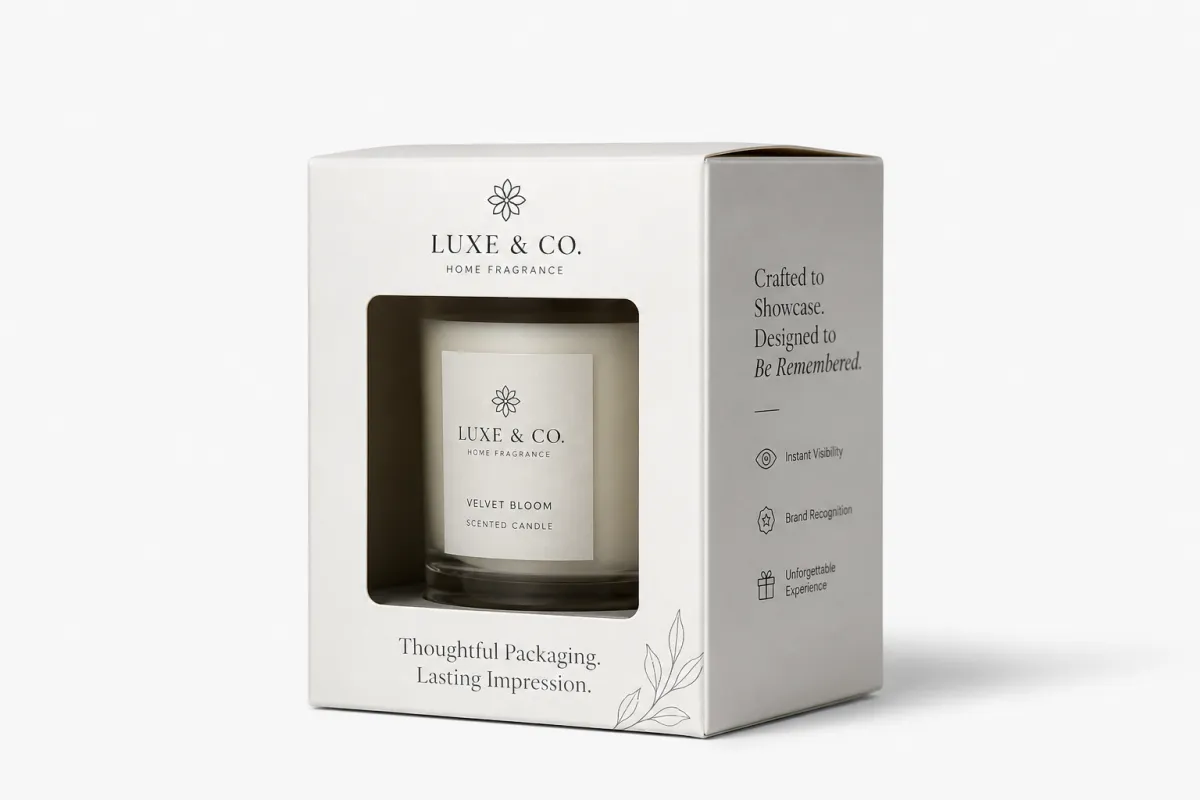
Walk down any retail aisle and watch the shelf for ten seconds. The boxes that make people guess usually lose to the ones that show the product plainly. That is why custom window boxes with logo pull attention so fast. They let shoppers verify color, shape, texture, fill level, and size without opening anything. Doubt drops. Trust goes up. Sales usually follow.
Most brands miss a simple truth: if the product is visible, the carton does less selling and more confirming. That is not a weakness. It is the point. The logo still handles recognition, but the window gives the buyer proof. For food, cosmetics, candles, toys, gift items, and small electronics, that proof matters because people want to know what they are getting before they commit.
Those first few seconds matter more than teams like to admit. A good window changes the shelf rhythm. It breaks the wall-of-boxes effect and creates a pause in the eye path. If the item inside looks clean and consistent, custom window boxes with logo can raise perceived quality without adding print clutter. That helps on tight retail packaging budgets, where every finish competes with margin.
There is a practical upside too. Visible product content reduces hesitation for items that are tactile or sensory. A bakery carton with a clear front, a candle box with a cutout, or a cosmetics pack that shows the shade usually performs better than a fully opaque box with a giant claims panel. The shopper does not need to guess. Guessing is expensive.
So the decision is not “window or no window” in the abstract. It is whether the product benefits from being seen early and whether the structure can handle that opening without turning flimsy. That is where custom window boxes with logo beat plain cartons, especially if the item already has strong visual appeal and the brand wants less friction at the shelf.
The best results come from packaging that tells the truth. Let the product do some of the work. Use the box to frame it, protect it, and make the logo stick. That is enough more often than not.
What Custom Window Boxes with Logo Are and How They Work
At the simplest level, custom window boxes with logo are printed cartons with a die-cut opening that reveals part of the product or the inner tray. The opening may sit on the front panel, a side panel, or the top, depending on how the item is displayed. A transparent film can cover the cutout if the product needs dust protection, extra strength, or a cleaner retail finish.
The structure usually starts with a folding carton style: tuck-end, reverse tuck-end, auto-lock bottom, sleeve, or display-front format. Logo placement matters because the window removes some of the print area. Good product packaging works with that constraint instead of fighting it. The logo often reads best above the window, below it, or off to one side where it stays visible even if the product shifts in the box.
Custom window boxes with logo also change how the buying experience feels. A shopper can see the texture of a matte candle jar, the color of lip balm, the crumb structure of baked goods, or the finish on a gift set. That kind of visual confirmation can move a hesitant buyer from “maybe” to “I’ll take it.”
Different box styles fit different jobs:
- Tuck-end boxes work well for lightweight retail items and are usually the most economical option for custom printed boxes with a window.
- Auto-lock bottoms add support for heavier contents and speed up packing.
- Sleeve boxes give a premium look and can hide or reveal the product in stages.
- Display-front boxes create more shelf visibility for impulse buys and gift items.
Not every product deserves a window. That part gets glossed over in sales pitches because, surprise, a window is not a cure-all. Items that need privacy, light blocking, moisture protection, or tamper resistance may do better in a fully printed carton or an inner tray setup. Some foods fade under light. Some cosmetics need more shielding. Some products shift too much in transit. In those cases, custom window boxes with logo should be a deliberate choice, not a reflex.
If you want a stronger sourcing framework, use the same discipline you would with any retail packaging project: define the product first, then the presentation, then the shipping method. That order matters more than the artwork mockup. A nice design that fails in transit is just an expensive apology.
Key Design and Material Factors That Make or Break the Box
The board choice usually decides whether custom window boxes with logo feel premium, sturdy, or painfully cheap. SBS paperboard gives a crisp print surface and sharp color reproduction, which is why it shows up so often in cosmetics, confectionery, and branded packaging. CCNB, which uses a coated top with recycled content, is common for value-driven retail cartons. Kraft paperboard creates a natural look that works for wellness, organic food, and handmade goods. Corrugated board belongs in the mix when the product is heavier, more fragile, or likely to ship farther before it reaches the shelf.
Window size matters too. Too large, and the carton loses rigidity. Too small, and the box wastes its best feature. A good rule is to size the opening around what the shopper needs to see, not around the temptation to show everything. The product should look intentional in the frame. If the window cuts through the most attractive part of the item, the design is failing its own job.
Finishes can help, but they can also get in the way. Matte lamination gives a softer, more modern feel. Gloss can make color pop. Soft-touch feels premium, though it raises cost and may not suit every brand story. Foil and spot UV should be used with restraint. I have seen plenty of custom window boxes with logo get worse because the surface effects were trying too hard while the window already did the real work. The best finish is the one that supports the product, not the one yelling the loudest.
Logo placement deserves real attention. Keep the logo inside safe margins so folds, seams, or the die line do not clip it. Use strong contrast between the logo and the background. Keep critical copy away from the window edge, because that area gets visually busy fast. In package branding, readability beats cleverness almost every time.
For sustainability, ask direct questions. Does the board contain recycled content? Is the window made from a plastic-free cellulose film or a standard PET film? Is the substrate FSC-certified? If a supplier says the box is recyclable, ask where and under what conditions. Recycling claims are not magic words, and local acceptance varies. For certification guidance, look at the FSC site. For transit performance and distribution testing, ISTA publishes widely used protocols that help validate how packaging performs under real shipping conditions.
That kind of discipline protects both the brand and the budget. A clean-looking box is good. A clean-looking box that passes handling, stacking, and shelf tests is better. If you need a starting point for material comparisons, start with the specs that actually matter: product weight, display environment, and shipping route. Everything else is decoration until those basics are locked.
One more practical note. If you are balancing brand image with volume purchasing, compare retail packaging options on the same board grade and finish before you compare prices. A cheap quote on a different stock is not a quote. It is bait.
Custom Window Boxes with Logo Pricing: What Actually Drives Cost
Pricing for custom window boxes with logo comes down to a handful of variables, and the first one is quantity. Small runs usually carry the highest unit price because setup is spread across fewer pieces. Larger runs can cut the per-unit cost by roughly 20% to 40% once print setup, die making, and finishing are absorbed across the order. That is the math, and it does not care how pretty the mockup looked.
Size comes next. Bigger boxes use more board, larger sheets, and more waste during die cutting. A compact cosmetic carton is not priced like a large gift box. Shape matters too. A simple rectangle is easier and cheaper than a complicated structure with multiple folds or a custom insert. Add a window, and you introduce another step: die cutting, film application, or both.
Print coverage changes the quote in a very direct way. One-color kraft cartons sit at the lower end. Full-bleed CMYK on coated board costs more. Add foil stamping, embossing, spot UV, or specialty lamination, and the number climbs. None of that is mysterious. It is just production time and material cost showing up on the invoice.
Here is a rough way buyers can think about it for standard retail packaging runs. These are not fixed rates, because no two jobs are identical, but they are useful ranges for planning:
| Structure | Typical Use | Relative Cost at 5,000 Units | Notes |
|---|---|---|---|
| SBS folding carton with clear film window | Cosmetics, candles, small gifts | $0.22-$0.48 each | Strong print quality; good for brand-heavy displays |
| Kraft carton with die-cut window | Natural goods, soap, bakery | $0.20-$0.42 each | Lower visual finish cost; natural look feels authentic |
| Corrugated display box | Heavier items, shipping-safe retail | $0.38-$0.85 each | More board, more strength, more protection |
| Sleeve + inner tray with window reveal | Premium gifts, seasonal sets | $0.45-$1.10 each | Higher perceived value; more setup and labor |
Hidden costs are where buyers get annoyed. Dieline changes cost time. New tooling can trigger die charges that may run from about $150 to $500 or more, depending on complexity and supplier setup. Proofing adds time, and sometimes a revision adds another round. Freight can swing the final landed cost more than people expect, especially if the boxes are bulky and lightweight. Rush orders are another classic trap. You can pay for speed, but speed is never free.
That is why comparing quotes on custom window boxes with logo requires matching specs line by line. Same dimensions. Same board. Same finish. Same window material. Same quantity. Same shipping terms. If one supplier quotes a window film and another quotes a bare cutout, the numbers are not comparable. They are just a distraction dressed up as a spreadsheet.
If a quote looks weirdly cheap, check the details. Often the board is thinner, the finish is simpler, the die is reused, or the supplier has quietly removed a feature you assumed was included. That is not always bad. It is only bad when nobody tells you.
How to Order Custom Window Boxes with Logo: Process and Timeline
The cleanest ordering process starts with product data, not artwork. Before you request custom window boxes with logo, measure the item’s length, width, height, and weight. Note whether it is fragile, oily, dusty, liquid, soft, or hard. Also note how the product sits in the box. Does it stand upright? Lie flat? Need a tray or insert? Those details shape the structure more than the logo ever will.
Step two is the dieline. Ask for a structural template so you can place the logo, ingredient copy, barcode, and regulatory text in the right spots. The window changes the available print area, and that has to be visible before the artwork gets too polished. Good packaging design respects the fold lines. Bad design assumes the printer will somehow fix it later. They will not.
Once the dieline is in hand, build the proof carefully. Check contrast, logo scale, safe margins, and barcode readability. If the box includes a clear window, check the visual balance between the opening and the printed panels. Custom window boxes with logo often look weak when the artwork crowds the frame or when the logo is placed where the product hides it on shelf.
After proofing, decide whether you need a physical sample. For launch items, seasonal runs, or products with odd shapes, I would usually say yes. A sample exposes problems that a PDF cannot show: scratch risk, shift inside the box, window glare, insert fit, and whether the carton survives a little abuse. If the product can move or crush, a sample is cheap insurance. I have had more than one pretty proof fall apart the second it met the actual product. The printer was not the villain; the spec was incomplete. Annoying, but fixable.
As for timing, straightforward jobs often take about 10-20 business days after proof approval. That window can stretch if the job needs new tooling, specialty finishes, extra revisions, or a custom insert. Add a few more days if freight is cross-country or if the receiving team needs pallet scheduling. These delays are boring. They are also real.
For teams managing a product launch, planning the handoff matters as much as planning the design. Make room for receiving, storage, and pack-out. If the boxes arrive before the product is ready, you now own a stack of packaging instead of a launch asset. I have seen that happen more than once, and it is not charming.
When you are ready to build a sourcing package, ask for one structural sample, one printed proof, and one line-item quote that lists board, finish, window type, quantity, and freight separately. That gives you a fair comparison across suppliers and cuts down on the quote churn that wastes everybody’s time. If you need a wider view of options, browse custom printed boxes that can be adapted to your size and display needs.
The best order process is simple. Clear specs. Clear proof. Clear timeline. Anything else invites mistakes, and custom window boxes with logo are too useful to treat casually.
Common Mistakes With Custom Window Boxes with Logo
The first mistake is making the window too large. A giant opening sounds attractive until the carton starts sagging, tearing, or losing stacking strength. The second mistake is making it too small. Then you pay for a die-cut feature that barely changes the customer’s view. Both mistakes are common because they come from the same impulse: design by instinct instead of by use case.
The next problem is logo placement. If the logo sits too close to the fold or seam, the print can distort when the box is assembled. If it sits too low, the product may cover it. If it sits too high, it can feel disconnected from the viewing area. Custom window boxes with logo work best when the branding and the window feel like one composition, not two separate ideas shoved onto the same panel.
Another error is assuming a desk sample proves everything. It does not. A sample on a table tells you little about vibration, stacking, compression, or transit scuffing. The real test is with the actual product, real pack-out method, and real shipping conditions. If you want to avoid embarrassing surprises, use shipping logic as part of the packaging brief.
Color is another trap. What looked perfect on screen may print differently on uncoated kraft, coated SBS, or textured paperboard. Barcode readability can also suffer if the background is too busy. Copy near the window edge can be hard to read under retail lighting. Custom window boxes with logo should be checked as physical objects, not just as files.
One more mistake: skipping the insert discussion. If the product shifts inside the box, the window can expose a crooked label, a scratched lid, or an off-center presentation. That hurts more than it helps. Good retail packaging holds the item where it belongs, especially if the item is fragile or visually precise.
There is also the sustainability theater problem. Brands sometimes print green claims before checking whether the board, film, and local recycling rules actually support the claim. That is a fast route to awkward questions from buyers. If your supplier cannot explain the material stack clearly, keep asking. Confusing eco language helps nobody.
In short, the mistakes are usually basic: wrong size, wrong placement, wrong proof, wrong material, wrong expectations. The fix is equally basic. Define the product, define the shelf, define the shipper, then build the box. It sounds dull because it is. Dull is good. Dull keeps you from reordering bad packaging.
Next Steps for Custom Window Boxes with Logo That Sell
If you want custom window boxes with logo to do real work, start with a short spec sheet. Include exact dimensions, product weight, board preference, finish, window shape, quantity, and target unit price. Add whether the box must survive shipping, sit on a shelf, or both. That one page will save a lot of back-and-forth and make supplier quotes easier to compare.
Then request two things: one structural sample and one printed proof. If the item is fragile, ask for a real product fit check before you approve the run. That sounds cautious because it is. Packaging mistakes are expensive mainly because they repeat. A little discipline up front beats a warehouse full of cartons that almost work.
Test the box in the actual environment. Put it in the shipping method you plan to use. Place it on the shelf where it will be sold. Check glare, visibility, handling, and how the window reads under store lighting. Custom window boxes with logo can look great in a mockup and still underperform if the shelf angle or the fill level is wrong.
From a buying standpoint, compare two or three suppliers using the same specs and the same artwork files. That keeps the conversation honest. If one quote looks low, ask what changed. Board thickness? Film window? Print coverage? Freight? A useful quote explains those things without turning the process into a detective story.
For brands building a repeatable package branding system, this is where consistency pays off. Keep the dieline, board grade, finish, and logo placement stable between runs whenever possible. Reorders get faster, production gets cleaner, and the product line looks like it belongs to the same family. That is boring in the best way.
If the next step is a quote request, send the dimensions, artwork, target quantity, and product photo together. That gives the supplier enough information to size the job correctly and keeps revision rounds to a minimum. If you need custom window boxes with logo that feel practical instead of decorative, start with the product data and build from there. That is the shortest path to Packaging That Sells.
And yes, custom window boxes with logo can absolutely pull their weight on shelf, in transit, and at the register. They just need the right structure, the right stock, and a buyer who is willing to ask a few sharper questions before ordering.
How much do custom window boxes with logo cost per unit?
Price depends on size, stock, print coverage, window material, and quantity. Small runs cost more per box because setup is spread across fewer units. For a simple retail carton, buyers often see quotes in a wide range, from under a dollar to well above that, depending on finish and structure. The safest move is to ask suppliers to quote the same specs so you can compare the real numbers instead of guessing.
What materials are best for custom window boxes with logo?
SBS and CCNB are common for retail-ready folding cartons because they print cleanly and look polished. Kraft works well if the brand wants a natural, less processed look. Corrugated is the better choice for heavier items or products that need more shipping protection. Match the stock to weight, shelf life, and handling conditions, not just to the mood board.
How long do custom window boxes with logo take to produce?
Simple jobs often take about 10-20 business days after proof approval. Complex finishes, new tooling, custom inserts, or late artwork changes can push that out. If launch timing matters, build extra time for sampling and freight so the box does not become the bottleneck.
Can I order small quantities of custom window boxes with logo?
Yes. Small orders are common for product launches, limited editions, and test runs. The tradeoff is unit cost, which rises because setup is spread across fewer pieces. If you expect to reorder later, lock the specs now so the second run is faster and easier to repeat.
What should I send to get an accurate quote for custom window boxes with logo?
Send dimensions, product weight, quantity, finish, logo files, and the desired window shape. Include whether you need inserts, a sample, or shipping-ready packing. The cleaner the brief, the fewer revisions and surprise fees later. That applies to custom window boxes with logo just as much as any other retail packaging job.


