Buyer Fit Snapshot
| Best fit | poly mailers for swimwear brands packaging for packaging buyers comparing material specs, print proof, MOQ, unit cost, freight, and repeat-order risk where brand print, material, artwork control, and repeat-order consistency matter. |
|---|---|
| Quote inputs | Share finished size, material target, print colors, finish, packing count, annual reorder estimate, and delivery region. |
| Proofing check | Approve dieline scale, logo placement, barcode or warning zones, color tolerance, and any recyclable or compostable wording before bulk production. |
| Main risk | Vague material claims, crowded artwork, or missing packing details can create delays even when the unit price looks attractive. |
Fast answer: Poly Mailers for Swimwear Brands Packaging: Film, Closure, Print, and Fulfillment should be specified like a repeatable production item. The safest quote includes material, print method, finish, artwork proof, carton packing, and reorder notes in one written spec.
What to confirm before approving the packaging proof
Check the product dimensions against the actual filled item, not only the sales mockup. Ask for tolerance on folds, seals, hang holes, label areas, and retail display edges. If the package carries a logo, QR code, warning copy, or legal claim, reserve that space before decorative graphics fill the panel.
How to compare quotes without losing quality
Compare board or film grade, print process, finish, sampling route, tooling charges, carton quantity, and freight assumptions side by side. A lower quote is only useful if the supplier can repeat the same color, closure quality, and packing count on the next order.
Poly Mailers for Swimwear Brands: Packaging That Sells
For a lot of labels, poly mailers for swimwear brands cost less to ship than the suit inside them. That sounds almost too simple, but it is the whole point. Packaging stops being background noise the second it affects postage, labor, or the customer’s first impression. A mailer that stays light, survives transit, and still looks good is doing real work. Not glamorous work. Useful work.
Swimwear sits in a strange packaging lane. The product is soft, flat, and usually easy to fold. The brand, meanwhile, is selling confidence, style, and that little spike of excitement people feel when a package lands at the door. Poly mailers for swimwear brands sit right in that gap. They are practical enough to keep fulfillment moving and polished enough to support the brand before the customer even opens the bag.
Custom Logo Things works with brands that need packaging to do more than just survive the ride. The real question is not whether a mailer can hold a bikini. Obviously it can. The question is whether it protects the product, keeps shipping costs sane, fits the brand, and still feels intentional on arrival. That is the filter that matters.
I have seen brands overpay for boxes they did not need, then wonder why margins started acting weird. I have also seen the opposite: cheap mailers that felt so flimsy they made a premium suit look suspicious. Packaging is part logistics, part psychology. Ignore either side and you usually end up fixing the problem later. Usually at the worst possible time.
Poly Mailers for Swimwear Brands: What They Are
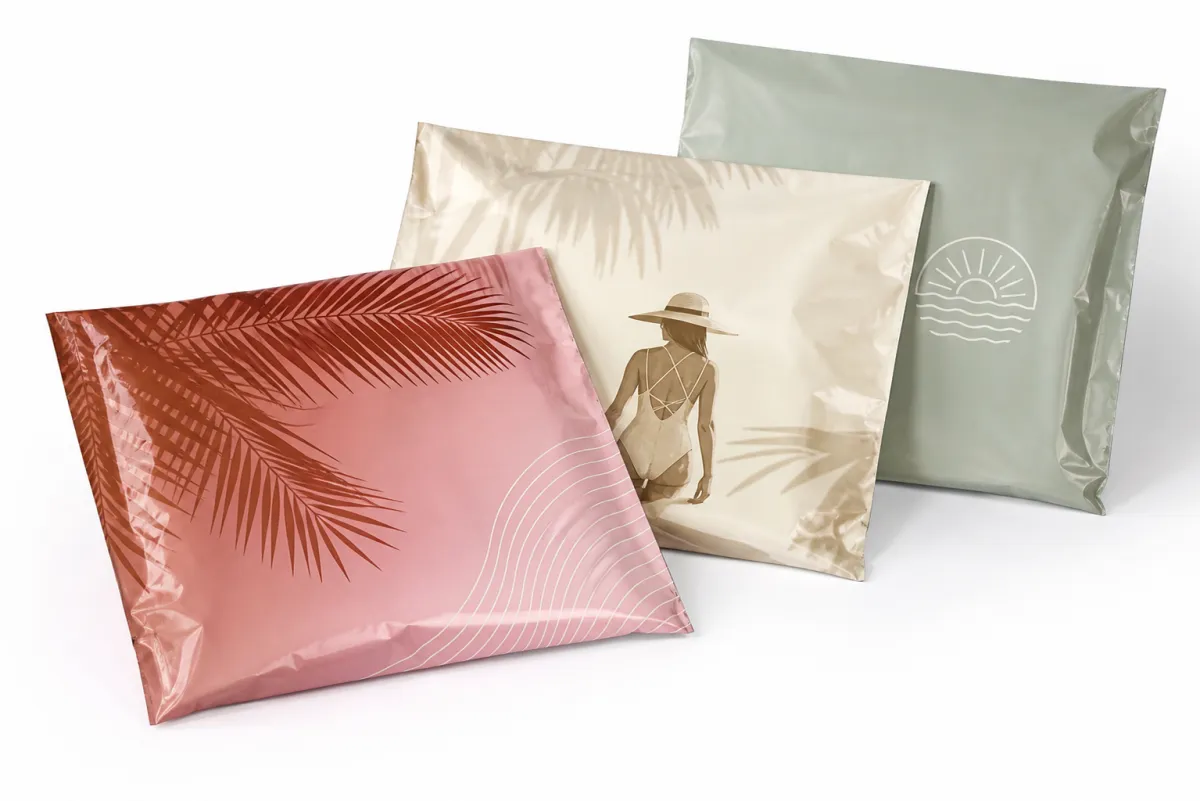
Poly mailers for swimwear brands are lightweight shipping envelopes made from polyethylene film. Plain English: flat plastic mailers with a self-seal adhesive strip. They are built to ship soft goods without the bulk of a box. For a swim label, that matters because most orders are one or two folded items, not fragile hardware or stiff pieces that need crush protection.
The format fits bikinis, one-pieces, cover-ups, rash guards, sarongs, and small extras like pouches or hair ties. Those items compress cleanly, which keeps the parcel slim. Slim usually means lower dimensional weight, easier storage, and less time at the packing station. None of that is sexy. All of it saves money.
The branding side is easy to miss if you only look at shipping specs. A mailer can feel minimal and modern. It can lean resort-inspired with warm color blocking. It can look premium with matte film and crisp typography. It can even signal sustainability if the brand uses recycled-content film, controlled ink coverage, or paper-based inserts. So yes, poly mailers for swimwear brands are shipping shells. They are also part of the first impression, whether anyone likes that or not.
Customers notice the package at the door. They notice it in the lobby. They notice it in a hotel room with bad lighting and a suitcase half-open on the floor. A neat printed mailer says care and consistency. A flimsy one says the opposite, even if the suit inside is excellent. Packaging gets blamed fast. That is just how it goes.
The starting point is simple. Poly mailers for swimwear brands are not trying to replace every packaging format. They are trying to solve a very common problem without making a mess of the budget. For compact, soft, folded apparel, they often do that better than heavier alternatives. No need to overthink it beyond that.
How Poly Mailers for Swimwear Brands Work
Most poly mailers for swimwear brands use a polyethylene film body, a pressure-sensitive adhesive strip, and a straightforward opening design that lets fulfillment teams move fast. Some come plain in white or gray. Others show full-color art, a logo pattern, or a printed message on the inside flap. The structure is simple. The details are where the results change.
The film itself handles the first job: it resists dirt, dust, and light moisture. That matters for beachwear because shipping lanes are messy and weather has no respect for your launch calendar. A sealed poly mailer gives a cleaner barrier than a paper envelope, and it usually weighs less than a padded mailer or box. Less weight can mean lower postage, especially when the order volume starts climbing.
The seal is the second job. A good closure keeps contents from slipping open during handling and reduces the chance of items popping loose on conveyors or in sortation. For poly mailers for swimwear brands, that seal matters as much as film thickness. A strong bag with a weak flap still fails. Packaging gets one job. Missing half of it is not ideal.
There is a limit, and it should be said plainly. Poly mailers are water-resistant, not waterproof. They can handle drizzle, damp loading docks, and the occasional delivery-day mess. They are not the answer for full submersion, heavy puncture risk, or bulky orders that need rigid crush defense. If the cart includes hard add-ons, gift boxes, or multiple dense pieces, a box may still be the better call.
From a fulfillment angle, poly mailers for swimwear brands speed things up. Flat garments slide into the envelope, the packer peels and seals, and the order moves out. That saves bench space and keeps warehouse flow cleaner. The package is doing operational work before the customer ever sees the branding. Good packaging does that. Bad packaging just sits there and creates a backlog.
There is also a customer-experience effect that shows up quickly. A slim, crisp mailer feels efficient. It does not look overbuilt for the product, which happens all the time when brands default to boxes out of habit. For a DTC swim label, efficiency can read as polish. The customer sees restraint, not cheapness, if the design is handled properly.
Key Factors That Shape Performance and Pricing
If you are comparing poly mailers for swimwear brands, thickness is the first number that deserves attention. Lighter films cost less and weigh less, but they can feel less sturdy and show wear faster in transit. Thicker films, often in the 2.5 mil to 4.0 mil range, usually improve tear resistance and give the bag a more premium hand-feel. The right spec depends on your route, your carrier mix, and how much abuse the package really sees.
Size matters just as much. A mailer that is too large wastes material, adds unnecessary cube, and makes a small order look awkward. A mailer that is too tight wrinkles the contents and can stress the seal. For poly mailers for swimwear brands, the best size is usually the smallest one that fits the folded product plus a care card, tissue, or insert without forcing the closure to fight back.
Print method changes the economics quickly. A one-color logo on a stock-colored bag can be efficient. Full-coverage artwork, internal printing, metallic accents, or multiple ink colors push the price upward. That is fine if the package earns the extra spend. It is not fine if the design looks expensive but fails on seal strength or print alignment. Pretty and useless is still useless.
Unit cost is only part of the bill. Brands should compare shipping weight, postage tiers, packing labor, damage rates, and the cost of rework. A mailer priced at $0.22 each may be cheaper overall than one priced at $0.16 if it speeds packing and cuts returns. That is especially true for poly mailers for swimwear brands with seasonal spikes, where labor time and shipping consistency matter almost as much as the mailer itself.
Minimum order quantities and setup fees change the picture too. Smaller runs often carry higher per-unit pricing because the printer is spreading setup across fewer bags. Larger runs lower the unit cost but require storage and cash flow. The real pricing question is not just, “What does the mailer cost?” It is, “What does the full packaging decision cost across the life of the order?” Those are not the same thing.
There is a small but real operational detail that brands miss all the time: bag stiffness. A mailer that feels just a little too floppy slows down packing because staff have to fumble the opening and flatten the contents before sealing. That sounds minor until you multiply it by 5,000 units. Then it is money. Packaging tends to be annoying in exactly that way.
For brands that want a clearer comparison, the table below is a useful starting point.
| Mailer Option | Typical Unit Cost | Best Use Case | Main Trade-Off |
|---|---|---|---|
| Plain stock poly mailer | $0.08-$0.18 | High-volume basics, low design complexity | Lowest branding impact |
| Custom printed poly mailer | $0.18-$0.35 | Most DTC swimwear orders, brand-forward shipping | Higher setup and print costs |
| Thicker premium poly mailer | $0.22-$0.45 | Luxury positioning, stronger feel, heavier inserts | More material weight and cost |
| Recycled-content poly mailer | $0.20-$0.40 | Eco-conscious positioning with clear packaging claims | Availability can vary by spec and supplier |
For brands serious about transit testing, standards matter too. ISTA packaging tests are useful because they simulate handling stress that reveals weak seals, film failures, and bad sizing decisions. The International Safe Transit Association explains the framework clearly at ISTA. If you are comparing recycled-content claims or broader material strategies, the U.S. EPA offers guidance on recycling and waste reduction at EPA recycling guidance.
A mailer that saves two cents but adds a 3 percent return rate is not cheap. It is expensive in disguise.
Poly Mailers for Swimwear Brands: Process and Timeline
The production process for poly mailers for swimwear brands starts with the product, not the artwork. First, list the garments you ship most often: one-piece suits, bikinis, cover-ups, multi-item sets, and any bundled orders with inserts. Then measure the folded dimensions and decide whether you need one mailer size or two. That sounds basic because it is basic, and skipping basic steps is how people end up reordering packaging in a panic.
After that, define the visual direction. Do you want minimal and clean, tropical and playful, premium and muted, or eco-conscious and understated? That choice changes the color count, print coverage, finish, and even the film color. A bright white mailer with a small black logo feels very different from a sand-toned bag with a full-wrap illustration, even if the swimsuit inside is identical.
Proofing is where many delays begin. Good suppliers will show digital mockups so you can confirm logo placement, seam direction, copy, and color balance before production starts. If your artwork wraps around the flap or needs exact registration, ask for that to be shown clearly. Poly mailers for swimwear brands often look simple on screen, but a half-inch shift in print can change the whole presentation. Packaging is annoying like that. Tiny mistakes become very visible.
Timing usually includes four stages: proof approval, production, quality checks, and freight. Simple stock-based jobs move faster. Fully custom printed runs with special sizing, spot colors, or inside printing take longer. A common planning window is roughly 12 to 15 business days after proof approval for standard custom work, but that can stretch if revisions stack up or freight slows down. Build in buffer before launch. Packaging should never be the thing that holds up sales.
One more practical thing: ask how the mailers are packed for delivery to you. If they arrive tightly compressed or boxed in awkward stacks, storage gets messy before the first unit even ships to a customer. A good packaging spec should work for both sides of the chain: inbound from the supplier and outbound to the buyer. Sounds obvious. Still gets ignored.
Brands should think about inventory the same way they think about best-selling SKUs. A summer drop can burn through packaging quickly. So can a creator partnership, a sale event, or a resort collection pushed into multiple markets at once. If you know your demand curve, order ahead. Not exciting. Very useful.
If your packaging strategy is still evolving, compare format options alongside the rest of your branded materials through Custom Packaging Products. If you want to see how packaging choices play out in live orders, our Case Studies page is a useful way to study real-world applications. And if your team is narrowing in on envelope specs, browse Custom Poly Mailers to see what a final order might look like.
Step-by-Step Guide to Choosing the Right Mailer
Choosing poly mailers for swimwear brands works best as a practical sequence, not a design-first guess. Start with the actual product mix. Write down the dimensions of your most common folded items, then add any recurring extras such as tissue, thank-you cards, promo inserts, or fabric care sheets. That tells you the minimum interior space you need, which is a lot more useful than staring at size charts and hoping for the best.
Next, decide what the package should communicate. A minimalist mailer says one thing. A bold, high-contrast print says another. A recycled-content bag with softer graphics suggests a different value set again. For swimwear, that identity decision matters because the package often arrives in a very visual context: on a porch, at a hotel, or in a shared building where people notice branding faster than they would with a standard garment shipment.
Then request samples. Ask for at least two or three variations, not just one. Compare seal grip, film feel, color quality, size, and whether the package stacks well in a packing area. Samples help because digital proofs cannot show tactile differences. A bag that looks premium on screen may feel thin in hand. Another may look plain but move better in fulfillment. That kind of detail matters for poly mailers for swimwear brands, where packing speed and presentation pull in different directions.
After that, run a live shipping test. Pack real orders, shake them, weigh them, and note whether the contents slide, wrinkle, or shift. If possible, include a few different scenarios: one-item orders, bundled orders, and an order with a card or insert. If your team ships through multiple carriers, test the package under the handling conditions you see most often. The goal is not perfection. The goal is evidence you can use without guessing.
Finally, score the options. A simple scorecard works well and keeps the decision from turning into a meeting that nobody enjoys. Rank each sample on cost per unit, postage impact, brand presentation, seal strength, and warehouse speed. The highest score is not always the cheapest bag. That is the point. Cheap is not the same thing as smart.
Here is a simple framework many packaging teams use:
- Fit: Does the mailer fit the folded swimwear without compression or excess slack?
- Protection: Does it resist scuffs, dirt, and light moisture during normal transit?
- Branding: Does the print style match the label's price point and voice?
- Operations: Does it seal quickly and stack neatly in the fulfillment space?
- Economics: Does the total landed cost make sense against shipping savings and returns?
That is the practical side of poly mailers for swimwear brands. Not “Which one looks prettiest?” More like, “Which one does the job well enough to justify the spend?” Brands that answer that honestly usually make better decisions the first time. Funny how that works.
Common Mistakes Swimwear Brands Make With Poly Mailers
The most common mistake is choosing on unit price alone. Cheap poly mailers for swimwear brands can be tempting, especially during launch season, but the savings are often smaller than they look. If a thinner mailer tears in transit, slows packing, or damages the brand impression, the hidden cost can outrun the upfront discount quickly.
Poor sizing is another repeat offender. Oversized bags look wasteful and can increase dimensional charges. Undersized bags compress the garment and make the package hard to seal. Either way, the result is friction. For swimwear, the fit needs to be snug without being stressed. That balance is exactly why packaging teams should test real order sets, not just individual products on a desk.
Print durability gets overlooked more often than it should. Some brands approve a design because the color looks great in the mockup, then discover the final print is low contrast or scratches too easily. The brand name should remain crisp from warehouse to doorstep. If a printed mailer fades, smears, or looks uneven at the fold, the whole package feels less reliable. That is a real problem for poly mailers for swimwear brands aiming for a premium position.
Moisture assumptions cause trouble too. A poly mailer can protect against light exposure, but it is not a promise against every weather condition. Brands shipping to humid climates, beachside addresses, or areas with heavy rain should think carefully about inner wrapping, insert materials, and seal quality. A package does not need to be waterproof to be good, but it does need to be honest about what it can and cannot do.
There is also a fulfillment mistake that happens behind the scenes. If the mailer is hard to open, hard to align, or too slippery to stack, warehouse productivity drops. That may sound minor until you multiply it by thousands of orders. Small annoyances become labor costs. For teams shipping a lot of poly mailers for swimwear brands, the package should help the operation move, not make everyone fight the thing.
Another issue is ignoring the inner brand story. If the outside bag is polished but the inside is messy, the customer notices the mismatch. A clean insert, a simple thank-you card, and a consistent seal can do more for perceived quality than heavy artwork alone. Packaging works best as a system, not a single object with a logo slapped on it and a prayer attached.
Finally, some brands overcomplicate the spec. They add too many colors, too many finishes, or too many special features, then struggle with price and lead times. The smarter move is often to choose one clear visual direction and execute it well. Simple can still feel premium if the proportions, stock, and print quality are right. Fancy does not automatically mean better. Sometimes it just means expensive and annoying.
Expert Tips and Next Steps for Poly Mailers for Swimwear Brands
If I had to narrow the advice down, I would start with samples, measurements, and a scorecard. Order two or three versions of poly mailers for swimwear brands before committing to a full run. Look at them in hand, not only on a screen. Slight differences in film stiffness, seal feel, and print finish become obvious once you pack a few real orders.
Then separate seasonal packaging from core packaging. A resort drop may call for brighter graphics. A limited-edition capsule may deserve a more premium finish. A steady evergreen line may need something simpler and cheaper. Treat those needs separately and you will avoid paying for a flashy package where a practical one would do, or using a plain bag where the brand deserves more presence.
A packaging scorecard is a small habit with a big payoff. Add columns for unit cost, freight weight, print appeal, opening speed, seal performance, and expected return condition. You do not need a complicated model. You need a repeatable way to compare choices. That is especially helpful for poly mailers for swimwear brands because the trade-offs are usually subtle rather than dramatic.
One more point: sustainability claims should be specific. If you use recycled-content film, say so clearly and accurately. If your paper inserts or care cards are FSC-certified, that can strengthen the overall package story. If your internal team is unsure about recycling guidance, use a source like the EPA for current basics and keep the claim language grounded in what the material actually is. Green messaging works better when it can be defended. Marketing fluff gets spotted fast.
For teams that want more proof before committing, a pilot run with live orders is the smartest next move. Ship a manageable batch, then review customer feedback, transit damage, packing time, and any return patterns. If the mailer performs well, scale it. If it does not, change the spec before the next reprint. That process is slower than guessing, but much cheaper than fixing a mistake across a full season.
From a buyer's point of view, the best poly mailers for swimwear brands make three things easier: shipping, presentation, and repeat ordering. If a package does not support those three jobs, it is probably overdesigned, underspecified, or simply the wrong format. Keep the choice practical, and the brand side usually follows.
Custom Logo Things sees the same pattern again and again: the brands that win with poly mailers for swimwear brands are the ones that choose one size, one print direction, and one controlled test batch before placing the full order. That discipline sounds boring. It is also how packaging stops being a cost center and starts acting like part of the product experience. Boring does not sound sexy, sure, but it ships on time.
Actionable takeaway: pick your top two mailer sizes, order samples in both, run a real pack-and-ship test with your most common orders, then score each option on fit, seal strength, postage, and brand presentation before you commit. If one bag wins on all four, stop shopping and place the order. If none of them do, your spec is the problem, not the supplier.
FAQs
What size poly mailers work best for swimwear brands?
Choose the smallest size that fits the folded garment plus any insert card or tissue without forcing the seal. Test both single-item and bundled orders so the same mailer can handle your common order mix. Leave enough room to prevent wrinkles, but avoid excess empty space that makes the package look bulky. Nobody needs a swim set shipped in a pillowcase.
Are poly mailers better than boxes for swimwear shipping?
For most folded swimwear orders, poly mailers are cheaper, lighter, and faster to pack than boxes. Boxes make more sense for premium gift sets, multi-item bundles, or products that need rigid crush protection. Use the customer experience you want to create as the deciding factor, not habit.
How do custom poly mailers for swimwear brands affect pricing?
Price changes with size, film thickness, print coverage, color count, and order quantity. Setup or plate fees can matter more on small runs, while larger orders usually reduce the per-unit cost. Shipping savings from lower package weight can offset part of the print upgrade, which is why unit price alone is a lazy way to judge the spec.
Do poly mailers protect swimwear from moisture and sand?
They help protect against light moisture, dirt, and surface scuffs during transit. They are not fully waterproof, so sensitive inserts or luxury finishes may need extra inner wrapping. A tight seal matters as much as the film itself for keeping packages clean.
How long does it take to produce poly mailers for swimwear brands?
Timelines usually include artwork approval, proofing, production, and shipping, so plan ahead before launch dates. Simple stock styles move faster than fully Custom Printed Mailers with special sizes or finishes. Build in extra time if you need samples, revisions, or multiple stakeholder approvals. Packaging delays are always more annoying than they look on paper.


