Buyer Fit Snapshot
| Best fit | custom pallet boxes with logo for packaging buyers comparing material specs, print proof, MOQ, unit cost, freight, and repeat-order risk where brand print, material, artwork control, and repeat-order consistency matter. |
|---|---|
| Quote inputs | Share finished size, material target, print colors, finish, packing count, annual reorder estimate, and delivery region. |
| Proofing check | Approve dieline scale, logo placement, barcode or warning zones, color tolerance, and any recyclable or compostable wording before bulk production. |
| Main risk | Vague material claims, crowded artwork, or missing packing details can create delays even when the unit price looks attractive. |
Fast answer: Custom Pallet Boxes With Logo: Branding That Ships should be specified like a repeatable production item. The safest quote includes material, print method, finish, artwork proof, carton packing, and reorder notes in one written spec.
What to confirm before approving the packaging proof
Check the product dimensions against the actual filled item, not only the sales mockup. Ask for tolerance on folds, seals, hang holes, label areas, and retail display edges. If the package carries a logo, QR code, warning copy, or legal claim, reserve that space before decorative graphics fill the panel.
How to compare quotes without losing quality
Compare board or film grade, print process, finish, sampling route, tooling charges, carton quantity, and freight assumptions side by side. A lower quote is only useful if the supplier can repeat the same color, closure quality, and packing count on the next order.
The buyer does not always see the product first. Sometimes they see a pallet stack in a receiving bay, and that is where custom pallet Boxes With Logo start doing real work. They Protect Freight. They also make the shipment look planned instead of improvised, which is a small miracle in a lot of warehouses.
A well-built pallet box does three things at once: it survives transit, keeps loading and unloading efficient, and carries your package branding without turning the carton into a loud poster. If you are moving wholesale replenishment, promo bundles, export cartons, or retail packaging through a warehouse network, Custom Pallet Boxes with logo can be the difference between looking like a supplier and looking like you packed everything during a power outage.
I have watched enough pallet specs go sideways to know the difference between a nice-looking concept and a box that actually earns its keep. Good custom printed boxes are not decoration for decoration's sake. They are clarity, handling, and brand recall in one piece of corrugated. This piece breaks down how Custom Pallet Boxes with logo work, what drives cost, what slows the timeline, and where buyers usually make the spec more complicated than it needs to be.
What custom pallet boxes with logo actually do
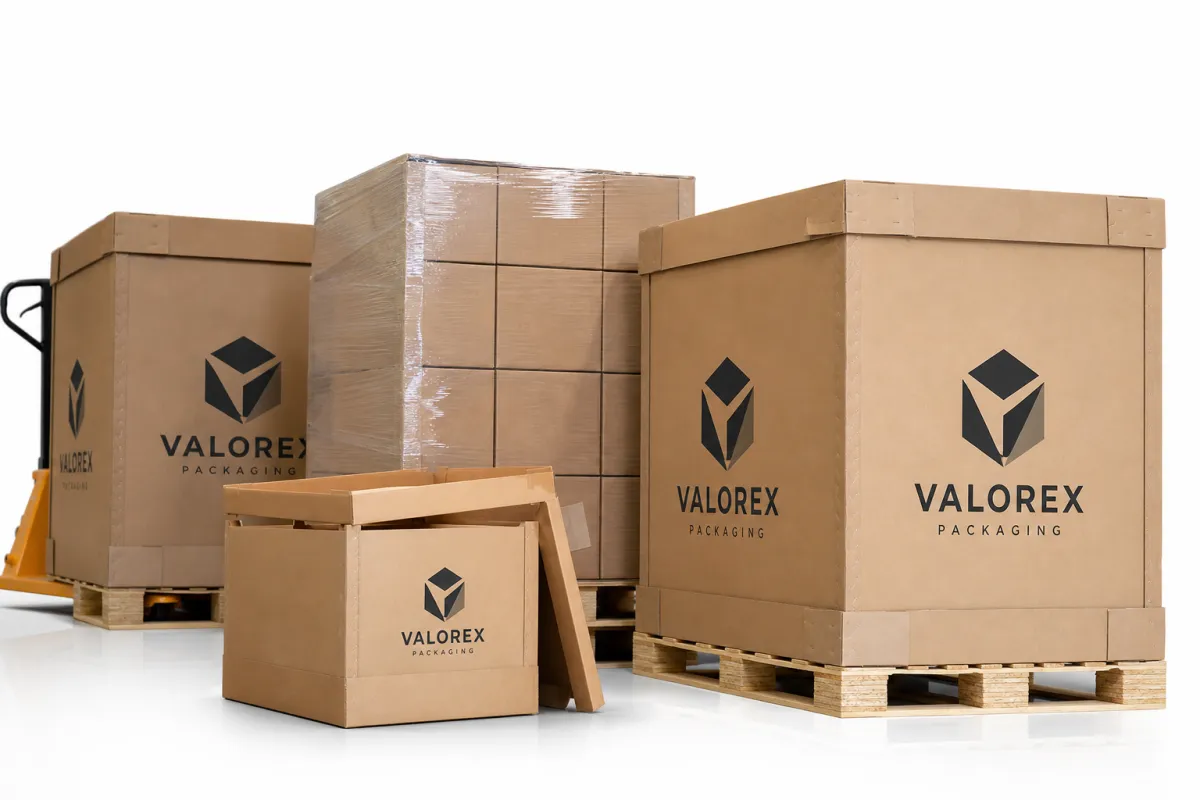
Custom pallet boxes with logo are large corrugated containers made to sit on a pallet, protect bulk goods, and put branding on the outside panels. Simple enough. The real job is messier. These boxes sit between shipping, warehouse handling, and product packaging, which means they have to survive forklifts, stack pressure, vibration, humidity, and the occasional receiving team that would rather not think about your shipment at all.
Warehouse reality: the pallet stack is often the first branded object a buyer, distributor, or retailer sees before they touch the product. A generic outside makes the whole shipment feel generic. A box that looks intentional makes the operation feel tighter. That is why custom pallet boxes with logo do more than "protect freight." They tell people the brand pays attention. Sometimes that is the whole game.
These boxes show up in wholesale drops, retail replenishment, subscription overpacks, export shipments, and promo kit launches. They also work when a fulfillment team needs faster identification at intake. A clear logo panel can tell a receiver what the shipment is, where it belongs, and whether it goes to a store, a back room, or a cross-dock lane. Practical branding wins here. Vanity does not.
Compared with plain stretch wrap and blank cartons, custom pallet boxes with logo give you a better middle ground. Stretch wrap is cheap, but visually weak and bad at presentation. Blank cartons protect goods, but they do nothing for recall. A branded pallet box keeps corrugated structure and adds recognition that lasts through the route.
Do not get precious about it. Nobody in a warehouse is pausing to admire your typography. The box needs to read from a distance, handle abuse, and support branded packaging without creating waste. If the logo helps the shipment move faster or look more organized, it is earning its keep.
One more useful point: custom pallet boxes with logo are not only for luxury brands. Industrial parts, food service, seasonal kits, and ecommerce replenishment all use them well. When the outer pack is part of the handoff, branding belongs on the box. That is not marketing fluff. It is basic operational clarity.
How custom pallet boxes with logo are made
The build starts with board grade, pallet footprint, sidewall height, lid style, and the route the box has to survive. Custom pallet boxes with logo can be folded, glued, or shipped flat depending on the design and the production line. Some are simple overpacks with a top cover. Others are full wraparound corrugated shells with hand holes, locking flaps, and insert support. The right format depends on product weight, stacking load, and how often the pack gets opened and closed.
A few build decisions matter more than most buyers expect:
- Board construction: single-wall, double-wall, or triple-wall corrugated.
- Footprint: matched to pallet size and warehouse handling.
- Height: enough room for product and cushion, not a cavern of wasted air.
- Access: hand holes, top flaps, or drop-front access when needed.
- Compatibility: whether the box sits on a standard pallet base, skid, or tray.
Printing is the branding layer. For large runs, flexographic print is usually the most cost-efficient choice because it handles volume well and keeps unit pricing sane. For shorter runs, digital print can make more sense because setup is lighter and artwork changes are easier. Labels and printed sleeves help when branding needs to stay flexible across products, regions, or seasonal programs. Full coverage is not automatically better. Sometimes one sharp panel does more than a noisy wraparound design ever will.
Logo placement should be planned, not guessed. The front panel helps with quick recognition. The side panel works well when pallets sit in aisles. The top panel helps when the load is scanned or handled from above. Repeating the mark on every panel only makes sense if the layout stays readable, balanced, and worth the print cost. A cluttered box usually hurts recognition more than it helps it.
The prepress workflow matters too. Good custom pallet boxes with logo start with a dieline, then an artwork check, then a proof, then a sample if the job is sensitive, then approval, then production. The weak point is usually the file, not the factory. Bad logo placement, low-resolution art, missing bleed, or a fold line through a critical word can sink the run. Packaging design is not just creative work. It is production work with consequences.
On the performance side, ask about crush resistance, stacking strength, moisture exposure, and the shipping route. If the load has to survive export, cold storage, or long dwell times, the box may need coatings, liners, or a stronger flute profile. I have seen a box pass a desk review and fail after two humid trailer transfers. Paperboard does not care how pretty the mockup was. For route testing, industry references like ISTA standards help keep the conversation tied to transit conditions instead of opinions.
"If the logo disappears because the box failed, it was never a branding decision. It was a guess with better graphics."
That is the point of custom pallet boxes with logo: the structure and the print need to earn each other. A nice graphic on a weak box is not branding. It is expensive disappointment with ink on it.
Material, size, and print choices that change performance
Material choice is where practical buyers separate from wishful ones. For custom pallet boxes with logo, single-wall corrugated is usually fine for lighter loads, simpler routes, and shorter handling cycles. Double-wall is the normal starting point for serious shipping jobs because it balances strength, cost, and print quality. Triple-wall makes sense when weight, stacking, or long-haul abuse becomes the real problem. Nobody needs triple-wall just because it sounds tough. They need it when the load actually demands it.
Size is not just a fit issue. The wrong footprint wastes pallet space, shifts weight badly, and can turn a decent structure into a collapse risk. If the product floats around inside the box, the walls take more stress than they should. If the box overhangs the pallet, edge damage shows up fast. If the height is too tall for the stack pattern, the load gets top-heavy and behaves badly in transit. Custom pallet boxes with logo should fit the product and the pallet flow together. Not one. Together.
Here is the rule that saves people money: choose the lightest structure that still passes load, handling, and branding requirements. Do not overbuild because "stronger sounds better." That habit gets expensive fast. A well-specced double-wall box often outperforms an oversized triple-wall build that just burns cash and wastes cube. Packaging buyers love saying they want protection. What they usually want is the right amount of protection.
Print scope is another cost and durability lever. A bold one-color logo on a single panel is often better than full-wrap graphics, especially if the box gets handled hard or exposed to moisture. Large blocks of ink can scuff, and complicated graphics can blur the brand message from a distance. For many custom pallet boxes with logo, strong contrast, a clear mark, and a clean product identifier beat decorative coverage every time.
Brands also forget the environment the box lives in. Humid trailers, cold chain transfers, export lanes, and rough distribution centers all affect print and board performance. Recycled content can change surface smoothness a bit, which affects sharpness in some print methods. If the box has to survive damp conditions, ask about coatings, liners, or moisture-resistant board before locking the spec. The paperwork can look polished. The trailer usually does not.
For materials tied to responsible sourcing, FSC-certified fiber is worth considering when your procurement team wants a traceable sustainability story. It does not fix weak design, but it does help align packaging with purchasing goals.
Here is a simple comparison of common options for custom pallet boxes with logo:
| Option | Best For | Typical Price Impact | Notes |
|---|---|---|---|
| Single-wall, one-color print | Lighter loads, internal transfers, short routes | Lowest setup and unit cost | Good when branding needs are simple and stacking demand is modest |
| Double-wall, one- to two-color print | Most wholesale and retail replenishment shipments | Moderate cost with strong value | Usually the best balance for custom pallet boxes with logo |
| Double-wall with coatings or liners | Humidity, export, or rough warehouse handling | Higher unit cost, better protection | Worth it when moisture or abrasion is a real threat |
| Triple-wall, minimal branding | Heavy industrial loads, long storage, high stacks | Highest material cost | Use when strength matters more than visual coverage |
| Label-based branding | Pilot launches, changing SKUs, short runs | Lower setup, flexible execution | Useful when artwork changes often or volume is still uncertain |
Do not ignore the boring details either: pallet height, fork entry, hand holes, stack orientation, and whether the box needs to open quickly at destination. The best custom pallet boxes with logo are the ones that make warehouse work easier while still supporting the brand story. That is the point. If the pack slows operations, it loses.
Cost and pricing for custom pallet boxes with logo
Pricing for custom pallet boxes with logo comes down to a few levers: board grade, dimensions, print method, number of colors, order quantity, and whether you need inserts, coatings, or special finishes. Once those variables are set, the quote gets much easier to understand. Before that, people are basically comparing apples, oranges, and shipping crates.
For practical budgeting, sample or prototype costs often land around $75-$300 depending on size and complexity. Artwork or setup fees might add another $150-$600, especially if plates, dielines, or print prep are involved. Per-unit costs can range widely. A simple branded build at higher volume may sit around $2.50-$4.50 per unit, while a heavy double-wall or triple-wall solution can move into the $5-$16 range or higher depending on size, print coverage, and freight. That is not a sales trick. That is what happens when corrugated gets big and serious.
The most common mistake is judging price by the box alone. Compare the total landed cost: packaging cost, freight, palletization, storage, potential damage reduction, and labor savings. A slightly more expensive custom pallet boxes with logo spec can still win if it reduces breakage, cuts packing time, or helps a distributor identify the shipment faster. Cheap packaging that causes one damage claim can wipe out a lot of savings in a hurry.
Here is the tradeoff most buyers miss: a clean one-color logo on a standard build often stays efficient, while large print coverage, specialty board, and custom tooling push the quote up fast. If your brand team wants a "wow" moment on every panel, fine. Just be honest about the cost. Ink is not magical. It adds up.
Hidden costs show up in annoying places. Freight can be significant because pallet boxes are bulky. Storage matters if you order too early. Minimum order quantities can force a bigger commitment than expected. Artwork fixes cost time and sometimes money. Rush fees show up the moment someone says the branding needs to be ready yesterday. Shocking, I know.
The cleanest way to compare quotes is to ask for the same spec across suppliers, then look at the landed price per shipped unit. That tells you whether the quote is actually good or just formatted nicely. If you need a wider range of packaging formats beyond pallet solutions, the broader assortment of Custom Packaging Products can help you compare board structures and branding approaches before you lock a run.
For brands that are still deciding between a plain shipper and a branded pack, I usually suggest this test: if the shipment touches customers, retailers, or major distributors, custom pallet boxes with logo have a business case. If the box only moves between back rooms and nobody sees it, the spec can stay simpler. Not every load needs a full branding treatment.
Process and timeline for ordering custom pallet boxes with logo
Start with the right input. Share product dimensions, product weight, stacking requirements, logo files, shipping route, and any warehouse or retail constraints before asking for a quote on custom pallet boxes with logo. Leave out the weight or the route, and the recommendation turns into a guess. Guessing is how expensive mistakes get dressed up as "close enough."
A realistic process looks like this:
- Quote turnaround: the supplier reviews the size, board, and branding needs.
- Structural recommendation: the box style and board grade get selected.
- Artwork proofing: the logo layout is checked against the dieline.
- Sample or prototype: used when fit, print, or handling risk is higher.
- Approval: the final spec is locked.
- Production: board is sourced, printed, die-cut, and assembled.
- Quality check and freight booking: the shipment is prepared for dispatch.
For simple builds, the timeline can move quickly when the spec is clean and materials are available. For more complex custom pallet boxes with logo, especially those with custom tooling, specialty coatings, or high-end print work, expect the schedule to stretch by weeks rather than days. That is not a delay so much as reality doing its job.
Typical planning windows often look like this: proofing can take a few business days, samples can add another week or more, production may run from about 12-20 business days depending on volume and factory load, and freight depends on distance, season, and mode. If the launch date matters, build buffer time into the plan. Packaging schedules rarely care about the product launch calendar, and shipping schedules care even less.
After approval, the work usually moves in a fixed sequence. Board gets sourced. Sheets are printed or labeled. The box is die-cut, scored, glued, or folded. Then quality checks catch the obvious problems before cartons go out the door. A clean process is boring, which is exactly what you want from production packaging.
It also helps to think about standards while you plan. If the shipment is high value, fragile, or export-sensitive, testing against common transit methods matters more than hand-wavy confidence. That is where sources like ISTA are useful, because they keep the conversation grounded in handling conditions instead of guesswork.
One practical tip: do not change the spec halfway through. People do that all the time. They approve a size, then realize the insert changed, then the pallet pattern changed, then the logo moved, and suddenly the "simple" job is a new job. Custom pallet boxes with logo reward disciplined planning. Give the project one version of the truth, and the box usually comes out right.
Common mistakes with custom pallet boxes with logo
The biggest mistake is designing for looks only. A pretty pallet box that crushes, bows, or fits the pallet badly is just expensive trash with a logo on it. Custom pallet boxes with logo need structure first and branding second. If the box fails in transit, nobody is praising the artwork.
The second mistake is branding overload. Too much ink, too many colors, and too many messages can make the box harder to read from a distance and more expensive than it should be. The warehouse does not need a novel. It needs a mark that reads fast and a shipment that stacks properly. One strong brand panel usually beats a crowded full-wrap design.
Weak spec writing causes a lot of pain. Vague dimensions, missing product weight, no stacking data, and no handling conditions lead to the wrong board grade. Then everybody acts surprised when the load sags. It is not a mystery. It is a bad brief. For custom pallet boxes with logo, the brief should include size, weight, route, storage conditions, and whether the box will be opened in the warehouse or at retail.
Proofing errors are another common mess. People approve artwork on a monitor without checking contrast, panel breaks, or how the logo lands around folds and seams. That is how a clean mark turns into a chopped-up mess on the actual box. The proof should show the real panel layout, not just the pretty front. Packaging design lives or dies on those details.
Then there is the pilot-run miss. If the shipment is high value, fragile, or tied to a critical launch, skipping a small test order is often false economy. A pilot run lets you confirm fit, print, handling, and warehouse behavior before the full order lands. One small test can save an expensive correction later. That is normal packaging discipline, not paranoia.
One more error worth calling out: people ignore how the box gets touched. Forklift lanes, humid trailers, returns, and rapid pick cycles all affect the final result. If the box is going to be handled three times and stacked high, the spec needs to reflect that. If it moves once, the build can be lighter. Custom pallet boxes with logo should match the actual workflow, not the fantasy workflow.
Expert tips and next steps for custom pallet boxes with logo
Make the logo readable from forklift distance, not just from a design mockup. That sounds obvious, but plenty of packaging ignores the real viewing distance. If the mark is too small, too detailed, or too low-contrast, it disappears the moment the box hits the warehouse floor. Custom pallet boxes with logo work best when the identity is clear at a glance.
One strong branded panel plus a clean product label is usually the sweet spot. It gives you recognition without forcing the structure to carry too much visual noise. It also helps cost control. A restrained approach often looks more confident than a box trying to shout from every side. Same story in retail packaging. Loud is not the same thing as clear.
Match the box build to the actual workflow. Ask basic questions: How is the pallet picked? How high is it stacked? Does it sit in humid storage? Does it need to open quickly at destination? Is it returnable? Does the customer care about the outer appearance, or just the contents? Once those answers are clear, the spec gets a lot easier. Custom pallet boxes with logo should fit the route, not just the product.
If you are comparing options, collect dimensions, confirm weight and stacking load, request board and print choices, ask for a sample, and compare landed cost across at least two specs. One spec is a guess. Two specs give you a tradeoff. Three specs usually show where the real value sits.
For buyers who are still early in the process, the simplest move is to pick one use case and lock it down. Is this for wholesale replenishment, retail rollout, export freight, or a promotional bundle? Each one has different handling needs. Once the use case is clear, request quotes for custom pallet boxes with logo and keep the comparison honest. Brand, freight, and budget need to agree before launch. Otherwise you just get a nicer way to make the same operational mistake.
Custom pallet boxes with logo are worth doing when they help the shipment look organized, move safely, and support the buyer experience. That is the standard. Not glossy. Not complicated. Just correct.
What is the best material for custom pallet boxes with logo?
Double-wall corrugated is usually the starting point because it balances strength, cost, and print quality for most pallet shipments. Triple-wall makes more sense for heavy loads, export freight, or stacks that sit in storage for a long time. If the route is humid or rough, ask about coatings, liners, or moisture-resistant board before you approve custom pallet boxes with logo.
How much do custom pallet boxes with logo printing add to the price?
A simple one-color logo usually adds far less than full-wrap graphics or multi-color coverage. Setup and artwork costs matter more on small runs, while higher volumes spread those costs out and lower the per-box impact. The cheapest quote is not always the best deal if the spec is wrong and you end up paying for rework or a second run.
Can I order a small batch of custom pallet boxes with logo?
Yes, but short runs usually cost more per unit because setup fees are spread across fewer boxes. Digital print or label-based branding is often the easiest path for pilot launches or seasonal programs. A small batch is smart when you are testing a new product, changing a retail program, or validating pallet fit before a larger rollout.
How long does it take to produce custom pallet boxes with logo?
The timeline depends on artwork approval, structural complexity, board availability, and print method. Fast jobs can move quickly when the spec is clean, but samples, custom tooling, and specialty finishes add time. If the launch date is fixed, add buffer for proofing and freight so the box does not arrive after the product.
What logo size works best on custom pallet boxes with logo?
Use a size that reads clearly from across a warehouse aisle or forklift lane, not just up close on a screen. Keep the mark simple and high-contrast so handling wear does not destroy legibility. Avoid placing key brand details near folds, seams, or hand holes where the artwork gets broken up. If you want the safest starting point, ask for a sample of custom pallet boxes with logo and check it in the actual handling environment before you commit to the full run.
Do I need a sample before placing a full order?
If the shipment is critical, yes. A sample catches awkward logo placement, fit issues, and handling problems that look minor in a proof but become annoying in production. I have seen a two-line artwork tweak save an entire run from looking off-center. That tiny check is boring. It is also cheaper than fixing 3,000 boxes after the fact.

