Buyer Fit Snapshot
| Best fit | Custom Windowed Cookie Boxes Wholesale for Bakeries projects where brand print, material claims, artwork control, MOQ, and repeat-order consistency need to be specified before quoting. |
|---|---|
| Quote inputs | Share finished size, material target, print colors, finish, packing count, annual reorder estimate, ship-to region, and any compliance wording. |
| Proofing check | Approve dieline scale, logo placement, barcode or warning zones, color tolerance, closure strength, and carton packing before bulk production. |
| Main risk | Vague material claims, crowded artwork, missing packing details, or unclear freight terms can make a low unit price expensive after revisions. |
Fast answer: Custom Windowed Cookie Boxes Wholesale for Bakeries should be specified like a repeatable production item. The safest quote records material, print method, finish, artwork proof, packing count, and reorder notes in one written spec.
Production checks before approval
Compare the actual filled-product size with the drawing, then confirm tolerance on folds, seals, hang holes, label areas, and retail display edges. Reserve space for logos, QR codes, warning copy, and material claims before decorative graphics fill the panel.
Quote comparison points
Review material grade, print process, finish, sampling route, tooling charges, carton quantity, and freight assumptions side by side. A quote is only useful when the supplier can repeat the same color, closure quality, and packing count on the next order.
A bakery shelf does not wait for hesitation. Shoppers make snap judgments from what sits under the lights, not from a polished deck or a supplier pitch. That is the first reason Custom Windowed Cookie Boxes wholesale matter so much: the cookie itself does part of the selling before anyone reads a word.
Clear visibility changes the conversation. A buyer can see freshness, icing detail, portion size, and the general care that went into the pack. In point-of-sale packaging, that immediate proof works like a speed test for the purchase moment. For bakeries moving product across counters, grab-and-go cases, and retail replenishment, visual proof can mean faster pickup, fewer questions at the register, and less disappointment after purchase.
In plain language, custom windowed cookie boxes wholesale is not only about design. It is about how a package behaves under real load, real lighting, and real customer pressure.
Why custom windowed cookie boxes wholesale work
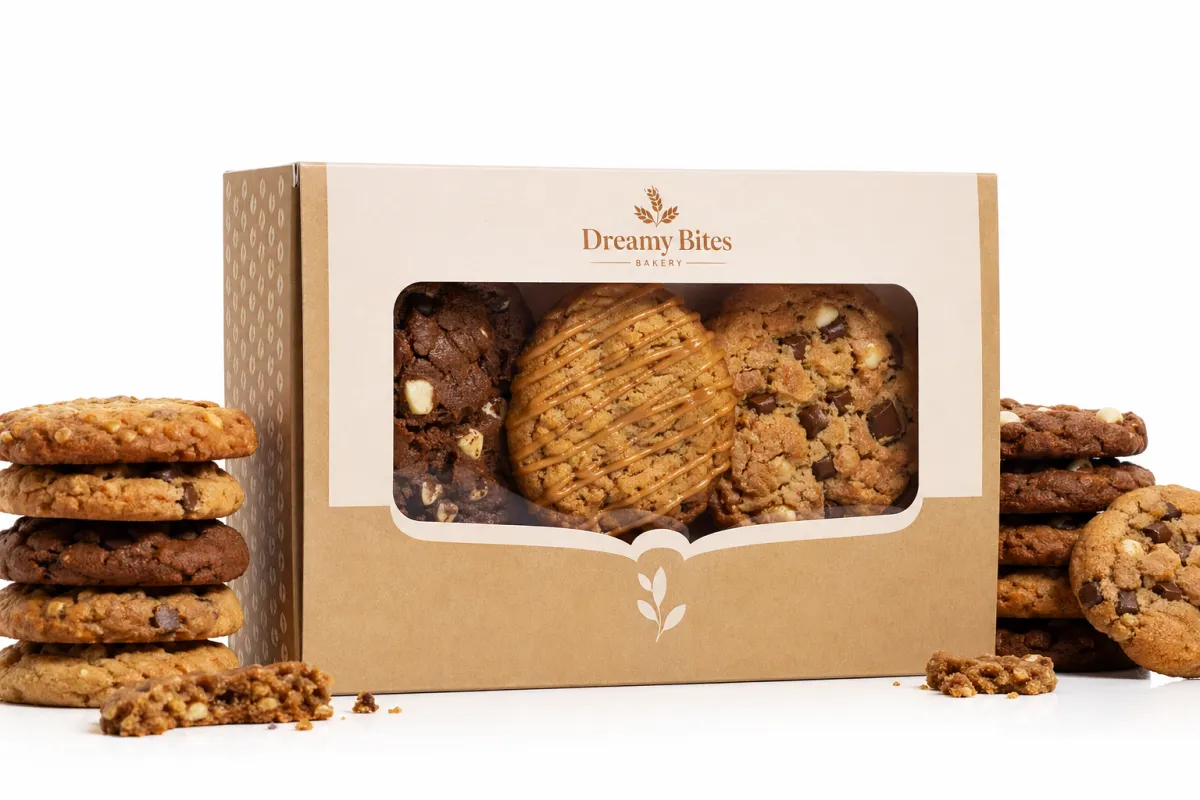
A windowed cookie box earns its keep by doing two jobs at once. It protects the product, and it shows enough of the product to shorten the sale. That sounds simple, but the shelf is a messy place. Warm lights change color, glazing reflects glare, and a box that looks fine in a studio can look oddly flat in store. A good wholesale design cuts through that noise.
I have watched buyers pick the plainer box off the shelf because the cookies inside were arranged better and the window sat at the right height. Not prettier. Better. That distinction matters. The right cut-out is not a decorative flourish; it is a visibility tool that tells the shopper, "Yes, this is the product you think it is."
For bakeries, the practical value is that a clean window reduces uncertainty. It can also lower the number of damaged-looking returns caused by customers opening a carton just to confirm freshness. No packaging fixes stale product, of course, but a well-built box prevents a lot of doubt before it starts.
There is another reason these boxes work. Wholesale buyers need repeatability. A retail program with five locations and three seasonal flavors cannot afford packaging that drifts from run to run. One box spec, one die line, one film placement, one color target. That kind of consistency is boring in the best way. It keeps the operation moving.
How do custom windowed cookie boxes wholesale drive shelf conversion?
Because shoppers buy with their eyes first, then validate with habit. When a front window aligns with a cleanly arranged cookie, the brain gets enough confidence to continue toward purchase. When that visual cue is missing, the decision process adds one more loop: inspection, doubt, comparison, and maybe a backtrack. That extra loop is where sales slip away.
The difference shows up fast in impulse zones. A product with high visual clarity usually needs one fewer interaction to convince a shopper that it is fresh, intended to eat, and worth the price point in that aisle moment. In a bakery case, one fewer pause can be the whole story.
Display pressure and conversion reality
The purchase moment is quick and sensory. A customer walks past warm pastries, gift sets, and single-serve options while trying to decide in a few seconds. A front window lets the cookie make the argument itself. Strong packaging does not need to shout. It needs to show the product cleanly and let the eye finish the sale.
One useful pattern appears again and again in store audits: if the cookies look clean, stable, and well spaced, shoppers read less risk into the purchase. If the top layer looks shifted, cracked, or crowded, conversion slips even when the artwork is expensive. That is not a branding theory. It is a custom windowed cookie boxes wholesale reality.
Premium cookies benefit even more. Glossy icing, browned edges, filled centers, and textured toppings are hard to describe in copy and easy to recognize through a clear panel. A small reveal can still drive impulse sales if the box frames the most attractive cookie without inviting crushing or smearing. Put differently: the box should show the best part and keep the messy part out of the picture.
Why visibility beats busy graphics for bakery sales
Many buyers assume the choice is about aesthetics alone. Aesthetic value matters, yet trust comes first. Shoppers look for proof before they look for claims. That is why a clean window often outperforms a dense surface packed with flourishes, badges, and repeated slogans.
For cookies with visible toppings, a custom windowed cookie boxes wholesale design should reveal texture, color contrast, and the shape of the filling. A closed box can still sell, but it usually needs a stronger discount or a stronger story to move at the same pace on a same-day shelf.
One more thing: if the cookie looks fragile, the shopper assumes the whole purchase is fragile. A better window can reverse that feeling. It tells the buyer the product was handled with care, and that cue matters almost as much as price. Maybe more, on a busy afternoon.
Wholesale math: where the margins improve first
The business case starts with scale. A standardized run of 5,000 or 10,000 units often cuts the per-box price by 15% to 35% compared with scattered local ordering, depending on board choice and finish. The savings do not stop at material cost. Labor drops, reorders get simpler, and the brand image stays consistent from one location to the next.
Inventory managers usually notice the effect quickly. One approved structure can serve multiple branches. Receiving gets cleaner. Wrong-part errors fall. Weekly and biweekly replenishment becomes easier to predict.
"The best packaging decision is usually the one that removes uncertainty. If the customer can see a tidy cookie through the window, they decide faster."
That is the practical value of custom windowed cookie boxes wholesale in bakery distribution: they reduce the risk shoppers feel at the shelf. They are not decorative extras. They are a sales tool with a measurable role.
The choice becomes clear fast. Either the box is teaching the shopper what is inside, or the shopper is forced to guess. Guessing is expensive.
Custom windowed cookie boxes wholesale product details
Core box styles that actually get used
Bakeries rarely use one box style for every program. They build a small family of formats and use each one for a different sales job. The most common options are straightforward:
- Tuck-top cartons for single-cookie packs and 4-pack retail runs.
- Sleeve boxes for light transport and a cleaner premium front face.
- Bakery display boxes with stronger sidewalls for dry cases or chilled display.
- Rigid gift-style options for holidays, corporate orders, and higher-end assortments.
Each structure behaves differently on the line. A tuck-top carton is quick to assemble and easy to stock. A sleeve can look more polished, but it often needs tighter folding control and stronger glue zones. Rigid gift packaging supports presentation and reuse, yet it raises the per-unit price and usually lifts the MOQ. That is where custom windowed cookie boxes wholesale planning starts: structure first, finish second.
In baked goods packaging, this order of operations appears simple, but teams that reverse it often pay twice. If the structure is wrong, no amount of varnish can hide the operational pain.
Window styles and cut-outs for real products
Window placement is not decoration. It changes how the box works as a physical object. Common options include:
- Front panel windows for small rectangular reveals or wider top-layer visibility.
- Top windows for controlled peek views and stacked products.
- Full-length strips for longer formats and larger assortments.
- Die-cut shapes such as arches, rounded corners, or brand motifs.
- Film windows with edge masking to keep adhesive lines out of sight and improve finish quality.
For custom windowed cookie boxes wholesale, window size is a tradeoff. Oversize openings weaken rigidity. Tiny openings hide too much of the product. For filled cookies with premium visual appeal, many teams begin with a reveal area that covers 30% to 45% of the front panel. That range often shows enough detail to prove freshness without exposing the full stack to damage.
In this range testing, it often helps to compare two mockups: one narrow confidence window and one cinematic window. The better seller is usually the one that balances confidence and protection, not the one that shows everything.
Printing and finishing for food-adjacent shelves
Packaging should read quickly. Emotional impact matters, yet legibility comes first. CMYK four-color printing gives most bakery brands a clean baseline with consistent results. Spot colors help when a logo or brand tone needs tighter accuracy than process printing can provide.
Common choices include:
- CMYK process + varnish for depth and cost control.
- Spot color matching for strict brand standards.
- Matte or gloss coating based on shelf lighting and product style.
- Foil accents for seasonal packs and premium runs.
- Embossing/debossing for tactile emphasis.
For bakeries selling both family packs and gift packs, a clean rule helps: keep the structure simple and keep the claims restrained. Dense text around the window becomes noise. Use the front for product proof and save side panels for ingredients, allergen details, and shelf-life information.
In Custom Printed Boxes, more copy is not automatically better. A box should be readable at a glance. That improves retail packaging performance and keeps the production side lighter because shorter runs and fewer screens reduce make-ready waste.
From a sourcing perspective, a stable custom windowed cookie boxes wholesale design supports faster approvals, because buyers are judging consistency, readability, and shelf confidence at the same time.
Use-case fit: singles, dozens, and assortments
One custom windowed cookie boxes wholesale template should not try to solve every SKU. Single packs need a tight aperture and minimal shifting. Dozen packs need side support and often a divider card. Assortments need a taller reveal or a custom insert so pieces do not collide in transit.
For singles, a window that frames one cookie and a short brand callout is usually enough. For dozen packs, a long strip or a centered panel makes more sense. Holiday assortments can benefit from wider visibility, but only if the cookies sit in a tray or light insert and do not crush each other under stacking weight.
Quality issues often begin here, not in the artwork stage. Teams that choose a structure based on product physics, not just appearance, usually lower defects before launch. That can save more than one percentage point of breakage on a first run, which matters a lot at wholesale scale.
If custom windowed cookie boxes wholesale are being used across channels, this stage is where a packaging supplier earns its fee. It is where hidden complexity gets translated into a reliable format.
Specifications that keep cookies safe and visible
Board and liner systems
Material choice is where many packaging programs go wrong in real use. Print quality gets the attention, then load behavior gets ignored. For custom windowed cookie boxes wholesale, the common structures include:
- SBS paperboard for crisp print quality, clean folds, and a polished shelf look.
- Kraft board for a natural tone and a strong rigidity-to-weight balance.
- Corrugated bakery cartons for heavier assortments, shipping resilience, and better stack strength.
- Food-safe liners for butter-heavy cookies, oily toppings, or humid storage conditions.
If a cookie weighs more than 40 g per unit, or if a dozen-pack crosses about 480 g total, stronger board often prevents bowing during transit. Many teams move from 300 gsm into the 400–450 gsm range for that kind of load. The exact number depends on structure, coating, and freight stress, but the pattern stays the same: weight makes weak board show its flaws fast.
In this kind of packaging, the real job is not just to look premium. It is to hold its shape after the second handoff, the third stack, and the first cold-to-warm temperature swing. That is where cheaper board starts to curl and where the better choice pays for itself.
For custom windowed cookie boxes wholesale, this is often less about luxury and more about predictable physical behavior under daily movement.
Dimensions, capacity, and fit
Most failures in product packaging happen at the tolerance stage, not during design review. A mockup can look right on screen and still chafe, crush, or shift once the product is packed. That usually comes from one of three mistakes:
- Using nominal cookie size and ignoring variation from batch to batch.
- Measuring flat space and forgetting icing height or topping spread.
- Leaving out compression from transport and changes in humidity.
A better workflow starts with the maximum cookie width, maximum thickness with decoration, a tolerance cushion of roughly 1.5–2.5 mm around each item, and then a stack-height test. A box that is even 1.5 mm too short can fail at the fold. A box that is too tall can create drift and poor window alignment.
For custom windowed cookie boxes wholesale, it helps to spec both the nominal size and the worst-case size: length, width, height, and spread for decorated dough. That extra time up front usually prevents days of adjustments later.
Functional specs for shelf life and transport
Most bakery buyers ask about shelf impact first. That is the right question. Packaging has to support the product after the box leaves the printer. Key specs include:
- Grease resistance: coating or lamination suited to butter-rich items.
- Moisture protection: useful in humid warehouses and longer distribution windows.
- Food-safe window film: clear film with stable appearance and safe contact characteristics.
- Stackability: compression tolerance for warehouse stacks and display pallets.
- Flat-shipping design: lower freight cost and stronger carton integrity from vendor to distribution center.
For transport testing, many teams reference ISTA standards during structural approval and use crush checks before release. For chain-of-custody questions tied to sourcing, FSC documentation and guidelines are useful for verifying board claims.
These details are not theoretical. Grease bleed on the top edge can ruin the final stretch of a promotion even if the cookies inside are perfect. A short liner strip or stronger inner coating often solves the issue. A loose insert can create the same problem from the inside out.
Direct food-contact rules vary by market, so the film, ink, and coating stack should be checked against the destination country before the run is approved. That check sounds tedious. It saves reprints, and it saves arguments nobody wants.
In practice, this is where custom windowed cookie boxes wholesale intersects food safety compliance. If the film edge passes, the shelf signal is strong; if it fails, the signal collapses.
Window placement and stabilization
A window only helps if the product stays where the customer expects it. For filled or soft-top cookies, a side-position window at about one-third height or a top strip with low-shrink support often works best. Crunchy styles can handle a central rectangular window and usually look stronger with that shape.
In custom windowed cookie boxes wholesale production, the window should follow the inner geometry. Curved openings may look elegant, but if the support layer is thin card, stress can collect at the edges. Rectangles are easier to die-cut and usually cheaper. Circles can look refined, yet they sometimes crack at the border unless the film reinforcement is handled carefully.
Placement should protect the top face from shear. If movement occurs, the answer is usually a shallower window, a better insert, or a divider. Otherwise, one jolt can smear frosting onto clear film and erase the premium effect the box was supposed to create.
Custom windowed cookie boxes wholesale pricing and MOQ
What actually changes the price
There is no universal cookie-box price chart. Cost shifts with a few basic variables:
- Board type: corrugated and heavier stock raise material cost.
- Box format: simple retail cartons cost less than inserts and rigid builds.
- Print colors: more colors and exact spot matches increase setup demands.
- Window shape: custom die shapes need tooling, especially with curves.
- Coating and finish: soft-touch, matte, UV spot, foil, and embossing all add cost.
- Order volume: higher runs spread setup costs across more units.
A stock-style SBS tuck-top unit usually lands far below a rigid custom box with split inserts, even if both carry the same logo. In lower and mid-volume programs, the gap can run 30% to 60% when setup complexity is high. That math belongs on the page before anyone approves a mockup that looks great and breaks the budget.
For many wholesale buyers, this is where custom windowed cookie boxes wholesale gets practical: the design has to match the sales model, not the mood board.
One helpful reality check is to ask whether the box is being bought for a short promotion or for a repeat line. A one-time holiday pack can justify a richer finish. A daily retail carton usually cannot. Same brand, different job.
| Structure | Typical MOQ | Indicative Cost per Unit | Lead Time (From Approved Proof) | Best Use |
|---|---|---|---|---|
| Standard SBS tuck-top, 2-color, small window | 2,000–3,000 units | $0.16–$0.28 | 7–10 business days | Daily retail singles, rotating flavors |
| Kraft or SBS 4-color, front/reverse print | 3,000–5,000 units | $0.24–$0.42 | 10–14 business days | Brand-led bakery programs, weekly replenishment |
| Rigid gift-style, custom dieline, premium window | 5,000–8,000 units | $0.55–$1.20 | 15–25 business days | Gift campaigns, corporate orders, holidays |
| Multi-SKU split program (2–4 designs) | 3,000 minimum per SKU / pooled run | $0.28–$0.65 | 12–20 business days | Seasonal flavors and test launches |
Unit cost matters, but it is not the whole story. A cheaper box that increases breakage or retail rejection is false economy. If a stronger design cuts damage from 3% to 1%, a 10,000-unit monthly run can save around 200 replacement units before margin is even counted. At a $4 sell-through price, that difference is real money.
MOQ logic that matches bakery cash flow
Most custom windowed cookie boxes wholesale buyers ask for the lowest MOQ possible. The right answer is conditional. Simple stock-style structures with limited tool changes can start lower, often around 2,000 units depending on finish. Fully custom dielines, inserts, or specialty coatings push the floor upward.
The rule is plain: simple structure + single film type + low color count = lower MOQ; complex structure + Custom Die Cut + premium coating = higher MOQ. Nothing mysterious is hiding in that formula. It is production complexity, labor time, and setup waste.
If cash is tight during launch month, a split program can ease the pressure. Ask whether 1,000 each of four SKUs is possible, or whether 2,000 total across three variants is easier to manage. Shelf cycle and shelf life usually decide that answer.
One useful question before locking MOQ is whether custom windowed cookie boxes wholesale are a one-time fill strategy or a repeat structural base. The second option usually gives better long-term value without increasing complexity.
Evaluate unit economics, not just print spend
Packaging should be judged against revenue, not against print cost alone. If a cookie line sells at $6 to $14, an extra $0.10 to $0.20 in packaging can make sense. If the product lands under $2.50, the same increase needs stronger proof that it prevents loss or lifts conversion.
For custom windowed cookie boxes wholesale buyers, a simple model helps:
Incremental profit = (extra shelf conversion x margin per unit) + (damage reduction x margin per unit) - (extra packaging cost + extra handling or disposal risk).
That framework keeps teams honest. I see better decisions once custom printed boxes are measured against margin instead of appearance alone. A premium look without financial discipline becomes a rush order waiting to happen.
In many audits, this one formula catches hidden losses faster than any dashboard, because it connects design choice to margin and spoilage in one line.
Budget planning by program type
Short runs are useful for test flavors, but they are not always the cheapest annual option. They often raise setup pressure and can complicate inventory planning. Seasonal replenishment needs a different approach: buy for the 3 to 6 strongest weeks, not for the entire season unless storage supports the full load.
Annual wholesale orders across multiple stores usually work best with one structural platform and two or three visual variants. That keeps setup stable while allowing artwork changes in controlled batches. For a chain with five or more locations, the model can reduce warehouse handling by 20% to 30% and lower reorder friction during peak periods.
If custom windowed cookie boxes wholesale sit at the center of your sales plan, treat packaging as recurring campaign spending rather than one-off event expense.
Custom windowed cookie boxes wholesale process and timeline
Order flow with clear checkpoints
Delays become much easier to prevent once the workflow is spelled out. A reliable process usually follows this order:
- Submit specifications: cookie dimensions, unit count, shelf location, and finish preference.
- Choose structure: tuck-top, sleeve, display, or rigid gift form.
- Define the window shape and clear film area.
- Finalize the dieline and any internal support or insert.
- Approve the digital proof for visual and technical accuracy.
- Complete the pre-production check and release sample.
- Move into production and finishing.
- Confirm packing configuration and pallet plan.
- Ship and verify receipt.
There is no hidden stage in that sequence. Buyers who confirm dimensions before quoting usually see fewer revisions and faster turnaround. For custom windowed cookie boxes wholesale, locking window size and artwork alignment early saves time everywhere else.
In multi-location bakeries, this sequence also smooths communication between branding, store operations, and finance. That is often the quiet difference between on-time launch and a missed promo window.
Where time is added, and why
Fully prepared artwork can move proofing in 24 to 48 hours, depending on the review cycle. Approved dielines also speed the process. Custom structures, inserts, and specialty coatings usually add 3 to 7 working days because setup, color calibration, and test runs take more machine time.
Seasonal gift orders can take longer once foil or spot varnish enters the job. That is not a surprise. It is a lead-time choice. Build the schedule from the review date, not from the optimism of a launch-week deadline.
A workable timeline might look like this: artwork complete at day 0, proof approved by day 2, production for a standard run at day 10, and delivery for a premium finish at day 15 to 20. Flat-pack preparation can add another 1 to 2 days depending on freight strategy.
For custom windowed cookie boxes wholesale, this timeline is more than logistics. It is a planning tool for reducing stockouts and protecting margin in busy distribution weeks.
What must be approved before production
These fields should be locked before the press starts:
- Exact external size and internal dimensions.
- Window position, shape, and edge offset.
- Material and coating specification.
- Print artwork files, preferably vector-based.
- Quantity split by variant and delivery address.
For custom windowed cookie boxes wholesale programs, incomplete instructions are the largest failure point. Two unresolved details after proof can double production risk. That usually shows up as color mismatch, fold issues, or weak film adhesion.
Compliance details matter too. Allergen panel placement, ingredient order, and label positioning should be checked with the product team before production begins. Missing that can trigger reprints and legal risk, even if the structure itself is perfect.
Shipment planning for launch and peak periods
Many bakery teams buy as enthusiasm rises and then discover that replenishment windows are narrower than expected. For custom windowed cookie boxes wholesale, planning ahead is essential around campaign launches, holidays, and school-gifting spikes.
Flat shipping should be the default. Flat packs lower freight claims, save warehouse space, and protect edges by reducing pressure inside the shipper. If pre-assembled shipping is required, cost can rise 15% to 35% depending on structure and route length.
A useful order cadence is:
- Launch prep: 6 to 10 weeks before a major rollout.
- Seasonal windows: 8 to 12 weeks for premium finishes.
- Emergency replenishment: keep a 10% to 15% buffer if possible.
This cadence is not theory. It matches what happens when a product line goes from weekly pull to predictable replenishment.
"Consistency is what scales. A team that locks the window position, material, and color profile early can serve two stores with one spec instead of two different conversations."
Why choose us for wholesale cookie packaging
Reliability over aesthetics-first proposals
Packaging procurement rewards reliability more than novelty. A buyer does not need a supplier promising miracles. They need one that delivers the right color, the right timing, and stable reorders. That is the day-to-day value of a serious custom windowed cookie boxes wholesale partner.
If you are managing 4 to 12 SKUs across a seasonal calendar, the supplier should make Wholesale Programs clear, not complicated. Clear acceptance criteria, repeatable samples, and documented specs cut a lot of friction later.
For a bakery with multi-region growth plans, the right packaging partner also manages the shift from pilot to scale without forcing redesign cycles for every quarter.
Risk control and production discipline
Packaging failures are avoidable when the production partner understands both artwork and mechanics. The work should focus on:
- Preflight checks for fold lines and film tolerances.
- Color management for consistent branding across large batches.
- Dieline consistency so replacement runs match earlier ones.
- Damage-resistant flat shipping with stable stack instructions.
For buyers, that means fewer urgent calls. A warped box is not a minor issue. It disturbs shelf layout, adds labor, and can lead to refunds. Reliable packaging execution protects shelf confidence.
In this setting, custom windowed cookie boxes wholesale quality is less about one-off inspection and more about process discipline from first cutline to final pallet.
Structural and design support included
Many teams need help turning packaging intent into production-ready files. That is where support matters beyond file upload. We help with:
- Window recommendations based on cookie mass and topper height.
- Structure selection based on store handling profile.
- Brand tone and print adjustments for bakery lighting conditions.
- Advice on balancing branded packaging with product visibility.
People often split print and structure as if they were separate decisions. They are not. The best custom windowed cookie boxes wholesale results come when the graphic team, print team, and packaging engineer line up before the proof is locked.
If you are evaluating a partner, ask whether they can provide structured options for singles, assortments, and gift channels without restarting production from scratch.
Cost control that shows after shipping day one
Good service is not only about the first shipment. The real test comes on run two, run three, and run four. Fewer setup errors, fewer corrections, and fewer overstock problems bring packaging cost per sold cookie down over time, even if the first print quote looks ordinary.
Efficient pack-out, flat shipping, and lower damage claims are not extras. They are part of the margin. Retailers gain the most when one box profile works across retail and gift channels. Forecasting gets simpler. Shelf communication gets cleaner.
If you manage a wider packaging mix, you can review linked options in Custom Packaging Products and keep the look of retail and shipping touchpoints aligned without creating branding conflicts.
In this model, custom windowed cookie boxes wholesale becomes a controllable platform for sales, not just a custom-printing line item.
Next steps for ordering wholesale cookie boxes
Step one: lock the product reality first
Most delays begin when teams delay the physical details and jump straight to design. Start with the real cookie and the real sales channel:
- Measure cookie size, height, and tolerance.
- Choose structure for weight and transport profile.
- Decide how much of the product should be visible through the window.
- Set a target quantity for each location and sales window.
That sequence gives custom windowed cookie boxes wholesale a stable starting point and reduces guesswork in quoting.
Step two: prep approval-ready assets
Before asking for production, prepare:
- Artwork files and logo files in print-ready format.
- Finish preference, such as matte, gloss, foil, or spot effects.
- Preferred board and window film assumptions.
- Shipping and delivery address details.
Once those pieces are ready, quoting and proofing move faster, and the pricing discussion stays focused on value instead of fixes. In that stage, one weak variable can wipe out the margin benefit of any custom windowed cookie boxes wholesale estimate.
For teams balancing multiple channels, this is also the point where a packaging supplier can prevent rework that usually starts as a "small" spec mismatch.
Step three: test before scale
For a new SKU, a seasonal launch, or a gift collection, request a sample or digital proof before committing to full production. That matters most when toppings vary by batch or the box faces the customer directly. A sample also helps confirm that your branded packaging looks right under actual shelf lighting.
The final question is practical: does the box protect, present, and support the sales target? If the answer is yes, approve the run. If not, fix the weak point before production starts and avoid expensive rework.
Once pricing and timing are settled, the path is clear: lock the specs, approve the proof, then place the custom windowed cookie boxes wholesale order and match replenishment to your busiest days.
If the line performs as expected, use the next quarter to tighten the spec rather than reinvent it. Better structure tolerances, cleaner windows, and repeatable proofing usually improve both conversion and margin.
FAQ
What is the minimum order for custom windowed cookie boxes wholesale?
MOQ depends on the box style, print complexity, and whether the structure uses stock tooling or a fully custom dieline. A simple retail carton with standard tooling often supports lower quantities, while rigid builds, custom inserts, and special finishes usually need a higher starting run. If you need a lower MOQ, keep the structure simple and the color count tight.
Can I choose different window shapes for wholesale cookie boxes?
Yes. Rectangles, circles, arches, strips, and custom die-cuts are all possible in typical production workflows. The best shape is the one that shows enough of the cookie while still protecting it during packing and freight. A pretty shape is nice, but a shape that protects frosting is better.
What materials work best for custom windowed cookie boxes wholesale?
SBS paperboard is common because it prints cleanly and presents well on shelf. Kraft board gives a natural look and a strong board tone. For oily or heavier products, ask about grease-resistant liners and stronger support board to reduce bowing and warping. For humid storage, ask for a coating or film stack that will not turn limp halfway through a promotion.
How long does the wholesale production process usually take?
Timing depends on proof readiness, structure complexity, quantity, and finishing level. Final artwork can move through proofing quickly, often within a few business days. Specialty coatings, inserts, and complex windows add setup time and usually extend the production schedule. If a holiday launch is involved, build in extra room because freight and approvals have a habit of eating the calendar.
Do custom windowed cookie boxes wholesale ship flat or assembled?
Most orders ship flat because that reduces freight cost and improves warehouse handling. Flat shipping generally lowers transport risk and uses space more efficiently. Assembled shipping is possible for selected programs, but it usually adds handling cost and takes more room in transit. For most bakery programs, flat-pack is the smarter default.
How do I know if the window is too large?
If the box feels soft in the hand, bows at the corners, or shows scuffing around the opening after a short transit test, the window is probably taking too much structure out of the panel. A larger window should always be paired with better board choice, better insert control, or a different placement. Otherwise, you end up with a nice reveal and a weak carton.

