Buyer Fit Snapshot
| Best fit | Custom Wine Shipping Boxes Wholesale for Safe Delivery projects where brand print, material claims, artwork control, MOQ, and repeat-order consistency need to be specified before quoting. |
|---|---|
| Quote inputs | Share finished size, material target, print colors, finish, packing count, annual reorder estimate, ship-to region, and any compliance wording. |
| Proofing check | Approve dieline scale, logo placement, barcode or warning zones, color tolerance, closure strength, and carton packing before bulk production. |
| Main risk | Vague material claims, crowded artwork, missing packing details, or unclear freight terms can make a low unit price expensive after revisions. |
Fast answer: Custom Wine Shipping Boxes Wholesale for Safe Delivery should be specified like a repeatable production item. The safest quote records material, print method, finish, artwork proof, packing count, and reorder notes in one written spec.
Production checks before approval
Compare the actual filled-product size with the drawing, then confirm tolerance on folds, seals, hang holes, label areas, and retail display edges. Reserve space for logos, QR codes, warning copy, and material claims before decorative graphics fill the panel.
Quote comparison points
Review material grade, print process, finish, sampling route, tooling charges, carton quantity, and freight assumptions side by side. A quote is only useful when the supplier can repeat the same color, closure quality, and packing count on the next order.
Custom Wine Shipping Boxes Wholesale for Safe Delivery is not a packaging slogan; it is a risk decision with real financial consequences. A single broken bottle can wipe out the margin on an entire order, and in a few cases I have seen it do more than that once freight, replacements, and customer recovery are tallied. That is why custom wine shipping boxes wholesale should be engineered around shock, stacking, and carrier handling from the first sketch, not dressed up after the fact.
Wine is a stubborn product to ship. It is heavy, glass, cylindrical, and often moving through lanes with temperature swings, so the box has to stop motion as much as it holds shape. Club shipments, gift sets, distributor replenishment, and ecommerce deliveries all ask the same thing of custom wine Shipping Boxes Wholesale: keep the bottle still and keep the brand intact. That mix is why buyers compare structure, inserts, and print before they argue over artwork.
If you are building a broader packaging program, it helps to compare Custom Shipping Boxes against the rest of your line and, where needed, align them with Custom Packaging Products. The right shipper is usually the one that fits the packing line, the bottle shape, and the carrier lane, not the prettiest mockup on a screen.
Why Custom Wine Shipping Boxes Wholesale Matter for Fragile Shipments
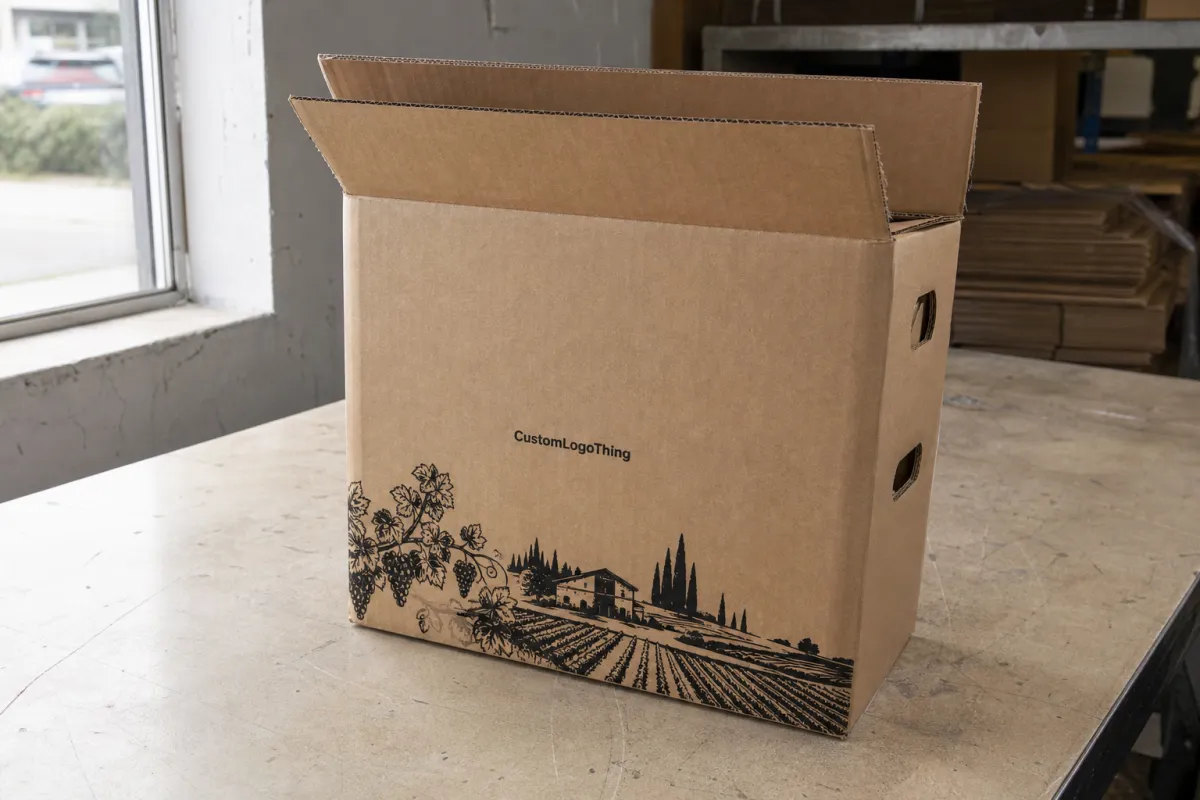
From a packaging buyer's point of view, the math is blunt. If a 12-bottle outbound order carries $240 in wine and two bottles break, the loss is not just product replacement. Freight gets paid twice, customer service gets involved, labor gets repeated, and the brand takes a hit that does not show up neatly on one invoice. Custom wine shipping boxes wholesale need to work as a protection system, not as a decorative container with flaps.
Wine shippers see more abuse than most product packaging. They get compressed in transit, dropped on corners, stacked in warehouses, and rattled through parcel networks. A box that survives only in a showroom is not enough. Custom wine shipping boxes wholesale have to hold the bottle still, absorb impact, and keep labels from rubbing against dividers or rough board edges.
Workflow matters too. Direct-to-consumer club orders often leave in waves. Gift sets may need premium custom printed boxes that look polished enough to open on camera. Distributor replenishment can call for a lower-cost structure with quick pack-out. Recurring wholesale fulfillment usually lands somewhere between those extremes. The same bottle may ship three different ways, and the packaging has to adapt without forcing the whole system to change every month.
Buying by appearance alone is a costly habit. A clean logo helps, but it will not rescue weak compression strength or a sloppy insert fit. In custom wine shipping boxes wholesale, structure does the heavy lifting. Branding should support protection, not distract from it.
"A shipper that survives the first mile usually saves money on the last mile. A shipper that fails once creates a repeat-cost loop."
Wholesalers, wineries, and beverage brands often standardize around a small set of proven formats for a reason. Training goes faster. Error rates drop. Fulfillment stays consistent when volume spikes. The right box also helps workers move faster because the insert fits correctly, the fold sequence is predictable, and the pack-out process does not force improvisation.
Custom wine shipping boxes wholesale should be judged on three measurable outcomes:
- Protection: the bottle stays centered and isolated during transit.
- Efficiency: the pack-out process stays quick enough for repeated wholesale runs.
- Presentation: the box supports branded packaging without weakening the structure.
That combination is why custom wine shipping boxes wholesale are rarely a commodity purchase. The cheapest board is not always the lowest-cost outcome, and the most attractive design is not always the one that cuts claims. I have reviewed enough shipping failures to trust one rule: the real cost often hides in the second and third order, not the first quote.
Custom Wine Shipping Boxes Wholesale: Product Details and Protection Options
Custom wine shipping boxes wholesale come in a handful of core structures, and each one solves a different problem. The right choice depends on bottle count, packing speed, print goals, and how much handling the shipment will see before it reaches the customer. There is no single perfect format, and any supplier who claims otherwise is probably overselling the easiest lane, not the hardest one.
Common box formats
Mailer-style shippers are often used for one- and two-bottle orders because they assemble quickly and usually work well for ecommerce shipping. They can include tuck-top closures, auto-lock bottoms, and fitted inserts that keep the bottle from shifting. For short parcel runs, that combination is hard to beat.
Tray-and-sleeve formats are a strong choice for gift sets or multi-bottle packs. The tray supports the product while the sleeve carries the branding. That split can improve the premium feel without turning the structure into a fragile retail packaging piece.
Telescope boxes use a top and bottom shell. They can be more forgiving for heavier bottles and higher stack pressure, especially when the program ships in mixed freight lanes. They are not always the lightest option, but they can deliver solid crush resistance.
Auto-lock structures are favored when speed matters. They fold fast, hold shape well, and work nicely with custom-fit interiors. In custom wine shipping boxes wholesale, that matters because pack-out labor can become a hidden cost very quickly.
Board, flute, and strength choices
Most parcel wine shippers use single-wall corrugated in the 32 ECT to 44 ECT range, although the actual spec should reflect bottle weight, pack count, and carrier exposure. Lighter programs often do fine with a well-designed single-wall build. Heavier runs, longer freight lanes, or palletized wholesale fulfillment may justify stronger board or double-wall construction.
Flute choice matters too. B-flute tends to balance cushioning and stacking strength, while E-flute can support sharper print detail and a cleaner retail look. Some custom wine shipping boxes wholesale programs use a combination approach: a sturdier outer box with an insert tuned to the bottle diameter. That often gives better performance than simply making the outer wall thicker.
Recycled fiber content is another factor. Buyers increasingly want corrugated with a high recovered-content mix, and many programs now request FSC-aligned sourcing when chain-of-custody documentation matters. That is not a marketing flourish. It affects procurement decisions, retailer expectations, and sustainability reporting.
Insert options that actually change performance
The insert is where many wine shippers win or lose. Corrugated dividers are inexpensive and efficient, but they may not be the best choice for odd bottle shapes. Molded Pulp Inserts provide a more contoured cradle and can reduce bottle-to-bottle contact. Chipboard partitions are lightweight and can work for lower-stress applications. Custom-fit interiors usually give the tightest movement control, which is why custom wine shipping boxes wholesale often specify them for fragile or premium bottles.
Label protection matters too. A well-designed insert keeps bottles from rubbing, and that reduces scuffing on capsules and front labels. For brands investing in package branding, that is not a small issue. A premium-looking bottle that arrives with a scratched label feels used, even if it is technically intact.
| Format | Best Use | Protection Profile | Typical Wholesale Price at 5,000 Units |
|---|---|---|---|
| Mailer-style shipper | 1-2 bottles, ecommerce orders | Good movement control with fitted insert | $0.85-$1.65 each |
| Tray-and-sleeve | Gift sets and multi-bottle presentation | Strong for display and repeat handling | $1.10-$2.30 each |
| Telescope box | Heavier or more exposed freight lanes | Better crush resistance and stack support | $1.25-$2.45 each |
| Auto-lock with insert | Fast pack-out, recurring wholesale orders | Efficient assembly with stable bottle hold | $0.95-$2.05 each |
Those ranges are not fixed quotes. Print coverage, die complexity, and insert material can move the number quickly. Still, they give buyers a realistic frame for comparing custom wine shipping boxes wholesale on something closer to landed cost instead of guesswork.
Specifications to Lock Before Ordering
Good packaging design starts with the bottle, not the box. Before a quote is finalized, custom wine shipping boxes wholesale need a clean specification set. Without it, the supplier is forced to guess, and guessing is expensive.
These are the details that should be on the table before production:
- Bottle dimensions: height, maximum diameter, shoulder shape, and neck style.
- Closure type: cork, screw cap, wax top, or a specialty finish that changes fit.
- Pack count: one, two, three, four, six, or mixed bottle configurations.
- Orientation: upright, horizontal, or a specific pack pattern required by the insert.
- Carrier method: parcel, LTL, palletized freight, or a mixed distribution model.
- Stacking requirements: how much compression the box must handle in a warehouse or on a pallet.
- Artwork needs: one-color logo, full-coverage custom printed boxes, warning marks, or interior messaging.
- Compliance marks: recycling symbols, barcode placement, handling icons, and any retailer-specific labels.
The shipper also needs a performance target. If the program is going into parcel networks, ask for design language that references ISTA test methods. If sustainability claims matter, ask for fiber sourcing that can support FSC certification. Those references are not decorative. They help define whether the packaging is expected to survive impact, vibration, and compression in a real shipping lane.
From a fulfillment standpoint, the order is easier when the spec sheet is complete. That sheet should answer six questions:
- What bottle is being packed?
- How many bottles ship in each unit?
- What is the outer box dimension?
- What insert style prevents movement?
- What print and labeling are required?
- What performance level has to be met?
That one-page approach saves time in revisions and reduces the chance that the artwork team, the operations team, and the supplier are all working from slightly different assumptions. In custom wine shipping boxes wholesale, that kind of misalignment is where delays usually begin.
It also helps to decide early whether the packaging is primarily product packaging or a display piece. If the box is going straight into the mail stream, durability wins. If it opens in a customer-facing setting, branded packaging and presentation matter more. Most programs need both, but one should lead the design brief.
One practical caveat: lab-style specs do not always match the rough edges of a real fulfillment center. A box that performs in a controlled test can still fail if the insert is hard to load, if the adhesive is weak in humid storage, or if the carton is overpacked by a busy warehouse team. That gap between theory and practice is where careful buyers earn their keep.
Custom Wine Shipping Boxes Wholesale: Pricing, MOQ, and Quote Factors
Pricing is where many buyers get pulled in the wrong direction. A low unit price looks good on paper, but custom wine shipping boxes wholesale should be compared on total landed cost: material, setup, inserts, freight, damage rate, and assembly labor. That is the number that tells the truth.
The biggest cost drivers are easy to spot. Larger boxes use more board. Stronger board costs more. Complex inserts add tooling and assembly time. Full-coverage printing raises the print bill. Specialty finishes, such as soft-touch lamination or foil accents, can lift the price fast. The more custom the structure, the more likely the order will need a higher MOQ to justify setup.
MOQ should be viewed in context. Prototype quantities are often small because they are meant to verify fit and structure, not to support a production program. Production runs are different. Higher volumes usually spread die costs and setup costs across more units, which is why custom wine shipping boxes wholesale become more efficient as the run scales.
A proper quote should include:
- Structural setup and dieline work
- Sample or prototype pricing
- Insert pricing by material type
- Print method and color count
- Freight assumptions
- Any one-time tooling or plate charges
- Special handling or packaging requirements
The quote should also make clear whether the pricing assumes stock board, recycled-content board, or a certified fiber program. That matters because buyers often compare custom wine shipping boxes wholesale without noticing that one quote includes a sturdier spec and the other does not. Apples-to-oranges comparisons are common, and they lead to bad buying decisions.
A useful range for a serious wholesale program, excluding freight and unusual tooling, looks like this:
- Simple one-bottle shipper: about $0.75-$1.40 each at volume.
- Two-bottle shipper with insert: about $0.95-$1.85 each.
- Four- to six-bottle shipper: about $1.30-$3.20 each.
- Premium printed format with specialty insert: often above $2.50 each, depending on coverage.
Those numbers shift with quantity, season, and print coverage. They still matter because they show how a slightly more expensive box can be the cheaper outcome if it cuts breakage, relabeling, or pack-out time. In custom wine shipping boxes wholesale, the cheapest quote is not always the best value. Sometimes it is the most expensive mistake.
Lead time pressure changes the picture too. If the job needs rushed plates, expedited freight, or extra proofing turns, the total can climb. A buyer who wants stable pricing should lock the spec early and avoid late changes to dimensions or artwork.
Process, Timeline, and Production Steps From Quote to Delivery
A good supplier should make the buying process feel orderly, not vague. For custom wine shipping boxes wholesale, the sequence should be predictable because every late correction adds cost and creates risk.
- Inquiry: share bottle dimensions, quantities, and shipping method.
- Quote review: compare structure, insert, print, and freight assumptions.
- Dieline or structure review: confirm the box format fits the bottle and the line.
- Artwork proof: check copy, placement, barcodes, and handling marks.
- Sample or prototype: verify fit and movement control before volume production.
- Approval: sign off on structure, print, and final specs.
- Production: run the order with in-line checks and quality control.
- Shipment: schedule freight or parcel delivery based on the approved plan.
Delays usually show up in the same three places: incomplete dimensions, missing artwork files, and last-minute changes after proof approval. Custom wine shipping boxes wholesale move faster when the buyer sends a clean spec sheet and responds quickly to proof questions. Slow approvals are expensive because production windows are narrow and corrugated schedules do not flex endlessly.
Lead time varies by complexity. A repeat order with an approved structure can often move in about 12-15 business days from proof approval, sometimes faster if the line is already set up. A new custom build with inserted components, new print plates, or full-coverage artwork may need 15-25 business days, especially if the sample stage uncovers a fit issue.
That timeline reflects the number of checkpoints that protect the shipment:
- Prepress verification: catches art and barcode mistakes before print.
- Structural signoff: confirms the bottle sits correctly in the insert.
- Sample approval: lets the buyer see how the box behaves in hand.
- In-line quality control: keeps print registration and board quality in range.
- Final pack-out review: confirms the box still works on the actual fulfillment line.
Communication cadence matters too. Buyers should expect updates when the proof is ready, when the sample ships, when production begins, and when freight is booked. If the supplier goes quiet during these stages, the program usually has a weak process behind the scenes. That is not the place to discover it.
If your order is part of a broader rollout, it can help to align it with Wholesale Programs. That makes quantity planning, repeat specs, and reorder timing easier to manage across seasonal demand spikes, especially when the same bottle needs to ship in different channels.
Good process is not glamorous. It is just what keeps custom wine shipping boxes wholesale from turning into a recurring scramble every time the sales team closes a new account or the warehouse sees a volume jump.
Why Buyers Source Custom Wine Shipping Boxes Wholesale Here
The real advantage is control. When a supplier manages design, manufacturing, and repeat production under one roof, the buyer usually gets fewer handoff errors and faster decisions. That matters a lot in custom wine shipping boxes wholesale because the box is not a static item. It has to fit changing bottle profiles, packing styles, and brand requirements over time.
Direct manufacturing also makes revisions easier. If a bottle shape changes slightly, if the logo placement needs a correction, or if the insert needs a tighter cavity, the feedback loop is shorter. That improves packaging design and reduces the chance that a small fit issue becomes a costly production error.
There is another reason buyers care about direct production: repeatability. A broker-only model can work for simple jobs, but complex custom printed boxes often need better structural testing, more precise print registration, and clearer accountability when something does not match the proof. In custom wine shipping boxes wholesale, that consistency is not a luxury. It is the difference between a packaging program and a guessing game.
From a brand perspective, the box has a second job. It represents the product before the bottle is opened. A clean outer shipper, consistent print, and clear messaging support package branding while the insert quietly does its protective work. That is the combination most buyers actually want.
Here is the uncomfortable truth: the hidden cost of weak packaging is usually larger than the cost of the packaging itself. Breakage creates claims. Claims create replacements. Replacements create extra freight and labor. When the customer receives a damaged bottle, the brand absorbs a credibility hit that is much harder to measure than a shipping invoice.
That is why custom wine shipping boxes wholesale should be judged by measurable outcomes, not by adjectives. Ask whether the box cuts damage. Ask whether it improves order fulfillment. Ask whether it keeps the packing line moving. Those are the questions that matter.
If you are building a broader program beyond wine, it is worth comparing the wine shippers with the rest of your Custom Packaging Products line. The same supplier may be able to standardize board choices, print methods, and structural logic across multiple products, which often reduces purchasing complexity.
"The cheapest box is the one that arrives intact. Anything else is just deferred cost."
That sentence sounds blunt because the numbers are blunt. A single percentage point of breakage can undo months of careful pricing work. In custom wine shipping boxes wholesale, the right supplier is the one that treats that reality as an engineering problem, not a branding problem.
Next Steps to Order Custom Wine Shipping Boxes Wholesale
Start with the facts. Before you request pricing, gather the bottle dimensions, pack count, target quantity, shipping method, print needs, and any labeling rules that must appear on the shipper. That small amount of prep makes custom wine shipping boxes wholesale much easier to quote accurately.
Then ask for a sample or structure review, especially if the bottle has unusual shoulders, a thick base, or a closure that changes the fit. Custom wine shipping boxes wholesale are far more predictable after one physical fit check than after five rounds of email guesses.
It also helps to separate the quote into distinct pieces. Ask for the box structure, insert cost, print cost, and freight to be listed separately. That way you can compare options on the same basis and see where the money is actually going. A quote that blurs those lines is hard to evaluate.
For buyers managing recurring programs, the checklist is short and practical:
- Confirm exact bottle dimensions.
- Choose the pack count and shipping orientation.
- Define the outer box style and insert type.
- Specify print coverage, barcode placement, and compliance marks.
- Set the volume target and reorder schedule.
- Approve a physical sample before production begins.
That sequence keeps the order grounded in measurable details instead of assumptions. It also gives the supplier enough information to recommend a box that fits the bottle, the warehouse, and the carrier lane instead of guessing at all three.
Orders that skip the sample stage often pay for it later. One small cavity mismatch can turn into a relabeling issue, a damaged capsule, or a loose bottle that rattles across a long haul. A sample costs far less than a claim.
If the goal is recurring wholesale supply, lock the spec after the first approved run and keep a record of the approved dieline, board grade, insert material, and print file. That file becomes the control point for every reorder. It is a simple habit, and it saves time every season.
The practical takeaway is straightforward: do not buy custom wine shipping boxes wholesale as if they were generic cartons. Start with the bottle, confirm the lane, test the insert, and only then finalize print. That order of operations is what keeps the packaging honest and the damage rate low.
FAQ
What makes custom wine shipping boxes wholesale different from standard shipping boxes?
Wine shippers need to control movement, absorb vibration, and protect glass under pressure. Standard shipping boxes may carry the weight, but they rarely account for bottle geometry, insert fit, or the repeated handling that wine shipments face. Custom wine shipping boxes wholesale are built around those conditions, which is why structure and insert design matter so much.
Do custom wine shipping boxes wholesale need testing before production?
Yes. A sample or prototype should be checked before full production, especially for new bottle shapes or higher-value shipments. Fit testing catches movement problems, label scuffing, and closure issues before the order scales. For parcel shipments, many buyers also ask for performance language tied to ISTA-style testing. That does not replace real-world validation, but it gives the order a measurable target.
What insert material works best for wine shipments?
It depends on the bottle and the shipping lane. Corrugated dividers are efficient for straightforward programs. Molded pulp gives a more contoured fit and can reduce bottle contact. Custom-fit interiors often perform best when the bottle shape is unusual or the wine has premium packaging. The right answer is the one that keeps the bottle still without slowing the line.
How should I compare quotes for custom wine shipping boxes wholesale?
Compare total landed cost, not just unit price. Include material, insert type, setup, print, freight, tooling, and assembly labor. A lower quote can be misleading if it uses weaker board or a looser insert that raises breakage rates. A quote that is slightly higher on paper can still save money if it lowers claims and speeds pack-out.
What information should I have ready before requesting a quote?
Have the bottle dimensions, pack count, shipping method, desired box style, insert preference, artwork files, and any compliance marks ready. The clearer the spec, the faster the quote and the lower the risk of revisions. That preparation is especially useful for custom wine shipping boxes wholesale because fit errors become expensive quickly.
Can custom wine shipping boxes wholesale support branded packaging without losing strength?
Yes, if the structure is designed with the print in mind instead of being decorated after the fact. Strong corrugated, a well-fitted insert, and print coverage that respects fold lines can support branding while keeping the box durable. The best programs treat branding and protection as the same design problem, not separate ones.

