Two knit samples can look almost identical on a table and still behave very differently in the real world. One rebounds cleanly after a stretch. The other bags out, pills early, or feels scratchier than it looked in the flat lay. That is the practical reason a wine club Pom Pom Beanies material sample guide matters before you commit to a full run.
Wine club merch has a different job than a generic winter hat. It is part gift, part brand signal, and often part membership experience. That means the beanie has to feel considered, not just warm. If it looks cheap or wears badly, the club notices. So do the people wearing it.
A good sample process saves money, but more than that, it keeps you honest. It shows whether the yarn, lining, cuff, pom, and decoration zone actually work together. A render can promise a lot. A sample tells the truth.
Wine Club Pom Pom Beanies Material Sample Guide
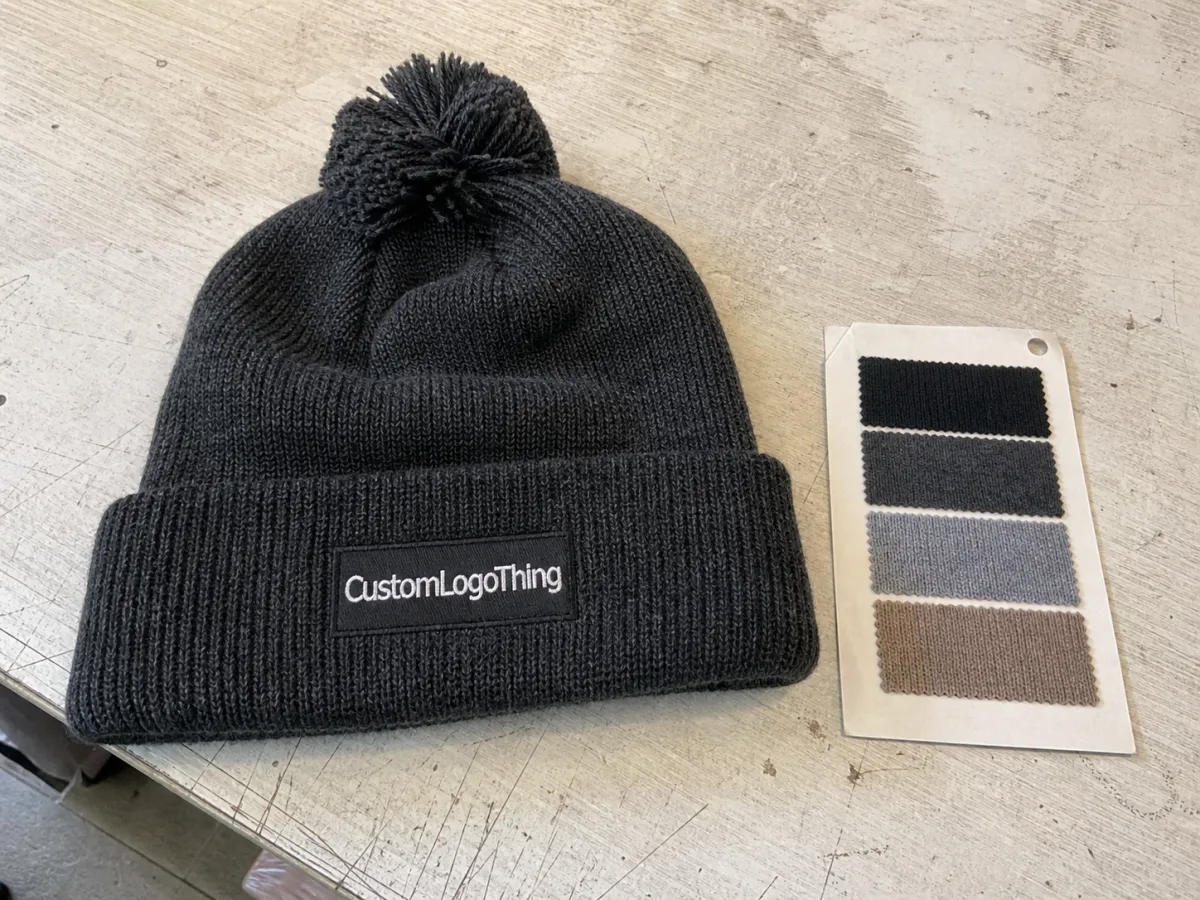
A useful sample for this category is more than a loose swatch in a plastic sleeve. It should show the yarn spec, knit gauge, cuff structure, pom style, and the decoration method you plan to use. If the final product will carry an embroidered logo, woven label, leather patch, or small appliqued mark, the sample should include that detail on the actual fabric. Otherwise, you are still guessing.
The smartest sampling starts with the end use. Is this a holiday gift for members, a premium item in a club shipment, or staff wear for cool-weather events? Those are different briefs. A member gift usually needs a cleaner surface and a more polished finish. Staff gear may need stronger recovery, easier care, and less concern about slight weight changes from lining or thread count.
Material choice drives most of the feel, but construction is what decides whether the hat behaves well after a few wears. Tight, even stitches usually read as more premium than a loose knit with uneven loops. A cuff with enough structure helps embroidery sit flat. A pom that is centered and firmly anchored makes the beanie look finished instead of improvised. Those details are small on paper and obvious in hand.
A sample can photograph beautifully and still fail the moment someone stretches it, packs it, or wears it for an evening outside.
The point is not to demand perfection from the first round. The point is to surface the weak spots early. If the fiber blend feels soft but loses body too quickly, you want that problem in sampling, not production. If the hat is warm but too heavy for comfortable all-day wear, that needs to come out before the order is locked. The sample is there to expose tradeoffs, not hide them.
For wine clubs, brand alignment matters as much as warmth. The hat should fit the tone of the program. A cellar-facing team might want a restrained, durable style. A direct-to-member holiday drop can support a more giftable feel, with a fuller pom or a richer yarn blend. The same silhouette can be right in one setting and awkward in another.
What a Swatch Reveals About Fit, Stretch, and Wear
A flat swatch tells you more than color. It shows how dense the knit is, how much the fabric opens under tension, and whether it comes back into shape after being stretched. That recovery matters on a pom pom beanie because the crown has to hold its form and the cuff needs to keep a clean line. A hat that slumps in week one is already a problem.
When I review a swatch, I look at three things first: elasticity, recovery, and seam behavior. Elasticity tells you how easily the knit expands. Recovery tells you whether it rebounds. Seam behavior tells you whether side seams, cuff folds, or lining attachments will create bulk or irritation. A yarn can feel lovely in the hand and still fail once it is folded, stitched, and worn against skin.
Handfeel alone is not enough. Plush can be misleading. A very soft surface may feel premium for ten seconds and then start to pill, trap lint, or feel uncomfortably warm under a hood. Color can mislead too. Knit samples should be checked in daylight and in indoor light because heathered and melange yarns can shift more than buyers expect. Screen images help with direction. They do not replace a real sample.
Decoration compatibility is another place where people cut corners. A loose structure can distort embroidery. A bulky seam can make a woven label sit crooked. A patch can look sharp on paper and clumsy on a stretchy cuff. If the design depends on a logo placement, test it on the actual sample body, not on a separate scrap. That is the only way to know whether the decoration lands flat or fights the knit.
One simple wear test catches a lot of trouble: wear the sample for an hour, take it off, and inspect the crown, cuff, and side seams. Then stretch it lightly and see whether it returns cleanly. If it comes back slowly, or not at all, the knit is too soft or too loose for the job. That is the kind of issue that never looks dramatic in a spreadsheet and always looks obvious on a head.
Fit also changes depending on who will wear it. A one-size beanie that works for staff with short hair may sit differently on someone wearing long hair, a bun, or glasses. If the club audience is broad, the sample should be tested on more than one head shape. That sounds obvious. It is still skipped constantly.
Choosing Yarn, Lining, and Pom Materials That Match the Brand
Yarn choice is where comfort, consistency, and budget start to split apart. Acrylic is usually the simplest baseline. It is widely available, takes color predictably, and tends to produce more consistent results across larger lots. Wool blends feel warmer and more premium, but they can introduce itch, care limitations, and more variation between dye lots. Recycled blends deserve a hard look if sustainability is part of the club story, as long as the knit still has good recovery and the surface stays clean.
The yarn weight and knit gauge matter just as much as the fiber content. A finer yarn with a tighter gauge usually gives a smoother face and better logo definition. A chunkier knit feels more casual and can read heavier on the head. That may be exactly what you want, or it may make the hat too bulky for gift packaging. There is no universal winner. The sample has to answer the question for the specific program.
The lining changes the wearing experience more than many buyers expect. An unlined beanie is lighter, easier to fold, and usually less expensive. Fleece lining improves warmth and comfort in colder climates, but it also adds weight and can reduce stretch at the cuff. Thermal linings can work for outdoor tastings, cellar crews, or mountain-region clubs, but they need to be checked for bulk. A lining that looks clean in the spec sheet can feel thick around the ears if the pattern is not balanced.
Poms deserve their own decision. They are not just decoration. Yarn poms create a cohesive, classic look and tend to match the body color closely. Faux-fur poms feel more premium and read better in gift sets, but they add visual volume, raise cost, and sometimes change the silhouette more than expected. If the pom is too heavy, it pulls the crown down. If it is too small, the beanie looks unfinished. Test it on the actual hat, not in isolation.
Attachment method is easy to overlook and hard to fix later. A pom that is lightly tacked may twist, loosen, or ship poorly. A secure attachment should still allow the hat to keep its shape. If the sample includes a removable pom, check the closure carefully. It should feel intentional, not like an afterthought built to save one step in production.
| Material Option | Look and Feel | Performance Notes | Typical Cost Impact |
|---|---|---|---|
| Acrylic knit | Soft, consistent, easy to color match | Good recovery when the gauge is firm and the pattern is balanced | Lowest base cost; usually the easiest option for controlled budgets |
| Wool blend | Warmer, more traditional, more premium in hand | Can itch for some wearers; care labels and shrinkage checks matter | Usually adds about $0.70-$2.00 per unit |
| Recycled blend | Modern, sustainability-forward, sometimes slightly less uniform | Check recovery, pilling resistance, and surface smoothness carefully | Often adds about $0.40-$1.50 per unit |
| Fleece-lined knit | Warmer and more structured | Better for colder climates, but heavier and less flexible in wear | Usually adds about $0.90-$2.50 per unit |
Packaging should be specified with the same discipline as the hat itself. Many buyers now ask for FSC certified cartons, kraft paper tissue, or corrugated cardboard mailers made with recycled materials or post-consumer waste content. A lower-impact unboxing moment can fit the brand well. Biodegradable packaging can also make sense. Just do not forget the practical part: packaging has to protect the sample in transit, not just look neat on a mood board.
Think like a shipping department for a minute. Delicate embroidery, a bulky pom, or a loose knit can get crushed if the box is too small or the inner wrap is weak. For longer routes or multi-touch logistics, transit testing standards from ISTA are useful. They help you check whether the outer carton, insert, and inner protection are doing their job. That matters if samples are moving through several hands before approval.
Pricing, MOQ, and Sample Kit Costs to Plan For
Sample pricing and production pricing are connected, but they are not the same line item. A sample fee usually covers development time, setup, yarn allocation, and the labor needed to create a prototype or small batch. Some vendors credit that fee back against the first bulk order. Others do not. Ask early. A $75 sample fee is a different conversation from a refundable sample charge.
The biggest cost drivers are predictable: yarn type, knit complexity, lining, pom construction, decoration method, color count, and packaging. A single-color acrylic beanie with a yarn pom is going to quote very differently from a wool-blend beanie with fleece lining, a woven label, and a faux-fur pom. Small choices add up. Even something as simple as a contrast cuff or denser gauge can move the price in a way that matters once the order scales.
MOQ affects both price and risk. Lower minimums usually mean higher unit costs because setup gets spread across fewer hats. Larger runs often reduce the per-unit price, but they also increase inventory risk if demand is overestimated. For seasonal merchandise, that tradeoff should be discussed honestly. It is often smarter to pay a little more per unit for a tighter quantity than to end up sitting on boxes of winter hats in spring.
Here is a realistic planning range many buyers use as a starting point:
- Simple sample swatch: often $15-$40, depending on yarn and dye setup.
- Full knitted prototype: often $45-$150, depending on decoration, lining, and pom style.
- Production unit price: roughly $3.20-$5.50 for a simple acrylic style at higher volume, or $5.50-$10.50 for more premium builds with lining or specialty poms.
- Setup and art fees: can add $25-$150, especially if you need multiple decoration placements or revisions.
- Freight and packaging: should be quoted separately so the landed cost stays visible from the start.
The landed cost is where budgets get messy. A beanie that looks affordable on paper can turn expensive once you add split shipments, label revisions, packaging inserts, and rush freight. If the order is going into a gift box or a club kit, ask whether the box uses corrugated cardboard, kraft wrap, or printed cartons, and whether that spec is already approved before sampling begins. That avoids expensive backtracking later.
Process and Timeline for Sample Approval
A clean approval process usually moves in a straight line, but it still needs time. First comes the brief: target wearer, logo placement, color direction, budget, and delivery date. Then the vendor selects yarn and stitch options, builds a swatch or prototype, and sends it out for review. After that, the buyer checks fit, finish, color, pom shape, and decoration details. If revisions are needed, the cycle repeats until the sample is ready for sign-off.
Turnaround depends on what is being requested. A simple yarn swatch can move much faster than a fully knitted sample with lining and decoration. A preproduction piece takes longer because it should reflect the actual build process, not a simplified version of it. If you need several options, build in time for side-by-side comparison. A few extra days spent comparing samples is cheaper than forcing a bad bulk order through production.
Color review deserves its own time block. That matters even more for wine club merchandise, where the hat may need to sit next to bottle packaging, membership materials, or a seasonal campaign. If the beanie has to match a specific burgundy, olive, charcoal, or cream, ask for a physical standard instead of relying on a screen. Light changes everything. Deep red under warm indoor light can drift browner than expected. Under daylight, it can look cleaner and cooler. That is normal. It is also why screen-only approvals are risky.
Timeline pressure causes bad decisions. If the club drop date is fixed, work backward from that date and set the sample deadline first. Not the production deadline. The sample deadline. Once that is in place, everyone has a reference point. If approval slips late, the likely result is rushed substitutions, higher freight, or a simplified build that was never the first choice. None of those are good surprises.
One more constraint deserves mention: seasonal factory capacity. Beanie programs spike before fall and holiday gifting windows. That means simple requests can take longer than expected if the production queue is already full. The sample may be easy. Getting the same build repeated at scale may not be. Planning buffer time is not being conservative. It is being realistic.
Common Mistakes That Cause Reorders or Returns
The most common mistake is approving from photos alone. A photo can flatten the texture, hide seam bulk, and make the knit look tighter than it really is. It can also overstate or mute color depending on lighting and editing. If the order matters, ask for a physical sample whenever possible and keep a labeled keeper sample once the final choice is made.
Another problem is choosing the softest yarn without checking recovery. A plush sample can feel luxurious in the hand and still lose shape quickly in wear. That is especially risky for a high-crown beanie, because the top can sag before the season is over. I would rather see a slightly firmer knit that holds its line than a dreamy sample that collapses after a few outings.
Poms create their own headaches. A heavy pom can drag the beanie off balance. A poorly anchored pom can loosen during shipping or handling. A pom that looks stylish on a tabletop can look oversized once the hat is on a head, so test it in context. Put it on, step back, and judge the silhouette from a normal viewing distance. That simple check catches a lot of “why does this look off?” moments.
Decoration errors are another easy way to waste money. A logo placed too close to a seam can warp when the hat stretches. A patch can sit fine in a flat photo and then buckle when worn. Embroidery thread that looks clean on one yarn color may disappear on another. The sample should be checked for alignment, legibility, and distortion under normal wear, not just on a table.
End-use testing is the last easy win. Wear the sample for a full day if you can. Try it over glasses, over a ponytail, and under a jacket hood. Fold the cuff. Unfold it. Pack it into a tote. These small checks reveal scratchiness, stretch problems, and fit issues that a five-minute inspection will miss. The point is to catch the annoyance before members do.
Packaging integrity matters too. If the beanies are being shipped in branded kits, make sure the insert cards, tissue, and outer cartons are strong enough for the route they will travel. FSC materials can support the brand story, but they still need to be specified correctly. Sustainable packaging is only useful if it arrives intact and protects the product inside.
Expert Checks and Next Steps Before You Place the Order
Before you approve anything, score every sample the same way. A simple sheet with seven columns is enough: fit, recovery, warmth, handfeel, color accuracy, pom balance, and decoration compatibility. Rate each one from one to five, then write one sentence about what you noticed. That removes some of the vagueness from the decision and makes the tradeoffs easier to discuss with the team.
Compare samples in different light if you can. Daylight, office light, and the environment where the hat will actually be worn can make the same knit read very differently. A vineyard patio, a tasting room, and a delivery shelf do not show material the same way. A deep charcoal can look richer indoors and flatter outside. A pom that feels dense in a close-up can look oversized from across the room. Context matters more than the mood board admits.
Documentation is the last piece, and it is the one that protects production. Record the fiber content, knit gauge, pom style, lining choice, decoration method, acceptable color tolerance, and packaging spec. If final approval lives only in an email thread, people will misread it later. If it is written clearly, production has a real target and the buyer has something to point back to if questions come up.
The best use of a wine club Pom Pom Beanies Material Sample guide is simple: it filters out weak options before they become expensive. A good sample confirms value, clarifies the tradeoffs, and helps the club land on something members will actually want to wear. If it passes the practical checks, you can move into production with more confidence than a mockup alone will ever give you. That is the difference between a seasonal item that gets remembered and one that gets shoved into a drawer.
How many samples should I request for wine club pom pom beanies?
Request at least three yarn or color options so you can compare handfeel, recovery, and appearance side by side. If possible, include one pom variation and one lining variation so you evaluate the full finished look, not only the knit body. Keep one labeled keeper sample after approval so later production runs can be checked against the same standard.
What material works best for a wine club pom pom beanies sample kit?
Acrylic is often the easiest starting point because it is consistent, cost-effective, and widely available in stable colors. Wool or wool-blend samples usually feel more premium and warmer, but they should be checked for itchiness and care requirements. Recycled blends can be a strong choice when sustainability matters, as long as the knit still has good recovery and a clean surface.
Can I approve wine club pom pom beanies from photos only?
Photos are useful for early comparison, but they do not show stretch recovery, weight, or how the pom changes the silhouette. Ask for a physical sample whenever possible, because texture and fit are much easier to judge in hand. If shipping is slow, request close-up video, flat-lay measurements, and daylight color references as a backup.
What affects the final cost of pom pom beanies the most?
Fiber choice, lining, and pom construction usually drive the biggest price swings. Decoration method, color count, and setup complexity also matter, especially if the design uses multiple placements. MOQ and freight can change the landed cost significantly, so ask for a fully broken-out quote.
How long does the sample and approval process usually take?
A basic swatch can move quickly, but a full knitted prototype and decoration review usually take longer. Revision rounds add time, especially when multiple stakeholders need to review the fit and finish. Build in extra buffer before a seasonal drop or club shipment so late approvals do not force a rushed production decision.


