One of the smallest parts of a garment often does the heaviest branding work, and Custom Woven Labels for boutique brands are a good example of that quiet influence. A customer may never study the stitching line by line, yet they will notice whether the label feels crisp, soft, flimsy, or fully finished, and that impression starts forming before the piece is even tried on.
That is why label choice matters so much in apparel presentation and product packaging. A woven label is not only an identifier; it becomes part of the product’s visual language, helping signal fit, care, origin, and the level of discipline behind the brand. For boutique labels, that small rectangle can support premium positioning in a way a printed sticker or generic tag rarely can.
There is also a practical layer. Labels have to survive sewing, shipping, washing, and repeated handling, so the best-looking option on a mockup is not always the best option in production. A label that frays, scratches, or loses clarity after a few laundry cycles creates problems that reach beyond aesthetics.
Why boutique labels do more than mark a garment
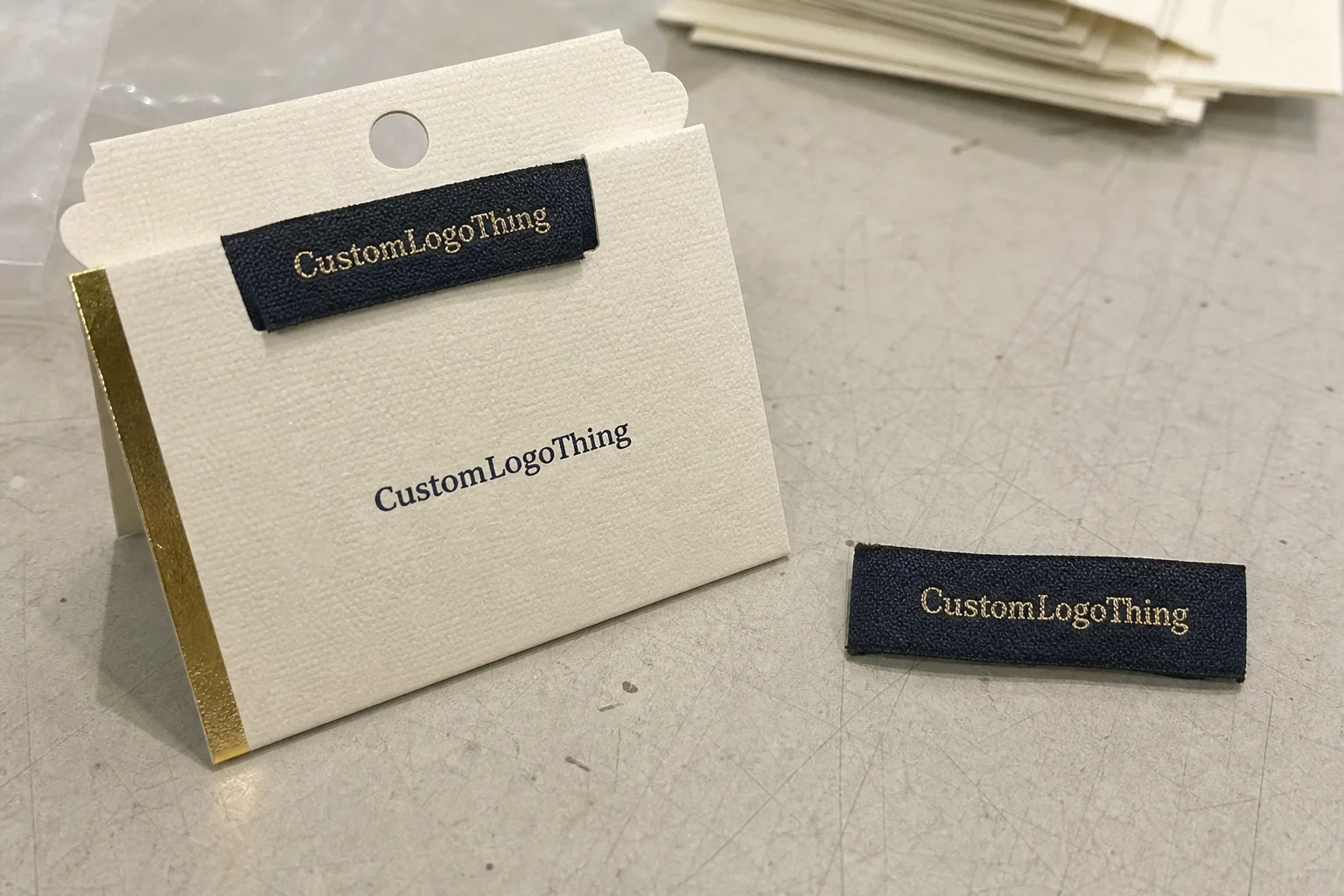
A woven label does several jobs at once. It tells the customer who made the item, yes, but it also communicates how much care went into the garment itself. In practice, the hand-feel of the label, its edge finish, and the way it sits in a seam all contribute to the buyer’s judgment of quality. That is why many brands choose Custom Woven Labels for boutique brands instead of simple printed alternatives.
From a packaging buyer’s point of view, labels are part of package branding, even when they live inside the garment rather than outside the box. They work alongside tissue, hang tags, inserts, and other Custom Packaging Products to create one consistent presentation. If the label looks sharp and intentional, the rest of the brand experience feels more credible.
Woven labels also tend to age better than many printed formats. Ink can crack, peel, or fade depending on the substrate and wash conditions, while woven thread usually keeps its structure longer. That does not mean every woven label is automatically durable enough for every use; the thread type, weave density, and garment fabric still matter. But for boutique brands that want a cleaner finish on knitwear, denim, outerwear, or accessories, woven construction is often the more reliable choice.
“A label is small, but the customer reads it as a quality signal. If the label feels cheap, the garment often gets judged the same way.”
For brands that care about retail packaging and presentation, the label is part of the front-line experience, not an afterthought. It should work with your packaging design, your care instructions, and your product story, not fight against them.
How custom woven labels are made and attached
Woven labels are built by weaving threads together on a loom rather than printing artwork onto a surface. That construction is why they feel so different in the hand. The design is created as part of the weave itself, which gives the label its texture, definition, and durability. For Custom Woven Labels for boutique brands, that process usually determines how much detail the logo can realistically carry.
The two most common constructions are damask and taffeta, with satin-style finishes used in some premium applications. Damask is generally finer and better for small text or detailed logos because it allows tighter thread counts and cleaner edges. Taffeta is usually more economical and a little less detailed, while satin can feel smoother and show more sheen. The right choice depends on the garment, the brand style, and how much visual detail the artwork needs to preserve.
Attachment style matters just as much as the weave. A label can be center folded, end folded, loop folded, straight cut, or sewn directly into a seam. Each fold changes how the label sits on the product and how visible the edges are. On a delicate blouse, a soft fold and low-profile weave may be best. On denim or workwear, a straight-cut label or a side-seam application may be more practical.
- Center fold: common for neck labels and size labels
- End fold: often used for side seams or clean edge presentation
- Loop fold: useful when the label needs to hang from a seam
- Straight cut: best when the label will be sewn on all sides
- Seam insert: integrated into construction for a tidy finish
Artwork complexity has limits. Thin fonts, tiny symbols, gradients, and photo-like details do not translate well into a woven format. Thread count and label size affect how much information can fit legibly. If a logo needs to read clearly at 1 inch wide, the design usually needs simplification before production starts. That is one reason a clean, bold mark often performs better than an overcomplicated one.
One production detail that gets overlooked is yarn direction and edge behavior. Some labels feel smooth in one direction and slightly more structured in another, especially after folding and sewing. A label that looks fine loose on a sample card can sit differently once it is anchored into a seam, so the sewn sample matters more than the flat proof.
Key specs that shape quality, cost, and feel
If you are comparing quotes for custom woven labels for boutique brands, the biggest cost drivers usually come down to five things: size, weave type, color count, fold style, and quantity. That sounds simple, but each one can move the final price and the customer experience in a noticeable way. A label that seems inexpensive on paper can become costly if it forces a second round of approval or looks unreadable on the garment.
Label size matters because it changes both how much detail you can fit and how much material is used. A 1" x 1.5" label may suit a small logo mark, while a 1" x 3" label can hold branding plus a care line or size indicator. Bigger is not always better, though. On light garments or delicate knits, an oversized label can feel bulky and annoy the wearer.
Thread count and weave quality affect clarity. Finer damask weaves can capture thinner lines and tighter lettering, but they often cost more than standard weaves. If your logo includes small serif text, a lower-resolution weave may blur the details. That is where many boutique brands lose value: they try to save a little on the label and end up with a finish that looks less premium than the garment itself.
Edge finish and backing choices influence comfort and application, especially on knitwear, activewear, and lightweight tops. A rough edge or stiff backing can scratch skin or distort a soft fabric. On denim jackets or bags, that stiffness may not matter much. On base layers or children’s clothing, it matters a lot.
Thread color count is another practical lever. More colors can make a logo more faithful to the original artwork, but every additional color adds production complexity. In small-run work, the cost difference may not be dramatic by itself, yet it compounds with fine detail and specialty folding. Keeping artwork disciplined usually pays off better than squeezing in one more shade that barely registers once sewn.
| Spec choice | Typical effect on feel | Typical effect on cost | Best use case |
|---|---|---|---|
| Damask weave | Soft, detailed, premium | Higher | Fine logos, boutique apparel |
| Taffeta weave | Simple, slightly firmer | Lower | Basic branding, lower-detail art |
| Satin finish | Smooth, slightly glossy | Moderate to higher | Fashion-forward pieces, soft hand-feel |
| Center fold | Clean and tidy in seams | Usually moderate | Neck labels, side labels |
The cheapest option is not always the best value. A better label can reduce complaints, support stronger branded packaging, and make the product feel more complete. That matters whether you are selling through your own site, a boutique retail shop, or a limited-drop collection that depends on strong first impressions.
For standards-minded brands, it can also help to think about overall packaging quality and testing expectations. Resources from groups like the ISTA can be useful when you are planning how the product will ship and survive handling, while the EPA offers guidance on materials and environmental considerations that may matter if you are aligning with sustainability goals. Labels may be small, but they sit inside a bigger production system.
Custom woven labels for boutique brands: process and timeline
The typical workflow starts with artwork review and digitizing. That is the step where a designer or supplier translates your logo into a woven format, adjusting line thickness, spacing, and color boundaries so the label can actually be manufactured. If the art is clean and provided at the right size, this step moves quickly. If it is fuzzy, cropped, or missing measurements, the timeline slows down immediately.
After digitizing, most suppliers issue a proof or sample image for approval. This is where you check spelling, color order, fold style, and final dimensions. If the label is going into a garment seam, you also need to confirm that the stitch line will not swallow key text or expose a rough edge. From there, the label enters production, then cutting, folding, and finishing, and finally shipping. For straightforward labels, the total process often lands around 12 to 15 business days from proof approval, though complex artwork or larger quantities can extend that window.
Delays usually come from avoidable issues: late feedback, unclear artwork, unexpected color mismatch, or a change in label dimensions after proofing. More than one launch schedule has slipped because someone approved the mockup without checking whether the label would sit correctly in the seam. That is a small mistake with a large ripple effect, because sewing and packing usually cannot start until labels are ready.
Build a buffer into your calendar. If garment production, custom printed boxes, and shipping cartons are all landing at the same time, the label order should be locked early enough to avoid bottlenecks. Boutique brands often work on tighter launch windows, so even a one-week slip can create pressure across the whole fulfillment plan.
A practical schedule might look like this:
- Finalize logo artwork and placement measurements.
- Approve digitized proof and thread colors.
- Allow time for sample checks if the design is detailed.
- Schedule production after approval, not before.
- Keep a shipping buffer before sewing and packing begin.
For broader context on branded product presentation and apparel labeling, you can also review Case Studies and compare label options through Custom Labels & Tags. Those resources help when you are narrowing the gap between what looks good on a screen and what works on a finished garment.
Production timing can also vary by season. Before major wholesale deadlines or holiday drops, lead times tend to stretch because label orders compete with larger apparel runs. If your collection depends on a hard release date, it is safer to place the label order earlier than you think you need to.
Cost, MOQ, and quote factors buyers should compare
Pricing for custom woven labels for boutique brands depends on more than the unit price in a quote. Material, weave detail, size, fold type, color count, and order volume all shape the final number. Special finishing, such as extra cutting, custom backings, or specific folding, can also influence cost. When a quote looks unusually low, it is worth checking what is missing.
For small boutique runs, minimum order quantity, or MOQ, can be the hardest part. Small runs usually pay more per label because setup costs are spread across fewer pieces. A run of 1,000 labels will usually cost more per unit than 10,000, even if the design is the same. That is normal manufacturing math, not a supplier trick.
Here is the part many buyers overlook: you need to compare total landed cost, not just headline unit cost. A quote that excludes proofing, setup, freight, taxes, or import charges may look attractive at first and then get less attractive very quickly.
For practical planning, a simple woven label in a larger quantity can sit in a lower per-unit range, while a fine-detail damask label with custom folding and a small MOQ can cost noticeably more. Exact pricing varies too much to rely on a single number, but the spread is wide enough that spec decisions matter almost as much as volume. If a supplier can quote your exact size, weave, color count, and finish, that quote is usually worth more than a vague “starting at” price.
| Quote item | What to confirm | Why it matters |
|---|---|---|
| Unit price | Per label at your exact quantity | Lets you compare apples to apples |
| Setup / digitizing | Included or billed separately | Affects small-run economics |
| Proofing | Digital proof or physical sample cost | Helps catch artwork errors early |
| Shipping | Freight method and destination | Can change landed cost sharply |
| Taxes / duties | Who pays and when | Prevents budget surprises |
Think about the label alongside the rest of your retail packaging spend. If you are already investing in strong hang tags, tissue, cartons, and inserts, the label should match that level of care rather than undercut it.
There is also a value question beyond the invoice. Labels that hold up well can reduce rework, customer complaints, and inconsistent presentation across a product line. In a boutique setting, that consistency carries real weight because the customer is often comparing your garment with higher-priced competitors and expects the finishing details to feel deliberate.
Common mistakes boutique brands make with woven labels
The most common mistake is trying to put too much into a small woven space. Thin fonts, tiny legal text, gradients, and overly intricate logos often lose clarity once translated into thread. The result can look busy or muddy, especially on small neck labels. If the design needs to explain everything, it is probably doing too much.
Another issue is color contrast. A label that looks strong on a white screen may disappear when sewn into a dark garment, or vice versa. Always check the label against the actual garment color, because thread contrast is one of those details that looks trivial until the finished goods are on the rack.
Underordering is another expensive habit. Boutique brands sometimes buy only what they need for the first run, then find themselves facing a reorder with a different dye lot, a slightly changed fold, or a deadline that is too tight. Consistency matters, especially if you want product packaging and apparel branding to feel aligned across seasons.
- Do not choose a font that is too small to weave cleanly.
- Do not stack too many colors into a tiny design.
- Do not approve art without checking garment color contrast.
- Do not forget seam placement and wearer comfort.
- Do not treat size labels, care labels, and branding labels as separate silos.
That last point matters more than people think. A size label that clashes with the brand label can make the interior of the garment feel disorganized. A coordinated label system, on the other hand, makes the product feel intentional from the inside out. For boutique brands, that internal consistency reinforces trust just as much as the outer box does.
Another frequent problem is approving a beautiful proof without checking how the label behaves after trimming and folding. A design can look balanced on a flat screen and still crowd the seam allowance once stitched in. If the garment uses a narrow seam, keep the label width modest and leave room for the fold so the edge does not curl or bulk up.
Expert tips for ordering the right label the first time
Start with the garment, not the artwork. That sounds backwards, but it saves a lot of trouble. A label that looks perfect on paper may be too stiff for silk, too small for outerwear, or too rough for a baby tee. Determine the placement first, then size and spec the label to fit the fabric and the sewing method.
If your logo has thin lines, gradients, or fine text, request a sample or a detailed proof before approving production. That small step can prevent a costly mistake. Most suppliers can flag issues early, but only if they have enough information to work with. Share the final logo, target size, color references, and garment placement when you Request a Quote.
Standardize wherever you can. One core label spec across multiple collections makes reordering easier and helps keep your branding consistent. That does not mean every garment must use the exact same label, but it does mean you should avoid changing thread colors, fold styles, and sizes casually from one drop to the next. Consistency is a quiet strength in branded packaging and apparel branding.
If you are choosing between comfort and visibility, give the garment the first say. A label that is highly visible but irritating to wear can still create negative feedback, especially in close-to-skin products. The best label usually disappears in use while remaining clear enough to identify the brand and care information at a glance.
Here is a simple pre-quote checklist:
- Final logo file or artwork
- Finished label size
- Fold style and edge finish
- Quantity needed, with a buffer
- Garment type and placement location
- Target launch date
- Any special comfort or wash requirements
If you are building a full packaging system, the label should sit comfortably beside the rest of the brand’s materials, from hang tags to Custom Packaging Products. That is where the best custom woven labels for boutique brands earn their keep: they make the product feel finished, recognizable, and ready for the customer the moment it is unpacked.
A final practical tip: keep one archive file for every approved label version, including the exact size, fold, thread colors, and placement notes. That record makes future reorders faster and protects you from quiet spec drift that can happen when a design gets passed from one season to the next.
Frequently asked questions
What makes custom woven labels for boutique brands better than printed labels?
Woven labels are made from threads rather than ink on a surface, so they usually feel more premium and hold up well through repeated washing. They also tend to keep their appearance longer than some printed labels that can crack, fade, or rub off with wear. Boutique brands often choose them because they reinforce a finished, higher-value product impression.
How much do custom woven labels cost for small boutique runs?
Pricing depends on size, weave detail, fold style, color count, and order quantity. Small runs usually cost more per label because setup and loom preparation are spread across fewer pieces. The best way to compare true cost is to request quotes using exact specs, then look at the landed total rather than just the unit price.
What is the usual turnaround for woven label production?
Turnaround depends on proof approval, design complexity, and the size of the order. Simple labels often move faster, while detailed artwork or larger quantities can add time. A good planning rule is to build extra buffer into your production calendar so the labels arrive before sewing and packing begin.
What artwork details are needed before ordering woven labels?
Provide the final logo, finished size, color references, and your preferred fold style if you already have one. It also helps to share the intended placement on the garment, because that affects sizing and comfort. If the design includes thin lettering or fine lines, make sure those details are large enough to weave clearly.
Can boutique brands use one woven label across multiple product types?
Yes, as long as the label works for each fabric and placement location. A soft damask or satin-style label may suit apparel better than a firmer construction for delicate garments. Standardizing one core label can simplify reorders and keep branding consistent, provided it remains readable and comfortable across product types.
Should boutique brands order extra labels for future runs?
Usually, yes. A modest overage can prevent dye-lot differences or last-minute rush orders later, especially if the design will stay in use across multiple drops. The right buffer depends on sales volume, but ordering only the exact forecasted quantity is often risky for growing brands.