Custom Woven Labels for cosmetics brands may be a small component, but they often do more visual and tactile work than the carton, insert, or shipping sleeve they accompany. Beauty buyers notice this quickly. The label is usually touched first, seen in close-up, and kept long after the outer packaging has been discarded, which gives it an outsized role in how the product feels.
For packaging teams, woven labels sit between trim and branding asset. They add polish without requiring the cost profile of a full printed component, and they hold up well on reusable items such as cosmetic bags, spa accessories, travel kits, satin pouches, and gift sets. That makes them especially useful in beauty packaging programs where the accessory needs to look premium, survive repeat handling, and still fit a controlled budget.
There is also a practical reason brands keep returning to them: they make even a modest item feel considered. A well-built woven label can lift a pouch or accessory immediately. A poorly specified one can do the opposite and make the entire package feel less finished than it should.
Why woven labels can outlast the packaging they’re sewn onto
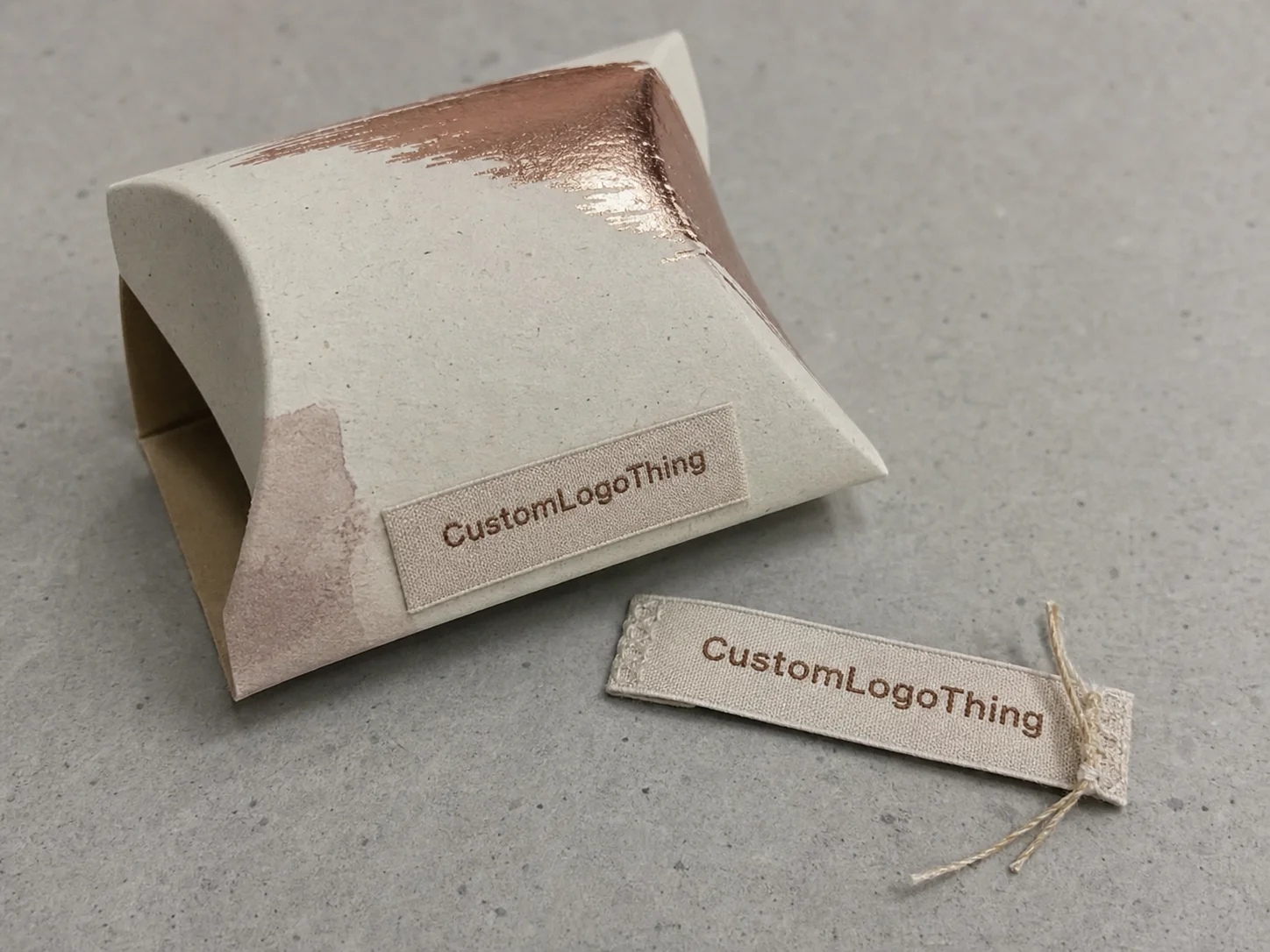
On many beauty accessories, the woven label survives longer than everything around it. Paper hang tags come off, cartons get recycled, and outer wraps are often discarded within minutes. A pouch, headband, storage sleeve, or makeup bag may stay in use for months. Because the design is built from thread rather than printed on top of the surface, the branding can remain legible and intact through far more handling.
That construction matters. A woven label is not ink sitting on a coating or film; it is a textile structure in which the artwork is formed by interlaced threads. The result is a softer hand feel than many printed trims and a more durable appearance on products that are touched frequently, folded, washed occasionally, or packed and repacked.
For Custom Woven Labels for cosmetics brands, the best use case is usually an accessory, not the primary formula container. The label is a strong fit for reusable pouches, beauty tool bags, spa headbands, sample kits, and retail gift packaging where the item itself is part of the brand experience. These are products that are photographed, unpacked, reused, and often gifted, so the trim needs to look good from several angles rather than only on a shelf.
There are limits, though. Woven labels are not the right answer for every beauty application. If the artwork is extremely detailed, if the placement area is narrow or curved, or if the label must carry a lot of compliance text, a printed or satin solution may be more practical. The smartest buyers do not start with the label type; they start with the item, the wear pattern, and the amount of information that actually needs to fit.
“The label isn’t just identifying the brand. In beauty, it often does the quiet work of making the entire accessory feel worth keeping.”
That is why woven labels show up so often in premium gift sets and retail accessories. They signal care without being loud about it.
How custom woven labels for cosmetics brands are made
The production process begins with artwork, but not every logo file is ready for weaving as-is. A supplier has to translate the design into thread logic, which means line weight, text size, spacing, weave density, and edge finish all need to be reviewed before the loom is set up. What looks clean on a screen can become crowded once it is converted into a textile format.
The usual workflow is straightforward, though a few steps are more important than new buyers expect. It typically moves through artwork review, quotation, proofing, sampling or strike-off, production setup, weaving, cutting, finishing, inspection, and shipment. If a program includes multiple sizes, colors, or versions, each variation may need its own setup, which affects both lead time and cost.
Thread density is one of the biggest technical decisions. Higher-density constructions, often referred to as damask-style weaving, are better for fine detail, small letters, and clean logo edges. Lower-density structures are more economical and can still look polished, but they work best with bold marks and simple shapes. If the logo depends on hairline strokes or tiny type, the label size and weave density have to be considered together, not separately.
Common attachment styles include:
- End fold for side-sewn applications
- Center fold for seams, loops, or folded placement
- Straight cut / sew-on for flat attachment
- Heat-seal backing when another application method is required
In cosmetics packaging, woven labels may be added during bag assembly, sewn onto a reusable merchandise piece, or attached during fulfillment if the product is built in stages. That flexibility matters because beauty programs are often assembled across more than one vendor. The label is only one part of the final package, but it still has to line up with the larger schedule.
Sampling is where many problems are caught early enough to matter. A strike-off shows whether the brand color reads correctly, whether the logo remains legible at the chosen size, and whether the edge finish feels soft or scratchy. It also exposes a common issue that digital proofs hide: a design can look balanced on screen and still disappear once it is woven into thread. That is why experienced buyers rarely approve woven labels from artwork alone.
For teams also coordinating Custom Labels & Tags, the sample stage is the best time to compare woven and printed options side by side, especially if the line includes both premium accessories and more text-heavy components.
Key specs that affect look, durability, and brand fit
Material construction is the first decision that changes the outcome. Damask-style weaving is usually the premium option because it can reproduce finer detail and cleaner letterforms. Simpler weave structures are more affordable and can still look refined, but they are better suited to bold logos, larger icons, and uncomplicated layouts. If your brand mark relies on thin serifs or delicate line work, ask whether the label can truly support that detail at the intended size rather than assuming it will translate cleanly.
Size comes next, and it affects far more than just how much space the label occupies. A one-inch label and a two-inch label tell different production stories. Small formats often require a simplified wordmark or an icon-only version, while larger labels allow more room for brand name, borders, and secondary text. A smaller version is not automatically a downgrade; in many cases, it is the more disciplined design choice.
Color is where buyers can overestimate what woven construction can do. Thread palettes are broad, but exact Pantone matching is rarely literal. A thread color can read warmer, cooler, darker, or softer depending on the yarn itself, the weave density, and the surrounding colors in the label. Good suppliers will provide thread charts and explain where close matching is realistic and where it is not. That conversation is worth having before proofs are approved.
Attachment style also affects comfort, especially for cosmetics accessories that sit near the skin or are handled repeatedly. A label that feels scratchy against the face, neck, or hands will be noticed very quickly. For that reason, edge finish and fold style are not cosmetic decisions only; they affect how the product is experienced in use.
Compliance can complicate things further. Some brands want care symbols, fiber content, origin marks, or regulatory language on the same label as the logo. That is possible in some cases, but not always legibly. If the text becomes too small, the woven label turns into decoration instead of information. Many beauty teams solve that by using one woven branding label and a separate care label, which is usually cleaner and easier to read.
For brands balancing sourcing language and sustainability claims, it helps to use recognized references rather than vague wording. The FSC matters for paper-based components, while broader packaging decisions may be shaped by guidance from The Packaging School and testing expectations from ISTA when a component must survive shipping and distribution.
Here is a practical comparison buyers often use during spec review:
| Label type | Best use | Typical strengths | Watch-outs |
|---|---|---|---|
| Woven label | Reusable pouches, spa accessories, premium kits | Durable, tactile, refined look | Fine detail can get lost |
| Printed label | Dense text, very small artwork, short runs | More flexible for text and detail | Less tactile, may wear sooner |
| Satin label | Soft-touch apparel-style applications | Comfortable, good drape | Can feel less structured on bags |
For packaging design, the right choice is usually the one that matches how the item will be used. A luxury gifting sleeve does not need the same construction as a DTC subscription pouch. Many teams make the mistake of choosing from a mood board alone, then discovering too late that the actual product use case needs something different.
Cost, pricing, and MOQ: what buyers should expect
Pricing depends most heavily on size, color count, detail level, finishing, and order volume. Sampling revisions can also add cost before production even begins, so buyers should budget for at least one proofing round and possibly a second if the artwork is still being refined.
Lower quantities almost always carry a higher unit price because setup costs are spread across fewer pieces. That does not mean the quote is inflated; it means the economics of short-run customization are different. Once volume increases, the unit cost usually falls, sometimes significantly. The math is simple, even if the first quote still feels higher than expected.
As a rough buyer range, simple woven labels for cosmetic accessories may land around $0.12-$0.25 per unit at mid-sized quantities, while more detailed constructions, specialty folds, or smaller runs can move higher. MOQ policies vary widely. Some suppliers support test launches and seasonal drops with lower minimums, while others are structured for scale and price more competitively only once volume reaches a certain threshold.
That is why landed cost matters more than the quoted unit price. Sampling, freight, rush charges, and any revision-related delays can change the economics quickly. A label that looks inexpensive per piece can become less attractive once shipping and setup are included. Comparing true delivered cost is the cleaner way to evaluate options.
To compare quotes fairly, the specs have to match exactly. Size, weave density, fold style, color count, and quantity all need to be identical. Otherwise, one quote may be for a denser weave, another for a smaller label, and a third for a different finish. Those are different products, not comparable bids.
Compared with printed alternatives, Custom Woven Labels for cosmetics brands usually cost more up front but often deliver better perceived value on reusable items. That extra spend can be easy to justify on a premium launch or gift set. On a disposable accessory or a piece that needs a lot of text, the value equation changes.
| Option | Relative cost | Durability | Best for |
|---|---|---|---|
| Woven label | Medium | High | Premium accessories, repeated handling |
| Printed label | Low to medium | Medium | Small text, short-run projects |
| Basic sewn tag | Low | Medium | Budget retail packaging, simple branding |
Production steps, timeline, and lead time planning
A realistic timeline starts with the brief, then moves into artwork review, proofing, sample approval, weaving, finishing, inspection, and shipping. For simple orders, the process can often move in about 12-15 business days after proof approval. More complex designs, multiple revisions, or peak production periods can extend that window.
Delays usually come from a series of small issues rather than one large failure. A color adjustment here, a size change there, a delayed approval from the packaging team, or a missing final logo file can push the schedule out. Cosmetics launches are especially vulnerable to this because labels are often treated as a final accessory instead of a component that should be planned alongside the rest of the packaging.
It helps to schedule labels together with Custom Packaging Products, inserts, and bags, not after them. If the line also includes custom printed boxes, the full packaging set should be mapped to one launch calendar. Otherwise, a single missing item can hold up the whole order, even if the label itself is already approved.
Build extra time into the schedule if the order involves:
- Multiple SKUs
- Seasonal gift sets
- Subscription shipments
- Retail launch windows
- International freight with longer transit times
Rush service can help, but it changes the economics quickly. Air freight on a small order can cost more than the labels themselves, and expedited production usually reduces flexibility for revisions. If the delivery date is fixed, communicate it early. Suppliers can often work around a hard deadline if they know about it at the start, but not if they hear about it after proof approval.
Common mistakes brands make when ordering label artwork
The biggest mistake is over-detailing the design. Thin lines, tiny serif type, and intricate illustration work often blur once woven. On a small label, simplicity is not a compromise; it is a production requirement. The artwork has to be built for thread, not for a zoomed-in screen preview.
The second mistake is approving color from a monitor alone. Screens vary, brightness settings are inconsistent, and thread behaves differently from RGB. A physical sample or thread chart is the only reliable reference when brand color accuracy matters. If a shade needs to feel exact, the team should verify it in hand rather than assuming the monitor was accurate.
Another common problem is trying to fit too much copy into a single woven label. Legal text, care instructions, fiber content, and branding rarely fit comfortably in the same small space. Many teams get better results by separating the functions: a woven label for identity and a separate care label for regulation. That approach is usually cleaner and easier to read.
Placement mistakes can be just as costly. A label sewn onto a rough seam, a curved edge, or a high-friction area can feel irritating and distort the artwork. For cosmetics accessories, especially items held near the face or used repeatedly, comfort is part of the product experience.
The replenishment issue is often overlooked until it becomes a problem. Brands frequently order only for the launch quantity, then discover a few months later that the product is selling well and the label stock is nearly gone. A second run means another setup and another wait, which can slow replenishment right when the item needs to stay available. From a product packaging standpoint, it is better to plan the re-order before the first order ships.
Expert tips for choosing a label spec that sells the brand
Start with the use case, not the mood board. A luxury gifting set, a spa retail pouch, a subscription beauty accessory, and a promotional travel kit do not need the same label spec. The more clearly the item’s role is defined, the easier the label choice becomes.
One practical approach is to prepare two versions of the artwork: a primary logo and a simplified secondary mark. The full version can be used where size and detail allow, while the simplified version works better on smaller woven formats. That is especially useful for Custom Woven Labels for cosmetics brands that need to appear across pouches, wraps, and accessory trims without feeling cramped.
Test the label against the real material before final approval. Nylon, cotton, velvet, satin, and coated synthetics all behave differently. A label that looks elegant on a flat proof can feel too stiff or too small once sewn onto the actual pouch. Material testing is a more reliable guide than guessing from digital artwork.
Before placing the order, ask a few practical questions:
- What thread chart is available?
- Can I see a strike-off or digital proof?
- Which attachment methods fit the item?
- What is the minimum order quantity by spec?
- How are revision rounds handled?
It also helps to consider how the label interacts with the rest of the packaging system. If the pouch, box, insert, and accessory all share a consistent visual language, the set feels more intentional. The label should support that system rather than compete with it. For teams coordinating broader packaging decisions, the best results usually come from thinking about the full branded package together instead of treating each component as an isolated purchase.
My practical view is simple: the best label is not the loudest one. It is the one that makes the product feel more premium without becoming scratchy, awkward, or overdesigned in hand.
Next steps: how to order with fewer surprises
A one-page spec sheet prevents a lot of back-and-forth. Include dimensions, logo files, color references, attachment method, quantity, and target delivery date. The more exact the brief is at the start, the fewer surprises there will be in quoting and proofing.
Then collect at least two quotes using the same specifications. If one supplier is quoting a different fold, a different weave density, or a different size, the comparison is not valid. You are not comparing pricing on one product; you are comparing different constructions.
Ask for a sample or proof before approval, then check three things in hand: readability, edge quality, and fit on the actual cosmetic item. If it looks good on the screen but awkward on the product, the screen is not the final decision-maker.
For brands that reorder regularly, tie the label schedule to launch calendars and best-selling SKUs. That keeps labels from becoming the item that slows down replenishment, seasonal kits, or retailer reorders.
Handled well, custom woven labels for cosmetics brands become one of the most efficient ways to add perceived value, improve durability, and strengthen presentation without overcomplicating the packaging program. The key is to match artwork, budget, and production timing before the order is placed, not after the rest of the package is already locked.
Are custom woven labels for cosmetics brands better than printed labels?
Woven labels usually last longer and feel more premium on reusable cosmetic accessories. Printed labels can be more economical and may work better for very small text or highly detailed artwork. The right choice depends on the item’s use, expected wear, and brand positioning.
What size works best for cosmetic bag woven labels?
There is no single best size, but most bags need enough room for a readable logo and a clear brand name. If the design includes fine text, increase the size or simplify the layout. Always test the label on the actual product before approving production.
How much do custom woven labels for cosmetics brands cost?
Pricing depends on size, color count, weave complexity, finish, and order quantity. Lower quantities usually have a higher unit cost because setup is spread across fewer pieces. Ask for quotes with the same specs so you can compare suppliers fairly.
What is the typical turnaround time for woven labels?
Turnaround usually includes proofing, sample approval, weaving, finishing, and shipping. Simple orders can move faster than highly detailed or heavily revised designs. Rush timelines may be possible, but they can increase cost and reduce flexibility.
Can woven labels include care instructions or legal text?
Yes, but space is limited, so keep copy short and highly legible. Many brands place regulatory text on a separate care label to avoid overcrowding the branding label. Review compliance requirements before finalizing artwork.


