Buyer Fit Snapshot
| Best fit | Custom Zipper Pouches Bulk projects where brand print, material claims, artwork control, MOQ, and repeat-order consistency need to be specified before quoting. |
|---|---|
| Quote inputs | Share finished size, material target, print colors, finish, packing count, annual reorder estimate, ship-to region, and any compliance wording. |
| Proofing check | Approve dieline scale, logo placement, barcode or warning zones, color tolerance, closure strength, and carton packing before bulk production. |
| Main risk | Vague material claims, crowded artwork, missing packing details, or unclear freight terms can make a low unit price expensive after revisions. |
Fast answer: Custom Zipper Pouches Bulk: Pricing, Specs, and MOQ should be specified like a repeatable production item. The safest quote records material, print method, finish, artwork proof, packing count, and reorder notes in one written spec.
Production checks before approval
Compare the actual filled-product size with the drawing, then confirm tolerance on folds, seals, hang holes, label areas, and retail display edges. Reserve space for logos, QR codes, warning copy, and material claims before decorative graphics fill the panel.
Quote comparison points
Review material grade, print process, finish, sampling route, tooling charges, carton quantity, and freight assumptions side by side. A quote is only useful when the supplier can repeat the same color, closure quality, and packing count on the next order.
Custom zipper pouches bulk is usually the better buy when a brand wants lower freight, cleaner shelf presence, and packaging people can open, close, and actually use. Swap out a stiff carton, a heavy jar, or a flimsy bag that tears in transit, and the numbers change fast: less material, less storage space, faster packing, and a better customer experience that still looks good on the shelf. That matters to product teams. It matters even more to procurement teams, because the savings show up in more than one place.
Most buyers do not need another glossy packaging speech. They need a package that protects the product, prints well, and does not eat margin for breakfast. That is where custom zipper pouches bulk makes sense. It fits repeat SKUs, subscription programs, test launches, and retail packaging that needs a strong brand face without dragging around the cost of rigid packaging. If the product needs freshness, portability, or easy resealing, a zipper pouch is the practical move.
I have seen teams spend weeks arguing over label shapes and end up fixing the wrong problem. The package was fine. The barrier was not. The zipper was cheap. Or the pouch looked sharp, but the fill line was wrong and half the units bowed in the box. That stuff is boring until it is sitting in a warehouse eating money. Get the spec right first, and the design work has room to do its job.
Why Custom Zipper Pouches Bulk Beat Rigid Packaging
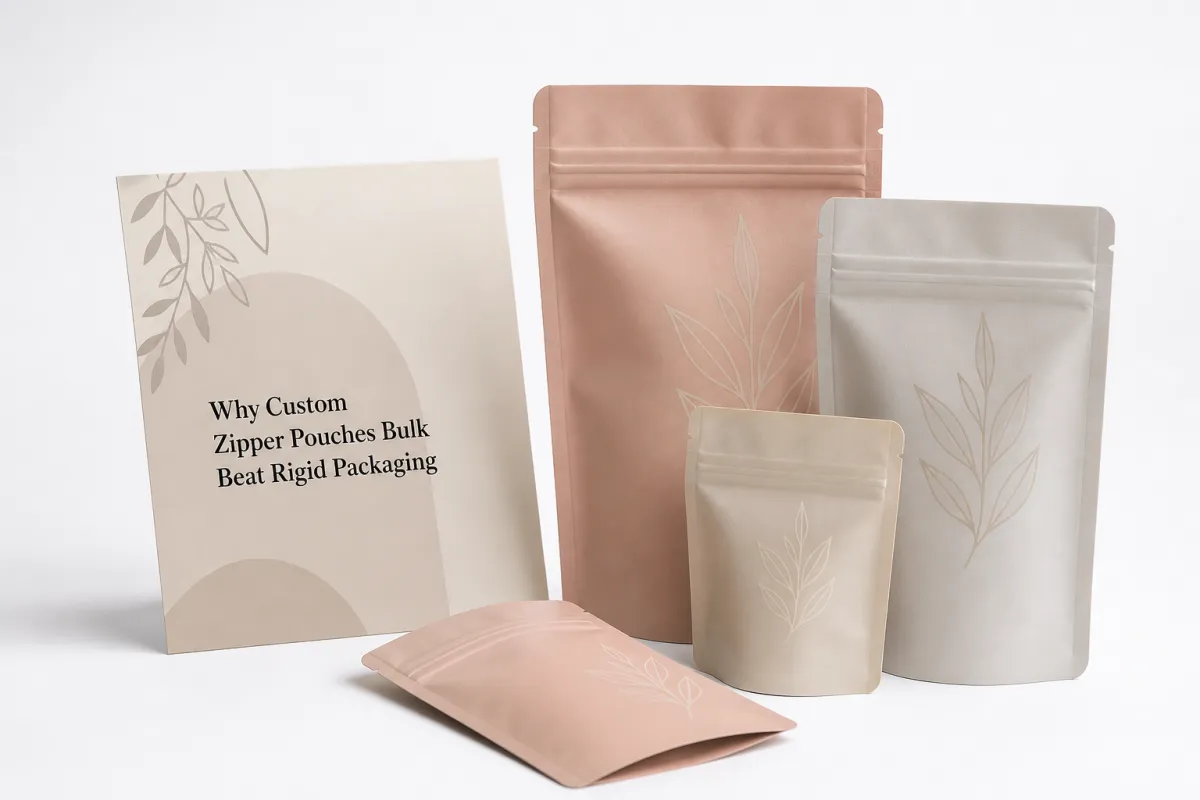
Custom zipper pouches bulk beat rigid packaging for one simple reason: they do more with less. A pouch can hold the product, protect it, stand upright, close again, and still take up less room in storage and on a pallet. Boxes can do part of that. Jars can do part of that. Bags can do part of that. A well-built zipper pouch usually handles all of it at once, which is why it shows up everywhere from snacks and coffee to supplements, pet treats, and dry goods.
The freight side is hard to ignore. Corrugated cartons and rigid tubs take up more cube than a flexible pouch, and cube is where shipping budgets get rude. With custom zipper pouches bulk, the product ships in a flatter, lighter form before filling, and the finished unit still weighs less than a similar rigid format. That means lower inbound freight, easier warehouse stacking, and fewer headaches when a pallet lands at a fulfillment center that charges by dimension.
There is also the customer side, which gets overlooked too often. A resealable zipper makes a product easier to use in real life. People do not want stale coffee, crushed granola, or pet treats spilling into a drawer because the package never closed properly. A good zipper pouch can feel tidy and premium without pretending to be fancy. That balance matters. A package that works well tends to get kept, reused, and remembered.
That does not mean rigid packaging is dead. Not even close. Glass still wins for certain premium products, and rigid tubs still make sense when breakage resistance or stack strength matters more than shipping efficiency. But for a lot of brands, especially ones moving volume, custom zipper pouches are the smarter tradeoff. They are not magic. They are just efficient. And efficiency is usually what finance wanted in the first place.
Custom Zipper Pouches Bulk: Product Details That Matter
The pretty mockup is the easy part. The real work starts with structure. For custom zipper pouches bulk, the material build has to match the product inside. A dry snack does not need the same barrier as roasted coffee. A protein powder does not need the same seal performance as a high-oil pet treat. That sounds obvious, but I keep seeing brands skip it, then act surprised when the pouch looks good and the product still fails shelf tests. Kinda defeats the point.
Most zipper pouches use laminated film structures made from combinations like PET, PE, metallized film, or kraft with a barrier layer. Each layer affects clarity, stiffness, seal strength, oxygen resistance, and moisture protection. If the product is sensitive to oxygen or humidity, barrier matters. If the brand wants a matte look with strong print quality, surface finish matters. If the product is heavy, side gussets, bottom gussets, and seal width matter too.
Zipper type is another detail that gets rushed. Press-to-close zippers work well for many consumer goods. Child-resistant options may be needed for regulated products. Tear notches help openability, but they need to sit in the right place so the pouch does not split awkwardly. Some formats add degassing valves for coffee, hang holes for retail hooks, or clear windows for product visibility. Each choice changes the final cost and function. There is no one-size-fits-all spec, no matter how much sales decks pretend otherwise.
Printing also matters more than people think. High-resolution artwork on a poor substrate can still look dull, and vivid colors can shift when the film surface changes from gloss to matte. If a brand uses dense black areas, metallic accents, or tiny type, press setup becomes important. I have seen beautiful packaging become muddy because nobody checked ink coverage against the film finish before approval. That is a fixable problem, but only before production starts.
Specifications for Custom Zipper Pouches Bulk Orders
Before placing custom zipper pouches bulk orders, lock in the specs that actually affect performance. Start with size. The pouch should fit the fill weight with enough headspace for sealing and a stable shape. Too small, and the fill line gets messy. Too large, and the pouch looks underfilled, which is a fast way to make a good product look cheap.
Then choose the structure. For dry goods with a shorter shelf-life expectation, a simpler film may be enough. For coffee, supplements, powders, dried foods, or anything with oils and aroma retention needs, a higher-barrier structure is usually the safer call. If the product will sit in hot warehouses or travel through long distribution chains, ask for heat resistance details and sealing guidance. That is the kind of detail teams skip right before a summer freight headache.
Thickness matters too. Measured in mil or microns depending on the supplier, film thickness affects puncture resistance and the feel of the pouch in hand. Thicker is not always better. Too much material can add cost without adding much value. Too little can lead to weak seals, pinholes, or poor shelf presentation. The right thickness depends on product weight, package size, and how rough the distribution chain is.
Finish and print method should be confirmed early. Gloss, matte, soft-touch, and kraft-look finishes each create a different visual effect. Digital printing works well for shorter runs and versioned artwork. Rotogravure is often better for larger volumes where unit economics matter more than setup speed. If the order needs barcode accuracy, nutrition panels, lot coding, or variable data, build that into the proofing process. Do not trust that detail to luck. Luck is not a production plan.
Finally, ask for sample approval with the actual product if possible. A pouch that performs well in a flat sample may behave differently once filled. Zipper closure, fill appearance, seal integrity, and shelf stand-up all change a bit after product goes inside. Testing with your real formula, snack, or powder is the honest move. It saves everyone from expensive surprises later.
Custom Zipper Pouches Bulk Pricing and MOQ
Pricing for custom zipper pouches bulk depends on size, material, print complexity, zipper style, and order quantity. Bigger runs usually bring the per-unit cost down because setup costs get spread across more pieces. That part is straightforward. What is less obvious is how many small choices nudge the price: matte finishes, custom windows, specialty zippers, metallic inks, and heavier barrier structures all add cost, even if the pouch still looks simple on the outside.
MOQ, or minimum order quantity, varies by supplier and print method. Digital runs can sometimes start lower, which is useful for new products, seasonal packs, or market tests. Larger production methods generally make more sense when the SKU has steady demand. If a brand is unsure about volume, it is better to start with a realistic test run than to overbuy and sit on boxes of packaging that got obsolete before launch. That happens more than people admit.
Freight and storage should be part of pricing, not an afterthought. A cheaper unit price can still lose if the packaging arrives in a bulky configuration or needs extra warehouse space. Bulk zipper pouches are often cost-effective because they ship efficiently before filling and store flat. That means the total landed cost can look better than the sticker price suggests. Procurement teams usually catch that fast. Marketing teams sometimes need a nudge.
If a quote seems unusually low, ask what is missing. Are the plates included? Are samples included? Is the zipper a standard press-to-close style or a premium version? Is the artwork proofed, or just assumed? Cheap quotes can be real, but they can also hide weak film specs or a shortcut on print quality. The easiest way to avoid a bad deal is to compare the full spec, not just the headline number.
Custom Zipper Pouches Bulk Process and Timeline
The typical custom zipper pouches bulk process starts with the product brief: what is inside, how heavy it is, how it ships, and what the brand wants the package to do. From there, the supplier recommends a structure, pouch style, and zipper format. If the brief is solid, the rest moves faster. If the brief is vague, the project gets stuck in a loop of guesswork and revision. Nobody enjoys that.
Next comes artwork setup and proofing. This is where the dieline matters. The design has to line up with gussets, zippers, tear notches, and seal zones. Text that looks centered in a mockup may shift once the pouch is formed. Barcodes, ingredient lists, and regulatory copy need to stay readable after layout adjustments. This step is not glamorous, but it is where a lot of avoidable mistakes get caught.
Sample production follows, often with physical prototypes or press proofs. This is the point to test closure strength, seal quality, and shelf appearance. If the product is dry and lightweight, the sample may look fine in a vacuum but behave differently under real packing conditions. Fill tests tell the truth pretty quickly. I always trust the filled sample more than the pretty render.
Once the sample is approved, production begins. Lead times depend on complexity, material availability, and order size. A simple digital run may move faster than a large gravure order, while specialty structures or custom features can add time. Shipping, customs, and final delivery add their own layer. The safest plan is to build in buffer time, because packaging delays love to show up right before launch. Annoying, but common.
Why Buy Custom Zipper Pouches Bulk From Us
Brands do not usually need more packaging jargon. They need a supplier who understands what the pouch has to survive after it leaves the factory. That means product fit, barrier needs, sealing behavior, and retail presentation all have to line up. With custom zipper pouches bulk, we focus on the boring details first because the boring details are what keep the project from going sideways.
We also pay attention to the part that gets skipped in a lot of sales conversations: honest limits. Not every pouch is the right pouch. If a product is fragile, unusually sharp, or sensitive to oxygen and moisture, we say so. If the structure needs more barrier, we say that too. A supplier that only tells you what sounds good is helping themselves, not the brand.
Experience matters here because packaging problems are often invisible until the product is already moving through the chain. A pouch can print beautifully and still fail if the zipper profile is weak, the seal width is too narrow, or the film structure is wrong for the fill. We have seen enough of those mistakes to know where to look before they become expensive. That is the part clients usually care about after the first bad run, not before.
The goal is not just a pouch that looks good in a mockup. The goal is a package that fills cleanly, seals properly, ships efficiently, and feels credible in the buyer’s hand. That is the job. The design should support it, not fight it.
Next Steps for Custom Zipper Pouches Bulk Orders
Before placing a custom zipper pouches bulk order, make sure four things are settled: product requirements, pouch structure, artwork layout, and target quantity. If those are vague, the project is gonna wobble. If they are clear, everything else gets easier.
Start with the product itself. Confirm fill weight, texture, shelf-life needs, and whether the contents react to oxygen, light, or humidity. Then choose the pouch style that fits the way the product will be sold: retail shelf, shipping box, subscription pack, or direct-to-consumer mailer. After that, confirm the zipper style and any special features like hang holes, windows, or tear notches. Only then should the design team lock the artwork.
There is one practical rule I trust: if the product is worth protecting, test the pouch with the actual fill, not a stand-in. That one step catches most of the problems people try to fix later with guesswork. It also gives procurement a real basis for comparing quotes, which keeps the conversation grounded instead of theoretical.
The best bulk packaging decision is usually the one that balances protection, print quality, and landed cost without pretending the pouch can do something it cannot. Get those pieces right, and custom zipper pouches stop being just packaging. They become part of how the product works in the real world.
FAQ
What products work best in custom zipper pouches bulk?
Dry snacks, coffee, supplements, pet treats, powders, dried foods, and other products that benefit from resealability and lighter shipping weight are usually a strong fit. Products that need rigid break protection may still need a different format.
Are custom zipper pouches bulk good for freshness?
Yes, if the film structure matches the product. Barrier layers, seal quality, and zipper type all affect freshness. For anything sensitive to oxygen or moisture, test the real product in the finished pouch before committing to full production.
Can I order lower quantities first?
Often, yes. MOQ depends on the print method and construction. Digital production may allow smaller runs, while larger-volume methods are better once demand is stable. If you are testing a new SKU, a smaller run is usually the safer move.
What should I confirm before approving artwork?
Check the dieline, seal zones, barcode placement, ingredient copy, nutrition panel, and any variable data areas. A design can look clean on screen and still fail in production if those details are not lined up.
What is the most common mistake with custom zipper pouches bulk?
Choosing the pouch based on appearance alone. The look matters, sure, but the structure, zipper, and barrier need to match the product. If those do not line up, the package may look great and still perform badly.

