A dad hats with woven labels order can read like retail merchandise even when the base cap is not dramatically different from a standard promotional hat. Texture does a lot of work. A woven label gives the cap a softer edge, a stitched surface, controlled detail, and a finish that feels closer to apparel than one-time event swag.
That difference matters because buyers are not only purchasing decoration. They are choosing fit, fabric, label construction, color behavior, packaging, and the amount of risk they are willing to carry before the caps arrive. A good order starts with a practical spec, not a logo pasted onto a mockup.
Custom Logo Things works with Buyers Who Need that production detail sorted before approval: whether a small tagline will survive weaving, whether a merrowed edge is too heavy for the artwork, whether the label should sit on the front panel or side seam, and whether the finished cap will photograph cleanly enough for retail or e-commerce use.
Why Dad Hats With Woven Labels Beat Printed Promo Caps
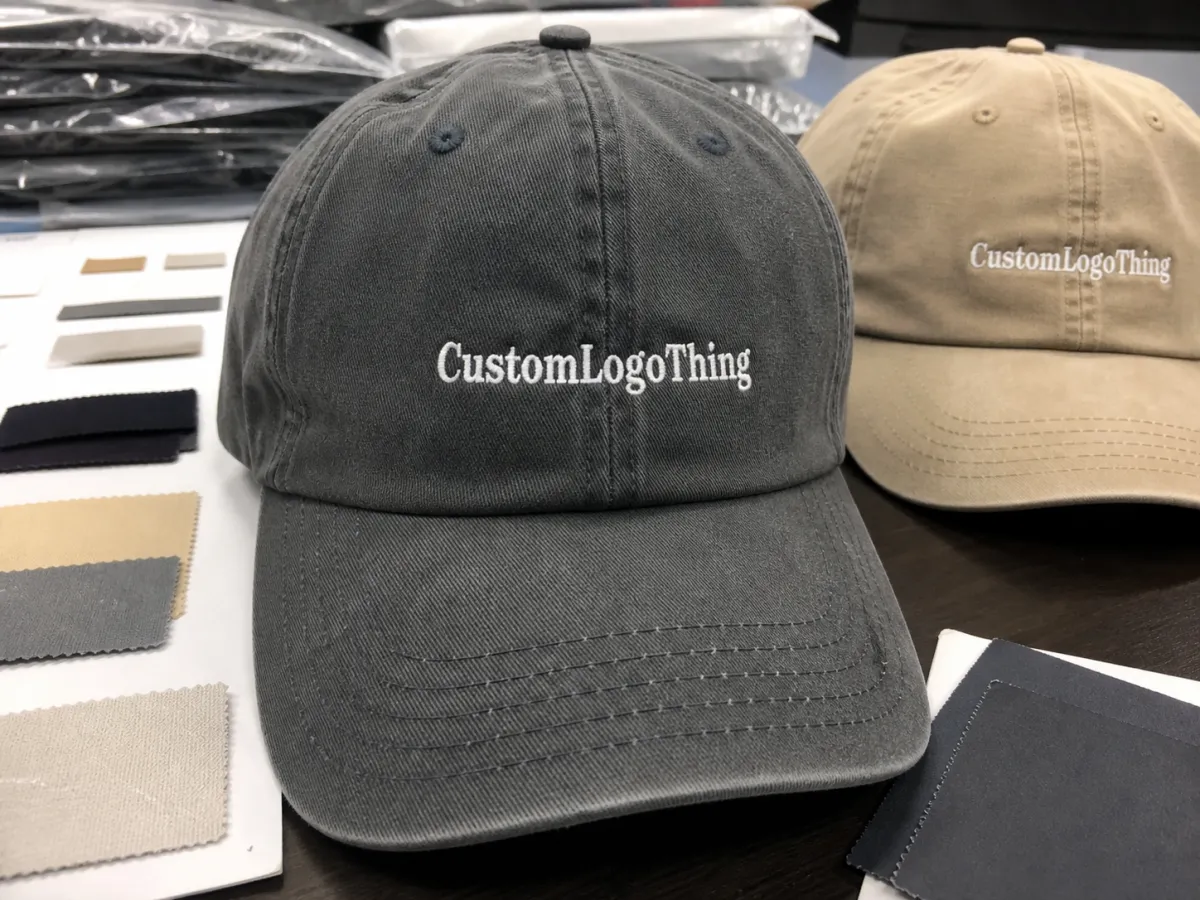
People judge caps with their hands before they study the logo. They feel the crown, flex the brim, test the closure, and notice whether the decoration looks temporary or built in. That is why a dad hats with woven labels order often has stronger perceived value than a printed promo cap, even when both start with a similar cotton body.
Screen print can work for bold graphics. Heat transfer can handle color-heavy artwork. Direct embroidery brings raised texture and long wear. Woven labels sit in a different lane: they hold small lettering better than embroidery, keep brand colors more controlled across a batch than many print applications, and create a sewn-on finish without loading an unstructured crown with thick thread.
The dad hat shape helps. A low-profile crown, curved brim, adjustable closure, and relaxed fit make it familiar across age groups and brand categories. Apparel brands, breweries, coffee shops, outdoor clubs, studios, Corporate Gifting Teams, and event producers use the same silhouette for different reasons, but the goal is usually similar: make a cap people keep in the car, pack for a trip, or wear on a weekend without treating it like a costume piece.
Buyer observation: On caps, decoration quality can lift perceived value faster than fabric weight. A clean woven patch can make a Washed Cotton Dad Hat feel closer to retail inventory than event giveaway stock.
There is also a packaging lesson here. A rigid box and a thin folding carton may protect a product equally well, but they do not create the same expectation. Caps behave the same way. Stitching, label edge finish, crown symmetry, closure hardware, and packing method affect the first read before anyone compares thread counts or fabric blends.
For branded merchandise, that first read is commercial. It influences whether the cap gets worn, resold, photographed, gifted, or left behind. Custom Logo Things helps turn the loose idea of “custom hats with a label” into an order-ready specification, with label construction and placement reviewed before production work begins.
Product Details Buyers Should Lock Before Ordering
A dad hat looks simple until the spec sheet opens. The usual anatomy includes an unstructured six-panel crown, pre-curved visor, top button, sewn eyelets, inner sweatband, rear opening, and adjustable closure. Change one of those parts and the cap reads differently.
Fabric sets the first impression. Washed cotton gives the soft, broken-in feel many lifestyle brands want. Cotton twill feels clean and versatile, with enough body for everyday wear. Canvas moves the cap toward workwear and outdoor styling. Corduroy can make sense for seasonal drops, especially fall and winter merchandise. Recycled blends may support sustainability positioning, but buyers should ask for fiber content and documentation rather than assuming every recycled claim is equal.
Closure choice is not just a fit detail. A fabric strap with metal buckle is the standard dad hat option because it feels familiar and adjusts easily. A brass-tone buckle can look warmer on earth-tone caps, while a silver-tone buckle may suit black, navy, grey, or cooler color palettes. Hook-and-loop closures can lower cost on some orders, but they rarely feel as retail-ready on lifestyle merchandise.
Label placement changes the selling story. A centered front woven patch is the strongest choice for main branding. A small side panel label feels quieter, almost private-label. A back arch above the closure can work for clubs, studios, hospitality brands, and internal programs that want branded detail without a large front mark. An inside sweatband label is less visible, but it creates a retail-style discovery moment for subscription boxes, apparel drops, and gift sets.
Woven label types are not interchangeable. A flat woven patch gives a clean surface. A merrowed-edge patch adds a raised border and a traditional badge feel. A laser-cut label can create sharper shapes with less border weight. A fold-over tag works for side seams, back placements, and small accent branding. A damask woven label is usually better for fine detail because the weave can capture smaller elements more cleanly. Satin labels add shine, though that gloss may feel too delicate for rugged or outdoor branding.
Color control deserves clear expectations. Thread does not behave like digital ink. Pantone references help communicate the target, but a physical sample is the better authority because weave density, thread sheen, cap fabric, and wash treatment all change how color is perceived. For strict brand systems, sampling and approval should be built into the timeline rather than treated as an optional formality.
Retail finishing should be specified early: hangtags, barcode stickers, polybags, care labels, branded tissue, carton marks, and e-commerce packing needs. If the cap is part of a wider launch, align it with Custom Labels & Tags so the woven patch, hangtag, and packaging feel like one program rather than three unrelated purchases.
Specifications That Decide Fit, Finish, and Label Quality
A serious dad hats with woven labels order starts with a serious spec list. At minimum, buyers should confirm cap fabric, crown height, panel count, brim type, closure, cap color, label size, label material, edge finish, stitch color, and total quantity. The list sounds basic because it is basic. It also prevents expensive guesswork.
Crown profile is the first fit decision. Low-profile dad hats are forgiving, casual, and safe for broad distribution. Slightly deeper crowns can suit streetwear, outdoor brands, or merchandise programs that need more front-panel presence. If the crown is wrong, even a well-designed label can look awkward because the patch may sit too high, too low, or too flat against a curved front panel.
Label dimensions need discipline. Small side labels often sit around 1 to 1.5 inches wide. Front patches commonly run around 2 to 3 inches wide, depending on artwork shape and crown size. Fold-over tags should stay small enough to avoid irritating the wearer, especially near the rear opening or sweatband.
Tiny text is the hidden failure point. Woven labels can capture fine lines better than direct embroidery, but micro lettering, thin serifs, and crowded taglines still need simplification. A logo that looks sharp on a 6-inch digital proof may turn muddy at 1.25 inches wide. Many cap orders lose retail value not from poor manufacturing, but from artwork that was never adapted for thread.
Thread color count also affects cost and clarity. Two or three colors often produce a stronger result than a five-color label trying to reproduce gradients, shadows, or delicate digital effects. If the brand mark depends on very fine tonal variation, a printed patch or another decoration method may be more appropriate than weaving.
Textile tolerances should be understood before approval. Slight variation in label placement, stitch tension, cap wash, and fabric shade is normal. ASTM textile standards and common apparel inspection practices recognize that soft goods are not machined metal parts. The goal is controlled consistency, not imaginary perfection.
- Logo files: vector AI, EPS, or PDF whenever possible.
- Color notes: Pantone references for cap fabric, label thread, and sewing thread.
- Placement notes: front center, side panel, back arch, or inside sweatband with approximate measurements.
- Approval chain: one named decision maker or a clear written approval hierarchy.
For sustainability claims, ask for supporting documentation. FSC certification, explained by the Forest Stewardship Council, applies to forest-based materials such as paper packaging and tags, not automatically to cotton caps. If hats are paired with paper hangtags, sleeves, or mailers, that distinction matters.
Pricing, MOQ, and Unit Cost Drivers for Custom Dad Hats
Final pricing for Custom Dad Hats depends on quantity, fabric, label complexity, thread color count, label size, closure type, packaging, sampling, shipping method, and deadline pressure. A woven label cap order usually makes the most financial sense in bulk because setup, sewing labor, and handling are spread across more units.
MOQ is not only a factory rule. It is math. If proofing, label setup, packing preparation, and project handling are similar for 100 caps and 500 caps, the smaller run carries more overhead per unit. Small runs can still be useful for testing a concept, but buyers should compare tiers before assuming the lowest quantity is the safest spend.
| Decision | Lower-Cost Direction | Higher-Cost Direction | Buyer Impact |
|---|---|---|---|
| Label size | Small side label, 1 to 1.5 inches | Large front patch, 2.5 to 3 inches | Changes visibility, sewing time, and thread use |
| Thread colors | Two to three colors | Five or more colors | Affects label setup and visual clarity |
| Cap fabric | Standard cotton twill | Corduroy, canvas, recycled blends, custom dyeing | Changes unit cost and sourcing time |
| Closure | Fabric strap with standard metal buckle | Premium metal hardware or specialty closure | Influences fit, finish, and perceived value |
| Packaging | Bulk pack by color or style | Individual polybag, hangtag, barcode, tissue, mailer | Adds labor but improves retail readiness |
Product cost and landed cost are different numbers. A useful quote separates cap production, label production, sewing, packing, freight, duties where applicable, and delivery to a warehouse, office, festival site, or fulfillment partner. A cheap unit price can become expensive if freight was ignored or cartons arrive too late for an event.
As a general buying pattern, larger quantities reduce the effect of setup and handling on each unit. More complex labels, specialty fabrics, individual packaging, and rush freight push the price back up. The cleanest way to understand the budget is to request two or three quantity tiers with the same specification, then compare the landed cost rather than only the cap price.
A quote-ready request should include quantity tiers, delivery postcode, required in-hands date, artwork, cap color, label placement, packaging needs, and whether a pre-production sample is required. The difference between 250 and 500 pieces can be meaningful once setup and freight are distributed.
The best quote is not always the lowest unit price. It is the price that matches the real use case, acceptable risk, and deadline. For buyers building repeat programs, Wholesale Programs can make more sense than treating every cap run as a one-off purchase.
Process and Timeline From Artwork to Delivered Caps
The ordering sequence is straightforward when the information is ready: inquiry, spec confirmation, artwork review, quote, invoice or deposit, digital proof, optional physical sample, production approval, bulk manufacturing, quality check, packing, and shipping. Missing details early usually reappear later as delays.
Proofing matters because a digital mockup verifies placement and scale, but it cannot fully show thread texture, washed fabric, edge finish, or how a label bends over a curved crown. A flat PDF is a control tool, not a physical sample.
Sampling depends on risk. Retail merchandise, large corporate campaigns, and wholesale launches usually benefit from a pre-production sample. Rush event orders may skip that step only when the buyer accepts the trade-off in writing. The decision should be explicit, not accidental.
Lead time depends on label weaving, cap availability, custom dyeing, sewing queue, quality control, freight method, customs clearance where applicable, and buyer approval speed. A practical schedule works backward from the in-hands date, then reserves time for proof review and freight. Production time alone is not the full timeline.
Common delay causes are ordinary but costly: late artwork, unclear Pantone references, committee approvals, revised label sizes, last-minute packaging changes, and missing delivery details. One missing postcode can stall freight planning. One undecided label size can stop both weaving and sewing.
For shipments that must survive parcel networks or multi-stop distribution, packing design matters too. The International Safe Transit Association publishes testing information for transport packaging at ista.org. Caps are soft goods, but crushed crowns, moisture exposure, and poor carton stacking can still damage presentation.
Quality Checks That Prevent Expensive Cap Mistakes
The failure points buyers rarely see in a quote are the ones that create the most frustration: crooked labels, puckered stitching, unreadable woven text, mismatched thread color, uneven brim curve, weak closures, inconsistent cap shape, and cartons packed without enough structure.
Inspection should focus on label alignment, stitch security, front-panel symmetry, fabric defects, color consistency, sweatband cleanliness, closure operation, and carton count accuracy. For a bulk dad hats with woven labels order, even a small defect rate becomes visible if caps are sold online and photographed individually.
Approve a production standard before bulk work begins. One accepted sample, one approved digital proof, and one written spec sheet reduce subjective disputes later. If the buyer approved a 2.5-inch merrowed-edge front patch, a later request for a smaller laser-cut label is not a production correction. It is a redesign.
Use-case testing should match the channel. Event giveaways may prioritize on-time delivery, clean branding, and simple bulk packing. Retail resale needs tighter inspection, hangtags, barcode labeling, cleaner folding or bagging, and consistent presentation. Employee uniform caps may need durable closures and sweatband comfort more than elaborate packaging.
Caps can arrive deformed if packed carelessly. Carton size, inner bagging, stacking method, and moisture protection matter as much as logo application. A cap with a perfect woven patch still looks cheap if the crown is crushed when the box opens.
Custom Logo Things treats caps like branded packaging objects, not disposable promo items. That distinction is practical. Presentation affects perceived merchandise value, return rates, product photography, and the confidence of the person handing the cap to a customer.
How Custom Logo Things Supports Bulk Woven Label Cap Orders
A capable supplier does more than accept a file. Custom Logo Things helps translate brand artwork into label-ready construction, flagging text size, scale, edge finish, placement, and sewing risks before they become production waste.
That guidance is useful because cap buyers often manage more than caps. A brand launch may include custom boxes, mailers, tissue, hangtags, stickers, retail displays, and staff apparel. Keeping those pieces aligned reduces the visual drift that happens when every component is sourced in isolation.
One supplier coordinating cap specs, label production, packaging requirements, and shipping details also reduces handoff errors. Fragmented vendors can work, but they require tighter project management. Someone has to confirm whether the hangtag barcode matches the carton mark, whether the woven label color matches the sticker, and whether the delivery date supports the campaign calendar.
Transactional buyers need facts early. Quote tiers, material choices, artwork requirements, sample options, and timeline assumptions should be visible before approval. An order for 1,000 caps with individual polybags, barcode stickers, and cartons marked by color is a different job from 250 bulk-packed caps for a staff retreat.
Customization depth can be practical without becoming excessive. Buyers can choose cap body, color, label style, label position, closure, packaging, and fulfillment preparation according to budget and deadline. The point is not to add decoration for its own sake. The point is to choose the options that make the cap sell, ship, and present correctly.
Fewer surprises come from tighter specs, faster approvals, documented tolerances, and realistic planning. That is the measurable confidence behind a well-managed woven label cap program.
Details That Help Produce an Accurate Quote
Before requesting pricing, collect the practical details: quantity, cap color, fabric preference, label placement, label size, logo file, thread color references, closure type, packaging needs, delivery address, and target in-hands date. If any of those are unknown, say so. A production team can recommend options faster when the gaps are visible.
Send two quantity tiers if budget is flexible. For example, ask for 250 and 500 pieces, or 500 and 1,000 pieces. Setup, freight, and handling can shift unit economics enough to change the buying decision.
Simplify artwork before quote approval. Remove tiny taglines, thicken fine lines, reduce thread colors where possible, and decide whether the label should feel subtle, premium, or bold. A clean two-color woven label often beats a crowded five-color patch that tries to reproduce every detail from a digital logo.
Identify the sales channel. Giveaway, retail resale, employee uniform, subscription box, festival merch, and wholesale launch each require different inspection and packaging priorities. A festival cap may need deadline certainty above all else. A retail cap may need hangtags, barcode labels, clean polybags, and carton organization by SKU.
If production questions remain, the FAQ page can help with common ordering details. For the fastest review, submit artwork and specs for a dad hats with woven labels order so Custom Logo Things can confirm feasibility, pricing, MOQ, timeline, and packaging requirements before production begins.
FAQ
What information do I need before placing a dad hats with woven labels order?
Prepare your logo file, quantity, cap color, fabric preference, label size, label placement, closure type, packaging needs, delivery address, and required in-hands date. If you are unsure about label size or placement, send the artwork first so the production team can recommend a practical layout before quoting.
What is the typical MOQ for custom dad hats with woven labels?
MOQ depends on the cap style, label construction, and customization level. Bulk orders usually produce better unit economics because setup, sewing, and handling costs are spread across more caps. Ask for multiple quantity tiers if you need to compare a smaller test run with a larger merchandise order.
Are woven labels better than embroidery for dad hats?
Woven labels are often better for small text, detailed logos, and a retail patch look. Embroidery works well for bolder marks with fewer fine details. The best choice depends on artwork complexity, desired texture, budget, and whether the brand wants a sewn-label finish or direct decoration.
How long does a woven label dad hat order take to produce?
Lead time depends on proof approval speed, cap availability, label weaving, sewing queue, packaging requirements, inspection, shipping method, and customs where applicable. For deadline-sensitive orders, share the in-hands date at the quote stage so production and freight options can be planned realistically.
Can I order dad hats with woven labels and custom packaging together?
Yes, caps can be paired with branded hangtags, polybags, stickers, tissue, mailers, cartons, or retail packaging depending on how they will be sold or distributed. Combining cap and packaging specs early helps align colors, labeling, barcode needs, and presentation before production begins.


