Buyer Fit Snapshot
| Best fit | Die Cut Corrugated Inserts Supplier projects where brand print, material claims, artwork control, MOQ, and repeat-order consistency need to be specified before quoting. |
|---|---|
| Quote inputs | Share finished size, material target, print colors, finish, packing count, annual reorder estimate, ship-to region, and any compliance wording. |
| Proofing check | Approve dieline scale, logo placement, barcode or warning zones, color tolerance, closure strength, and carton packing before bulk production. |
| Main risk | Vague material claims, crowded artwork, missing packing details, or unclear freight terms can make a low unit price expensive after revisions. |
Fast answer: Die Cut Corrugated Inserts Supplier: Material, Print, Proofing, and Reorder Risk should be specified like a repeatable production item. The safest quote records material, print method, finish, artwork proof, packing count, and reorder notes in one written spec.
Production checks before approval
Compare the actual filled-product size with the drawing, then confirm tolerance on folds, seals, hang holes, label areas, and retail display edges. Reserve space for logos, QR codes, warning copy, and material claims before decorative graphics fill the panel.
Quote comparison points
Review material grade, print process, finish, sampling route, tooling charges, carton quantity, and freight assumptions side by side. A quote is only useful when the supplier can repeat the same color, closure quality, and packing count on the next order.
A Die Cut Corrugated inserts supplier can be the difference between a box that just closes and a package that actually protects what is inside. The outer carton may look fine on a shelf or pallet, but if the insert shifts, crushes, or scuffs the product, the shipment still fails. I have seen that happen with glass, cosmetics, electronics, and industrial parts alike. The damage usually shows up in transit, not while the packer is standing at the bench.
Custom inserts are not loose filler dressed up as packaging. A strong die cut corrugated inserts supplier designs board to hold shape, reduce movement, and keep the product in the same position from pack-out to delivery. That means the geometry has to be right, the board grade has to match the load, and the cut has to stay clean enough for the insert to survive vibration, compression, and drops. The supplier is part engineer, part converter, and part quality checkpoint.
For Custom Logo Things, the practical question is pretty direct: how do you choose a die cut corrugated inserts supplier that protects the product Without Wasting Money or labor? Fit comes first, then board selection, then test methods, then total landed cost. When the package also needs a full shipping structure, pairing the insert with Custom Shipping Boxes often gives you a cleaner pack-out and fewer surprises on the line.
What a Die Cut Corrugated Inserts Supplier Actually Does
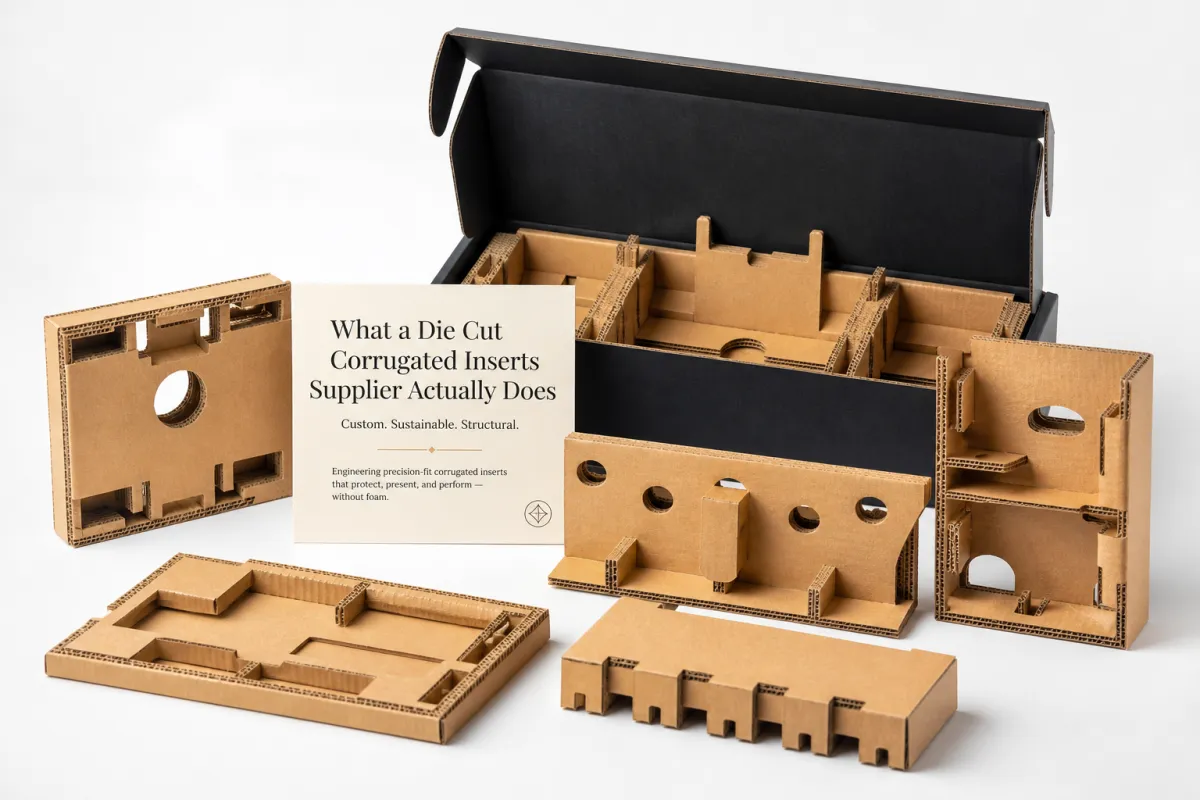
At the simplest level, a die cut corrugated inserts supplier turns flat corrugated board into a shaped internal component. The insert may cradle a bottle, divide a kit into separate compartments, form a cavity for a device, or lock a product in place so it cannot drift inside the carton. That sounds simple enough. The hard part lives in the details. A difference of 2 mm, the wrong flute direction, or a board grade that gives up after a few compression cycles can turn a promising insert into a weak one.
Stock void fill and engineered inserts do very different jobs. Void fill is built to take up empty space, while engineered inserts are built to control motion. A die cut corrugated inserts supplier is not selling paper fluff or loose padding; the job is to design repeatable protection. That repeatability matters in real shipping lanes. One hand-packed carton can look fine on the worktable. Ten thousand cartons need the same fit every time, or returns start climbing.
In many product categories, the insert does more work than the outer box. A rigid shipper may handle stacking, yet the inner pack still fails if a corner contacts the carton wall or if the product settles after a temperature swing. A capable die cut corrugated inserts supplier thinks about friction fit, edge support, suspension, and how the item behaves after the carton has been handled a dozen times. That is a different mindset from simply filling a box.
Buyers get tripped up here more often than they expect. Quotes for inserts are often compared the same way carton quotes are, then everyone wonders why the cheaper supplier produces more damage. Cut quality and converting accuracy affect performance. A sloppy crease, a crushed flute, or a slot placed in the wrong location can create a weak point right where the shipment needs strength.
A sample that fits on a desk does not automatically survive a parcel network. A good die cut corrugated inserts supplier should be willing to talk about vibration, compression, and drop behavior, not just dimensions.
For sourcing context, industry references from ISTA and organizations such as The Packaging School and PMMI help frame material and process decisions. Those references do not replace supplier knowledge. They keep the conversation anchored in shipment performance instead of guesswork.
How a Die Cut Corrugated Inserts Supplier Builds the Fit
The fit process starts with product data, not artwork. A capable die cut corrugated inserts supplier asks for dimensions, weight, photos, handling concerns, and sometimes CAD files or even a quick sketch. Fragile surfaces, protrusions, batteries, closures, and nested parts all change the design immediately. A cylinder does not get treated like a flat electronics accessory. A glass jar does not get treated like a metal bracket. Geometry drives the protection strategy.
Once the supplier has the basics, the team drafts a dieline. Depending on the project, that may be prepared for a steel rule die or cut digitally for a short-run prototype. The die cut process is straightforward in theory: the board is cut to the exact shape required, then creased, slotted, or perforated so it folds into a functional insert. In reality, cut depth, crease pressure, and slot location all matter. A die cut corrugated inserts supplier has to balance a snug fit with pack-out speed, because a perfect insert that slows assembly becomes an operational problem.
Protection logic matters more than many people expect. A well-built insert holds the product by friction or by a controlled cavity, which prevents the item from bouncing inside the carton. It also spreads load across a larger area, which reduces point pressure on corners and edges. That is why some designs use locking tabs, nested layers, or multi-cavity layouts. The supplier may rotate flute direction to improve stiffness where the product needs it most. Small choices like that often decide whether the insert holds up under real shipping stress.
The best die cut corrugated inserts supplier will think in tolerances. Corrugated board is not a machined plastic part. It compresses a little, and humidity changes its behavior. A good design builds in enough pressure to hold the product, but not so much that the packer has to force every unit into place. If the line worker needs both hands and a prayer to load the insert, the design needs another round.
There is also a meaningful difference between manual packing aids and engineered inserts. A spacer or folded paper pad can work at low volume, yet it tends to drift in performance as labor changes. Engineered inserts are repeatable. Once the die cut corrugated inserts supplier has locked the tooling and the drawings, the same cavity size and the same fold sequence can be used across thousands of units. That consistency is one reason packaging engineers favor custom inserts over improvised dunnage.
If the product is unusually shaped, the supplier may split the insert into two or three components rather than forcing one complicated blank to do every job. That choice can reduce waste, simplify folding, and improve speed on the line. A die cut corrugated inserts supplier who understands production realities will not insist on the fanciest design. The right design is the one that protects the item, packs quickly, and survives the trip.
Key Factors to Evaluate Before You Choose a Supplier
The product itself should be the first filter. A die cut corrugated inserts supplier needs to know whether the item is fragile, heavy, sharp-edged, oily, coated, or cosmetically sensitive. A glass bottle with a silk-screened label needs different support than a machined aluminum component. A retail kit may need a cleaner presentation because the insert is visible during unboxing. A transit-only shipper may care more about compression strength and stacking than appearance. Good suppliers ask those questions early, because the wrong assumption wastes time later.
Board selection comes next. Single-wall corrugated is common for lighter items and moderate protection, but double-wall may be better for heavier loads, long-haul distribution, or awkward geometry. Some buyers want recycled content, some need FSC-certified board, and some want the lowest total cost. A thoughtful die cut corrugated inserts supplier will explain the tradeoffs instead of pretending every board grade is interchangeable. More fiber is not always better. Sometimes it only makes the insert harder to pack.
Tolerances matter more than many first-time buyers realize. A few millimeters can be the difference between snug support and impossible assembly. That is why a supplier should be clear about how they measure, what tolerance band they can hold, and whether the material choice affects cut accuracy. A die cut corrugated inserts supplier with real process control will usually speak in practical terms: how much compression the board has, how much variation is expected, and whether the product itself stays consistent from unit to unit.
Capability is another separator. Some suppliers can design the insert but struggle with short runs. Others can produce quick samples but do not have the tooling depth for scale-up. You want the die cut corrugated inserts supplier that can move from prototype to production without rewriting the project. Ask whether they handle dielines in-house, whether they can make steel rule tooling, and whether they support digital cutting for pre-production samples. The answers tend to predict how painful the project will feel.
Presentation matters too. If the package is retail-ready, the internal structure affects shelf appeal, brand perception, and how quickly warehouse teams can pack orders. A neat insert can make a product look premium even when the outer carton is plain. A poorly designed insert does the opposite. Buyers often forget that the internal package is visible during unboxing, which means the die cut corrugated inserts supplier is shaping brand experience as well as shipping performance.
| Option | Best For | Typical Unit Cost | Tooling / Setup | Notes |
|---|---|---|---|---|
| Stock void fill | Simple cushioning, low-value shipments | $0.06-$0.12 | Low or none | Fast, but poor fit control and more labor variability |
| Simple die cut corrugated insert | Bottles, kits, light-to-medium products | $0.18-$0.35 at 5,000 units | $250-$600 | Good balance of protection and pack speed |
| Multi-cavity engineered insert | Fragile, high-value, or irregular products | $0.45-$1.10 at 5,000 units | $400-$900+ | Better control, more design time, often better damage reduction |
| Digital prototype insert | Sampling, short runs, early testing | $1.00-$3.00 | Minimal | Fast iteration, useful before committing to a die |
Buyers comparing quotes should also ask about sustainability claims. A board that is recyclable in theory may still be a poor fit if it arrives too weak and causes damage. A better approach is to select the right structure first, then look at recycled fiber content or FSC chain-of-custody status. That is a more honest way to evaluate a die cut corrugated inserts supplier. Sustainability matters. Product survival matters too.
If your packaging mix includes shipping cartons, inserts, and retail outer packs, it helps to map the full system rather than buying each piece separately. A good die cut corrugated inserts supplier should be able to work alongside your box spec, not against it. That matters even more if you are pairing inserts with Custom Shipping Boxes for a pack-out that needs both strength and a cleaner footprint on the pallet.
Die Cut Corrugated Inserts Supplier Process and Timeline
A disciplined die cut corrugated inserts supplier usually follows a predictable process. Discovery comes first: the supplier collects product dimensions, weights, photos, and ship method. Concept work follows, often as a rough sketch or dieline. Sampling, approval, tooling, production, and shipment come after that. The sequence sounds linear, yet the best projects loop once or twice between sample and revision because the first prototype reveals hidden issues. That is normal. It is also much cheaper to correct on paper than after 20,000 pieces have been cut.
Clean input keeps the schedule moving. Send CAD files, pack-out dimensions, carton specs, and handling risks early, and the die cut corrugated inserts supplier can move with fewer assumptions. Photographs help too. A picture of the item in its current packaging often reveals contact points that measurements alone miss. If the product has a label, a finish, or a sensitive surface, say so. A matte-coated device and an uncoated steel part do not need the same treatment.
Lead times vary, but a practical range helps buyers plan. Simple digital samples may turn around in a few business days. More complex custom inserts usually need extra time for design, sample cutting, review, and revisions. Production can then take roughly one to three weeks, depending on quantity and plant capacity. A die cut corrugated inserts supplier that gives you a firm timeline with checkpoints is doing you a favor. Anyone who promises perfection with no questions is probably skipping the detail work that prevents trouble later.
Delays tend to come from the same places. Measurements are incomplete. Feedback arrives late. A sample is approved verbally but not documented. Or the product changes after the die has already been made. That last one is more common than buyers like to admit. A reliable die cut corrugated inserts supplier will push for version control because a 3 mm change in product width can invalidate the entire insert structure. In packaging, the smallest revision can be the one that breaks the schedule.
Batch planning matters too. If you know a second run will be needed, it is smart to finalize the specs before the first order is released. That can reduce lead time on follow-up orders because the tooling already exists and the supplier can reuse the approved structure. A well-organized die cut corrugated inserts supplier will save the drawings, the board spec, and the approval record so production can repeat the same result later without re-engineering the whole job.
Transit testing is the part many teams rush past, and they pay for it later. A hand-fit sample may look perfect, but the real question is whether the package survives vibration, compression, and drop events. ISTA test procedures such as those described by ISTA are useful reference points because they simulate the shipment environment more realistically than a desk test ever can. A serious die cut corrugated inserts supplier should be comfortable talking about that gap between “fits nicely” and “passes distribution.”
Die Cut Corrugated Inserts Supplier Pricing: What Drives Cost
Pricing from a die cut corrugated inserts supplier is driven by several variables at once, which is why two quotes can look similar on paper and still create very different total costs. Board grade is one factor. Cut complexity is another. A simple two-panel insert costs less than a multi-cavity structure with tabs, folds, and tight tolerances. Tooling method matters too. A digital prototype may avoid die costs, while a production tool spreads setup over a larger run. The useful question is not just “What is the unit price?” It is “What does the complete order cost once tooling, labor, damage risk, and freight are included?”
Volume changes the economics quickly. At small quantities, setup costs can dominate the order. At larger quantities, the unit price usually drops because the die and setup are amortized across more pieces. That is why a die cut corrugated inserts supplier may look expensive on a 500-piece quote and very reasonable on a 10,000-piece quote. Buyers sometimes compare those numbers without adjusting for run size, then draw the wrong conclusion. The pricing curve is real, and it is steep at the low end.
Hidden costs deserve a hard look. Poorly designed inserts increase labor time because packers have to force products into position or handle multiple loose parts. Weak inserts increase damage claims. Overly large inserts can reduce carton efficiency and raise dimensional weight. A thoughtful die cut corrugated inserts supplier should help you see those downstream costs, because the cheapest insert can become the most expensive packaging element in the chain. That is especially true for retail kits and products with a high return rate.
The comparison most buyers find useful is simple: generic packing materials may cost less upfront, but custom inserts often reduce scrap, speed packing, and protect higher-margin products better. The total cost difference can be wider than the quote suggests. A die cut corrugated inserts supplier should be evaluated on system performance, not just line-item price.
Fair comparison depends on identical variables. Same board grade. Same dimensions. Same quantity. Same print requirements, if any. Same sampling scope. If one quote includes design support and another does not, you are not comparing the same thing. A disciplined die cut corrugated inserts supplier will welcome that level of comparison because it reveals whether the quoted price is competitive or simply incomplete.
There is also a sustainability angle in pricing. FSC-certified board, recycled content, and source transparency can slightly change cost, but not always by much. The bigger issue is whether the material choice fits the shipment. For some programs, a lighter board that still passes testing may lower the total footprint because it uses less fiber and ships more efficiently. A good die cut corrugated inserts supplier will not push the greenest-sounding option at the expense of performance; they will point you toward the option that can be justified on material use and protection.
The EPA has long encouraged waste reduction and material recovery across packaging systems, and that still matters even when the project is commercial rather than consumer-facing. If you want a broader resource on material stewardship, EPA sustainable packaging guidance is a useful place to start. A die cut corrugated inserts supplier who understands those pressures can help you make a cost choice that does not create avoidable waste later.
Common Mistakes When Working With a Supplier
The first mistake is measuring only the product and forgetting the full pack-out. A die cut corrugated inserts supplier needs the product dimensions, yes, but also the carton interior, any accessories, and the way the item is actually loaded. A product might fit the insert perfectly and still fail because the outer box compresses the structure, or because a cable, charger, or accessory creates an unexpected high point inside the cavity. Packaging is a system. Treat it that way.
The second mistake is overengineering. Buyers sometimes assume more board layers, tighter cavities, and more nested pieces automatically mean better protection. That is not how it works. If the insert becomes slow to pack, labor cost rises. If it traps the product too tightly, operators start forcing it in. If it uses more material than needed, you pay for weight and waste. A practical die cut corrugated inserts supplier will try to reach the smallest design that still passes the test. That discipline usually saves money and lowers stress on the floor.
The third mistake is skipping transit testing. A sample that looks good in the office is not the same as a package that survives handling, stacking, and environmental swings. Corrugated board reacts to humidity. Products shift under vibration. Cartons take compression from pallets and warehouse racking. A good die cut corrugated inserts supplier should be willing to support a test plan, ideally one tied to a relevant method such as ISTA distribution testing or an internal simulation that reflects your actual lane.
Another common error is choosing price before proof. Low-cost board or a slightly simpler geometry can look attractive until the first damage claim lands. Then the savings disappear. A seasoned die cut corrugated inserts supplier will push for sample approval and, for sensitive products, real-world testing before volume production. That is not upselling. It is risk control.
Version control is the last mistake, and it creates more trouble than many teams expect. Products evolve. Labels change. Closures shift. Small design updates can invalidate a previously approved insert. If the old dieline is still in circulation, warehouses can end up with mismatched inventory that looks right until it is loaded. A reliable die cut corrugated inserts supplier should keep records clean and make sure the current revision is obvious to everyone involved.
For FSC-certified material options, it helps to review the chain-of-custody basics directly from FSC. That is especially useful if your procurement team needs documentation for brand claims or retailer requirements. A die cut corrugated inserts supplier that already works with certified board can save you a lot of back-and-forth during approval.
Expert Tips and Next Steps for a Die Cut Corrugated Inserts Supplier
Start with the product and the ship method. That is the most practical advice I can give. A die cut corrugated inserts supplier should build around the product first, then adapt to parcel, freight, retail, or warehouse handling. If the structure is being designed around a logo or a visual idea before the function is settled, the odds of rework go up. Presentation matters, but protection comes first.
Ask for both a prototype and a flat sample before you commit to production, especially if the item is fragile or high-value. The flat sample helps you review cut geometry and assembly logic. The prototype shows how the insert behaves in real space. A capable die cut corrugated inserts supplier should not resist that request. They should encourage it. The difference between those two samples often exposes hidden issues with stack height, locking tabs, or cavity depth.
Compare at least three suppliers, and do not limit the comparison to unit price. Look at sampling speed, communication quality, design support, and how consistently they answer questions. A die cut corrugated inserts supplier that explains board choices in plain language is usually easier to work with than one that hides behind jargon. You are buying a packaging component, but you are also buying responsiveness. That matters when production deadlines are tight.
Ask direct questions about what happens if the product changes. Can the dieline be revised quickly? How are revisions documented? Is there a charge for a second sample? Those details do not sound glamorous, but they are the difference between a controlled launch and a rushed scramble. A solid die cut corrugated inserts supplier will have a clear answer. If they do not, the project is probably not as organized as it should be.
It also helps to think in terms of total pack-out performance. If the insert saves five seconds per pack and prevents even a small percentage of returns, that can outweigh a slightly higher unit cost very quickly. The right die cut corrugated inserts supplier is the one that improves the whole system, not just the quote sheet. A lower price is only useful if it still delivers protection, speed, and consistency.
Use a simple launch checklist: exact product dimensions, weight, photos of the item and current packaging, carton interior dimensions, target ship method, fragility concerns, and the timeline you need. Then ask the die cut corrugated inserts supplier for a sample dieline and a prototype path before production starts. Recheck the first production run and treat that shipment as the baseline. If it passes, you have a repeatable package. If it does not, you have useful data instead of guesses.
Bottom line: the best die cut corrugated inserts supplier is not the one with the lowest headline price. It is the one that balances fit, board selection, test discipline, and speed without creating labor problems or damage claims. Get those four pieces right, and the insert does its real job: it protects the product, supports the brand, and keeps the shipment moving with fewer surprises.
What should I send a die cut corrugated inserts supplier for an accurate quote?
Send exact product dimensions, weight, quantity, carton size, and photos of the item in its current packaging. Include shipping method, fragility concerns, and whether the insert needs to support retail display or only transit protection. If available, share CAD files or a sketch so the die cut corrugated inserts supplier can estimate fit and tooling more accurately.
How long does a die cut corrugated inserts supplier usually need for samples and production?
Simple projects can move quickly, but custom shapes usually need time for design, die creation, sampling, and approval. Prototype turnaround is often the longest variable because changes after sampling can reset part of the schedule. Production timing depends on quantity, complexity, and current plant capacity, so it helps to finalize specs early with the die cut corrugated inserts supplier.
How do I compare pricing from different die cut corrugated inserts suppliers?
Compare quotes on the same board grade, dimensions, cut style, quantity, and sampling scope so pricing is truly comparable. Ask whether tooling, design support, and freight are included because those costs can change the real total significantly. Look beyond unit price and estimate damage reduction, labor savings, and carton efficiency to judge true value from each die cut corrugated inserts supplier.
Can a die cut corrugated inserts supplier help if my product shape is irregular?
Yes, irregular products are common use cases for custom inserts because the design can be built around exact contours. The supplier may use locking tabs, nested cavities, or multi-piece assemblies to stabilize unusual shapes. The key is to provide accurate measurements and clear photos so the die cut corrugated inserts supplier can match the real geometry, not an assumption.
What mistakes cause the most problems with custom corrugated inserts?
The biggest issues are poor measurements, weak board selection, and skipping sample testing before production. Another common mistake is designing for appearance only and forgetting packing speed or shipping stress. Version control matters too; even a small product revision can make a previously approved insert unusable, so the die cut corrugated inserts supplier and buyer should both track revisions carefully.