Buyer Fit Snapshot
| Best fit | Die Cut Poly Mailers Custom projects where brand print, material claims, artwork control, MOQ, and repeat-order consistency need to be specified before quoting. |
|---|---|
| Quote inputs | Share finished size, material target, print colors, finish, packing count, annual reorder estimate, ship-to region, and any compliance wording. |
| Proofing check | Approve dieline scale, logo placement, barcode or warning zones, color tolerance, closure strength, and carton packing before bulk production. |
| Main risk | Vague material claims, crowded artwork, missing packing details, or unclear freight terms can make a low unit price expensive after revisions. |
Fast answer: Die Cut Poly Mailers Custom: Film, Print, MOQ, and Carton Packing should be specified like a repeatable production item. The safest quote records material, print method, finish, artwork proof, packing count, and reorder notes in one written spec.
Production checks before approval
Compare the actual filled-product size with the drawing, then confirm tolerance on folds, seals, hang holes, label areas, and retail display edges. Reserve space for logos, QR codes, warning copy, and material claims before decorative graphics fill the panel.
Quote comparison points
Review material grade, print process, finish, sampling route, tooling charges, carton quantity, and freight assumptions side by side. A quote is only useful when the supplier can repeat the same color, closure quality, and packing count on the next order.
A clean mailer changes how a shipment reads before the customer even touches it. A sloppy oversized bag makes good branding look cheaper than it is, and Die Cut Poly Mailers custom are often the fix brands reach for when they want a better presentation without jumping straight to rigid packaging.
Shipping is public now. Customers film unboxings, post arrival photos, and judge a package from the porch. That is the reality, whether brands like it or not. Die cut poly mailers custom give teams more control over that first impression with a tighter fit, sharper print, and less visual noise in transit.
Used well, they work for apparel, subscription kits, light accessories, beauty products, and retail shipping where package branding is part of the sale, not an afterthought. Used badly, they become a plastic bag with a logo floating around on it. The goal is not to make poly pretend it is a box. The goal is to make the shipping package feel deliberate.
What die cut poly mailers custom are, and why they sell better
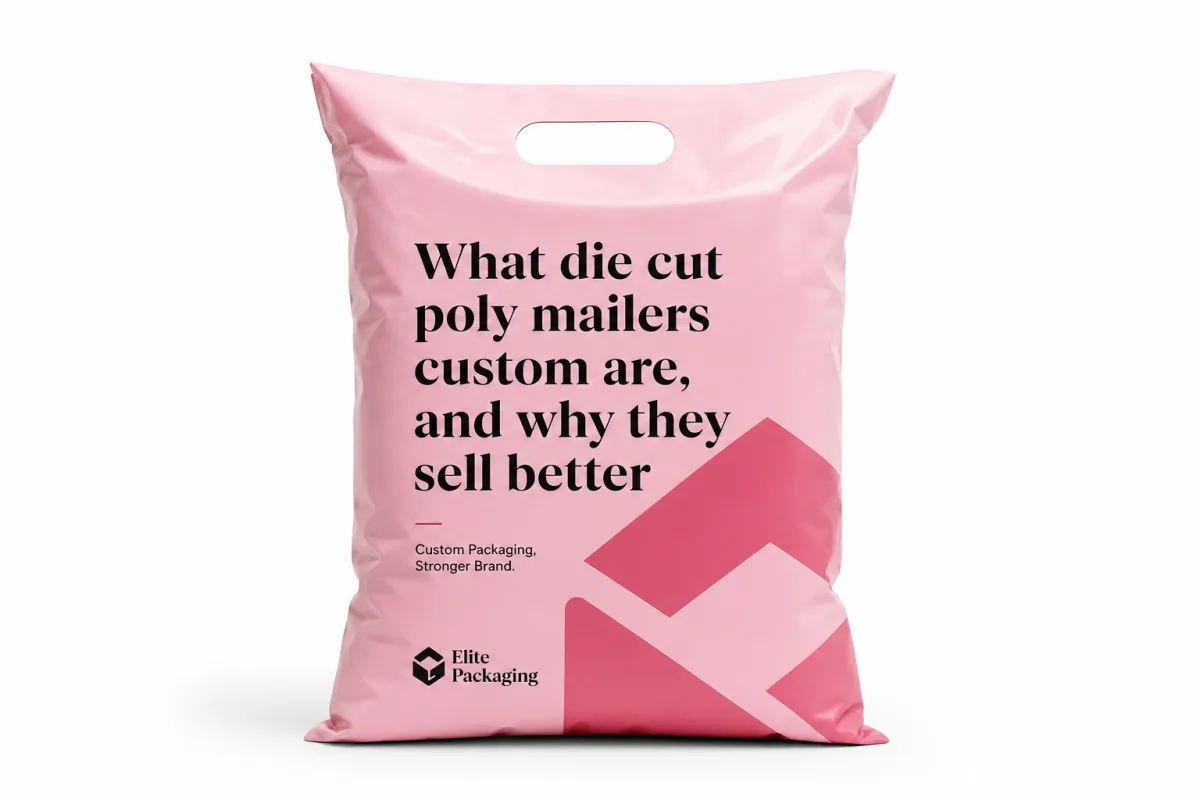
Die cut poly mailers custom are flexible shipping bags made from polyethylene film, shaped with a die-cut opening or handle area, and printed for a specific brand instead of pulled from generic stock. The custom version differs from plain mailers in two obvious ways: the size and structure are chosen for the product, and the outer surface is built to carry branded artwork cleanly.
That sounds simple. Real orders are messier. A mailer that fits the product properly changes how the customer reads the brand before anything gets opened. For apparel, a snug mailer says the brand pays attention. For subscription kits, it keeps the monthly delivery from feeling like a random warehouse shipment. For accessories and beauty items, the surface becomes part of the product packaging story.
Here is the blunt version: custom packaging does not need to be fancy to work. It just needs to look considered. That is why die cut poly mailers custom often sell better than plain shipping bags. They make the order feel intentional, and intentional packaging tends to look more premium than packaging that simply exists.
Brands also like them because they reduce visual clutter. A clean printed bag with a strong logo, a clear return address, and a smart color choice reads better in photos than a bag covered in too much decoration. The same logic applies across branded packaging, whether you are doing mailers, custom printed boxes, or a mixed product packaging system with inserts and labels.
Most buyers use die cut poly mailers custom for one of these situations:
- Apparel shipments that need a slim, presentable outer layer.
- Subscription kits that benefit from repeatable branding.
- Lightweight accessories that do not need a corrugated box.
- Beauty or wellness items where the outer package is part of the retail packaging feel.
- E-commerce launches where package branding has to look polished on day one.
One mistake buyers make is assuming the mailer should do everything. It should not. Die cut poly mailers custom are not a substitute for crush protection, humidity protection, or fragile-item engineering. They are a presentation and shipping layer. If the product needs structure, add it. If it needs more than a bag can provide, use a box. Common sense is still cheaper than rework.
A good mailer should do two jobs: protect the shipment and make the brand look like it has its act together. If it only does one, the design missed the point.
If you are comparing outer-package options, the tradeoff is pretty plain. A bag is faster and lighter than a box, but a custom bag still needs to look designed. That is the sweet spot for die cut poly mailers custom: useful, light, branded, and not trying to cosplay as luxury packaging.
For broader sourcing context, the packaging industry has long treated outer packaging as a branding tool, not just a shipping container. The Packaging Association’s resources at packaging.org are a decent place to sanity-check terminology and packaging categories before you spec anything out.
How die cut poly mailers custom are made and finished
The production path for die cut poly mailers custom is straightforward on paper and full of small decisions in real life. It starts with film selection, usually LDPE or a co-extruded poly film, then moves through bag formation, sealing, die-cut shaping, printing, and finishing. Every step affects how the final bag feels in hand and how the print lands on the surface.
The base film is where durability starts. Thinner film cuts cost, but it also lowers tear resistance and can make the bag feel flimsy. Thicker film improves puncture resistance and opacity, which is useful when the contents should not show through. For most brands, the useful range is somewhere around 2.5 mil to 5 mil depending on weight, shipping abuse, and how much you care about the customer’s first tactile impression.
Printing is the other big piece. Die cut poly mailers custom may be printed with flexographic or gravure-style production depending on the factory setup, and the artwork needs to be adapted to the printable area instead of pushed into a box layout that ignores the bag shape. That is why some designs look crisp and controlled while others look stretched or muddy. The film can only take so much detail before tiny text starts to blur or the ink density gets ugly.
Matte and Glossy finishes change the tone fast. A glossy finish usually gives brighter color and a more reflective, energetic look. Matte finish tends to feel calmer and more premium, especially for minimal branding or muted color systems. Neither is automatically better. If your brand uses bold color blocks and high-contrast art, gloss can help. If your packaging design depends on restraint, matte often looks cleaner.
Die cut poly mailers custom also need closure and security details that buyers should not ignore. Adhesive strips vary in strength, peel behavior, and temperature tolerance. Tear resistance matters when the mailer is handled by people who do not care about your packaging nearly as much as you do. Opacity matters if the contents should stay private. And the die-cut opening itself needs to be positioned so it does not interfere with loading, sealing, or the way the package sits on a conveyor or in a hand.
Proofing is where expensive mistakes get avoided
Before production starts, insist on a dieline, bleed allowance, and safe zone review. Those three items save more money than nearly any other prepress step on die cut poly mailers custom. If the artwork bleeds too close to a cut line, the logo can get clipped. If the handle or opening area is ignored, text can land where the bag flexes or seals. If the print file was built for a box and not for a mailer shape, the result usually looks awkward.
That is also why design teams should not rush artwork approval. A bag is not a flat poster. It has physical behavior. It folds, seals, and flexes. I have seen teams spend days debating one shade of blue and then miss the fact that the logo sat right in the seal area. That kind of mistake is avoidable. It is also the sort of thing that makes everybody grumpy later.
In shipping tests, the right mailer still needs to survive real movement, not just a pretty mockup. For teams that care about package performance, the ISTA standards are worth reviewing because they focus on transit testing, drop behavior, and practical distribution hazards rather than wishful thinking.
Cost factors, pricing ranges, and what changes the quote
Pricing for die cut poly mailers custom is not mysterious. It is just annoying if you do not know what is driving the number. The main factors are bag size, film thickness, print coverage, color count, quantity, and any finishing extras like special adhesives, custom perforation details, or surface effects that make the run more complex.
Quantity is the largest lever. Small runs almost always have a higher unit cost because setup gets spread over fewer pieces. Larger runs lower the unit price, but they also increase your upfront spend and inventory risk. That is the part people skip when they get excited about a low per-unit quote. Cheap per piece means nothing if you bought too many bags that do not match actual demand.
As a rough working range, die cut poly mailers custom at modest quantities can land anywhere from about $0.18 to $0.45 per unit, depending on size and print complexity. Heavier full-coverage runs or larger mailers can move higher, especially if you are asking for strong opacity, multiple colors, or specialty finishing. At 5,000 pieces, a simple one-color design may price very differently from a four-color full-wrap design. That is normal. Plastic, ink, labor, and setup are not free just because the final product is thin.
The hidden costs are where buyers get irritated. Setup charges, plate fees, sample costs, freight, rush fees, and sometimes import-related costs all affect the landed number. If you compare only the factory price, you are not comparing quotes. You are comparing half-quotes, which is a great way to fool yourself.
Here is a clean way to think about the economics of die cut poly mailers custom:
| Spec | Typical Use | Approx. Unit Range | Tradeoff |
|---|---|---|---|
| 2.5-3 mil, one-color print | Light apparel, low-abuse shipping | $0.18-$0.28 | Lower cost, but less puncture resistance and less opacity |
| 3.5-4 mil, two- to three-color print | Most apparel and accessory brands | $0.24-$0.38 | Better balance of strength, presentation, and cost |
| 4.5-5 mil, full-coverage print | Premium branding or rougher transit conditions | $0.32-$0.55+ | Stronger bag and richer look, but higher material and print cost |
| Special finish or custom adhesive upgrade | Brand-forward launches or repeated fulfillment use | Varies by spec | Can improve presentation or sealing, but usually adds setup complexity |
The quote also changes depending on print coverage. A small logo on a single panel costs less to produce than a full-bleed graphic with registration requirements across both sides. That is true for die cut poly mailers custom the same way it is true for custom printed boxes. More ink, more alignment control, more risk, more cost. Nobody likes that answer, but it is the answer.
If you want a fair comparison between vendors, ask for landed cost per mailer. That should include freight, setup, and any proof fees. A lower factory unit price with expensive shipping often loses to a slightly higher unit price with better freight terms. Die cut poly mailers custom should be compared like a real procurement decision, not like a shopping cart screenshot.
For brands that also source paper components, FSC-certified materials can be useful for inserts, wraps, or paper labels. If that matters to your packaging design, FSC has guidance on responsible sourcing. It will not make a poly bag paper, obviously, but it helps keep the broader system credible.
Step-by-step ordering process and realistic timeline
The easiest way to keep die cut poly mailers custom moving is to treat ordering like a sequence, not a conversation. The process starts with product measurement, then size confirmation, then artwork, then proofing, then production, then shipping. If you skip a step or blur the order, delays show up fast.
- Measure the product. Get the length, width, and thickness at the largest point, not the nicest-looking sample.
- Confirm the bag size. Add enough insertion room for loading and enough closure room for the adhesive strip.
- Lock the artwork direction. Decide if the goal is minimal branding, bold retail packaging, or a more detailed pattern.
- Build the dieline. Make sure the cut, seal, and print-safe areas are clearly marked.
- Review the proof. Check color placement, logo scale, copy, barcode positioning, and all legal or return details.
- Approve production. Once approval is given, avoid casual changes unless you enjoy paying for them.
- Run quality checks. Confirm print clarity, seal strength, and consistency before the full shipment leaves.
- Dispatch and receive. Separate factory lead time from transit time so delivery expectations stay realistic.
For timing, a typical production window for die cut poly mailers custom often lands around 10 to 20 business days after proof approval, depending on quantity and spec complexity. Transit can add another week or more if the shipment is moving far or crossing borders. Rush orders can happen, but rush fees are not a hobby I recommend funding unless the launch date is real and unavoidable.
The most common delay is artwork revision. Not production. Artwork. Someone uploads a file without bleed, someone else moves the logo after proof approval, or a stakeholder decides the brand color is slightly wrong after the bags are already in motion. That is how a three-week job turns into a longer one for no good reason.
If you are coordinating die cut poly mailers custom with other packaging design work, do not wait until the last minute to align it with labels, inserts, or shipping cartons. The outer mailer should match the rest of the system, including branded packaging on the product side and any support materials that live inside. This is the part where good project management saves money that bad design habits would otherwise burn.
One practical note: production time and delivery time are not the same thing. Factory lead time covers making the mailers. Shipping time covers the bags getting to your door. Buyers mix those up constantly and then act surprised when the timeline does not obey wishful thinking. It never does.
Common mistakes that waste money or delay production
The biggest mistake with die cut poly mailers custom is sizing by guesswork. People eyeball a product, pick a mailer that seems right, and then wonder why the bag is either too tight or comically loose. Measure the actual item, add for thickness, and leave clearance for insertion and sealing. That is boring. It also works.
Another common mistake is designing like the bag is a billboard. It is not. The print area has safe zones, and the seal or opening area can swallow text if you ignore it. Crowded artwork often looks worse on die cut poly mailers custom than it does on a flat screen mockup because the physical bag introduces folds, handling stress, and visual interruption. A cleaner design usually wins.
Cheapest quote? Sure. If you enjoy reprinting bags.
Thin film is another trap. Low-cost die cut poly mailers custom can look fine in a quote sheet and fail in the hand. They tear more easily, show contents more readily, and feel less substantial during unboxing. Sometimes a slightly thicker film adds a few cents and saves the entire order from feeling flimsy. That is a smart trade. Buying the thinnest option just because it is the thinnest is not.
Timeline mistakes are just as expensive. Skipping samples, approving artwork too quickly, or leaving no buffer for freight delays is how launch plans go sideways. If the design is new or the size is new, ask for a sample or test run before committing to the full quantity. A sample costs less than a warehouse full of something awkward.
Inventory mistakes matter too. Some buyers under-order because they want to stay safe, then burn time on reordering too soon. Others over-order because they are excited, then sit on boxes of mailers that no longer match the branding. With die cut poly mailers custom, the right quantity depends on launch confidence, forecast stability, and how likely the design is to change. It is not a moral question. It is just stock control.
For shipping performance, ask suppliers how their bags behave under pressure and whether the construction has been tested against common distribution abuse. A vendor who knows its specs can usually explain the difference between cosmetic appearance and transit performance. That is a good sign. If they cannot explain it, your risk goes up. If you need a reference point for transit testing, ISTA’s resources at ista.org are useful because they focus on what packages go through in real distribution, not just how they look on a table.
Expert tips for choosing the right specs and print method
My first rule for die cut poly mailers custom is simple: choose thickness based on product weight and shipping abuse, not on what sounds premium in a sales deck. A 3 mil bag can be perfectly fine for a light apparel line. A 5 mil bag might be the right answer for a heavier kit or a route with rough handling. The right spec is the one that survives the shipment and still looks good when it arrives.
Second, design for readability before embellishment. A strong logo treatment and a clear brand color usually outperform a crowded layout with too many details. This is where package branding and packaging design need discipline. The mailer should communicate quickly from a distance, on camera, and in imperfect light. If it only looks good when enlarged on a monitor, the design is doing too much work for too little payoff.
Third, test one or two sample sizes before locking a large run. This matters more for die cut poly mailers custom than for a simple label because the bag’s dimensions and handling behavior affect everything. A product that slides around in a too-big bag feels less premium. A product forced into a too-small bag stresses the seal and looks rushed. A sample tells you which failure mode you are buying.
Fourth, do not assume more color equals more impact. In many cases, one strong Logo Placement on a clean background will beat a full-coverage design that fights the shape of the bag. That is especially true if your broader product packaging system already uses labels, inserts, or custom printed boxes. The mailer does not need to do every branding job by itself.
Fifth, ask the vendor specific questions before you place the order. For die cut poly mailers custom, that means asking for the dieline, print limit, proof format, minimum order quantity, approval rules, and what happens if the proof is approved and then changed. Those are not annoying questions. They are the questions that keep procurement from turning into a mess later.
Here is a quick comparison that helps brands decide how far to push the spec:
- Minimal brand treatment: Best for low-cost fulfillment, simple logo use, and fast reorders.
- Mid-level brand treatment: Best for most DTC brands that want a cleaner look without overspending.
- High-coverage treatment: Best when the outer bag is part of the launch story and the budget supports it.
That last point matters. Good die cut poly mailers custom are rarely the most complicated option. They are usually the best-balanced option. The right mailer hits fit, print clarity, durability, and cost without making a mess of any one of them.
If you are building a broader packaging program, it helps to keep the outer mailer aligned with the rest of the line. The same brand rules that make Custom Packaging Products useful for sourcing should also guide your mailers and inserts. If everything feels like it came from a different planet, customers notice. They may not name the problem, but they feel it.
Next steps for die cut poly mailers custom orders
If you are ready to move on die cut poly mailers custom, start with the basics: measure the product, decide your target quantity, and define the finish you want before asking for quotes. That alone will make the conversation with a vendor much cleaner. It also stops you from drifting into vague pricing that sounds good but solves nothing.
Gather the exact specs before you request pricing. You want dimensions, thickness preference, print colors, artwork files, delivery location, and the launch date you actually need to hit. If you are comparing vendors, build a simple sheet that tracks unit cost, setup cost, freight, sample cost, and lead time side by side. That is how you compare die cut poly mailers custom without getting fooled by the lowest number in the room.
For new designs or new sizes, ask for a proof or sample. That is not hesitation. That is smart buying. A small delay now is better than a full run of mailers that miss the mark on scale, color, or fit. The best die cut poly mailers custom order is usually the one where the fit, print, pricing, and timeline were all checked before production started.
If you need a broader sourcing starting point, review Custom Poly Mailers alongside the rest of your shipping materials so the outer package matches your operation instead of fighting it. And if the plan includes inserts, stickers, or other support materials, align them with branded packaging rules early. That is a lot easier than fixing the brand story after everything is already boxed and bagged.
Bottom line: die cut poly mailers custom work best when they are treated like a real packaging decision, not a decoration order. Measure the product honestly. Spec the film for transit, not for vibes. Ask for a proof. Lock the artwork before production. Do those four things, and the mailer earns its place instead of becoming another line item you regret later.
FAQ
How much do die cut poly mailers custom usually cost?
Price depends on size, film thickness, print coverage, color count, and quantity. Small runs usually cost more per bag because setup gets spread across fewer pieces. For a real comparison, ask for a landed cost that includes setup, freight, and any proof fees, not just the factory unit price. That is the only way to judge die cut poly mailers custom without pretending shipping is free.
What file type do I need for custom die cut poly mailers?
Vector files are safest: AI, EPS, or a print-ready PDF. Fonts should be outlined, and artwork should include bleed and safe zones. Request the dieline before you design so nothing lands in a seal, fold, or cut area. That advice saves more rework than any fancy design trick, especially on die cut poly mailers custom with tight print boundaries.
How long do die cut poly mailers custom orders take?
Timeline usually includes proofing, production, and shipping as separate steps. Artwork revisions and sample approval are the most common sources of delay. A typical production window can run around 10 to 20 business days after proof approval, with transit time added on top. If the launch date matters, build buffer time so the shipment does not depend on luck.
What size should I choose for die cut poly mailers custom?
Measure the product at its thickest point, then add room for insertion and closure. The best fit is snug without forcing the product into the bag. If the product varies in thickness, choose the size that handles the largest version cleanly. That is the practical way to size die cut poly mailers custom instead of guessing and hoping.
Are die cut poly mailers custom better than stock mailers?
Custom makes sense when presentation, branding, and repeat shipping matter. Stock mailers are faster and cheaper for generic shipping needs. If the mailer is part of the customer experience, custom usually earns its keep quickly because it supports package branding and makes the shipment look intentional instead of improvised.