Buyer Fit Snapshot
| Best fit | Double Wall Corrugated Boxes Supplier projects where brand print, material claims, artwork control, MOQ, and repeat-order consistency need to be specified before quoting. |
|---|---|
| Quote inputs | Share finished size, material target, print colors, finish, packing count, annual reorder estimate, ship-to region, and any compliance wording. |
| Proofing check | Approve dieline scale, logo placement, barcode or warning zones, color tolerance, closure strength, and carton packing before bulk production. |
| Main risk | Vague material claims, crowded artwork, missing packing details, or unclear freight terms can make a low unit price expensive after revisions. |
Fast answer: Double Wall Corrugated Boxes Supplier: Board, Finish, Dieline, and Unit Cost should be specified like a repeatable production item. The safest quote records material, print method, finish, artwork proof, packing count, and reorder notes in one written spec.
Production checks before approval
Compare the actual filled-product size with the drawing, then confirm tolerance on folds, seals, hang holes, label areas, and retail display edges. Reserve space for logos, QR codes, warning copy, and material claims before decorative graphics fill the panel.
Quote comparison points
Review material grade, print process, finish, sampling route, tooling charges, carton quantity, and freight assumptions side by side. A quote is only useful when the supplier can repeat the same color, closure quality, and packing count on the next order.
Double Wall Corrugated Boxes Supplier: Buyer Guide
Picking a double wall Corrugated Boxes Supplier looks straightforward right up until cartons start failing in the real world. Two boxes can look basically identical in a PDF, then one collapses at the bottom of a pallet while the other survives stacking, vibration, and a little warehouse abuse. Same dimensions. Very different outcome. A good double Wall Corrugated Boxes supplier knows packaging is not decoration. It is a working part of the shipment.
For buyers, the target is not cardboard. The target is predictable performance. A strong double wall corrugated boxes supplier matches board grade, flute combination, print needs, and load conditions to the shipment itself. That takes more thought than grabbing the cheapest quote, but it saves money when the product is heavy, the route is rough, or the cartons sit in storage longer than planned.
Custom Logo Things sits in that practical middle zone where packaging has to protect the product, move cleanly through shipping, and still make financial sense. If the carton needs to carry weight, resist stacking pressure, or survive a humid lane, the spec should be settled before anybody gets distracted by artwork or a bargain number that smells too good. I’ve seen that movie before, and it usually ends with someone reordering boxes in a hurry.
What a double wall corrugated boxes supplier does
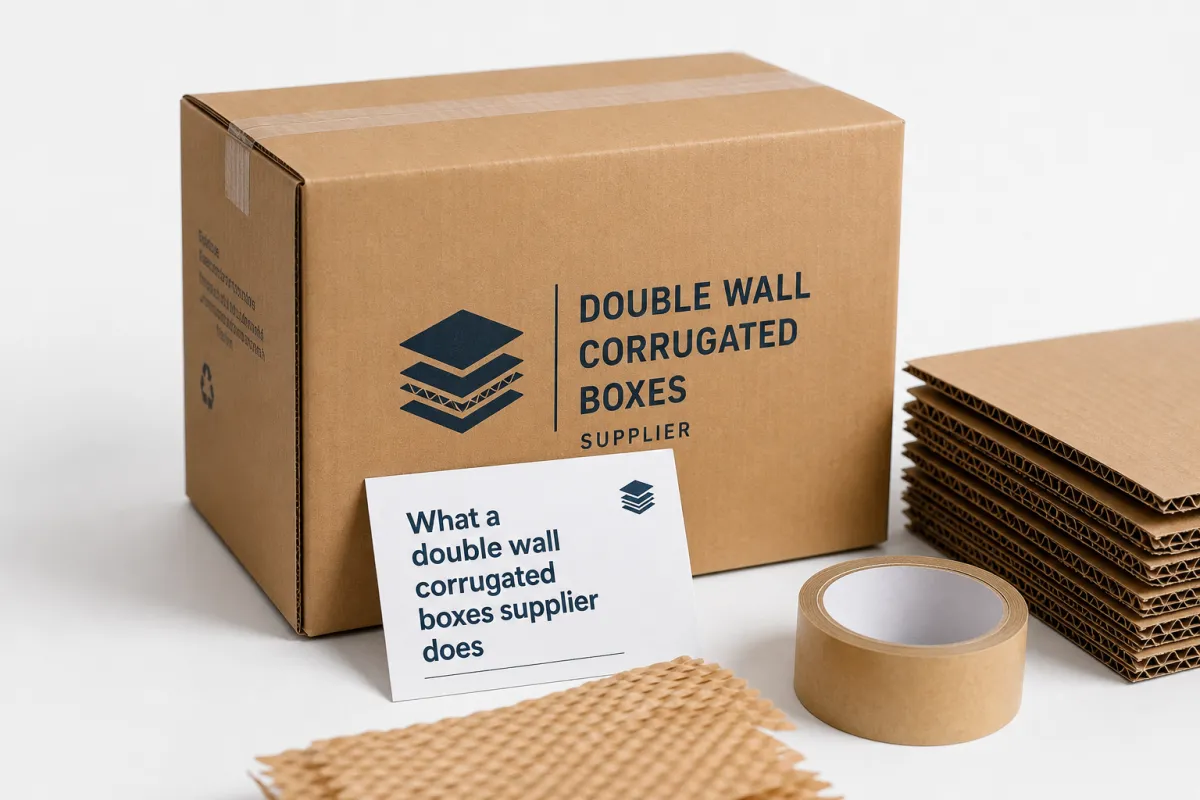
A double wall corrugated boxes supplier does a lot more than cut cartons to size. The useful ones translate product weight, handling risk, storage conditions, and shipping method into a box spec that actually performs. Two cartons can share the same outside dimensions and still behave very differently because the board grade, flute mix, and liner weights are not the same. Buyers who skip that detail usually find out the hard way. Usually after damage claims show up.
Double wall board contains two fluted layers and three linerboards. That gives the carton better crush resistance, stronger puncture protection, and much better stacking performance than single wall. No magic. Just structure. For heavy products, dense goods, or palletized shipments, a double wall corrugated boxes supplier can point you toward a build that resists compression without turning the carton into an overpriced brick.
Most buyers need a supplier, not a middleman. A direct double wall corrugated boxes supplier can talk through stock sizes, custom tooling, board availability, and production capacity in one conversation. A broker may still help in some situations, but direct supply usually wins on consistency, repeatability, and honest lead times. That matters if you ship industrial parts, bottled goods, hardware kits, appliances, or export cartons.
The goal is not the thickest carton on paper. The goal is the right carton for the job. Overbuilt boxes waste money on freight, board, and storage. Underbuilt boxes create damage claims and rework. A good double wall corrugated boxes supplier keeps you out of both traps.
A box should be specified for the shipment it will face, not the sample that looks nice on a desk.
Double wall makes sense fast for heavy retail goods, industrial components, e-commerce orders with real weight, export shipments, and products that spend time stacked in warehouses. If the carton sees compression, moisture, or rough handling, double wall is usually the better starting point. A smart double wall corrugated boxes supplier asks about those conditions before quoting. That simple habit saves everyone a headache.
Standards matter too. Solid suppliers talk in ECT and Mullen burst ratings, and they may reference tests like ASTM D642 for compression or ASTM D4169 for distribution simulation. If your team validates packaging performance, ISTA is worth keeping in the loop. If you need documented fiber sourcing, ask about FSC-certified board and chain-of-custody paperwork from FSC. A double wall corrugated boxes supplier that can discuss those details is usually more useful than one that only says “strong box” and disappears.
Humidity, stacking height, and storage time all affect performance. A carton that behaves fine in a dry warehouse can get soft in a coastal lane or a summer trailer. Paperboard does not care about your optimism. A double wall corrugated boxes supplier should factor in the environment early, because the box has to live in the conditions you ship through, not the conditions you wish you had.
For buyers handling a broader packaging program, pairing carton work with Custom Packaging Products makes it easier to standardize inserts, labels, and outer packs across SKUs. If some of your products are lighter, compare them against Custom Shipping Boxes before defaulting every order to the heavy-duty option. Over-specing everything is just a more expensive way to stay busy.
How a double wall corrugated boxes supplier builds the box spec
A solid double wall corrugated boxes supplier starts with structure, not guesswork. The box spec usually begins with flute profile, liner weight, board caliper, and the way the carton will be made. Those details affect durability, print quality, and cost. The short version: thicker is not automatically better. Better matched is better.
Double wall board often comes in combinations such as BC flute, AC flute, or EB flute, depending on whether you need more cushioning, more stacking strength, or a tighter print surface. A double wall corrugated boxes supplier might recommend one build for puncture resistance and another for compression. That is because a tall pallet of dense product needs a different answer than a carton protecting something sharp or irregular.
Liner weight matters too. Heavier liners improve stiffness and crush resistance, but they can raise cost and reduce converting flexibility. Board caliper changes how the carton folds, closes, and prints. If your artwork has tight registration or small type, a competent double wall corrugated boxes supplier should warn you that a heavier board can shift the print result a bit. That is the kind of problem you want caught before production starts.
Box style changes performance just as much as board build. Regular slotted cartons are usually the most economical. Die-cut options can give you a tighter fit, a cleaner look, or easier assembly. A custom structure earns its keep if the product is awkward, fragile, or costly enough that wasted space becomes a shipping problem. A double wall corrugated boxes supplier should tell you when a special style is worth the tooling and when it is just an expensive way to feel fancy.
What the supplier should test
Good suppliers do not stop at a sample that “looks fine.” They check edge crush resistance, burst strength, pallet stacking performance, and handling risk. A desk sample can look perfect and still fail once the cartons are stacked four or five high in a warehouse. That is why a serious double wall corrugated boxes supplier asks about storage height, freight mode, and whether the load sits for days or weeks before delivery.
The product inside the carton matters just as much. A box holding steel parts deals with sharp edges. A carton carrying bottled liquids deals with weight and leak risk. Electronics usually need more movement control than raw compression resistance. A double wall corrugated boxes supplier should match the carton spec to the contents, not just the dimensions.
Materials and product compatibility
If your goods are moisture-sensitive, a supplier may recommend stronger liners, a different flute combination, or tighter storage guidance. High-humidity lanes and export routes can pull performance down fast if the board is not chosen carefully. Some buyers need coatings or treatments too, but those are not default upgrades. They are responses to a real problem. A good double wall corrugated boxes supplier will say that clearly instead of pitching extras you do not need.
Sharp corners change the conversation as well. A carton may need a tighter fit or internal support so the load does not punch through the board. Heavy but stable product often needs stacking strength more than puncture resistance. That is the practical part of working with a double wall corrugated boxes supplier: the box is built around the shipment, not around a catalog page.
Samples help, but they are not a full distribution test. A sample in your office tells you fit and finish. It does not tell you how the carton handles vibration, humidity, pallet pressure, and carrier handling. If a double wall corrugated boxes supplier sends a sample, treat it as one checkpoint, not the final answer.
Key factors to compare before you choose a supplier
Choosing a double wall corrugated boxes supplier is part packaging science, part operational sanity. If the supplier cannot quote cleanly, explain tradeoffs, or keep the details straight, the box quality is only half the problem. The other half is your time. That gets expensive in a hurry.
The first comparison point is board grade. Ask for the ECT or burst rating, liner composition, and flute combination. Then ask why that grade is being recommended. A good double wall corrugated boxes supplier should be able to tell you whether the carton is being built for stacking, puncture resistance, or a balance of both. Vague answers are not a good sign.
The next point is size tolerance. If the carton dimensions drift, your inserts stop fitting, pallets waste space, and product movement increases. A box that is a quarter inch off may not matter for a loose retail item, but it can matter a lot for a tightly packed shipment. A seasoned double wall corrugated boxes supplier will confirm internal dimensions, not just outside numbers, because the inside is where your product actually lives.
Print capability matters if the box is customer-facing. Flexo is common on corrugated cartons and works well for logos, handling marks, and simple graphics. If you need more detailed branding, ask whether the supplier can hit the finish you want without turning the carton into a cost joke. A double wall corrugated boxes supplier should be straight about print limits.
Environmental factors belong in the conversation too. Humidity, long transit, warehouse stacking, and export lanes all change the spec. A carton that is fine in a dry regional route may be underbuilt for ocean freight or a hot trailer run. That is why a double wall corrugated boxes supplier should ask about the shipping environment before the build gets locked.
Sustainability gets sold with a lot of noise, so ask for actual details. Recycled content helps only if the carton still meets the strength target. FSC certification matters if your customer needs documented sourcing. You can read more about responsible fiber sourcing at FSC. A double wall corrugated boxes supplier should be able to tell you whether the greener option truly works for your load, not just whether it sounds nice in a proposal.
Supplier reliability markers
- Clear quoting: line items for box cost, tooling, freight, and setup charges.
- Sample speed: a realistic sample timeline, not a promise that falls apart later.
- Spec support: someone who can explain board choices in plain language.
- Communication: quick answers when dimensions, artwork, or dates change.
- Repeatability: the same box should show up the same way next order.
If you are comparing several vendors, give each double wall corrugated boxes supplier the same input set and watch who asks the better questions. The best one is rarely the one with the flashiest PDF. It is usually the one that catches a missing pallet height, a humidity issue, or a bad delivery date before you do.
That is also the point where some buyers widen the conversation to include other packaging formats. If your program includes unit packs, inserts, or lighter shipping formats, review Custom Packaging Products alongside the carton spec. The goal is not to buy everything from one place out of habit. The goal is to keep the system coherent.
Cost and pricing from a double wall corrugated boxes supplier
Pricing from a double wall corrugated boxes supplier comes down to a handful of variables, and they do not all matter equally. Board grade, box size, custom tooling, print complexity, order volume, and freight usually move the number more than buyers expect. The mistake is thinking unit price tells the whole story. It almost never does.
Board is the biggest lever. A heavier liner or a stronger flute mix can push the cost up more than a logo or a one-color print. Tooling is the other obvious cost center. If you need a custom die-cut carton, you are paying for setup that stock sizes avoid. A double wall corrugated boxes supplier should show that difference clearly, not tuck it into the quote and hope nobody asks.
Here is a practical budget view. For standard double wall cartons in moderate volumes, buyers often see rough unit pricing somewhere in the $0.85 to $1.80 range for simpler stock-style builds, depending on size and quantity. Heavier custom formats, printed cartons, and smaller runs can climb into the $1.90 to $4.50 range or higher. Freight can add a meaningful chunk if the order ships far or if pallet density is poor. A double wall corrugated boxes supplier should explain where your number sits inside that range and why.
| Option | Typical use | Strength profile | Common tradeoff | Rough unit price range |
|---|---|---|---|---|
| Stock double wall carton | Standard shipping, repeat SKUs | Good compression, fast availability | Less precise fit | $0.85-$1.45 |
| Custom regular slotted carton | Heavy e-commerce, industrial parts | Strong and efficient | Setup and spec approval required | $1.10-$2.30 |
| Custom die-cut double wall | Tight fit, presentation, odd shapes | Very good fit and protection | Tooling cost and longer lead time | $1.90-$4.50+ |
| Printed double wall carton | Branded shipping, retail programs | Depends on board and print coverage | Higher setup and ink costs | $1.30-$3.75 |
The cheapest quote can be the expensive one later. If the box fails, you pay in damage claims, customer complaints, repacking, labor, and possibly a missed delivery window. A smart double wall corrugated boxes supplier should help you compare total landed cost, not just the lowest unit price.
Short-run pricing and bulk pricing are not the same animal. A small order carries more setup cost per unit because the press time and conversion time are spread across fewer cartons. Once quantities rise, unit cost usually drops. That does not mean you should overbuy just to chase a price break. A double wall corrugated boxes supplier should help you balance inventory risk against the savings.
Ask for line-item quotes. Seriously. You want to see whether the money is going into board strength, setup, freight, or artwork prep. That one move makes supplier comparison a lot more honest. If two proposals look close, the double wall corrugated boxes supplier that explains the numbers usually earns trust faster than the one hiding behind a single total.
If you are matching cartons to other parts of a packaging system, use the pricing review to check whether a shipping carton upgrade lets you reduce inserts, void fill, or secondary packaging elsewhere. That is where the real savings sometimes hide.
Order process and timeline with a double wall corrugated boxes supplier
The order process with a double wall corrugated boxes supplier should feel structured, not improvised. A clean workflow usually starts with an RFQ, moves to a spec recommendation, then drawing review, sample approval, and production. If a supplier wants to skip straight to “just send a PO,” that is not speed. That is future confusion with a shipping label on it.
Send complete product details on day one. Dimensions, weight, fragile points, shipping method, stacking expectations, and whether the carton is printed all matter. If the supplier has to chase basic information for three days, the timeline is already slipping. A practical double wall corrugated boxes supplier will ask for the missing pieces, but you save time by sending them up front.
Lead times depend on the format. Stock-style cartons can often move in roughly 3-7 business days. Custom sizes and printed runs often need 10-15 business days after proof approval. If tooling is required, add more time for die creation and testing. A double wall corrugated boxes supplier should give you a real window, not a hopeful guess that falls apart once the plant gets busy.
Where delays usually happen
- Artwork changes: the box is approved, then the logo changes, then the clock starts over.
- Missing dimensions: the outside size is sent, but no one confirms the internal fit.
- Tool creation: custom die-cut work needs time before the first good sample exists.
- Capacity issues: peak production periods can stretch lead times.
- Freight booking: the carton may be done, but the shipment still needs a truck.
Sample timing matters too. If a supplier says they can sample quickly, ask what “quickly” means in business days and whether the sample is structural or print-accurate. A double wall corrugated boxes supplier should keep those separate because one sample checks fit while another checks branding. Mixing them up creates avoidable approval loops.
If the order is urgent, the supplier may suggest a stock size or a simpler print route to protect the schedule. That can be smart. It can also be a compromise worth understanding before you agree to it. A good double wall corrugated boxes supplier will tell you exactly what you gain and what you give up if speed matters more than a perfect custom build.
Here is the buyer checklist I would send first:
- Product dimensions and weight.
- Internal fit requirement and any inserts.
- Shipping mode: parcel, LTL, export, or palletized storage.
- Expected stack height and warehouse conditions.
- Print file, if the carton is branded.
- Target quantity and delivery date.
If you send that upfront, a double wall corrugated boxes supplier can usually respond with a better recommendation, fewer revisions, and a more believable schedule. Funny how that works: give people the information they need and the process stops wobbling.
Common mistakes when working with a double wall corrugated boxes supplier
The most common mistake is ordering by outside dimensions only. That sounds harmless until the product does not fit, the insert is too tight, or the pallet pattern wastes space. A double wall corrugated boxes supplier needs the full picture: product size, packaging allowance, and how the cartons will be arranged for shipment. Outer dimensions alone are lazy spec writing, and lazy spec writing costs money.
Another classic error is comparing only unit price. A cheap carton that crushes, tears, or forces a repack is not cheap. The real number includes damage risk, labor, freight efficiency, and rework. A double wall corrugated boxes supplier worth your time will push you toward total landed cost, not the prettiest per-unit number.
Skipping samples is another bad habit, especially for heavy, fragile, or temperature-sensitive products. A carton can look fine and still fail under load or in humidity. If you are buying for export, stacked warehouse storage, or long carrier routes, test the spec before you commit. A double wall corrugated boxes supplier should support that, not act annoyed by it.
Underestimating lead times causes a lot of self-inflicted pain. You can rush some orders, but rush freight and emergency production are not gifts. They are costs. Often ugly ones. A double wall corrugated boxes supplier can move quickly, but only if the spec is clean and the approval cycle is tight.
Weak communication creates more damage than most buyers expect. If dimensions keep changing, artwork files are incomplete, or the product spec is still being “finalized,” the supplier ends up guessing. Guessing is bad in packaging. It leads to board recommendations that are too light, too heavy, or just plain wrong. A good double wall corrugated boxes supplier wants stable inputs because box production is not a brainstorming session.
What buyers should avoid
- Changing box size after proof approval.
- Sending vague weight estimates instead of actual unit weight.
- Ignoring humidity, export, or warehouse stack conditions.
- Assuming all double wall board performs the same.
- Accepting a quote without freight, tooling, or setup details.
If your packaging program is bigger than one carton, map the box order against the rest of the lineup. That is where Custom Packaging Products can support consistency across SKUs, inserts, and shipping formats. A double wall corrugated boxes supplier is most useful when it fits into a clear system instead of serving as a one-off panic buy.
One more mistake deserves its own line: changing requirements mid-order. It happens all the time, and it is almost never cheap. If the logo moves, the closure changes, or the load spec changes after approval, the double wall corrugated boxes supplier may need to restart part of the process. That means time, waste, and added cost. Packaging does not love surprises. It tolerates them poorly.
Expert tips and next steps with a double wall corrugated boxes supplier
If you want cleaner buying decisions, ask a double wall corrugated boxes supplier for two or three board options instead of one. That gives you a real comparison between strength and cost, not a single number tossed over the wall. A useful quote should show what changes if you move up or down in board grade.
Ask for a sample, a dieline, and a quote that separates box cost from freight and tooling. Those three things tell you whether you are comparing real options or just collecting sales sheets. A competent double wall corrugated boxes supplier should be comfortable laying out the numbers that way.
Build a simple supplier scorecard. Keep it boring. Lead time, responsiveness, spec accuracy, sample quality, and order consistency are usually enough. You do not need a 40-column spreadsheet unless you enjoy pretending. A double wall corrugated boxes supplier that is solid in those five areas is usually worth keeping.
Validate the box in the same conditions it will face in the real world. That means pallet height, warehouse humidity, carrier handling, and expected shelf life. If the product sits for weeks before shipping, say so. If the cartons are exposed to summer heat or export transit, say that too. A double wall corrugated boxes supplier can only recommend properly if the use case is honest.
From a practical buyer’s view, the best process is simple:
- Shortlist two or three suppliers.
- Send exact dimensions, weight, shipment method, and quantity.
- Request board options and a sample.
- Compare landed cost, not just unit price.
- Approve only after fit and performance are checked.
If you need broader packaging support, browse Custom Shipping Boxes and compare carton formats before locking the spec. Sometimes the smarter move is not a bigger box. Sometimes it is a better-sized one.
For teams that ship heavy products regularly, the right double wall corrugated boxes supplier is not the cheapest vendor on paper. It is the one that keeps your cartons strong enough, your lead times believable, and your freight spend under control. That is the relationship worth keeping, because it turns packaging from a recurring fire drill into a repeatable system.
FAQ
How do I know if I need a double wall corrugated boxes supplier instead of single wall?
Choose double wall if the product is heavy, the stack height is high, or the shipment has a real chance of being crushed in transit. Single wall can still work for lighter goods, but double wall gives you more protection margin when the cost of failure is higher than the box upgrade. If the load sits on pallets, ships long distance, or gets handled hard, a double wall corrugated boxes supplier is usually the safer conversation.
What affects pricing from a double wall corrugated boxes supplier the most?
Board grade, box size, custom tooling, print setup, and order volume usually move the price more than buyers expect. Freight can quietly become a major part of the total too, especially if the cartons ship far or the pallet count is inefficient. A double wall corrugated boxes supplier should show you unit price, tooling, and freight separately so you can compare landed cost instead of chasing the lowest number.
How long does a custom order usually take?
Stock-style cartons can move fast, while custom sizes, printed cartons, and new tooling need approval and production time. A realistic range is often a few business days for stock and roughly 10-15 business days after proof approval for many custom runs, with extra time if dies need to be made. The fastest orders are the ones with complete specs on day one: dimensions, weight, print file, quantity, and delivery target. That is where a double wall corrugated boxes supplier can move without chasing basics.
What should I send when requesting a quote from a double wall corrugated boxes supplier?
Send product dimensions, weight, fragile points, shipping method, stacking needs, and whether the box will be printed. Include your target quantity and any special conditions like humidity, export shipping, or retail display requirements. A good double wall corrugated boxes supplier can work with partial information, but the quote is better when the inputs are complete.
Can a double wall corrugated boxes supplier help with export or humid environments?
Yes, but you need to say that up front because moisture, long transit, and warehouse storage can change the board recommendation. The supplier may suggest stronger liners, different flute combinations, or sample testing before you commit to production. That is not upselling by default. It is basic risk control, and a serious double wall corrugated boxes supplier should treat it that way.
If you are buying for heavy goods, export lanes, or stacked warehouse storage, the right double wall corrugated boxes supplier can save you from weak cartons, late shipments, and the usual pile of avoidable packaging nonsense. Get the spec right, compare real numbers, and do not confuse a cheap quote with a good one. Then lock the carton to the shipment, not to somebody’s guess.


