Buyer Fit Snapshot
| Best fit | Kraft Corrugated Boxes Supplier projects where brand print, material claims, artwork control, MOQ, and repeat-order consistency need to be specified before quoting. |
|---|---|
| Quote inputs | Share finished size, material target, print colors, finish, packing count, annual reorder estimate, ship-to region, and any compliance wording. |
| Proofing check | Approve dieline scale, logo placement, barcode or warning zones, color tolerance, closure strength, and carton packing before bulk production. |
| Main risk | Vague material claims, crowded artwork, missing packing details, or unclear freight terms can make a low unit price expensive after revisions. |
Fast answer: Kraft Corrugated Boxes Supplier: Board, Finish, Dieline, and Unit Cost should be specified like a repeatable production item. The safest quote records material, print method, finish, artwork proof, packing count, and reorder notes in one written spec.
Production checks before approval
Compare the actual filled-product size with the drawing, then confirm tolerance on folds, seals, hang holes, label areas, and retail display edges. Reserve space for logos, QR codes, warning copy, and material claims before decorative graphics fill the panel.
Quote comparison points
Review material grade, print process, finish, sampling route, tooling charges, carton quantity, and freight assumptions side by side. A quote is only useful when the supplier can repeat the same color, closure quality, and packing count on the next order.
Kraft Corrugated Boxes supplier sounds like a tidy search phrase. Real life is messier. Buyers compare crushed cartons, freight bills, warehouse labor, and whether the box actually fits the product without turning the packing line into a small disaster. The cheapest box often becomes the priciest decision after returns, dents, and dimensional weight get a vote. A good kraft Corrugated Boxes Supplier is not just pushing cartons. They are balancing board strength, box style, print, stacking performance, and the kind of consistency that keeps operations from bleeding waste in slow motion.
I would start there and stay there. A kraft corrugated boxes supplier can be a stock vendor, a custom converter, or a packaging partner that helps shape the carton around the product instead of forcing the product into the nearest square hole. Those are different animals. One sells you a box that fits the shelf. Another helps cut void fill, improve cube efficiency, and stop transit damage before it starts eating margin. If your packaging team has ever ordered a box that was "close enough," you already know how that story ends. Kinda ugly.
Kraft Corrugated Boxes Supplier: What They Actually Provide
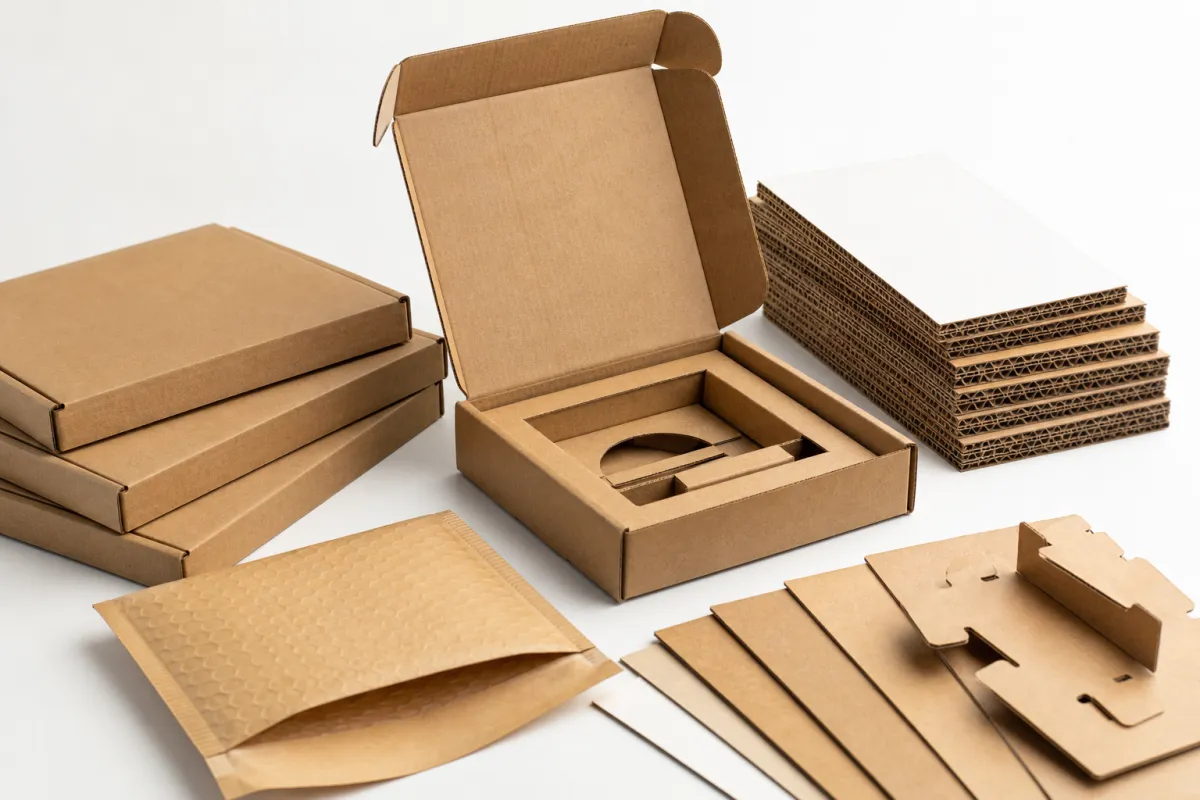
A kraft corrugated boxes supplier usually offers more than a carton and a freight quote. The real package is board grade, flute profile, box construction, and support around the specs that keep the thing from failing later. Kraft facings give the familiar brown look, sure. The performance comes from the structure: linerboard outside, corrugated medium in the middle, and the way those layers are built into single-wall or double-wall board.
That matters because most shipping problems do not start with appearance. They start with weak points. A light-duty carton can look fine in a sample room and then fold up after a few stack cycles in a warehouse aisle. I have seen teams blame the carrier, the dock crew, even the tape gun, when the real issue was a box spec that was too soft for the job. A stronger kraft corrugated boxes supplier should be able to explain the difference between a standard 32 ECT single-wall box and heavier 44 ECT or 48 ECT options, then match that spec to product weight, handling method, and transit distance without guessing like a person throwing darts blindfolded.
Good suppliers usually support a few box styles:
- Regular slotted containers for common shipping and storage use.
- Die-cut mailer styles for e-commerce presentation and tighter fits.
- Custom mailers and inserts for product protection and branding.
- Heavy-duty shipping cartons for industrial goods, parts, and bulk orders.
A capable kraft corrugated boxes supplier also helps with print options, from single-color branding to multi-color graphics, and with closure choices such as tuck flaps, tape-seal formats, or glued auto-bottom structures. Decoration is not the goal. Shipping the product intact is the goal. If the carton does that and looks decent doing it, great. If not, the fancy print is just expensive wallpaper on a failure.
The cheapest carton is rarely the cheapest packaging decision. Count damage, returns, repacking labor, and freight cube, and the stronger spec often wins on total cost.
From a buyer's point of view, a kraft corrugated boxes supplier should act more like a technical partner than an order desk. They should ask about product dimensions, unit weight, how the box is stacked, whether it ships parcel or pallet, and whether the packaging has to hold up in a humid back room or a fast-moving fulfillment center. That conversation is where the savings usually hide. If they skip straight to price, they are probably selling convenience, not performance.
If the operation is growing, a kraft corrugated boxes supplier should also think beyond the first purchase order. Custom runs, repeatability, label placement, and the way a carton works with other Custom Shipping Boxes matter. Packaging is not one box in a vacuum. It is a system, and systems punish sloppy assumptions.
How Kraft Corrugated Boxes Are Made and Sourced
To judge a kraft corrugated boxes supplier, it helps to know how the board gets made. Corrugated board starts with linerboard and corrugating medium. The medium is fluted, then bonded between liners. That flute structure gives stiffness without using a ridiculous amount of material, which is why corrugated packaging still carries so much shipping volume. Kraft facing gives the box its clean brown appearance and, depending on the pulp mix, can improve tear resistance and moisture behavior too.
Material sourcing is where things get less tidy. A kraft corrugated boxes supplier may offer virgin kraft, recycled-content board, or mixed-pulp constructions. Virgin kraft usually brings stronger fibers and a cleaner look. Recycled content often supports lower material impact and can reduce cost in some markets, though performance depends on the grade and the way the board is engineered. Mixed boards sit between those poles. There is no trophy for choosing the trendiest one. The right answer depends on product weight, graphics needs, and sustainability goals. If a supplier tells you one board is magically best for every use, they are selling a story, not packaging.
There is also a big gap between a supplier that buys generic stock and one that can repeat the same board specification across multiple runs. Consistency matters because a box that survives a pilot order still needs to survive six months later, after the warehouse has a different shift mix, the season is wetter, and the shipping lane is less forgiving. A careful kraft corrugated boxes supplier should be able to speak plainly about tolerances, caliper, ECT, burst strength, and whether the chosen board can handle repeat production without wandering off spec.
Manufacturing usually follows a predictable path: board is converted, cut, scored, glued or stitched, folded, bundled, and packed for shipment. More complex jobs bring die-cutting and printed finishing into the mix. The machine list matters less than the end result. A box built from the wrong flute profile may look fine and still fail under compression or puncture load. A box with the wrong face stock may scuff too easily, soak up moisture, or show graphics badly. That is why a strong kraft corrugated boxes supplier should talk about performance, not just machinery and nice photos of a factory floor.
For buyers who care about compliance and verification, industry references help. The ISTA test framework is useful for transit validation, and the FSC chain-of-custody model matters if documented sourcing claims are part of the job. Those references do not replace real-world testing, but they do give structure to the conversation. A kraft corrugated boxes supplier that knows these benchmarks is usually more useful than one that only talks Price Per Unit and hopes nobody asks follow-up questions.
Sourcing affects lead times too. If a board grade is easy to source, a kraft corrugated boxes supplier can often turn a custom order faster than if the spec requires unusual flute combinations or special print materials. For repeat programs, stock reliability matters a lot. One late sheet shipment can throw an entire fulfillment schedule sideways. Procurement teams should ask not only what the box costs, but how repeatable the raw material supply is across multiple order cycles.
How to Choose a Kraft Corrugated Boxes Supplier
A solid kraft corrugated boxes supplier is chosen by fit, not habit. First question: do they understand your product dimensions, weight, and distribution channel, or are they trying to shove a standard carton onto something that needs a custom spec? A good fit can reduce filler, improve presentation, and save space in shipping cartons and pallets. A bad fit creates movement, abrasion, and extra freight. The box should do work, not create more of it.
Construction details matter next. A kraft corrugated boxes supplier should be able to compare flute types like A, B, C, and E without turning the room into a jargon contest. Larger flutes usually cushion better. Smaller flutes often print cleaner and make the carton profile sleeker. The board choice should reflect the product, not the supplier's convenience. That is especially true for e-commerce packaging, subscription kits, and industrial parts that face different handling risks.
Service matters more than many buyers like to admit. A kraft corrugated boxes supplier that answers quote questions quickly, sends samples without drama, and provides a plain-language spec sheet usually makes life easier later. Packaging programs fail most often in the gray areas: unclear tolerances, mismatched artwork, missing approvals, or a sales team that disappears after the order is placed. That kind of nonsense costs time and confidence.
Compare suppliers across a few criteria instead of chasing the lowest line item:
- Spec accuracy - internal dimensions, board grade, flute, and closure style.
- Customization depth - custom sizing, print options, inserts, and structure changes.
- MOQ flexibility - stock runs, pilot orders, and scale-up capacity.
- Communication - response speed, quote clarity, and revision handling.
- Repeatability - whether the same carton can be produced consistently over time.
If the brand needs packaging that does more than ship a product, look at broader Custom Packaging Products too. A kraft corrugated boxes supplier may handle the outer carton, but labels, mailers, inserts, and retail-ready components often shape the final result just as much as the box itself.
| Supplier Type | Typical Strength | Best For | Watch-Out |
|---|---|---|---|
| Stock-box vendor | Fast availability, limited variation | Common sizes, low-complexity shipping | Fit may be poor, which can raise damage and filler costs |
| Custom converter | Better sizing, more board choices | Brands with repeat packaging needs | Lead time and setup details matter more |
| Packaging advisor | Spec guidance, testing, and optimization | Products with transit risk or high margin pressure | Needs good input from the buyer to be effective |
The most reliable kraft corrugated boxes supplier is often the one that asks the best questions. If they want product photos, shipping method, pallet pattern, warehouse conditions, and acceptable damage rates, that is a good sign. They are thinking like a packaging engineer, not an invoice machine. And yes, the right supplier will probably make you do a little homework. That is a good thing.
Kraft Corrugated Boxes Supplier Pricing: What Drives Cost
Pricing is where buyers get tripped up. A kraft corrugated boxes supplier can quote a low per-unit number that looks attractive, but the total cost can still be ugly if the box is underbuilt, oversized, or expensive to ship. Real price drivers are board grade, dimensions, print coverage, order volume, tooling, and freight distance. Bigger boxes use more board. Stronger board costs more. More print colors usually add setup and processing time. None of that is mysterious, but it gets ignored when procurement only stares at unit price like it owes them money.
For rough planning, stock kraft cartons in moderate quantities may land around $0.25-$0.80 per unit depending on size, while custom unprinted cartons often sit closer to $0.40-$1.25 per unit at mid-sized volumes. Fully branded cartons with higher print coverage, special finishes, or custom inserts can move above that range. A kraft corrugated boxes supplier should be able to explain why a higher unit cost can still lower the total packaging bill if it cuts damage, trims void fill, or reduces dimensional weight charges.
Hidden costs deserve the same attention. Setup fees, plate charges, die charges, rush fees, and rework caused by unclear specs can quietly blow up a job. So can inconsistency. If the first run is perfect and the second run arrives with slightly different dimensions, the warehouse pays for it through labor and errors. A professional kraft corrugated boxes supplier should show where those costs sit before the order gets approved.
Use a practical method to compare quotes from a kraft corrugated boxes supplier or three different suppliers without getting fooled by headline numbers:
- Match the exact internal dimensions.
- Match the board grade and flute profile.
- Match print coverage, color count, and finish.
- Confirm quantity break and delivery destination.
- Ask whether tooling, plates, and freight are included.
That list looks basic because it is basic. Still, quote reviews go off the rails all the time. A supplier quoting 1,000 cartons is not offering the same thing as a supplier quoting 5,000 cartons with heavier board and free freight. A good kraft corrugated boxes supplier will not mind the scrutiny. The weaker ones tend to hide behind confusion and hope nobody notices.
There is also a real tradeoff between short-term cash and long-term packaging economics. A carton that is five cents cheaper but causes a small rise in damage can erase the savings fast. For higher-value products, the right kraft corrugated boxes supplier may save more through fewer claims than through a bargain unit price. That is not clever theory. It is plain arithmetic with a warehouse attached.
Step-by-Step Process and Timeline From Quote to Delivery
The cleanest projects start with a clear brief. A kraft corrugated boxes supplier should receive product dimensions, unit weight, shipping method, storage conditions, stacking expectations, and any branding needs before quoting. If the product is fragile, say it. If the carton needs to survive pallet stacking for several days, say that too. Vague briefs produce vague quotes, and vague quotes tend to come back later as rework.
Once the brief is in, the supplier should move through quote, sample, and approval in a disciplined sequence. A kraft corrugated boxes supplier that skips sample approval to save time usually creates more delay later. Samples are where dimensional fit, closure behavior, print placement, and compression feel get tested against reality. For higher-risk packages, I would rather spend an extra day on samples than lose a week fixing a bad production run.
A realistic timeline often looks like this:
- Requirement intake: 1-2 business days.
- Quote and revisions: 2-4 business days.
- Sample or proof approval: 2-5 business days, depending on complexity.
- Production: often 7-15 business days after approval for custom work.
- Freight and delivery: 1-7 business days, based on distance and mode.
A kraft corrugated boxes supplier with a simple stock program may move faster. Custom printed cartons or unusual die-cuts take longer. That is normal. The real issue is not speed by itself; it is predictability. A buyer can plan around a 12-business-day production window. A buyer cannot plan around a supplier that keeps moving the finish line like it is a hobby.
Testing deserves a place in the process. For shipping environments with real transit risk, ask for performance testing that matches the package profile. The ISTA transit testing framework is a common reference point, and it is useful because it pushes teams to think about vibration, compression, drop events, and handling patterns instead of leaning on vibes. A smart kraft corrugated boxes supplier knows the box does not live in a vacuum. It lives inside a shipping network that enjoys bruising things.
A good box schedule is not just faster. It is calmer. It cuts surprises, keeps inventory moving, and gives operations teams a repeatable standard they can trust.
The strongest sign of a dependable kraft corrugated boxes supplier is how they handle revision cycles. If artwork changes, dimensions shift, or freight terms need to be updated, they should document it cleanly and keep the spec current. Packaging failures often begin as paperwork failures. The box itself is only half the system.
Common Mistakes Buyers Make With a Kraft Corrugated Boxes Supplier
The most common mistake is plain enough: choosing the lowest quote and assuming the rest will sort itself out. A kraft corrugated boxes supplier can hit a low number by lowering board grade, changing the flute, or using oversized stock that chews up freight dollars. Shopping is fine. Shopping without matching the actual job is where things get expensive.
Another mistake is ordering before the shipping environment is understood. A box that performs well in a dry warehouse can act very differently in humid storage or long pallet dwell times. A kraft corrugated boxes supplier should know whether the carton will travel parcel, LTL, or full truckload because that changes the risk profile. Automated pack lines, hand packing, and retail backrooms create different stress points too.
Vague specs are a third trap. If the buyer says "strong kraft box" and stops there, the supplier has to guess. Guessing leads to mismatched expectations. A better brief includes internal dimensions, product weight, flute type, ECT target, closure style, print area, and tolerance ranges. That level of detail helps the kraft corrugated boxes supplier return a box that fits the job instead of merely sounding fine in a quote email.
Testing in a controlled sample is another place buyers go wrong. A sample that looks good in the office may fail after a few real handling cycles. Drop it. Stack it. Tape it. Put product in it. Let the warehouse team touch it. A kraft corrugated boxes supplier that encourages this kind of validation is usually trying to reduce future claims, not just close a sale. That is a good sign.
Do not ignore consistency either. The first run may be right, but the second run can drift in size or board feel if the spec is not locked down. A dependable kraft corrugated boxes supplier should support repeatability because repeatability protects margin and process. In packaging, variation is rarely a virtue.
- Do not compare different board grades as if they were identical.
- Do not skip sample testing just because the quote looks good.
- Do not assume a stock carton can solve a custom-fit problem.
- Do not forget freight, tooling, and setup charges in the total cost.
Expert Tips for Vetting a Kraft Corrugated Boxes Supplier
If you want a fast way to separate a decent kraft corrugated boxes supplier from a truly useful one, ask for a spec sheet, a sample build, and a written comparison of board options. You are looking for clarity, not charm. A real partner should be able to say why one flute profile beats another, how much compression strength comes from a heavier board, and what the tradeoff is in cost and printability.
Ask about quality control in plain terms. How are dimensions checked? How are bundles packed? What tolerance is allowed on score lines and closure tabs? How are print proofs approved? A kraft corrugated boxes supplier that answers those questions without hesitation usually has a process worth trusting. A vague answer usually means the process is improvised and everyone is pretending that is fine.
It helps to build a scorecard. Keep it simple, and compare suppliers across the same five categories every time:
- Communication - speed, clarity, and follow-through.
- Consistency - repeatability from sample to production.
- Customization - ability to fit the product and the brand.
- Transparency - quote detail, freight assumptions, and hidden fees.
- Problem-solving - willingness to adjust the spec for damage reduction or cube efficiency.
One more practical move: test a single box line before scaling. A kraft corrugated boxes supplier may be excellent on the quote and still miss on warehouse fit if the carton is awkward to assemble. Give the line team the sample, watch the packing rhythm, and note whether the product slides, jams, or wastes motion. Small observations usually expose large costs.
For brands that need a broader packaging mix, it makes sense to build the carton conversation alongside other packaging programs instead of treating each item separately. A kraft corrugated boxes supplier that works comfortably with inserts, mailers, and branded shipping components can help keep the whole system aligned. That matters because packaging problems love hiding at the seams between components.
My practical advice is simple: shortlist two or three suppliers, request matching specs, and compare them side by side. The winning kraft corrugated boxes supplier is not always the cheapest one. It is the one that protects product integrity, keeps shipping efficient, and gives your team confidence that next month’s order will behave the same way as this month’s order. If you have to keep re-litigating the carton spec every quarter, something is off.
What does a kraft corrugated boxes supplier actually provide?
They supply corrugated packaging in kraft board, from stock cartons to custom sizes and printed formats. A stronger supplier also helps with board spec selection, sample testing, and order planning. The best ones act like packaging advisors, not just box resellers.
How do I compare kraft corrugated boxes supplier quotes?
Compare the same box dimensions, board grade, flute type, print details, quantity, and delivery terms. Watch for hidden charges such as tooling, setup, or rush fees. Judge total packaging cost, not just the per-box price.
How long does it take to order from a kraft corrugated boxes supplier?
Stock boxes can move quickly, while custom boxes usually require sample approval and production scheduling. Lead time depends on order volume, material availability, and freight distance. Ask for a timeline that separates quoting, sampling, production, and delivery.
What box specs should I ask a kraft corrugated boxes supplier for?
Ask for internal dimensions, board grade, flute type, and closure style. Include product weight, shipping method, and stacking requirements so the spec matches the job. If you need branding, confirm print area and artwork limits early.
Can a kraft corrugated boxes supplier help reduce shipping damage?
Yes, if they review your product weight, fragility, and transit conditions before recommending a box. They can help right-size packaging and choose stronger board where needed. Sample testing is the fastest way to prove whether the box performs in real shipping, and that is usually what separates a useful kraft corrugated boxes supplier from a basic one.