Buyer Fit Snapshot
| Best fit | Eco Friendly Pallet Boxes Manufacturer projects where brand print, material claims, artwork control, MOQ, and repeat-order consistency need to be specified before quoting. |
|---|---|
| Quote inputs | Share finished size, material target, print colors, finish, packing count, annual reorder estimate, ship-to region, and any compliance wording. |
| Proofing check | Approve dieline scale, logo placement, barcode or warning zones, color tolerance, closure strength, and carton packing before bulk production. |
| Main risk | Vague material claims, crowded artwork, missing packing details, or unclear freight terms can make a low unit price expensive after revisions. |
Fast answer: Eco Friendly Pallet Boxes Manufacturer: Board, Finish, Dieline, and Unit Cost should be specified like a repeatable production item. The safest quote records material, print method, finish, artwork proof, packing count, and reorder notes in one written spec.
Production checks before approval
Compare the actual filled-product size with the drawing, then confirm tolerance on folds, seals, hang holes, label areas, and retail display edges. Reserve space for logos, QR codes, warning copy, and material claims before decorative graphics fill the panel.
Quote comparison points
Review material grade, print process, finish, sampling route, tooling charges, carton quantity, and freight assumptions side by side. A quote is only useful when the supplier can repeat the same color, closure quality, and packing count on the next order.
Eco Friendly Pallet Boxes Manufacturer Buying Guide
Most pallet damage does not begin with a dramatic drop or a forklift collision. It usually starts much earlier, with stacking pressure, trapped moisture, a slightly off-center load, and a box that slowly loses shape until the failure shows up at the receiving dock. That is why choosing an eco friendly pallet boxes manufacturer matters so much. A well-designed pallet box protects bulky, irregular, or fragile goods while using less material, less empty space, and less disposal burden than a heavy crate that was never really matched to the shipment.
For Custom Logo Things buyers, this is not only a sustainability decision. It is a shipping decision with very real cost implications. A careful eco friendly pallet boxes manufacturer balances fiber content, structural strength, print requirements, pallet compatibility, and end-of-life recyclability so the packaging performs in the warehouse, in transit, and at the destination. The better suppliers do not sell “green” packaging as a vague promise. They build for load performance, documented recycled content, and repeatable production quality.
If you are comparing suppliers now, the differences often show up in the details: board grade, compression strength, closure method, lead time, and how clearly the quote defines the spec. That is why this guide walks through engineering, pricing, timeline, and selection the way a packaging buyer actually uses them. If you also need broader packaging options, the team at Custom Packaging Products can help you compare formats before you lock in a final structure.
Why an eco friendly pallet boxes manufacturer matters
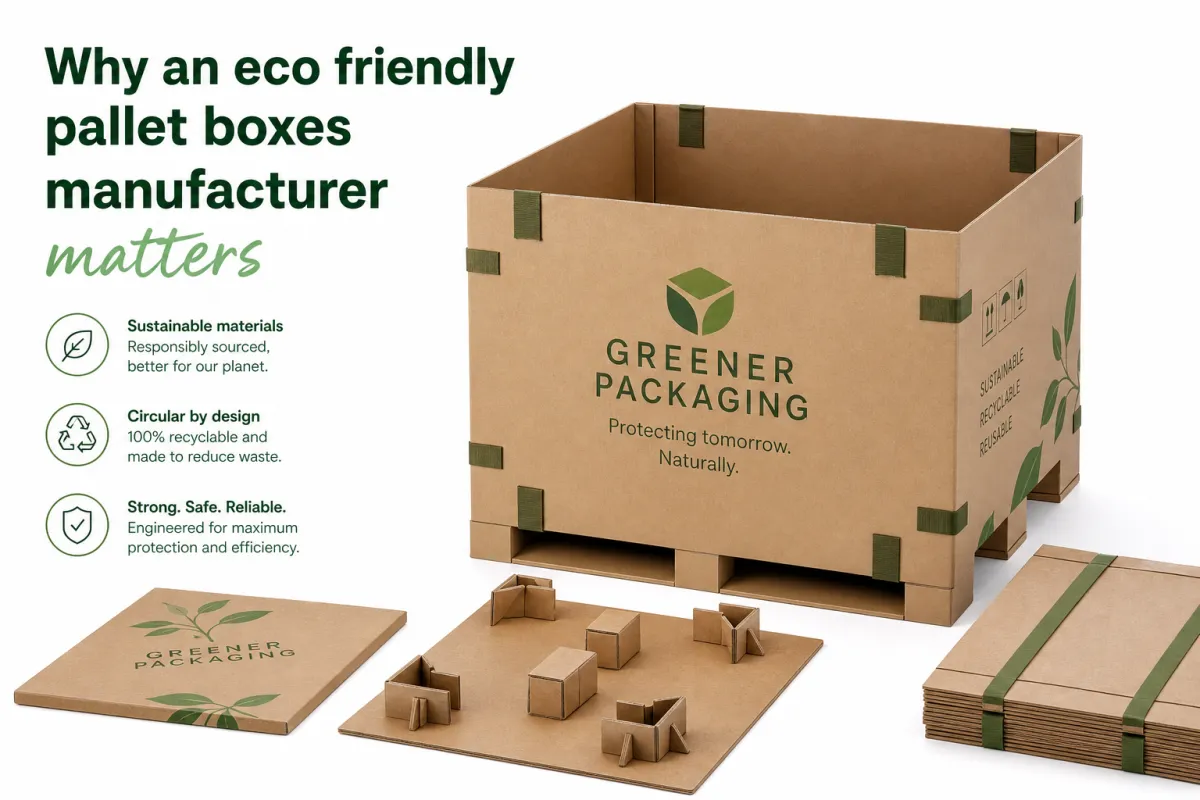
A pallet box is a large shipping container designed to sit on a pallet or integrated base, usually for goods too bulky, awkward, or sensitive for a standard carton. Think industrial parts, agricultural goods, e-commerce bulk orders, or mixed SKU shipments that need more protection than a simple wrap-and-stack approach can deliver. An eco friendly pallet boxes manufacturer makes that format with an eye on material efficiency, not just size.
That distinction matters. A standard carton is usually optimized for unit packing. A crate often leans toward rigidity and can include more wood or mixed materials. A pallet box sits between those poles, and a strong eco friendly pallet boxes manufacturer will use recycled fiberboard, FSC-certified board, hybrid structures, or reusable formats where the route justifies it. The goal is not to look sustainable. The goal is to reduce packaging mass while still protecting the load from compression, puncture, and edge failure.
There is also a hidden cost in weak packaging. If a box reduces transit damage, you cut returns, repacking labor, product loss, and emergency replacements. That often matters more than the material savings on the quote sheet. I have seen teams focus on unit price and ignore the cost of one failed shipment lane; one weak design can erase the savings from dozens of inexpensive boxes. That kind of mistake is gonna catch up with you fast.
What makes a manufacturer genuinely eco friendly?
- Recycled or FSC-certified fiber with traceable sourcing
- Board usage matched to the load instead of oversized by default
- Less void space, which means less filler and less wasted air in transit
- Recyclable end-of-life performance after use
- Designs that avoid mixed materials where possible
A practical eco friendly pallet boxes manufacturer should also be able to explain the tradeoffs. A box with more recycled content may need a stronger flute profile or a different reinforcement pattern to match the same compression performance. That is not a flaw. It is honest engineering. For buyers who want standards-based validation, the freight and transit testing guidance from ISTA is a useful reference point, especially for ship-to-distribution and export scenarios.
From a packaging buyer’s point of view, the question is simple: does the structure reduce waste without increasing claims? A strong eco friendly pallet boxes manufacturer should answer that with material data, sample prototypes, and a clear production plan. If the answer feels vague, that usually signals a gap somewhere in the process.
A box that saves 8% on board but doubles damage claims is not cheaper. It is just quieter about its failure.
How an eco friendly pallet boxes manufacturer builds the box
The build starts with the load, not the board. A good eco friendly pallet boxes manufacturer will ask for product dimensions, gross weight, center of gravity, fragility, stacking height, and route conditions before suggesting a structure. A 60 kg shipment with no top load is a very different problem from a 350 kg export load that will sit in a humid container for two weeks.
Four engineering questions shape the final box: how much compression it must carry, whether the pallet fork access needs to stay open, how much moisture the route will introduce, and whether the box must be opened and closed more than once. That is why the best eco friendly pallet boxes manufacturer teams think in performance terms. They do not begin with a catalog size and force the product into it.
Common material choices include corrugated fiberboard, paper-based pallet boxes, recycled-content reinforcements, and hybrid board-and-wood formats. Corrugated works well for many industrial and export applications because it is light, printable, and recyclable. Hybrid designs can make sense for heavier loads when the box needs stronger bottom support or edge reinforcement. A paper-based pallet box is often attractive for buyers trying to simplify recycling at destination.
Typical structural tests include compression, edge crush, burst, and fit testing with the actual pallet configuration. Many buyers know the names of these tests but not what they mean. Compression tells you how well the box resists vertical load in storage and transit. Edge crush helps estimate stacking durability. Burst strength checks resistance to puncture and pressure spikes. A competent eco friendly pallet boxes manufacturer should translate those numbers into real shipment behavior, not just hand over a test sheet.
There is also a clear difference between standard and custom builds. Standard boxes are faster and usually cheaper. Custom builds can add print branding, ventilation slots, inserts, divider systems, or access features for forklifts and pallet jacks. The trick is to improve function without turning the package into a mixed-material headache. A seasoned eco friendly pallet boxes manufacturer will keep recyclability in view while adjusting the structure for the route.
For buyers who want packaging that still represents the brand, the print surface matters too. A plain kraft exterior may be enough for some industrial shipments. Other lanes need a cleaner face for SKU identification, compliance marks, or logo printing. That is where an experienced supplier can connect structural design with brand presentation, which is also why About Custom Logo Things is worth reviewing if you want a supplier relationship that treats packaging as part of the customer experience, not just a shipping box.
One more useful benchmark: not every pallet box needs the same spec. A domestic lane with controlled storage may run on a lighter board grade, while export cargo may need a heavier flute profile, moisture resistance, or stronger closure. The right eco friendly pallet boxes manufacturer will not push the heaviest option by default. They will fit the design to the actual risk.
Eco friendly pallet boxes manufacturer pricing: cost drivers and MOQ
Pricing is where buyers often get tripped up. The quote may look simple, but the cost is usually driven by box size, board grade, reinforcement level, print complexity, moisture resistance, and order volume. An eco friendly pallet boxes manufacturer can look expensive on a unit basis if you compare it to a stripped-down box that is not engineered for the load. That comparison is not fair, and it usually leads to the wrong purchasing decision.
Minimum order quantity, or MOQ, matters a great deal. A small run spreads setup, cutting, and approval work across fewer units, so the unit price climbs. Larger runs usually lower the cost per box because the tooling, prep, and production overhead are shared across more pieces. An eco friendly pallet boxes manufacturer will normally give a sharper unit rate once the order reaches a stable production quantity, but that does not mean the cheapest quote is the smartest one.
Here is a simple way to think about typical commercial pricing. The numbers below are directional, not universal, because dimensions and board grade can change everything:
| Option | Typical MOQ | Approx. unit price | Best use case | Notes |
|---|---|---|---|---|
| Light-duty recycled corrugated pallet box | 500-1,000 units | $1.20-$2.20 | Domestic shipments, lighter parts | Lower freight weight, easier recycling |
| Custom reinforced fiber pallet box | 1,000-3,000 units | $2.40-$4.80 | Export and mixed-load shipping | Better compression and edge protection |
| Hybrid board-and-wood pallet box | 300-1,000 units | $4.50-$8.50 | Heavy industrial goods | Stronger base, more material complexity |
| Reusable foldable pallet box | 100-500 units | $12-$30 | Closed-loop internal logistics | Higher upfront cost, lower reuse cost |
A serious eco friendly pallet boxes manufacturer will quote on the same basis every time: same dimensions, same board grade, same print coverage, same delivery terms. If one supplier quotes ex-works and another quotes delivered pricing, you are not comparing like for like. Ask for the same testing standard too. If a quote references ISTA procedures or a box compression target, that becomes a meaningful basis for comparison.
Landed cost is where the real answer lives. A slightly higher unit price can still win if it lowers freight weight, reduces warehouse labor, cuts damage claims, and avoids landfill fees after use. In many operations, the box is only a small slice of the total cost. Product loss, customer complaints, and repacking can dwarf the packaging spend. That is why an eco friendly pallet boxes manufacturer should be judged on total ownership, not just the first invoice.
Here is a useful rule of thumb: if a better pallet box prevents even one serious claim in a high-value lane, the extra material cost may pay for itself quickly. That is not always the case, and I would never promise a fixed payback period without the shipment data. For fragile, dense, or export-bound loads, though, the math often favors stronger design.
Material certifications also affect value. If recycled content, chain-of-custody claims, or FSC documentation matter to your customer, the proof matters as much as the fiber itself. The FSC framework is useful here because it gives buyers a recognized way to verify responsible sourcing. A good eco friendly pallet boxes manufacturer should be able to tell you which claims are documented and which are simply marketing language.
Production process, timeline, and lead time from quote to shipment
The production flow is usually more structured than buyers expect. A capable eco friendly pallet boxes manufacturer will move from discovery call to specification review, then sample creation, approval, production, quality checks, and dispatch. Each stage protects against a different kind of mistake. Discovery stops mismatched specs. Sampling catches fit issues. Quality checks catch strength or print errors before freight leaves the dock.
Lead time depends on whether the box is a stock size or a custom build. Stock formats can be faster because the cutting patterns and material setup already exist. Custom Pallet Boxes add sampling and setup, and those steps can add several days before full production starts. An eco friendly pallet boxes manufacturer that gives you a real schedule, rather than a vague promise, is usually easier to work with over time.
What slows the schedule most? New dimensions, special print requirements, material shortages, high-volume orders, and seasonal congestion. Moisture barrier requirements can also stretch the timeline if the build needs extra material sourcing or a different coating process. A practical eco friendly pallet boxes manufacturer will flag these issues early instead of waiting until you are already committed to a ship date.
Typical timing looks something like this:
- Quote review: 1-2 business days once the brief is complete
- Sample build: 3-7 business days for many custom structures
- Approval window: 1-5 business days, depending on internal sign-off
- Production: often 10-20 business days for custom runs
- Dispatch: depends on freight method and destination
Those ranges are common, but not fixed. A high-volume order or a complex printed structure can run longer. A simple structural change can be quick. The important thing is that the eco friendly pallet boxes manufacturer should state the assumptions behind the schedule. If they do not ask for pallet configuration, destination, artwork deadline, and required documentation, the quoted lead time may be more hopeful than real.
Buyers sometimes forget that approval time is part of the schedule too. If your packaging, operations, and procurement teams all need to sign off, a sample can sit for days before anyone says yes or no. That is not the manufacturer’s fault, but it still affects shipment timing. A disciplined eco friendly pallet boxes manufacturer will build that into the plan and keep communication visible.
Step-by-step selection guide for the right pallet box
Start with the product, not the box. Measure length, width, height, gross weight, and any protrusions that affect fit. Then note fragility, temperature sensitivity, and whether the load will travel as a single layer or stacked. A strong eco friendly pallet boxes manufacturer cannot Choose the Right board grade without those basics.
Next, map the route. Domestic trucking, export transit, air freight, humid climates, or multiple handoffs all change the packaging spec. A lane that stays dry and controlled can use a different build than a shipment sitting in a coastal warehouse or crossing a long ocean route. The best eco friendly pallet boxes manufacturer will ask those questions because route conditions often matter as much as weight.
Then build a requirement list. Recycled content may be non-negotiable. So may printable surfaces, pallet base compatibility, or a reusable format that stays in circulation for several trips. If the box must be recyclable at destination, avoid mixed-material features unless there is a clear operational reason for them. A disciplined eco friendly pallet boxes manufacturer will help you preserve those priorities instead of quietly drifting into a more complicated structure.
Use samples, and test them with real product. Paper specs are useful, but they do not show how a team will feel when lifting the box, folding it, loading it, and closing it for dispatch. If the closure takes too long or the fit is too tight, the warehouse pays the price every day. I would rather see a slightly simpler structure that runs cleanly than a fancy one that creates bottlenecks. That is often the difference between a theoretical design and a workable one.
A quick scorecard can keep the selection process grounded:
- Sustainability: recycled content, FSC sourcing, recyclability
- Durability: strength, compression, puncture resistance
- Price: unit cost, MOQ, and tooling assumptions
- Timeline: sample speed, production lead time, freight timing
- Service: responsiveness, spec clarity, documentation quality
That scorecard gives you a fairer comparison between suppliers than a single quote line ever will. A strong eco friendly pallet boxes manufacturer will welcome it because good suppliers like clear briefs. Weak suppliers prefer ambiguity because it hides gaps in their process.
One more practical check: ask whether the design can be adjusted for ventilation, pallet jack access, or stack stability without harming recyclability. If the answer is yes, you probably have a flexible supplier. If the answer is a hard no, the design may be too rigid for real operations.
Common mistakes when sourcing pallet boxes
The cheapest quote is often the most expensive decision. A weak box can trigger damage claims, product replacement, rush freight, and customer frustration. A good eco friendly pallet boxes manufacturer will usually help you see the hidden cost before you approve the order, but only if you ask for the right data.
Moisture is another blind spot. Fiber performance changes fast in humid environments, cold-chain transitions, or export lanes where condensation is common. If the route is damp, the board grade and structural design need to account for that. A box that performs well in a dry warehouse may struggle in a container that sees temperature swings. The right eco friendly pallet boxes manufacturer should discuss those conditions upfront.
Vague specifications create bad packaging. If the supplier does not know exact weight, stacking load, route, closure method, or handling pattern, the box may be over-built or under-built. Over-built means wasted material and cost. Under-built means failure. Neither is acceptable. That is why an eco friendly pallet boxes manufacturer will push for more detail, not less.
Warehouse ergonomics also matter more than many teams expect. If a box is hard to fold, hard to close, or awkward to load, labor costs rise. The packaging may still be recyclable, but the operation will not love it. This is a classic case where sustainability and usability need to move together. A smart eco friendly pallet boxes manufacturer designs for both.
Finally, do not confuse claims with proof. “Recycled” is not enough unless the content basis is documented. “Recyclable” is not enough unless the local recovery path is realistic. “Eco friendly” is not enough unless the material, structure, and end-of-life outcome are clear. Ask for the specification sheet, recycled-content statement, and any certification documents before you sign. If you need a broader packaging discussion around branded structures and formats, the team at Custom Packaging Products can help you compare options without guessing.
One line I hear often, and agree with, is this: sustainability has to survive the warehouse. That is the real test. If a box cannot be folded, filled, stacked, and shipped without constant friction, the environmental story does not carry much weight in practice.
Expert tips and next steps with an eco friendly pallet boxes manufacturer
Ask for a specification sheet before you ask for a discount. That sheet should spell out dimensions, board grade, recycled content, closure style, and any testing references. A reliable eco friendly pallet boxes manufacturer will have no problem putting those details in writing.
Request a sample and a recycled-content statement at the same time. If the shipment is high value or unusually shaped, pilot a small run first. That gives you a real-world read on fit, handling, and closure quality before you commit to scale. A cautious eco friendly pallet boxes manufacturer should support that approach because it reduces surprises for both sides.
Compare at least two or three suppliers from the same brief. Same dimensions. Same load. Same board grade. Same delivery terms. If one eco friendly pallet boxes manufacturer is dramatically cheaper, ask what changed. Sometimes the answer is a smarter design. Sometimes it is simply less material.
Use a review cycle after each shipment lane. Track breakage, moisture issues, warehouse complaints, and any unused margin in the structure. If the box is outperforming expectations, reduce material carefully. If it is struggling, reinforce before the next run. That is how an eco friendly pallet boxes manufacturer relationship becomes more valuable over time: not by locking the spec forever, but by tightening it with evidence.
For buyers at Custom Logo Things, the next steps are straightforward. Finalize the product specs, gather samples, compare full landed cost, and choose the eco friendly pallet boxes manufacturer that balances protection, recyclability, and timeline. If branding matters too, align the pallet box with your wider packaging mix so the shipment looks intentional from warehouse to customer. You can also review About Custom Logo Things to understand how the team approaches custom packaging projects with both design and logistics in mind.
The best outcome is not the lowest quote. It is the box that arrives intact, is easy to handle, and can be recovered responsibly after use. That is the standard I would use with any eco friendly pallet boxes manufacturer, and it is the standard that usually protects margin as well as the environment. If you are making the choice now, start with the shipping lane, then match the structure to the actual risk, not the guess you hope will hold.
What should I ask an eco friendly pallet boxes manufacturer before ordering?
Ask for material details, recycled content, certifications, and whether the design is recyclable after use. Request a quote with the same dimensions, board grade, quantity, and shipping terms so comparisons are accurate. If you can, ask for a sample that uses the exact product you plan to ship, because paper specs only tell part of the story.
How does an eco friendly pallet boxes manufacturer set the price?
Price usually depends on size, structural strength, customization, print, and order volume. MOQ matters because smaller runs spread setup costs across fewer units, which raises the unit price. Freight method, moisture-resistance features, and testing requirements can also move the number more than buyers expect.
What is the typical lead time for custom pallet boxes?
Stock designs are usually faster, while custom builds add time for sampling, approval, and production setup. Lead time can also change with seasonality, material availability, and the complexity of the requested structure. A dependable supplier should state the assumptions behind the schedule instead of tossing out a best-case estimate.
Are eco friendly pallet boxes strong enough for export shipping?
Yes, if the design is matched to the load weight, route, stacking pressure, and moisture exposure. A good manufacturer should provide testing details or performance guidance before you commit to scale production. Export lanes often need a little more margin than domestic routes, especially when humidity and long dwell times are part of the trip.
How do I compare two eco friendly pallet boxes manufacturers fairly?
Compare them on the same specification sheet, then look at sample quality, durability, recycled content, and responsiveness. Include freight, damage risk, and warehouse handling in the comparison so the cheapest quote does not hide the highest total cost. If one supplier is far below the others, ask exactly where the savings are coming from.