Buyer Fit Snapshot
| Best fit | Custom Pallet Boxes for Branding projects where brand print, material claims, artwork control, MOQ, and repeat-order consistency need to be specified before quoting. |
|---|---|
| Quote inputs | Share finished size, material target, print colors, finish, packing count, annual reorder estimate, ship-to region, and any compliance wording. |
| Proofing check | Approve dieline scale, logo placement, barcode or warning zones, color tolerance, closure strength, and carton packing before bulk production. |
| Main risk | Vague material claims, crowded artwork, missing packing details, or unclear freight terms can make a low unit price expensive after revisions. |
Fast answer: Custom Pallet Boxes for Branding: Design, Cost, and Use should be specified like a repeatable production item. The safest quote records material, print method, finish, artwork proof, packing count, and reorder notes in one written spec.
Production checks before approval
Compare the actual filled-product size with the drawing, then confirm tolerance on folds, seals, hang holes, label areas, and retail display edges. Reserve space for logos, QR codes, warning copy, and material claims before decorative graphics fill the panel.
Quote comparison points
Review material grade, print process, finish, sampling route, tooling charges, carton quantity, and freight assumptions side by side. A quote is only useful when the supplier can repeat the same color, closure quality, and packing count on the next order.
Custom Pallet Boxes for branding do far more than hide a load. They turn stacked freight into a visible brand surface, and that matters long before anyone opens the carton or touches the product inside. A pallet sitting in a warehouse aisle, a stockroom, or a receiving dock can still project quality, order, and consistency when the outer packaging is built with care.
The real strength of Custom Pallet Boxes for branding comes from that mix of protection, organization, and identity. Buyers, distributors, and store teams usually meet the outer package first, which means the branding has to hold up under rough handling, harsh lighting, and the pace of a busy supply chain. Strong packaging design earns its place by doing useful work while still looking deliberate.
Used well, custom pallet Boxes for Branding elevate product presentation without adding noise to the process. Used poorly, they become oversized cardboard with a logo on one face and little else. The difference usually comes down to structure, print planning, and whether the package was designed for real transit conditions instead of a polished render.
What custom pallet boxes for branding actually are
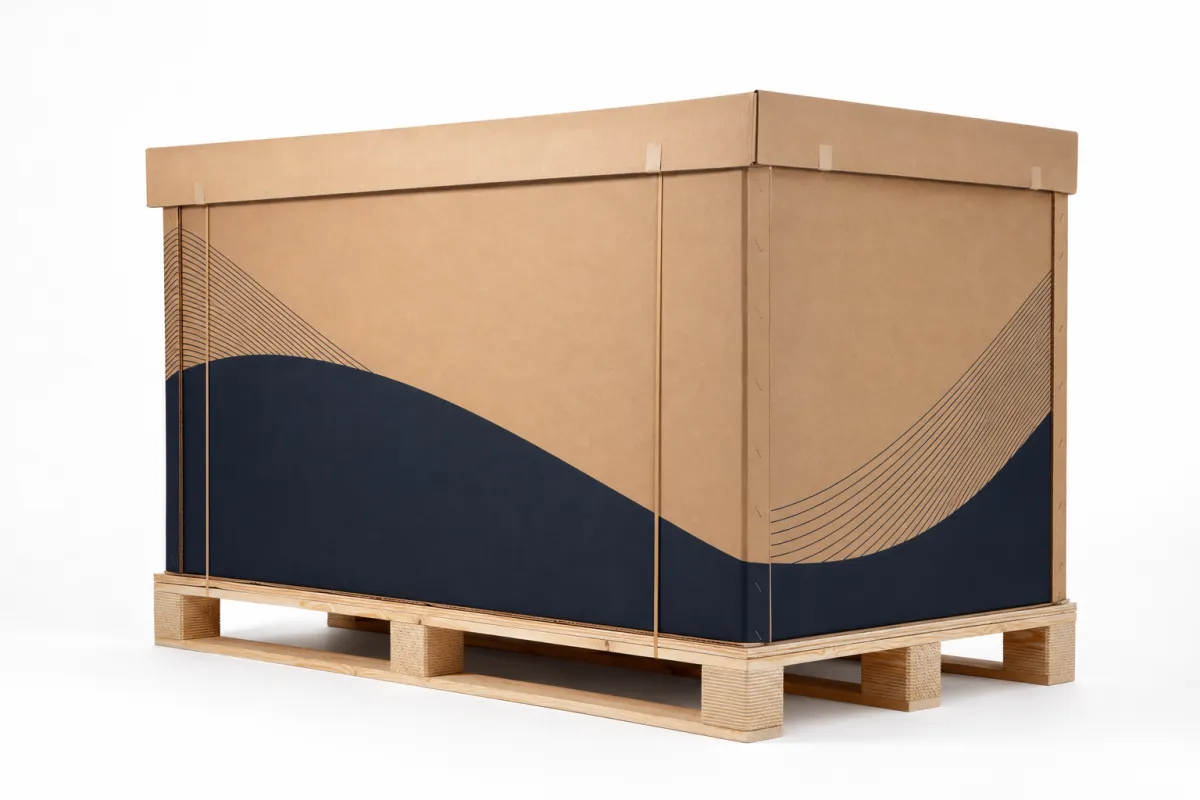
At the simplest level, Custom Pallet Boxes for branding are oversized shipping containers built around a pallet footprint so stacked goods can travel as one unit while carrying printed graphics, logos, and handling information. They are often made from corrugated board, sometimes paired with a wood frame or reinforced base, and sized to protect the load while giving the shipment a cleaner outer face than plain freight wrap or generic master cartons.
That shift looks small on paper, yet the visual effect is substantial. A plain shipping pallet reads as transport. A branded pallet box reads as product line, planned delivery, and professional operation. In retail packaging, distributor replenishment, and business-to-business delivery, that difference shapes the first impression before anyone checks the contents. Custom pallet boxes for branding help that first look feel intentional instead of improvised.
They also sit between standard custom printed boxes and full crate-style shipping systems. There is room for bold graphics, product codes, and brand messaging, yet the package still remains practical for palletized freight. For a packaging buyer, that balance is often the right one because it supports logistics and brand identity without drifting into unnecessary expense or complexity.
“If the outside looks careless, most people assume the inside got the same treatment.”
That sentiment carries real weight in warehouses and back rooms, where shipments may sit for hours or days before opening. Custom pallet boxes for branding keep the load visually organized during that time, which makes the brand feel more credible and easier to recognize across channels. Used consistently, they can also become part of a broader branded packaging system alongside labels, inserts, and pallet tags from Custom Labels & Tags.
For brands shipping to multiple accounts or distribution centers, the outer box also becomes a practical identification tool. That is one reason custom pallet boxes for branding show up in cosmetics, beverages, food service, industrial supplies, and other categories where product packaging has to survive handling while still looking composed.
How custom pallet boxes for branding work in transit
The journey starts with the load, not the artwork. Custom pallet boxes for branding need to be built around the actual pallet footprint, stacked height, and weight of the shipment, then matched to the way the product is packed inside. In a working production flow, the box or sleeve is formed, the product stack is set on the pallet, and the outer structure is lowered or wrapped around the load before banding, tape, or stretch film secures everything for shipment.
Print placement matters because different people see different sides. A carrier may only notice one panel at pickup, a warehouse associate may see the long face while scanning labels, and a receiver may only see the front and top after unloading. Custom pallet boxes for branding should carry the strongest graphics on the most visible surfaces, with secondary marks such as product codes, lot references, and handling instructions placed where they support the brand instead of competing with it.
Construction choices affect both appearance and durability. Single-wall corrugated works for lighter, shorter-haul loads. Double-wall board adds more stacking resistance and usually holds up better when custom pallet boxes for branding need to travel farther or sit in storage before use. Corner reinforcements, pallet skirts, die-cut hand holes, and locking tabs can all improve handling, but each one changes how much artwork space remains and where the print can safely live.
Moisture, scuffing, and compression are the three forces that usually hurt the finished look first. Strap contact can crush ink near the pallet edge. Stretch wrap can dull graphics. Condensation can weaken board performance if the shipment moves between temperature zones. Good custom pallet boxes for branding account for those conditions from the start, so the final package still looks planned after it has moved through the dock, the truck, and the receiving area.
For teams shipping under more demanding conditions, testing is worth the effort. The ISTA family of distribution test methods is a useful reference point for vibration, drop, and compression expectations, while board sourcing can be tied to responsible fiber choices through FSC certification. Neither one replaces a real sample, but both help ground the design conversation in practical standards instead of guesswork.
Custom pallet boxes for branding: key design factors
Good packaging design starts with measurements. Custom pallet boxes for branding need the pallet footprint, stack height, total weight, and any overhang limits before anyone starts talking about artwork. If the load is narrow, tall, or uneven, the structure may need extra clearance or reinforcement so the box does not buckle, bow, or rub against the goods inside.
From there, the print strategy should match the goal. Some brands want a simple one-color logo with strong contrast, because that keeps custom pallet boxes for branding readable from a distance and easy to reproduce across repeat runs. Others want full-coverage graphics, panels of color, or a high-impact product story that feels closer to retail packaging. Neither approach is wrong; the right choice depends on the route, the customer, and the level of brand presence you want in the receiving dock.
Board grade matters more than many buyers expect. A lighter board can look fine on a render but fail quickly under compression or humid conditions. A heavier flute, better liner quality, or moisture-resistant treatment can make custom pallet boxes for branding last longer and keep their print cleaner. If the shipment is moving locally and opening quickly, you may not need the same build as a pallet that sits in a regional distribution center for a week.
Design details also need to stay out of the way of operations. Tape zones, pallet forklift access, hand holes, and load labels should all be planned before final artwork is approved. A logo that sits directly under a strap or a critical message placed on a seam can become unreadable once the box is assembled. The best custom pallet boxes for branding respect those constraints instead of treating them as afterthoughts.
- Product dimensions: confirm the longest, widest, and tallest points of the load before choosing the structure.
- Board strength: match flute and liner grade to weight, stacking, and transit time.
- Print coverage: decide whether the goal is a clean logo panel or full branded packaging.
- Handling zones: keep critical art away from straps, tape seams, and forklift contact points.
- Visibility: place the strongest graphics where receivers and carriers will actually see them.
That balance is what makes custom pallet boxes for branding feel useful instead of decorative. They should support the logistics team, hold up in transport, and still present a clean face to the customer. If you need to compare structure options, the broader line of Custom Packaging Products can help you think through material and format choices before you lock in a final build.
Custom pallet boxes for branding: cost and pricing factors
Price is usually driven by five things: size, board strength, print coverage, color count, and order quantity. Custom pallet boxes for branding also tend to include more setup than a standard carton, because large-format cutting, scoring, and print registration need careful planning. If the design includes special inserts, reinforced corners, or a hybrid wood-and-corrugated build, the price moves up again.
Larger boxes do not cost more only because they use more material. They also increase handling time, freight volume, and often the complexity of storage before assembly. That is why a quote for custom pallet boxes for branding should always be read in context, not as a raw carton price alone. Two structures that look close on paper can behave very differently once palletized and shipped.
Low-volume work and repeat production runs also price differently. A short run might carry higher per-unit cost because setup, plates, and sampling are spread across fewer boxes. A recurring program can reduce the unit price, especially if the artwork and structure stay stable. Buyers comparing custom pallet boxes for branding should ask for pricing by unit, by pallet, and by repeat-run tier so they can see how the numbers shift over time.
| Structure option | Typical use | Approx. unit cost range | Notes |
|---|---|---|---|
| Single-wall corrugated sleeve | Lighter loads, short regional shipping | $1.40-$3.25 | Lower material cost, good for simple branding and fast turns |
| Double-wall corrugated box | Heavier loads, longer transit, better stack strength | $2.75-$6.50 | Better protection and a cleaner finish under pressure |
| Reinforced corrugated with corners | Mixed handling, higher-value shipments | $4.25-$9.00 | More durable, useful when brand presentation matters after rough transit |
| Wood-and-corrugated hybrid | Premium presentation or demanding freight conditions | $8.00-$18.00+ | Higher cost, but strong structure and strong visual impact |
Those ranges are only a planning guide, because actual quotes depend on size, coverage, and quantity. Still, they help buyers avoid the common mistake of comparing custom pallet boxes for branding against a plain shipping carton and assuming they should cost the same. A branded freight package is doing more work.
Hidden savings matter too. Better custom pallet boxes for branding can reduce overpackaging, cut down on repacks, limit damage, and keep receiving teams from reworking the load. If branding helps a shipment arrive looking organized and professional, that can be worth more than a small difference in unit price. For teams that need consistent labeling and recurring brand marks, pairing the box with Custom Labels & Tags can also simplify the package system and reduce confusion at the dock.
Process and timeline for custom pallet boxes for branding
A clean process makes the whole project faster. Custom pallet boxes for branding usually move from discovery to delivery in a sequence: collect dimensions, define the shipping environment, choose the structure, review artwork, approve a prototype, then move into production. If the team has clear specifications from the start, the early stages are usually much smoother.
Artwork approval is one of the main timing gates. A logo file that is only available as a low-resolution image, a color callout with no matching reference, or a layout that has not been checked against the real dimensions can all add days. With custom pallet boxes for branding, the artwork has to fit the actual panel size, score line, fold direction, and tape path. A design that looks fine on a screen may need minor reshaping once it is mapped onto a large corrugated surface.
Structural sampling is another factor. Many buyers want to see a sample before full production, and that is a smart move if the shipment is high value or the box will be used often. A physical sample shows whether the box sits correctly on the pallet, whether the graphics land in the right place, and whether the board feels strong enough for the load. For custom pallet boxes for branding, that sample often pays for itself by catching issues early.
Most delays come from missing information rather than manufacturing itself. If the pallet height changes after the quote, the package may need to be resized. If the product weight is updated, the board grade may need to change. If the brand team decides to add messaging late in the process, the print layout may need another approval cycle. Good custom pallet boxes for branding depend on a tight brief, not just a good vendor.
A practical schedule often looks like this:
- Day 1-2: collect dimensions, load weight, shipping conditions, and brand assets.
- Day 3-5: review structure options and initial pricing.
- Day 6-10: approve artwork or sample layout.
- Day 10-15: build sample or prototype if needed.
- Day 15-25: run production, depending on quantity and complexity.
That is not a promise, just a realistic planning frame. Simple custom pallet boxes for branding can move faster, while heavier structures, specialty finishes, or larger print runs take longer. The best way to stay on schedule is to gather specs before quoting and to have operations, marketing, and purchasing review the same brief.
Common mistakes with branded pallet packaging
One of the biggest mistakes is designing for the mockup instead of the dock. A render may show crisp edges and perfect color, but custom pallet boxes for branding spend their real life under straps, near forklifts, and in mixed lighting. If the structure only works on a screen, it is gonna disappoint the first time it gets handled in the real world.
Another common issue is trying to cram too much into one panel. A pallet box is not a billboard. When teams add a long slogan, a regulatory note, a barcode, and a large logo to the same face, the result can look busy and hard to read from a distance. Strong custom pallet boxes for branding usually rely on one dominant message and a few supporting elements rather than every available inch.
Skipping the sample is risky as well. I have seen projects where the artwork looked polished, but the box seam cut directly through the brand mark once assembled. That kind of miss is avoidable, and honestly, it is cheaper to find it on a sample than in a receiving bay. Sampling also helps confirm whether the print still looks good after handling, because ink that seems rich at press check can still scuff once the pallet gets wrapped and moved.
Finally, some teams forget that branding and logistics share the same surface. If a forklift pocket blocks the logo, if a tape strip covers the product code, or if the box height changes after the art is approved, the whole system gets messy. Custom pallet boxes for branding work best when operations, design, and procurement are all looking at the same drawing.
- Designing only for appearance: the package has to survive loading, transit, and storage.
- Overcrowding the panels: too much copy makes the branding harder to read, not stronger.
- Ignoring moisture and compression: board choice needs to match the route, not just the budget.
- Skipping prototype checks: seam placement and fold lines can change the final look in a big way.
- Leaving operations out: forklift access, tape zones, and labels should be part of the initial layout.
Expert tips for better custom pallet boxes for branding
Start with the shipping path, not the artwork folder. If you know whether the load moves regionally, sits in storage, passes through humid docks, or travels with mixed freight, you can make better choices about board grade and print protection. That one decision often does more for the final result than a fancier graphic treatment.
Use contrast that survives distance and poor lighting. In a warehouse, low contrast disappears fast. A clean dark mark on a light board, or a bold light mark on a dark panel, usually reads better than delicate color blends that look lovely in a proof but vanish under fluorescent fixtures. With custom pallet boxes for branding, clarity beats decoration nine times out of ten.
Think about how the box will be photographed. A lot of shipments are captured at receiving, on the dock, or during internal quality checks. If the brand face is visible from the front and top, the box tends to present better in those quick photos, which can matter for account managers, inventory teams, and internal documentation. It is a small detail, but it helps the package do its job.
I also like to advise teams to reserve one panel for the “quiet” information. That means product code, lot data, and handling notes live on a face that does not fight the main branding. It keeps the package easier to read and gives the brand room to breathe. Nobody wants a pallet box that looks like a busy instruction manual.
And yes, sometimes the simplest build is the smartest build. A clean sleeve with careful print placement can outclass a complicated structure that tries to do too much. If the shipment is short-haul and the goal is recognition, not theater, you do not need to make it harder than that.
- Match print to distance: use bold type and strong contrast where the package will actually be seen.
- Protect the artwork: keep logos away from straps, corners, and likely scuff zones.
- Specify the environment: heat, humidity, and storage time affect board choice.
- Plan for reuse: if the box will be opened and reused internally, make the structure easy to handle.
- Approve a physical sample: it is the best way to catch seam, size, and print-placement issues.
That kind of planning is what makes custom pallet boxes for branding feel credible instead of flashy. The package should look like it belongs in the operation, because if it looks out of place, everyone notices.
Next steps for custom pallet boxes for branding
The best next move is to build the brief around the shipment, not around a wish list. Measure the pallet footprint, record the product weight, note the storage environment, and decide how visible the branding needs to be at the dock. With those details in hand, custom pallet boxes for branding become much easier to specify, price, and approve.
From there, choose the structure that matches the route and the handling risk. A lighter sleeve can be perfect for short runs and controlled distribution. A reinforced box may be smarter if the shipment needs more protection or a better finish after rough movement. Once the structure is set, the artwork can be shaped around real panel sizes instead of guessed dimensions, which saves time and keeps the package honest.
One final practical takeaway: if you want the branding to hold up, design the box as a freight system first and a marketing surface second. That order matters. The most effective custom pallet boxes for branding are the ones that travel well, read clearly, and still look composed after the pallet has done its work.
FAQ
Are custom pallet boxes for branding only for premium products?
No. They are useful anywhere the outer package matters, including replenishment shipments, distributor deliveries, industrial supplies, and retail support freight. Premium products may get the most obvious visual benefit, but the practical value shows up in many categories.
Do custom pallet boxes for branding need full-color printing?
Not always. A single-color mark with strong contrast can be enough, especially if the box will travel through busy warehouses and be viewed from a distance. Full color helps when the outer package is part of a larger presentation strategy, but it is not a requirement.
What material is best for custom pallet boxes for branding?
Corrugated board is the most common choice because it is light, printable, and easy to size around a pallet. Depending on the load, single-wall, double-wall, or reinforced combinations may make more sense. Wood hybrids are usually reserved for heavier freight or more demanding presentation needs.
How do I keep the branding from getting damaged?
Place important graphics away from straps, corners, tape seams, and forklift zones. Choose board strength for the route, not just the quote, and ask for a sample so you can see how the assembled box holds up before full production.
What should I have ready before requesting a quote?
Pallet dimensions, product weight, stack height, shipping conditions, print goals, and any handling or compliance details. The more complete the brief, the cleaner the quote and the fewer surprises later.

