Buyer Fit Snapshot
| Best fit | Eco Friendly Subscription Sleeve Packaging Explained projects where brand print, material claims, artwork control, MOQ, and repeat-order consistency need to be specified before quoting. |
|---|---|
| Quote inputs | Share finished size, material target, print colors, finish, packing count, annual reorder estimate, ship-to region, and any compliance wording. |
| Proofing check | Approve dieline scale, logo placement, barcode or warning zones, color tolerance, closure strength, and carton packing before bulk production. |
| Main risk | Vague material claims, crowded artwork, missing packing details, or unclear freight terms can make a low unit price expensive after revisions. |
Fast answer: Eco Friendly Subscription Sleeve Packaging Explained should be specified like a repeatable production item. The safest quote records material, print method, finish, artwork proof, packing count, and reorder notes in one written spec.
Production checks before approval
Compare the actual filled-product size with the drawing, then confirm tolerance on folds, seals, hang holes, label areas, and retail display edges. Reserve space for logos, QR codes, warning copy, and material claims before decorative graphics fill the panel.
Quote comparison points
Review material grade, print process, finish, sampling route, tooling charges, carton quantity, and freight assumptions side by side. A quote is only useful when the supplier can repeat the same color, closure quality, and packing count on the next order.
Eco Friendly Subscription sleeve packaging can do more brand work than the box beneath it. That may sound backwards at first, yet the sleeve is often the first surface a customer touches, the first place where the brand story becomes physical, and the first detail that turns a recurring shipment into something that feels deliberate rather than routine.
For brands sending repeated shipments, the sleeve has a practical advantage: it is a highly visible piece of branded packaging that can change from one drop to the next without rebuilding the entire pack. That flexibility matters when you are managing monthly themes, tiered offers, seasonal inserts, or different product lines. It also matters on the production side, because a well-planned sleeve can improve the look of product packaging without forcing every shipment into a heavier custom carton.
If you are sourcing through a packaging supplier, the real question is not whether a sleeve can look attractive. The question is whether Eco Friendly Subscription sleeve packaging can support print quality, packing speed, and sustainability claims at the same time. When the structure is planned well, the format can do all three. When it is handled casually, it turns into another overworked packaging layer that costs too much and recycles less cleanly than expected.
A sleeve is not just a decorative band. It is a brand message, a handling aid, and a waste decision rolled into one strip of board.
Eco Friendly Subscription Sleeve Packaging: What It Is and Why It Stands Out
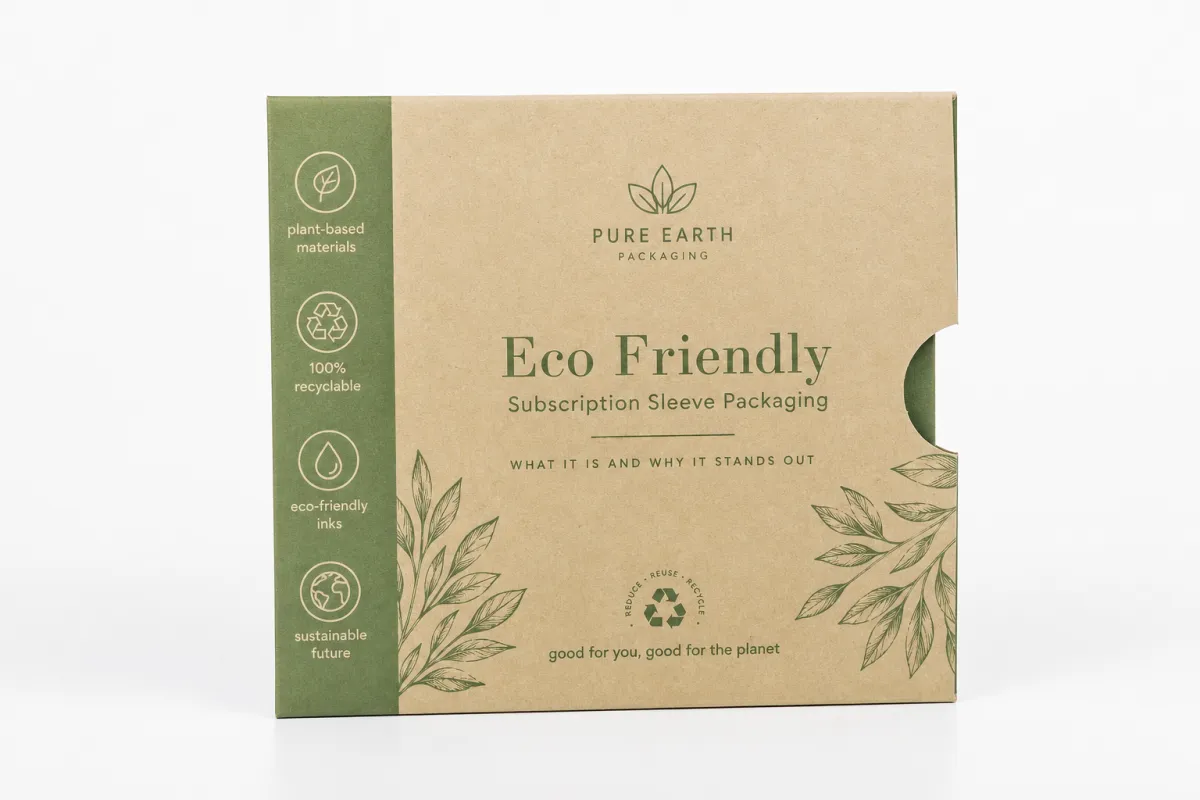
Eco friendly subscription sleeve packaging is usually a printed paperboard or fiber-based sleeve that wraps a subscription box, tray, or mailer. Its job is straightforward: add branding, product information, and a finished look without depending on a second full carton. Because the sleeve covers only part of the pack, it often uses less material than a full outer box while still creating a strong visual presence.
That is why many subscription teams keep coming back to eco friendly subscription sleeve packaging as a middle path. Labels cost less, but they rarely deliver much perceived value. Belly bands can work, though they may feel too slight if the board is thin or the printable area is small. Full custom cartons offer the most surface area, yet they also add fiber, expense, and warehouse complexity. A sleeve sits in the useful center of those choices.
From a packaging buyer’s perspective, the format stands out because it can be adapted quickly. One month it can carry a holiday design. The next month it can highlight a limited drop, a product bundle, or a member-only offer. That makes eco friendly subscription sleeve packaging useful for brands built around recurring shipments and frequent campaign changes.
There is a structural benefit as well. A sleeve can protect the main box from scuffing, help keep the lid aligned during handling, and soften the visual effect of minor transit wear. It does not replace primary protection, but it can make a simple mailer look intentional. For brands trying to balance package branding with material restraint, that trade-off is hard to dismiss.
Compared with the other common options, the differences are easy to see:
- Labels are low-cost and quick, but they are limited in size and usually feel less premium.
- Belly bands create more presence than labels and often use less board than a full carton.
- Full custom cartons offer the most print space and structure, but they also increase material use and freight weight.
- Eco friendly subscription sleeve packaging delivers visible branding, campaign flexibility, and lower material input than a full wrap in many cases.
That makes the format especially useful for seasonal sets, gift subscriptions, and products that ship in repeatable box sizes. The board is doing more than carrying a logo. It is helping the entire pack feel intentional. In subscription commerce, that sense of intent tends to matter a great deal.
How Eco Friendly Subscription Sleeve Packaging Works in the Subscription Model
The subscription model rewards consistency, but it also rewards surprise. That tension is exactly where eco friendly subscription sleeve packaging performs well. The box underneath can stay stable from month to month, while the sleeve carries the theme, the offer, and the seasonal personality. Customers still get a fresh experience even when the core structure stays the same.
On the fulfillment line, the sleeve is usually designed around the finished outside dimensions of the box or mailer. The supplier prints the board, cuts the dieline, scores the folds, and either glues it into a wrapped form or ships it flat, depending on the packing workflow. In high-volume operations, a flat-supplied sleeve can be easier to store and quicker to stage. In lower-volume or more premium programs, a pre-formed sleeve may reduce labor and keep results more consistent.
Eco friendly subscription sleeve packaging also supports recurring content without requiring a structural overhaul every month. That matters if your team wants to rotate messaging for limited-edition drops, QR-linked recipes, membership perks, or campaign-specific product education. A single sleeve layout can carry variable data, small callout panels, or interchangeable art zones while the main carton remains the same.
From the customer’s point of view, the sleeve is doing three jobs at once. It sets the tone before the box is opened. It carries information that helps explain the contents. It reinforces the feeling that the brand is organized enough to ship regularly without looking mass-produced. That subtle effect is one of the main reasons subscription teams choose eco friendly subscription sleeve packaging instead of plain mailers.
It can also support lighter-touch sustainability goals. A sleeve built with the right board weight, modest ink coverage, and a finish that does not complicate recovery can feel premium without looking wasteful. The best versions are disciplined: enough color to tell the story, enough structure to survive transit, and enough restraint to keep the fiber stream cleaner.
In a subscription model, that discipline pays in two ways. It lowers the material burden of every shipment, and it gives the brand a flexible canvas for future drops. That is usually a better use of board than printing a one-off carton for every campaign.
Key Factors That Shape Eco Friendly Subscription Sleeve Packaging
Eco friendly subscription sleeve packaging is never just one decision. It is a stack of decisions, and each one affects recyclability, appearance, line speed, and cost. If any piece of that stack is off, the sleeve stops pulling its weight.
Material choice comes first. Recycled paperboard, kraft stock, and FSC-certified fiber boards each behave differently. A higher recycled content board may reduce environmental impact, but it can also change stiffness and print response. Kraft can create a natural look that fits sustainable branding, yet it may not hold fine detail in the same way a coated white board does. That is why the material spec should be written before artwork starts, not after. For buyers who need a clear reference point for responsible fiber sourcing, the Forest Stewardship Council is a useful starting place.
Print and finish choices are the next layer. Spot colors, low-migration inks, and aqueous coatings can preserve more recoverability than heavy foil stamping or full plastic lamination. That does not mean every finish is a mistake. It means the finish should serve the brand and the use case, not just the mood board. A subtle matte aqueous coating can protect the sleeve from scuffing during transit while keeping it more recovery-friendly than a glossy film laminate.
Structural fit is where many projects drift off course. If the sleeve is too loose, it shifts during shipping and looks cheap. If it is too tight, packers slow down, corners rub, and the board tears at the score. The difference between a sleeve that works and one that frustrates a fulfillment team can be a couple of millimeters. I have watched otherwise polished launches stumble because the sleeve looked right in a mockup but arrived a touch too snug on the actual line. That is not theory. It is the part buyers notice the day the line starts running.
Brand and compliance needs matter more than many teams expect. The sleeve may need a barcode, lot code, ingredients, legal copy, or recycling guidance. If those elements are not planned early, the art can become crowded and the whole pack loses clarity. Good packaging design leaves room for information hierarchy. Strong packaging design makes the information feel deliberate.
End-of-life reality is the last filter. A sleeve is only as eco friendly as the local recovery stream allows. If the board is fiber-based but hidden under a non-recyclable coating, the sustainability story weakens. If the sleeve uses simple paperboard and the customer can separate it easily, the claim becomes more credible. That is why many teams now print disposal instructions directly on the sleeve instead of assuming customers will know what to do.
For transit validation, it is also smart to ask for packaging tests that reflect the way the product actually ships. The ISTA test methods are a useful benchmark if your subscription box needs drop, vibration, or compression checks before launch. A sleeve does not need to survive every possible test, but it should hold up under the shipment profile it will actually face.
Material, print, fit, compliance, and recovery shape the final result. Ignore one of those, and the sleeve becomes more decorative than functional. Get them all right, and it becomes a compact piece of branded packaging that earns its place.
Eco Friendly Subscription Sleeve Packaging Cost and Pricing Drivers
Eco friendly subscription sleeve packaging is often cost-efficient, but only when you understand what is driving the quote. Buyers sometimes focus on the paperboard price and miss the other costs sitting around it. That is how a project that looked affordable on paper turns into an unexpectedly expensive program.
The biggest drivers are board grade, print complexity, coating, die-cut shape, supply format, and order volume. A simple kraft sleeve with one or two colors and a standard rectangle dieline will usually price far below a complex, multi-panel sleeve with specialty coating and a custom locking feature. The shape matters too. Every extra notch, window, or unusual fold usually adds setup complexity.
There is a reason eco friendly subscription sleeve packaging can still be cheaper than a fully custom box. It uses less material, which can lower board cost and freight weight. It can also be stored more compactly if it ships flat. For brands managing multiple SKUs, that smaller footprint can reduce warehouse clutter and make replenishment easier.
Hidden costs deserve attention as well. Tooling and die charges can be modest on a large run but meaningful on a pilot order. Proofing rounds take time. Freight can swing sharply if a supplier is far from your fulfillment center. If the sleeve needs to be hand-applied, labor may become the real cost center rather than the board itself.
A practical pricing lens helps when comparing eco friendly subscription sleeve packaging options:
| Option | Typical Look | Common Unit Range at 5,000 | Common Unit Range at 25,000 | Notes |
|---|---|---|---|---|
| Simple recycled kraft sleeve | Natural, minimal, earthy | $0.16-$0.26 | $0.09-$0.16 | Best for low-ink branding and straightforward pack lines |
| FSC-certified white board sleeve | Clean, bright, premium print | $0.19-$0.31 | $0.11-$0.18 | Works well for richer imagery and tighter color control |
| Printed sleeve with aqueous coating | More protection, slightly higher gloss or matte | $0.22-$0.36 | $0.13-$0.21 | Good balance for scuff resistance and recovery-friendly finishing |
| Complex sleeve with special die cuts | Custom, high-impact, structural detail | $0.28-$0.48 | $0.16-$0.29 | Use only if the design truly needs the extra structural feature |
Those numbers are not universal. They shift with geography, board supply, ink coverage, and the exact production setup. Even so, they offer a better starting point than a vague request for “eco-friendly pricing.” A buyer should ask for quotes at several quantities, because the economics of eco friendly subscription sleeve packaging often improve sharply as the run moves from pilot scale to growth scale.
Value matters as much as unit price. A slightly higher cost can still make sense if the sleeve reduces complaints, supports retention, or lets you keep one base box in inventory across multiple campaigns. In subscription work, that kind of flexibility can be worth more than saving two cents per unit.
If you are comparing sleeve programs with other Custom Packaging Products, look beyond the sticker price. Compare total pack-out cost, stored inventory, shipping weight, and the effect on brand perception. The lowest number on the quote sheet is not always the lowest-cost choice in the operation.
Step-by-Step Timeline for Eco Friendly Subscription Sleeve Packaging
Every eco friendly subscription sleeve packaging project starts with a brief, but the strongest briefs are specific. A good one includes box dimensions, product weight, the monthly or quarterly ship cadence, the target finish, and the sustainability claim you actually want to make. If the sleeve has to carry compliance copy or a QR code, that belongs on the brief too.
From there, the supplier usually develops a dieline and checks the structural fit against the finished box or mailer. This is where spacing, score placement, bleed, and safe zones matter. If the sleeve is off by even a small amount, the result can feel sloppy. Good eco friendly subscription sleeve packaging starts with a clean structural file, not a flashy mockup.
Artwork approval comes next. This stage often takes longer than brands expect because color, copy, and fit have to work together. A design that looks fine on screen can fail in production if the ink load is too heavy, the barcode is too small, or the recycled board shifts the color slightly. That is not a defect in the material; it is a normal part of packaging design. The job is to plan for it.
Prototype approval is worth the time. A sample sleeve should be checked for color accuracy, scuff resistance, line speed, and how it lands on the finished box. If the sleeve will be applied by hand, test that by hand. If the team will run it through a semi-automated station, test it there. A mockup that works on a design table can still slow down a real fulfillment line. I have seen projects where the art team loved the sleeve and the operators hated it, which is usually a sign the workflow got less attention than the visuals.
For durability testing, many teams use transit methods aligned to their shipping risk. That may mean drop tests, vibration checks, or compression trials, depending on the pack. The goal is not to over-test every sleeve like it is a shipping container. The goal is to make sure eco friendly subscription sleeve packaging survives the actual trip from warehouse to doorstep.
Once approved, production timing often lands in a practical range of 12-15 business days from final proof approval for straightforward runs, with longer lead times for specialty finishing, unusual tooling, or busy seasonal capacity. Shipping and receiving add more time. If the sleeves arrive flat, the warehouse still needs to stage them. If they arrive pre-formed, the line still needs a stable application process.
That final step is where many launches succeed or fail. A sleeve that slows packing by five seconds per unit may not sound serious, but across a large subscription drop it can create overtime, bottlenecks, or missed dispatch windows. That is why line testing should happen before the launch date is locked.
The sequence most teams follow is straightforward:
- Write the brief and confirm box dimensions.
- Request dielines and structural guidance.
- Build artwork with bleed, safe zones, and copy hierarchy.
- Review printed samples for fit and color.
- Test application speed at real pack-out volume.
- Approve production and schedule delivery.
- Verify the sleeves integrate cleanly into the fulfillment process.
That sequence keeps eco friendly subscription sleeve packaging from becoming a last-minute design exercise. It turns it into a production-ready part of the subscription system.
Common Mistakes to Avoid With Eco Friendly Subscription Sleeve Packaging
The first mistake is greenwashing the claim. Paper-based does not automatically mean sustainable. A sleeve with heavy plastic lamination, excessive foil, or unclear disposal instructions can be harder to recover than a simpler board structure. If the customer cannot recycle it easily, the claim turns shaky quickly. Honest language builds more trust than inflated language.
The second mistake is ignoring fit. Oversized eco friendly subscription sleeve packaging slides around in transit and can make even a good box feel loose. Undersized sleeves create packing friction, especially if operators are rushing through a tight ship window. The fit should be checked with the final board caliper, not just the CAD drawing.
The third mistake is overdesigning the print. More inks do not always create more impact. Sometimes they just create more cost, more waste, and more room for error. Heavy coverage can also create a less recoverable structure if it complicates the board stream. A cleaner design often feels more confident than a crowded one.
The fourth mistake is skipping fulfillment testing. A sleeve can look excellent in a sample photo and still become a nuisance when real workers have to apply it hundreds or thousands of times. If the line slows, the economics shift. Once that happens, the brand may quietly abandon the sleeve even if the design team loves it. That is a poor outcome because the concept itself was not the problem; the workflow was.
The fifth mistake is forgetting local recovery rules. Recycling is not identical everywhere. Some municipalities accept certain coated paperboard structures; others do not. That is where many brands overstate their environmental performance. The more disciplined path is to print a simple recycling note and make the end-of-life step obvious.
Eco friendly subscription sleeve packaging should also avoid unnecessary embellishment if the goal is to reduce waste. A sleeve can still feel premium with good typography, smart color blocking, and careful material choice. It does not need thick plastisol effects, oversized foil panels, or decorative add-ons that weaken the fiber story.
Another problem shows up often: teams make the sleeve do too much. It becomes a promo insert, a legal document, a story sheet, a membership card, and a brand billboard all at once. That usually produces clutter. Better to give the sleeve one primary job and let inserts or QR-linked content handle the rest.
In short, eco friendly subscription sleeve packaging fails when it is treated like a mood board item instead of a working part of product packaging. The strongest programs are honest about what the sleeve can and cannot do.
Expert Tips and Next Steps for Eco Friendly Subscription Sleeve Packaging
If you are considering eco friendly subscription sleeve packaging for a live subscription program, start small and test like a buyer, not like a designer. A pilot run on one tier or one month’s shipment will tell you more than a stack of mockups. You will see how the board behaves, how the sleeve feels in hand, and how it changes pack-out speed.
Ask suppliers for evidence instead of adjectives. The word “eco friendly” is easy to print and easy to overuse. Better questions are specific: What is the board grade? How much recycled content is in it? Is it FSC-certified? Does the coating affect recovery? Those answers make the sustainability story more credible and make procurement easier later.
Design for the real world, not the spec sheet. That means readable type, moderate ink coverage, and enough space for fulfillment marks if your operation needs them. It also means thinking about wear. If a sleeve rubs against carton edges, shipped inserts, or a secondary seal, choose finishes that can handle that abrasion. Eco friendly subscription sleeve packaging should survive the same handling your boxes survive.
Measurement matters after launch. Track damage rates, pack time, subscriber feedback, and reorder behavior. If the sleeve improves perceived value but slows the line, you need to know that. If it reduces complaints and lifts retention, you need to know that too. Packaging is not only a design outcome; it is an operational one.
A practical framework works well for many teams:
- Use one base box. Let the sleeve carry the monthly theme.
- Keep finishes restrained. Save heavy effects for genuinely premium runs.
- Confirm recycling language. Print it clearly and concisely.
- Test at line speed. If it adds friction, fix the structure before launch.
- Document the final spec. That keeps future drops consistent.
For teams comparing sleeve options with other Custom Packaging Products, the smartest move is to compare the entire program, not just the sleeve itself. A slightly higher board cost can still be the right answer if it reduces overpackaging elsewhere, shortens lead time, or keeps inventory simpler across multiple SKUs.
My practical view is simple: eco friendly subscription sleeve packaging works best when it is treated as a disciplined branding surface, not an afterthought. The strongest programs are the ones that combine good material choice, clean structure, and clear recycling guidance. If you can get those three elements right, eco friendly subscription sleeve packaging becomes more than a nice-looking wrapper; it becomes a reliable part of your subscription economics, your package branding, and your customer experience.
The next move is straightforward: lock the box dimensions, choose the board first, and test a sleeve on the actual fulfillment line before artwork is finalized. That single sequence usually prevents the most expensive surprises and gives the packaging team a cleaner path from concept to repeatable production.
What makes subscription sleeve packaging eco friendly?
It uses less material than a full custom carton when the structure is right-sized and the design stays simple. It becomes more credible when the board is recycled or FSC-certified, inks are low-impact, and local recycling is realistic for customers.
Is eco friendly subscription sleeve packaging more expensive than standard sleeves?
Not always. Price depends more on board grade, print complexity, quantity, and finishing than on the sustainability label alone. A simple recycled sleeve can be competitive, especially when it replaces a heavier carton or reduces overpackaging elsewhere in the kit.
How long does eco friendly subscription sleeve packaging take to develop?
A basic project can move from brief to approved sample in a few weeks, but custom finishes or repeated revisions extend the timeline. Plan extra time for dieline checks, color proofing, and production scheduling if your subscription ship date is fixed.
Can eco friendly subscription sleeve packaging be recycled with the box?
Usually yes if both components are fiber-based and free of problematic coatings, but local recycling rules still matter. Make disposal easy by printing a clear instruction line on the sleeve, such as remove sleeve and recycle with paperboard if accepted locally.
What should I ask a supplier before ordering eco friendly subscription sleeve packaging?
Ask what substrate they recommend, what recycled content it contains, and whether the coating or ink system affects recovery. Also ask for unit pricing at several quantities, sample turnaround time, and whether the sleeve can be packed and applied efficiently on your line.


