Buyer Fit Snapshot
| Best fit | eco poly mailers practices tested for packaging buyers comparing material specs, print proof, MOQ, unit cost, freight, and repeat-order risk where brand print, material, artwork control, and repeat-order consistency matter. |
|---|---|
| Quote inputs | Share finished size, material target, print colors, finish, packing count, annual reorder estimate, and delivery region. |
| Proofing check | Approve dieline scale, logo placement, barcode or warning zones, color tolerance, and any recyclable or compostable wording before bulk production. |
| Main risk | Vague material claims, crowded artwork, or missing packing details can create delays even when the unit price looks attractive. |
Fast answer: Eco Poly Mailers Practices Tested: Film, Closure, Print, and Fulfillment should be specified like a repeatable production item. The safest quote includes material, print method, finish, artwork proof, carton packing, and reorder notes in one written spec.
What to confirm before approving the packaging proof
Check the product dimensions against the actual filled item, not only the sales mockup. Ask for tolerance on folds, seals, hang holes, label areas, and retail display edges. If the package carries a logo, QR code, warning copy, or legal claim, reserve that space before decorative graphics fill the panel.
How to compare quotes without losing quality
Compare board or film grade, print process, finish, sampling route, tooling charges, carton quantity, and freight assumptions side by side. A lower quote is only useful if the supplier can repeat the same color, closure quality, and packing count on the next order.
Eco Poly Mailers best practices start with a simple truth that buyers sometimes want to ignore: the greenest-looking mailer is not automatically the better one if it splits open in transit and triggers a replacement shipment. That second package usually uses more film, more labor, and more transport than the original bag ever saved. From a packaging buyer’s point of view, the lightest mailer that still survives the roughest part of the route is usually the right target, and that is the lens I use for eco Poly Mailers Best Practices.
Across packaging reviews I have seen the same pattern repeat. Buyers want less waste, a better unboxing moment, and a spec that does not slow down fulfillment. Those goals can fit together, but only if the mailer is sized correctly, the seal holds, and the sustainability claim is real enough to stand behind. That is the center of eco poly mailers best practices. Everything else is a tradeoff that needs to be managed carefully instead of guessed at. A lot of teams are gonna save more material by Choosing the Right size than by chasing a louder eco label.
Eco Poly Mailers Best Practices: The Quick Answer
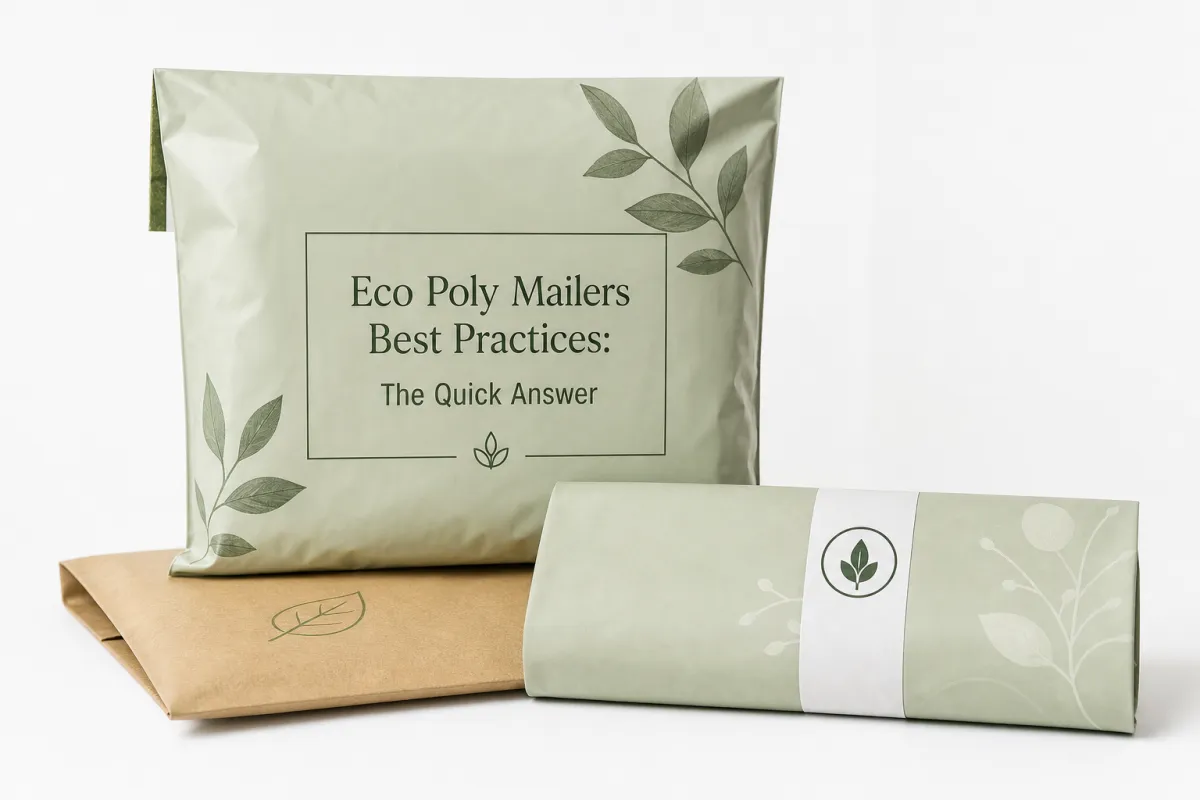
If I had to condense eco poly mailers best practices into one sentence, it would be this: choose the lightest mailer that still holds up to your most punishing shipping lane, then verify every claim before it goes anywhere near a print file. That means looking at recycled content, seal integrity, and size discipline before you chase finishes or special graphics. A bag that fits properly and closes cleanly usually outperforms a heavier bag that was chosen only because it sounded more sustainable.
The biggest mistake is buying a mailer because it reads green on a spec sheet. A replacement order, a return caused by seam failure, or a carton that needs another layer of protection can wipe out the environmental benefit pretty quickly. Eco poly mailers best practices are less about symbolism and more about preventing avoidable waste. In practical terms, that means enough strength for the product shape, enough opacity for brand presentation, and enough consistency from unit to unit that one bad shipment does not spoil the entire run.
A mailer that survives the rough route is greener than a fragile “eco” bag that gets replaced once.
Three factors matter most in any real test. First, material claim strength: recycled content, PCR percentage, and any certified source claims need to be supportable. Second, seal performance: peel-and-seal adhesive strength, flap width, and heat tolerance all matter more than buyers expect. Third, size fit: a mailer that is too large wastes film and air space, while one that is too tight raises failure risk. That is why eco poly mailers best practices start with the SKU mix, not with the brochure.
My quick verdict format for buyers is simple:
- Best for apparel: recycled-content poly mailers with a reliable peel seal and a 2.5-3.0 mil spec.
- Best for mixed SKUs: custom-sized mailers that reduce empty space and keep pack-out consistent.
- Best for brand presentation: printed mailers with clean graphics, good opacity, and a matte or soft-touch look.
- Best for lowest landed cost: stock recycled-content mailers with minimal print coverage and a right-sized format.
That is the practical side of eco poly mailers best practices. Compostable options can be the right answer for certain brands, but they are not automatically the best answer. Recycled-content bags often win on durability, price stability, and availability. Hybrid paper-look options can improve perceived quality, though they may add cost and weight. The right choice depends on route stress, customer expectations, and the level of proof you can support.
Eco Poly Mailers Best Practices: Top Options Compared
Eco poly mailers best practices become easier to apply once you compare material families side by side instead of treating them like interchangeable substitutes. The categories below show up constantly in e-commerce and subscription shipping, and each one has a clear strength profile. The useful comparison lens stays the same across all of them: durability, print quality, unboxing feel, end-of-life story, and shipping efficiency.
Recycled-content poly mailers are usually the strongest all-around choice. Post-consumer recycled content can reduce dependence on virgin resin, and in practice it often delivers the best blend of price, strength, and supplier availability. The sustainability story is strongest when the recycled content is disclosed clearly and backed by documentation. If the mailer still meets your handling requirements, eco poly mailers best practices usually point here first.
Compostable mailers can work for brands with a very specific story and a customer base that understands the claim. Their limitations show up quickly: shelf-life sensitivity, heat sensitivity, and a price premium that is hard to ignore. Many compostable options also rely on industrial composting, which is not available everywhere. That makes eco poly mailers best practices more nuanced than the marketing copy suggests.
Hybrid paper-look mailers sit in the middle. They often improve first impressions because they feel less like a shipping bag and more like a branded package. The tradeoff shows up in one of three places: more weight, more cost, or weaker moisture resistance. For low-breakage shipments, they can be a smart presentation play. For humid lanes or rough carrier handling, they may underdeliver.
Here is a simple comparison that keeps the tradeoffs honest:
| Option | Typical Unit Cost | Durability | Brand Look | End-of-Life Story | Best Fit |
|---|---|---|---|---|---|
| Recycled-content poly | $0.10-$0.22 | Strong | Clean, flexible | Better than virgin, if claims are documented | Apparel, accessories, general e-commerce |
| Compostable mailer | $0.18-$0.38 | Moderate to strong, depending on spec | Natural, sustainability-forward | Best only when composting infrastructure is realistic | Mission-led brands, short-life-cycle programs |
| Paper-look hybrid | $0.15-$0.30 | Moderate | Premium, tactile | Depends on mixed-material design | Giftable orders, brand-heavy campaigns |
| Virgin poly with optimized sizing | $0.08-$0.16 | Strong | Basic to polished, depending on print | Weaker sustainability narrative | Lowest landed cost, low-risk routes |
If the shipment is apparel or soft goods, recycled-content mailers often win. If the shipment is a branded launch where presentation matters as much as waste reduction, a hybrid bag may justify the premium. If your fulfillment team is running on volume and consistency, eco poly mailers best practices usually favor the option that packs fast and fails rarely. If you want a starting point for custom sizing and print, review the format range on Custom Poly Mailers and compare it with other Custom Packaging Products before you decide.
The honest comparison also includes customer behavior. Some customers reuse mailers for returns, storage, or secondary shipping. Others recycle them properly if the local stream accepts that film type. A few do neither. That is why eco poly mailers best practices cannot assume ideal disposal behavior. The better strategy is to reduce damage and right-size the bag first, then Choose the Best-supported material claim second. That order matters more than most spec sheets admit.
Detailed Reviews of the Best Eco Poly Mailers
Detailed review work matters because spec sheets tend to blur the differences that show up in packing rooms. In side-by-side use, the question is never just “Is this eco?” It is whether the bag tears when overfilled, whether the adhesive grabs on the first pass, whether the print still looks sharp after transit, and whether the batch feels consistent from the first unit to the last. That is the point where eco poly mailers best practices move out of theory and into operations.
Recycled-Content Poly Mailers
Verdict: the best all-around choice for most apparel and soft-goods brands. Recycled-content poly mailers usually strike the cleanest balance of cost, performance, and sustainability story. In practical use, they are the option I would reorder first if the route is moderately rough and the product is not sharp-edged. Eco poly mailers best practices tend to point here because they reduce virgin resin without forcing the business into a fragile or expensive format.
What stands out most is how predictable they are. A good recycled-content mailer in the 2.5-3.0 mil range packs quickly, seals cleanly, and tolerates the normal abuse of carrier sorting. The better versions also print well, which matters more than many teams expect. A clean logo on a matte or semi-gloss surface can lift perceived value enough to offset the fact that the bag is still a shipping envelope, not a rigid premium carton.
Clear drawback: recycled-content claims vary. Some bags lean heavily on marketing language while offering only modest post-consumer content. That is why documentation matters. I would rather see a transparent claim on a 50% PCR mailer than a vague green badge on a bag with no proof. Eco poly mailers best practices reward specificity, not broad promises.
Compostable Mailers
Verdict: a specialized tool, not a universal answer. Compostable mailers are strongest when the brand story is built around disposal claims and the customer understands the conditions attached to them. They can be useful for subscription drops, limited-edition collections, or brands with a very visible sustainability message. The unit economics are tougher, and the operational guardrails are tighter.
In testing terms, compostable mailers often feel less forgiving. Heat, storage time, and long dwell periods can matter more than with recycled-content PE. If a warehouse sits warm or the mailer inventory turns slowly, performance can drift. I have also seen adhesive consistency matter more than expected; if the seal strip is weak, the environmental story turns into a customer service problem very quickly. That is not the outcome eco poly mailers best practices are trying to create.
Clear drawback: compostable does not automatically mean convenient. Many buyers assume the end user can toss the bag anywhere and feel good about it. Reality is less tidy. Industrial compostability, local collection, and consumer understanding all have to line up. If they do not, the claim becomes harder to defend than a straightforward recycled-content spec.
Paper-Look Hybrid Mailers
Verdict: best when presentation matters and the product is not heavy or moisture-sensitive. These mailers can look more elevated than plain poly, especially for fashion, gifts, and promotional shipments. The tactile change is real. So is the cost. Eco poly mailers best practices favor hybrids only when that visual lift is worth the tradeoff in weight, price, or moisture protection.
What surprised me most is how quickly a good paper-look finish can change the feel of an order. It makes the parcel seem more deliberate. That matters in categories where perceived value drives repeat buying. The weak point is durability. Some hybrids look premium but are less forgiving if the carton gets scraped, loaded under weight, or exposed to damp handling.
Clear drawback: mixed-material designs can complicate recovery claims. If the structure is not easy to separate or the paper layer is only cosmetic, end-of-life messaging becomes less straightforward. Buyers should ask whether the material story is truly better, or whether the product simply looks greener. Eco poly mailers best practices do not reward cosmetic sustainability.
Optimized-Size Stock Mailers
Verdict: the best budget-friendly route for low-risk goods. A stock mailer in the right size can outperform a custom bag that is oversized, under-printed, or slow to approve. This is one of the easiest places to reduce waste because better fit cuts down on excess film and empty shipping volume. Eco poly mailers best practices often start here when a team wants better sustainability without making the supply chain more complicated.
In practical terms, the gains are simple. Better fit means less internal shifting, lower chance of seal strain, and less temptation to overpack. It also keeps fulfillment moving because the packer is not wrestling with a bag that is too large or too stiff. If your SKU profile is narrow, a stock option can be a smarter first step than jumping straight to custom construction. And yes, it can feel a little boring, but boring packaging often performs best.
Clear drawback: the brand story is weaker unless you add labels, stickers, or a secondary insert. That may be fine for pure cost control, but if your packaging is part of the marketing mix, stock bags may underperform on first impression. Still, eco poly mailers best practices sometimes favor a simpler bag that performs reliably over a prettier one that creates friction.
High-Print Custom Mailers
Verdict: best for brands that need packaging to carry part of the marketing load. Strong print coverage can raise perceived quality fast, especially when the color is consistent and the logo is crisp. The catch is obvious: every extra ink layer, every custom effect, and every special finish can push cost up. If the bag is not protected by a disciplined size spec, that premium can be wasted.
From a review standpoint, print quality is one of the most underpriced variables in packaging. A cheap-looking bag lowers the whole shipment’s perceived value, even if the material itself is a stronger environmental choice. Good custom print helps close that gap. Eco poly mailers best practices should always make room for visual quality, because customers judge the package before they judge the claim.
Clear drawback: custom print can hide weak fundamentals. A bag with beautiful art but poor adhesive is still a weak bag. I would rather see a simple, durable print layout than a busy design that distracts from a bag that will not hold up. Eco poly mailers best practices are about the full system, not the artwork alone.
Eco Poly Mailers Best Practices on Cost, Pricing, MOQ, and Quote
Eco poly mailers best practices become much more useful once you price the whole decision instead of staring at the unit cost alone. A quote that looks cheap can become expensive after freight, setup, sampling, and waste from oversized packaging. Landed cost is the number that matters. Not the sticker price. Not the unit price by itself. The full picture.
For custom runs, I usually think in layers. First is the mailer itself. Second is setup or plate charges. Third is freight. Fourth is the hidden cost of wrong sizing or late approvals. A mailer that saves one return or one re-ship cycle can pay for a surprising amount of its premium. That is why eco poly mailers best practices are as much about math as they are about materials.
Here are realistic price bands buyers often see, though size, print coverage, and order volume can move them quickly:
- Stock recycled-content mailers: about $0.08-$0.16 per unit at moderate volume.
- Custom recycled-content mailers: about $0.10-$0.22 per unit, depending on print and size.
- Compostable mailers: about $0.18-$0.38 per unit, sometimes higher for smaller MOQ.
- Paper-look hybrids: about $0.15-$0.30 per unit, especially with custom printing.
MOQ changes the decision almost as much as material choice. Lower minimums help testing, while higher MOQ can reduce unit price enough to matter once a team has validated the spec. If you are testing a new launch or a seasonal drop, I would rather see a smaller pilot than a large purchase based on assumptions. Eco poly mailers best practices favor evidence over optimism.
Custom sizing and print coverage are the two places where quotes drift fastest. A wider flap, a thicker seam, a darker print area, or an upgraded adhesive can move the price in ways that are not obvious if you only compare the front-page quote. Ask for the same dimensions, the same film thickness, the same seal style, and the same print coverage every time. Otherwise the comparison means very little.
The useful rule of thumb is simple: if a mailer reduces damage, lowers returns, or cuts packing time, a small premium can pay back quickly. That is especially true in apparel, where returns and exchanges are common. Eco poly mailers best practices do not say “buy the cheapest bag.” They say buy the bag that gives the lowest total cost once real shipment behavior is included.
Eco Poly Mailers Best Practices for Your Operation
Choosing the right bag starts with the product, not the packaging catalog. Eco poly mailers best practices work best when you ask five questions in order: How fragile is the item? How heavy is the packed order? What is the average order size? How humid or rough is the shipping lane? And will the customer reuse the bag? Those answers point you toward the right thickness, size, and material family faster than any sales pitch can.
The size discipline rule is the one that gets ignored most often. A bag that is too large wastes material and shipping space. A bag that is too small increases failures and repacks. Either way, you lose. In practice, the best eco poly mailers best practices are usually the boring ones: match the bag to the most common SKU, allow just enough room for the product to slide in without stress, and avoid the temptation to buy one size up “just in case.”
It also helps to match material to brand priority. If the priority is premium presentation, a hybrid or high-print mailer may be worth the extra cost. If the priority is sustainability claims, a recycled-content bag with transparent documentation is usually easier to defend. If the priority is cost control, a simple stock bag with optimized sizing may beat everything else. Eco poly mailers best practices are not one-size-fits-all; they are a decision framework.
For testing and route validation, I like using carrier-style abuse as the benchmark. The International Safe Transit Association publishes useful test frameworks at ISTA, and the Environmental Protection Agency keeps clear guidance on recycling behavior at EPA recycling guidance. Those references help buyers keep claims and performance grounded instead of guessing. A custom spec should survive the route it will actually face, not an idealized lab-only scenario.
My buyer checklist is short but strict:
- Seal strength: peel-and-seal strip must hold under pressure and temperature swings.
- Thickness: enough film gauge to protect the product without overspecifying.
- Opacity: brand privacy and a cleaner retail feel.
- Print area: room for logo, sizing marks, and return messaging if needed.
- Handling comfort: packers should be able to load the bag quickly.
- Return logic: the bag should not make returns awkward or messy.
- Claim support: recycled content, compostability, and any certification must be documented.
One more caution: sustainability claims are only as strong as the documentation behind them. That matters with recycled content, compostable materials, and any paper-facing element that may carry an FSC reference. If you cannot support the claim with a spec sheet or certification paperwork, do not build your packaging messaging around it. Eco poly mailers best practices call for restraint when the evidence is thin, and that restraint protects both the brand and the buyer.
Eco Poly Mailers Best Practices: Production Steps, Timeline, and Lead Time
Production is where buyer expectations usually get distorted. The quote looks neat, the mockup looks polished, and then approvals, sampling, and freight slow everything down. Eco poly mailers best practices are easier to follow if you map the process from the beginning: requirements gathering, material selection, artwork prep, proofing, sample approval, production, inspection, and shipping. Each step can add time, and each step can also prevent a costly mistake.
For stock bags, lead time can be short. If inventory is available, shipping may happen in a few business days. Custom printed orders are different. A realistic range is often 12-20 business days after proof approval for production, plus freight time. The range widens if the material changes, the artwork is revised, or the size is non-standard. Eco poly mailers best practices say to plan for that instead of hoping the order lands early.
Sampling is not an optional luxury. It is the cheapest insurance you can buy against a bad run. A sample lets you check the seal width, the print balance, the tactile feel, and the size fit against real products. If the bag is slightly off, you want to catch it before thousands of units are produced. A delayed proof or an ignored sample can cost more than a modest price premium from a supplier with better response times.
Seasonal peaks are another hidden risk. If a launch date, holiday window, or campaign drop depends on the mailer, build a buffer. I would rather see a buyer hold two extra weeks of cushion than shave the schedule to the bone. Rush production can make sense when the cost of missing the launch is higher than the rush premium, but it is not a fix for poor planning. Eco poly mailers best practices are about avoiding preventable stress, not paying extra to solve it later.
Here is the practical timeline I would use as a planning baseline:
- Brief and spec review: 1-3 business days.
- Art prep and proofing: 2-5 business days, depending on revisions.
- Sample approval: 3-7 business days if samples must be shipped.
- Production: 10-18 business days for many custom runs.
- Freight: a few days for domestic stock, longer for imported custom runs.
That schedule is not universal. It depends on supplier inventory, print method, and material availability. Still, it is a more realistic planning tool than a vague promise of “fast turnaround.” Eco poly mailers best practices work better when the buyer treats the timeline as part of the spec. If you ignore lead time, you are only halfway buying the package.
Our Recommendation: Eco Poly Mailers Best Practices to Act On
Here is the ranking I would give after weighing cost, durability, and claim quality. Best overall: recycled-content poly mailers with a dependable seal and a right-sized format. Best budget: optimized stock mailers with minimal print and strong fit discipline. Best premium: a well-executed hybrid or high-print custom bag for brands that need presentation to do real work. Best for lower-volume testing: a small pilot run of the material you are most likely to scale. That ranking reflects eco poly mailers best practices in the real world, not in a sales deck.
If you want a simple 30-day rollout, do this: order samples, compare two quote tiers, run one route test, and measure damage, returns, and pack speed. Then score the options using three weights: sustainability claim strength, shipping protection, and landed cost. A pilot order beats a full conversion almost every time because it reveals how the bag behaves under actual workload. That is the fastest way to make eco poly mailers best practices useful instead of theoretical.
A good internal scorecard does not need to be complicated. Give each option a score from 1 to 5 for durability, claim support, pack-out speed, print quality, and total landed cost. Weight the categories according to your business model. A subscription brand may value presentation more heavily; a volume apparel shipper may care more about throughput and damage control. The point is to make the tradeoff visible. Eco poly mailers best practices become much easier once the decision is measured instead of argued.
My final recommendation is straightforward: do not convert everything at once, and do not choose the greenest-sounding bag without testing it first. Start with one SKU family, one shipping lane, and one clear metric for success. If the bag reduces waste, protects product, and keeps fulfillment moving, you have found a real improvement. That is what eco poly mailers best practices are supposed to do, and it is why the right mailer is almost always the one that performs best on real orders, not the one that only looks best in a quote.
What are the most practical eco poly mailers best practices for small e-commerce brands?
Start with the smallest mailer that safely fits your most common SKU, because oversizing increases material use and shipping cost. Then test seal strength, puncture resistance, and print quality before placing a larger order. For small teams, eco poly mailers best practices usually come down to fit, failure rate, and how quickly the pack line can move.
Are recycled-content mailers better than compostable eco poly mailers?
Recycled-content mailers usually offer the stronger balance of durability, cost, and availability for general shipping. Compostable options make more sense when the brand story and customer base support a higher unit price and stricter handling rules. In most routine e-commerce settings, eco poly mailers best practices lean toward recycled-content first.
How do I compare eco poly mailers by unit cost and total landed cost?
Compare the quote line by line: unit price, freight, setup, samples, and any custom print or sizing charges. Then add the cost of damage, returns, and overpacking, because the cheapest mailer can become the most expensive choice. Eco poly mailers best practices are about the full invoice, not one line item.
What MOQ should I expect when ordering custom eco poly mailers?
MOQ varies by material, print method, and supplier, but custom runs usually require more units than stock bags. If you are testing a new spec, start with a lower-MOQ option or a sample run before committing to full production. That is one of the most practical eco poly mailers best practices for keeping risk under control.
How long do custom eco poly mailers take from quote to delivery?
Lead time depends on proof approval, material availability, and print complexity, so the quote alone does not tell the full story. Build in extra time for approvals and shipping buffers, especially if the mailers are tied to a launch or seasonal peak. Eco poly mailers best practices work best when the timeline is treated as part of the purchase, not an afterthought.