ecommerce cuffed knit Beanies Bulk Order Planning looks simple until yarn, cuff depth, and decoration start steering the schedule. The hat is small; the decision stack behind it is not. For a winter drop, promo bundle, or retail launch to stay on calendar, the spec has to be set before art approval turns into a moving target.
Why a Mockup Is Not Enough
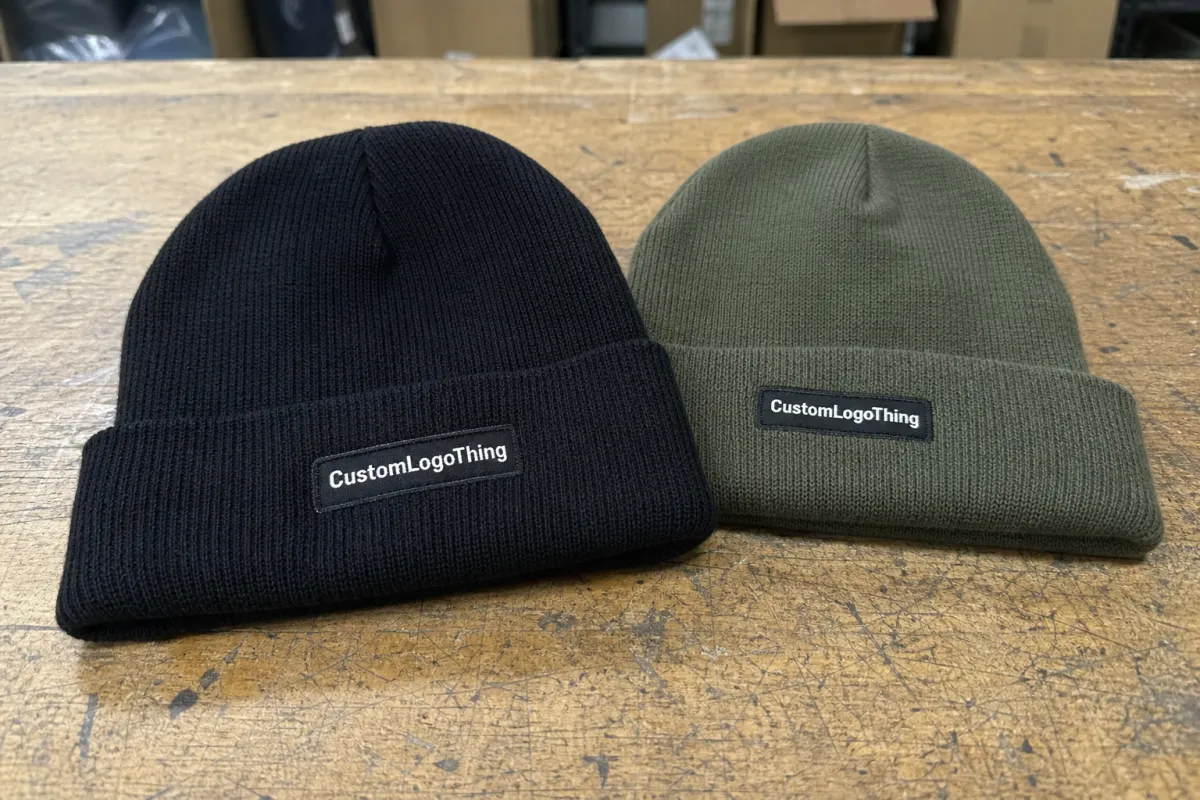
A cuffed beanie seems forgiving from a distance. The silhouette is familiar, the decoration area is small, and the product can work for streetwear, team merch, and holiday promos without much visual drama. That is exactly why teams underestimate it. The shape looks easy on screen, but the manufacturing choices behind it are tightly connected.
Yarn type affects drape, warmth, and cost. Knit gauge changes how the surface accepts embroidery. Cuff depth changes where the logo lands and how the hat sits on the head. Even a few millimeters can make a folded cuff read as polished retail product or look like an afterthought.
Most avoidable problems start the same way: a buyer approves a clean digital mockup before the knit structure is settled. The sample arrives with a looser body than expected, the logo sits too high once the cuff is folded, and the retail photo no longer matches the physical item. That gap is expensive because it shows up late, after schedules are already fixed.
The practical lesson is straightforward: decide the construction first, then approve art. It sounds conservative, but it is how you keep a bulk order from getting trapped between marketing preference and factory reality.
Three mistakes account for a surprising share of problems:
- approving artwork before the knit structure is selected,
- treating cuff width as a cosmetic detail instead of a placement control,
- assuming the first sample automatically defines the bulk run.
A sample can look close enough while still hiding a gauge difference, a looser crown, or an embroidery location that shifts once the beanie is folded and stretched. Those details are small on paper and expensive in fulfillment.
Choose the Right Knit, Cuff, and Fit Before You Quote
The yarn choice sets the feel of the product and the ceiling on your cost. Standard acrylic is still the most common option because it is durable, widely available, and easier to price at volume. Recycled acrylic blends can support a lower-impact story without pushing the item too far up-market. Wool blends offer more warmth and a richer hand feel, but they usually raise both unit cost and approval scrutiny because buyers notice the texture immediately. Soft-touch specialty yarns can improve perceived value, though they often add lead time and reduce flexibility if the schedule is tight.
Finished weight matters too. A typical cuffed beanie often lands in the 70 to 100 gram range, while heavier winter styles can run beyond that. Weight is not just a material spec; it changes the way the hat hangs, how warm it feels, and how much freight you are paying to move each carton.
Knit gauge is one of the most important decisions in the whole order. Many cuffed beanies sit around a 5-gauge to 9-gauge construction. Lower gauge gives a chunkier, more casual look with larger loops and more visible texture. Higher gauge produces a tighter face and usually gives embroidery a cleaner base. If the logo uses fine lines or small text, tighter construction is safer. If the brand wants a heavier winter look, a chunkier knit may be the better choice.
Fit should be written down instead of guessed. “One size fits most” is a marketing phrase, not a production instruction. A usable spec usually includes:
- cuff depth - often 2.5 to 3.5 inches for a folded retail cuff,
- crown height - commonly 8 to 10 inches before stretch,
- profile - snug, standard, or relaxed,
- finish - classic fold, slouch, or closer fit around the ears.
That decision affects product photography, perceived warmth, and logo placement. A cuff that is too shallow can crowd the decoration area. A crown that is too tall can make the beanie read slouchy even if that was never the plan.
Decoration should be matched to the knit, not chosen in isolation. Embroidery works well on a folded cuff when the logo is simple and the stitch count stays reasonable. Woven patches help when the artwork needs crisp edges or small type that would blur in thread. Sewn labels are quieter and often fit better when the brand wants a minimal finish. Knit-in logos can look sharp, but they lock the artwork into the structure of the fabric and are less forgiving if revisions are still possible.
Specs That Change Quality, Decoration, and Reorder Risk
Small details create large differences in knitwear. A buyer can get the color, logo, and overall shape approved and still end up with a run that feels off because the technical notes were incomplete. That is why a decent spec sheet should cover fit, yarn, finishing, decoration, and packaging in the same document.
Color is a classic source of friction. Pantone matching on yarn is not the same as ink on paper or a hex code on a screen. Dyed yarn, melange blends, and heathered effects all shift the final look. If color accuracy matters, ask for lab dips or yarn approvals before bulk production begins. Photos alone are not enough.
Size tolerance should also be written clearly. Knit goods stretch, so a beanie will never behave like a molded plastic part. Even so, Buyers Should Ask for a measurable range, such as a circumference tolerance of about plus or minus half an inch. That gives everyone a concrete benchmark.
Quality checks are easier when the brief is measurable. The most useful ones usually include:
- cuff height and crown height measured after finishing,
- stitch consistency across front, back, and side panels,
- color match against the approved yarn reference,
- embroidered logo alignment and pull distortion,
- trimmed loose ends and secure seam closure,
- stretch recovery after the beanie is extended and released.
Those checks sound basic because they are. Basic is exactly what protects the order once production starts. If the factory does not have a clear pass/fail standard, the run can drift from sample to sample.
Decoration brings its own risks. Embroidery can distort a soft knit if the backing is too stiff or the stitch density is too high. Patches add structure and can hide small knit irregularities, but they create another sewn element that must be centered and secured. Sewn labels are usually low-risk, though they can curl or shift if the placement is not tested on the actual cuff height. The right option depends on the logo, the gauge, and how the beanie will be sold.
Packaging also deserves attention. Individual polybags, tissue wraps, barcode labels, carton marks, and warehouse pack counts all change how the order moves after production. If the beanies are going direct to ecommerce fulfillment, cartons should be packed to match the pick-and-pack process. If a brand needs retail-ready packaging, the spec should define fold direction, insert placement, and label position.
For shipping durability, transit expectations matter. A carton that leaves the factory looking perfect can still arrive crushed if the paperboard is too light or the pack density is too loose. If the order has to survive parcel networks rather than a clean pallet handoff, ask for a packing method suited to real transit, not just factory storage.
Pricing, MOQ, and Unit Cost for Bulk Beanie Orders
Unit cost is usually driven by five things: yarn choice, knit gauge, decoration method, packaging, and volume. Buyers often focus on the logo because it is the visible part of the product. The quote, however, is usually affected just as much by the less visible items. A folded cuff with one embroidery location is a very different job from a wool blend with a patch, custom yarn color, and individual packaging.
MOQ follows the setup, not a random supplier preference. Simple acrylic cuffed beanies with one decoration location may start around 300 to 500 pieces. Recycled blends, custom color yarns, or sewn patches often move the floor to 500 to 1,000 pieces. Premium wool blends and more complex jacquard constructions can push that higher. Ask for the minimum by exact style and decoration method, not just by product type.
| Beanie Build | Typical MOQ | Unit Price at 500 pcs | Unit Price at 2,500 pcs | Best Fit |
|---|---|---|---|---|
| 100% acrylic, single embroidery | 300-500 | $3.20-$4.80 | $2.10-$3.40 | Promos, first ecommerce test runs, team stores |
| Recycled acrylic blend, woven patch | 500-800 | $4.20-$6.00 | $3.00-$4.70 | Brand drops, mid-tier retail, seasonal bundles |
| Wool blend, premium label, tighter gauge | 800-1,500 | $5.80-$9.00 | $4.20-$6.50 | Premium gifting, fashion collections, colder-climate assortments |
Those ranges are practical planning numbers, not guarantees. Setup fees often fall somewhere between $45 and $125 per logo location, depending on embroidery complexity or patch construction. Sampling may add $35 to $90 if the style needs a new proof. Extra yarn colors usually add a modest per-unit increase, and specialty packaging can add more than buyers expect. Rush schedules, split shipments, and late revisions are the fastest ways to push a tidy quote out of shape.
Freight should be broken out separately whenever possible. If shipping is folded into a single lump sum, it becomes hard to compare suppliers or understand where the real cost sits. A clean quote should show product cost, setup, sampling, packaging, and freight on separate lines. That does not just help budgeting; it helps decision-making when a buyer is comparing a lower-cost style with a better-quality one.
At a practical level, the lowest bid is not always the cheapest outcome. A slightly higher per-unit price can be the better deal if it reduces sampling churn, rework, or missed delivery windows.
Production Steps, Timeline, and Approval Milestones
A capable supplier should be able to explain the workflow without vague language. The normal sequence is straightforward: art review, yarn matching, sample development, sample approval, bulk knitting, decoration, final QC, packing, and shipment. The process is not complicated on paper. It becomes complicated when the brief leaves room for interpretation.
Lead time usually slips in the same few places: slow feedback on samples, unclear color signoff, artwork revisions after bulk production has already started, and packaging changes that were never mentioned in the first brief. Each one can add days, and sometimes a lot more than days. A small tweak late in the process may require a fresh knitting setup or a new embroidery run.
For a simpler stock-based build, buyers often plan around 5 to 10 business days for sample development and 12 to 18 business days after approval for bulk production. More custom builds, heavier decoration, or seasonal congestion can stretch that to 18 to 30 business days or longer. Shipping time sits outside that window, and that is where many schedules get squeezed.
The cleanest approval chain looks like this:
- Confirm artwork and decoration method.
- Lock knit gauge, yarn type, and cuff dimensions.
- Review the pre-production sample with written notes.
- Approve packaging, carton marks, and SKU labeling.
- Release bulk production only after open issues are closed.
Ask for milestone dates in writing: sample ETA, revision window, bulk start, final QC, and ship date. If a supplier cannot give those checkpoints, the schedule is probably more hopeful than real.
What Reliable Suppliers Handle Before You Ask Twice
Strong suppliers do more than quote a price. They tell you where the spec may create cost, where the logo might not read cleanly, and which decoration method fits the knit surface. That kind of input matters because it prevents bad setup choices before they reach production.
The best support usually shows up in small, practical ways:
- itemized quotes without hidden packing surprises,
- advice on cuff depth and decoration placement,
- realistic timing with visible checkpoints,
- measured QC standards for size, color, and stitch consistency,
- packaging that matches the fulfillment method, not just the factory shelf.
Sampling response time is often more telling than polished sales language. A supplier can be friendly and quick on email, then take ten days to answer a sample correction. Reliability means the next proof arrives when promised and the order does not stall because one internal detail was never clarified.
Consistency matters just as much on reorders. If the first run used a measured spec and a signed sample, the second run should not feel like a new project. The color should match. The cuff should sit the same way. The logo should land in the same place.
Quality control should not stop at a finished sample photo. A solid factory will check measurements after finishing, inspect the decoration for placement and pull, and confirm packing counts before release. Those checks are routine, but routine is what keeps a low-cost item from becoming a customer service problem later.
What to Send in the First Brief
If the order needs to move, send one clear brief instead of five scattered messages. Include quantity by color, target delivery date, logo file, preferred yarn color, decoration method, and packaging requirements. That alone removes a lot of unnecessary back-and-forth.
It also helps to make the decoration decision before requesting samples. A proof built for embroidery is not the same as one built for a woven patch, and the positioning can shift with the cuff. A sample without a fixed decoration method is usually a draft of a draft.
A strong quote request should include:
- quantity by color and style,
- exact decoration method,
- logo file in editable format,
- target ship date and destination,
- packaging requirements,
- sample requirements before bulk release.
That is enough for a supplier to give a real number and a real schedule. If the response still sounds vague after that, the order probably does not have enough structure yet for a safe launch window.
FAQ
What MOQ should I expect for cuffed knit beanies?
Simple acrylic styles often start around 300 to 500 pieces. Custom yarns, recycled blends, multiple colors, or patch applications can raise the minimum to 500 to 1,000 pieces or more. The best quote is the one tied to the exact build, not the broad category.
How long does bulk production usually take after approval?
For a straightforward order, sample development can take 5 to 10 business days and bulk production another 12 to 18 business days after approval. More custom runs often need 18 to 30 business days or longer. Shipping time is separate and should be added to the calendar from the start.
Which decoration method works best on a cuffed beanie?
Embroidery is a strong choice for simple logos and tends to look clean on a folded cuff. Woven patches work better for small text or more detailed artwork. Knit-in decoration can look sharp, but it is less flexible if the art changes late.
Can I mix colors in one bulk beanie order?
Usually yes, but color splits can raise cost if they create extra yarn setups or separate SKUs. The more colors you add, the more carefully the packout and labeling need to be managed. That matters even more for ecommerce fulfillment, where mixed cartons can slow picking.
What should be checked before approving the sample?
Measure cuff depth, crown height, and overall stretch. Check color against the approved reference, confirm logo placement, and inspect the stitching for loose ends or distortion. If the sample looks good in a photo but the measurements are off, treat that as a warning sign rather than a small miss.